Given by an Emperor, fetched under passport, bequeathed by the caskThe Royal Prussian Cellar
In 1704 four bottles of Tokaji left the Berlin cellar in a day and all four went to the King’s cupbearer. The Prussian file follows that wine from Habsburg toll patents to a testament that dispersed it across ten princely households — and to fourteen bottles catalogued in 1839 under the name of Frederick the Great.
Berlin, 7 June 1704
4 of 4Bottles of Tokaji, all to the King’s cupbearer
Imperial gift, 1728–1740
8 EimerA year — about 600 bottles, frozen for nine years
Fetched at source, 1746
200 AntalAlberdahl’s mission, and a passport crisis
Bequeathed, 1769
280 AntalAcross ten princely households
Berlin, 1839
14 bottles«Alter Ungar v. Friedrich II.»
Berlin and Potsdam · 1561 — 1921
The Royal Prussian Cellar, Berlin and Potsdam
The Prussian file runs from Habsburg toll patents of 1561 to the administrative end of the royal cellar in 1921, and it documents something the Saxon record does not: a complete life cycle — procurement, accumulation, testamentary dispersal, and the formation of relics.
1561 — 1758
Passage and procurement: the legal frame and the wine convoys
The oldest layer of the file is Habsburg paper. Ferdinand I granted Duke Albrecht of Prussia toll-free passage for wine bought in the hereditary lands: a patent of 1561 for forty Fuder, granted for life, and a second — surviving in the original with the Emperor’s autograph — granting thirty Fuder annually for ten years, to be bought in Silesia and Lower Lusatia and carried toll-free «in das Lande zu Preussen». The original was too precious for the roads, so the Königsberg council issued a certified transumpt for the convoys to carry.
The first documented Hungarian wine convoy is the Genderich mission of 1566: Duke Albrecht’s Latin open letter of 6 November commissions the purchasing agent Erasmus Genderich to fetch ten wagon-loads of Hungarian wine for the ducal household, and Genderich’s vintage report adds that in twenty years so good a one had not been seen. The registry rubric — «Hoff- und Staats-Sachen. Weinkeller etc. 1566 — Ungarische Weine» — opens the ducal wine-cellar files.
The wine-pass registry then documents the eighteenth-century supply system: the Cadogan transit of 1720, the January 1728 purchase of 100 Antal routed through the imperial envoy Graf von Seckendorff, and the 125-Antal affair of 1729, when the Viennese Hofkammer stalled the King’s purchased wine, invoking quantities and the customary discretion, and Berlin routed the fight to Baron Gotter. Under Frederick II the purchase channel becomes the only channel: Vockerodt in 1743, Alberdahl in 1746, and 240 Antal through conquered Breslau in 1748–49.
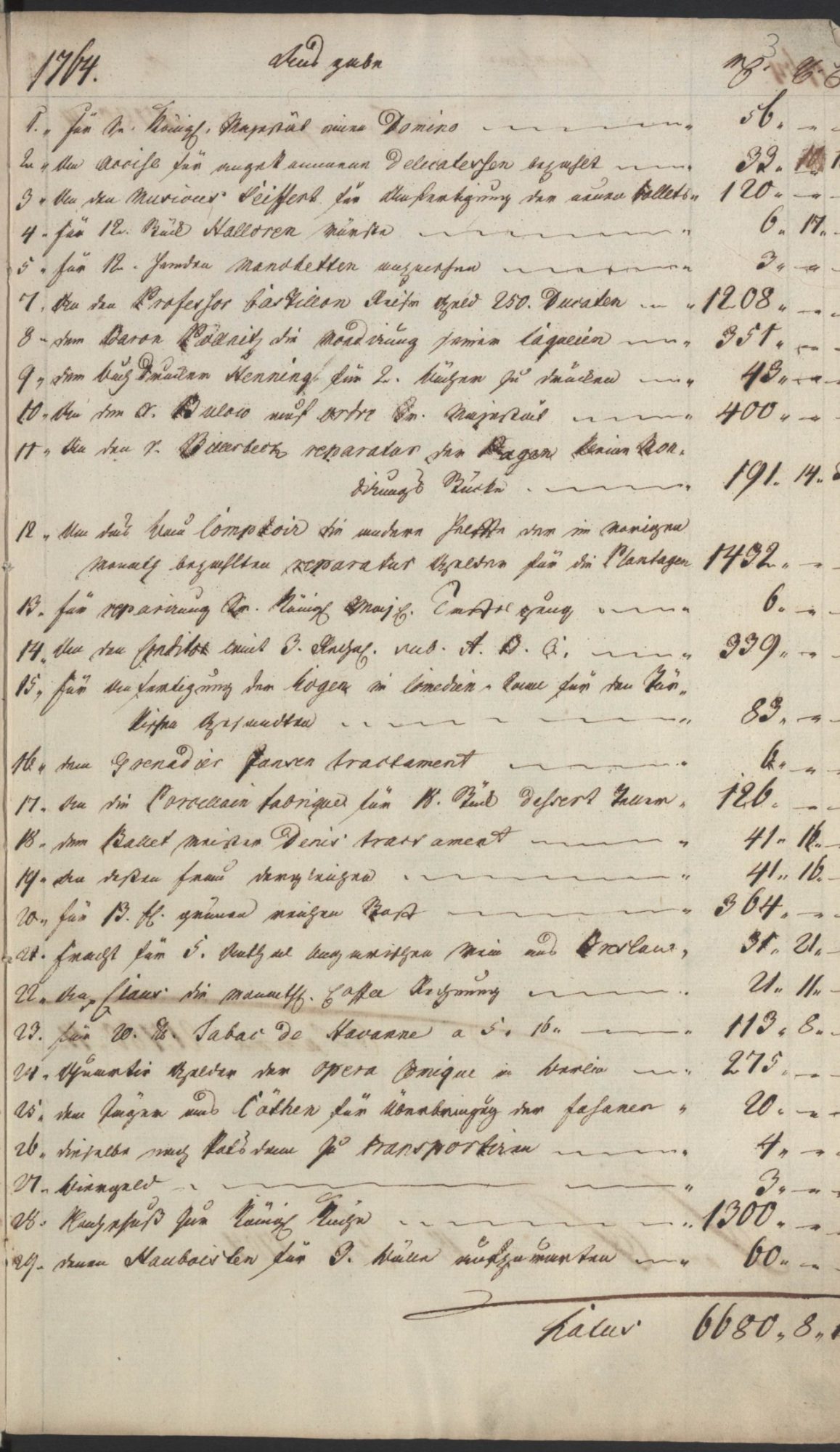
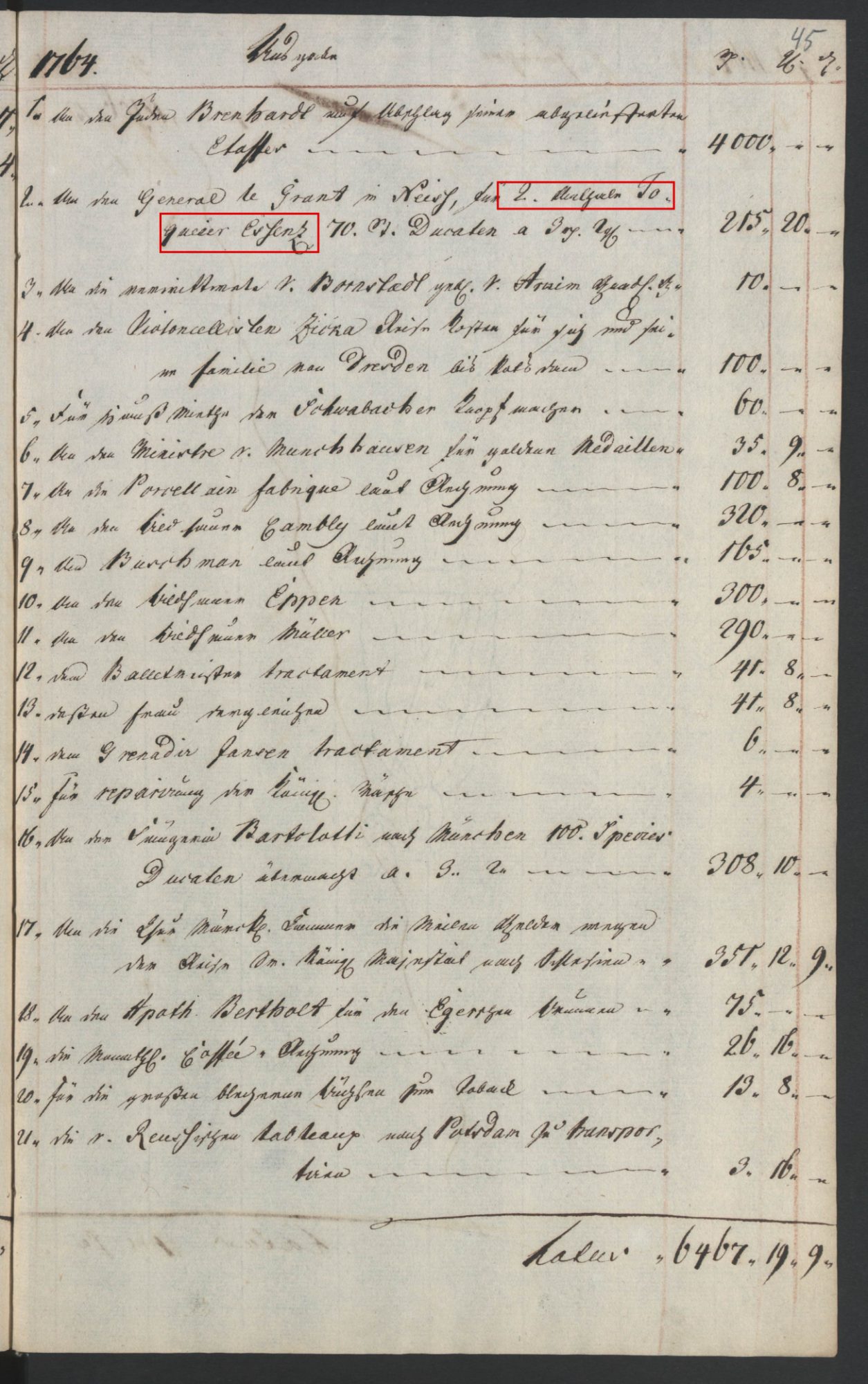
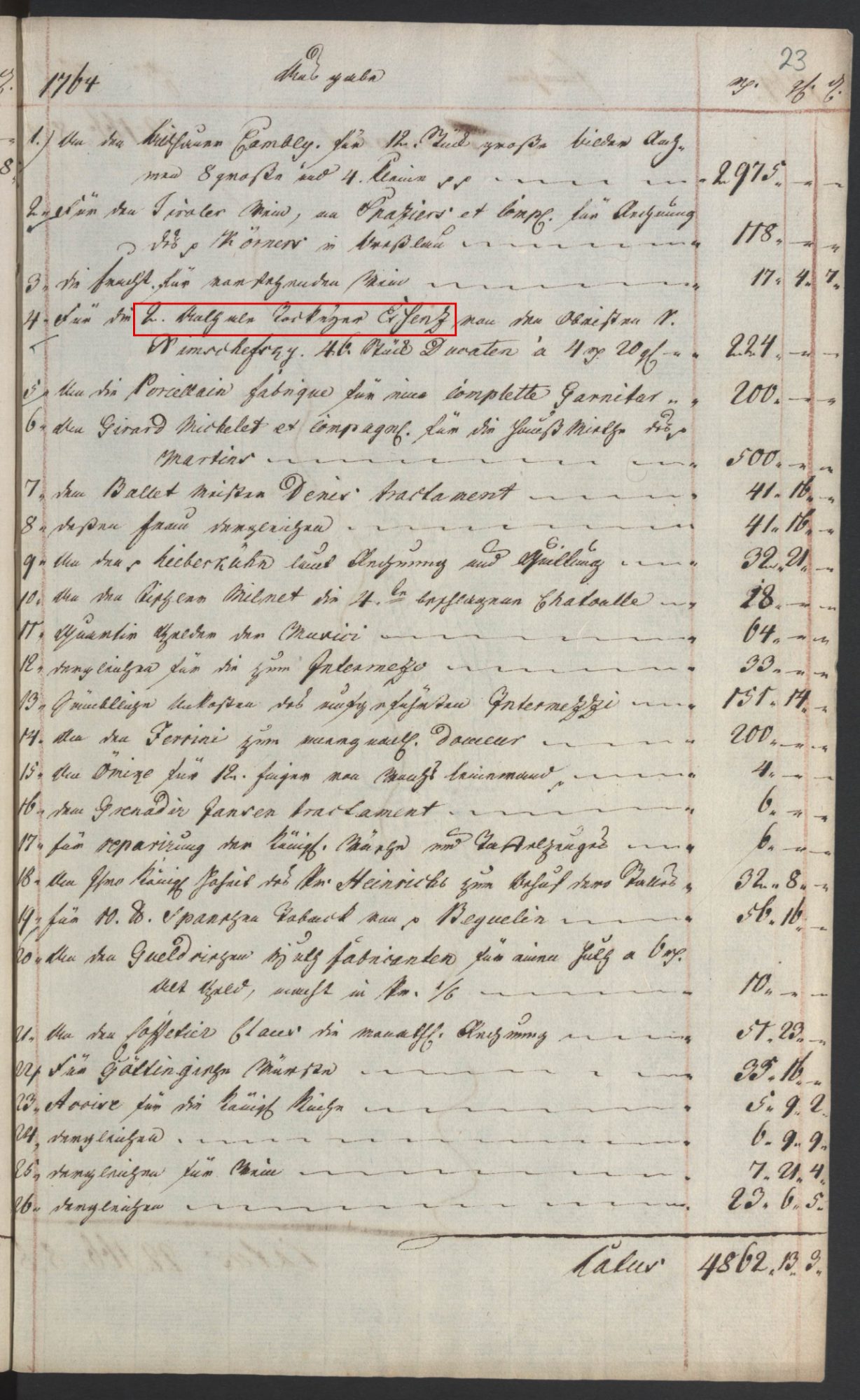
The King’s privy purse, 1764. A page of the Schatullrechnungen: among the domino for the court marshal, the porcelain factory and the Havana tobacco stands the wine, entered in Anthal. Frederick’s Hungarian wine was paid for out of the same book as the opera and the pheasants.
A consumer’s-eye view, 1758
The one private document in the series: a letter from the Adhémar de Marsanne family papers reports a case of Tokaji stolen off the Strasbourg mail-coach between Bayreuth and Lunéville, written the same week as the Battle of Domstadtl. Mid-Seven-Years-War, Tokaji still travels the post roads of the Empire in private cases — and is worth stealing.
c. 1680 — 1718
The cellar record: from trickle to house wine
Around 1680 Hungarian wine is marginal in the electoral cellar. The weekly accounts of the Cölln/Berlin Keller- und Brotamt book it at roughly 6½ Ohm a year — dead last among the fine wines of the Great Elector’s Malvasia-and-Pedro-Ximénez cellar — and one inventory shows none in stock at all.
Fourteen years later it leads the ledger and is reserved for the King. The weekly account of the royal Hoff-Küche-Kellerey at Schönhausen for 14–21 June 1704 opens its balance with «Tockayer Wein: 19 Bout. + 9 Bout. = 28 Bout.; außgegeben 16 Bout.; bleibet 12 Bout.», and the supply column shows Schönhausen replenished weekly from the central Hoff-Wein-Keller in Berlin. The Tuesday day-sheet gives the sociology in one column: four bottles of Tokaji issued, all four to the King’s own cupbearer, nobody else receiving a drop — while champagne, 74 bottles that week, and Pontac flow to the whole court.
Image withheld pending permission.Who got what, 7 June 1704. The cellar issue list for the Saturday before the sheet transcribed above, with every recipient named down the left and the wines in columns. The first column — highlighted in the reproduction — is the Tokajer, and it stops at the King’s and the Crown Prince’s cupbearers. Champagne, Burgundy and Frantzwein run on down the whole court. Reproduced from Prüfer, Potsdam und der Wein (2006), Abb. 12, after GStA PK Rep. 36 Nr. 1132.
By 1718 Tokaji is the opening line of the King’s central cellar ledger, kept in bottles like the French grands crus around it, with about 94 bottles on hand and roughly a dozen a week — some 620 bottles a year — flowing to the royal table. Between about 1680 and 1718 Tokaji moved from exotic trickle to the house wine of the Prussian monarchy.
Image withheld pending permission.The central cellar week by week, 1718. «Nro. 10 Post Trinitatis 1718» — the Berlin Hoff-Wein-Keller balance, day by day from 30 July to 5 August. Tokajer is the first column, ahead of Burgundy, Pontac, Champagne and Hermitage, and is issued in bottles like them. GStA PK, I. HA GR Rep. 36 Nr. 1065. The Tock. column heading, framed in red, is the leftmost of the wine columns.
1728 — 1740
The imperial gift channel: the Verehr-Wein program
Charles VI’s annual wine present to Friedrich Wilhelm I was an institution, not a gesture. Nine years are attested — 1728, 1729, 1733, 1734, 1735, 1737, 1738, 1739, 1740 — with the package frozen throughout.
The standard package, 1728–1740
Wine
Quantity
For
Tokaji
6 Väßl = 8 Eimer
the King — at the head of the manifest
Oedenburger (Sopron)
12 Eimer
the King
Lüttenberger (Ljutomer)
20 Eimer
the King
Austrian, generic
20 Eimer
the King
Oedenburger
30 Eimer
the Prussian Privy Councillors
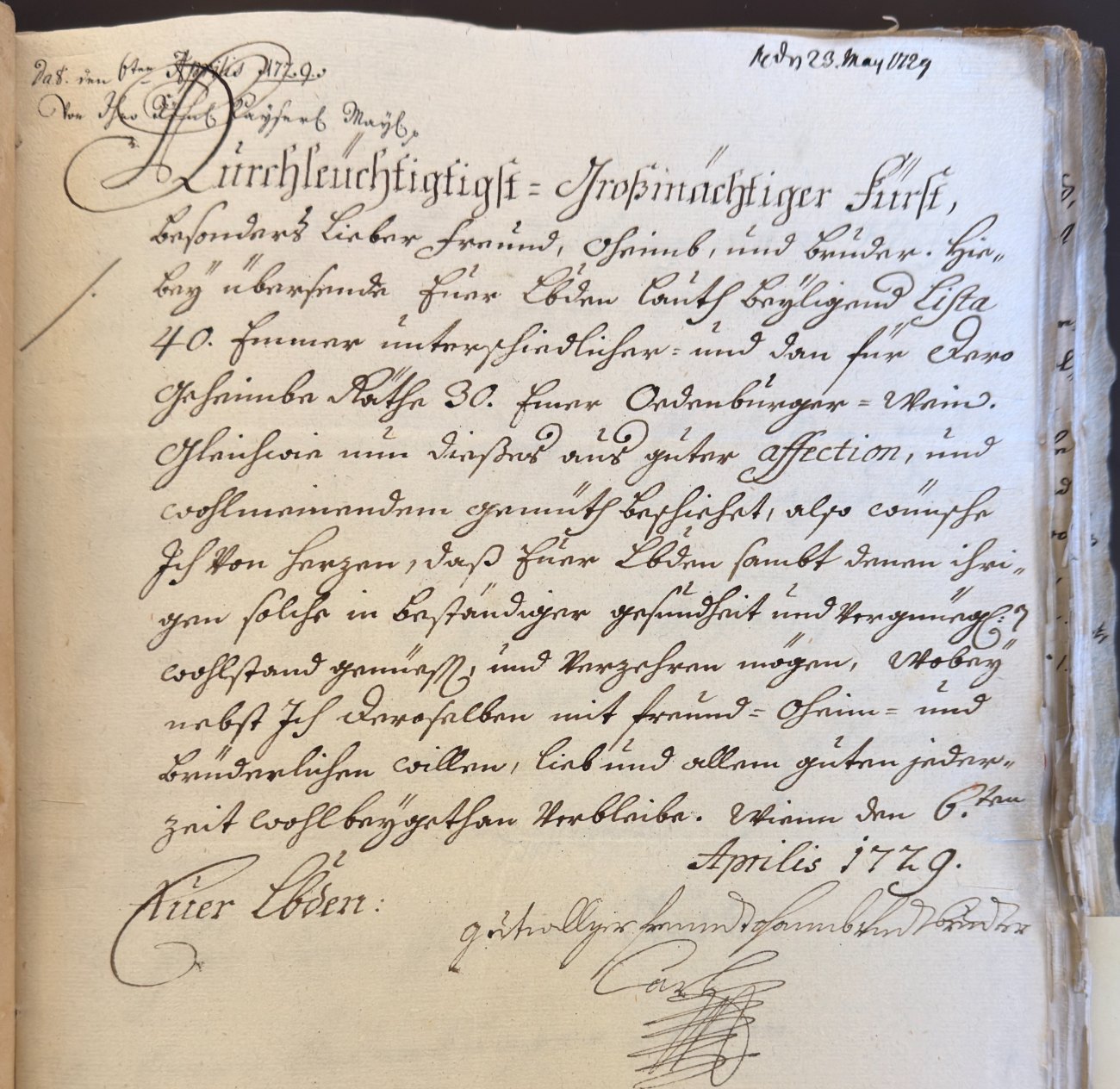
Institutionalised soft power, the ministry’s loyalty lubricated by the cask. The King’s 1728 thanks show the program already routine — «abermahl», once again — and Charles VI’s 1729 letter lifts the formula geniessen und verzehren verbatim from Leopold I’s gift letter of 1667 to the Great Elector, the program’s ancestor.
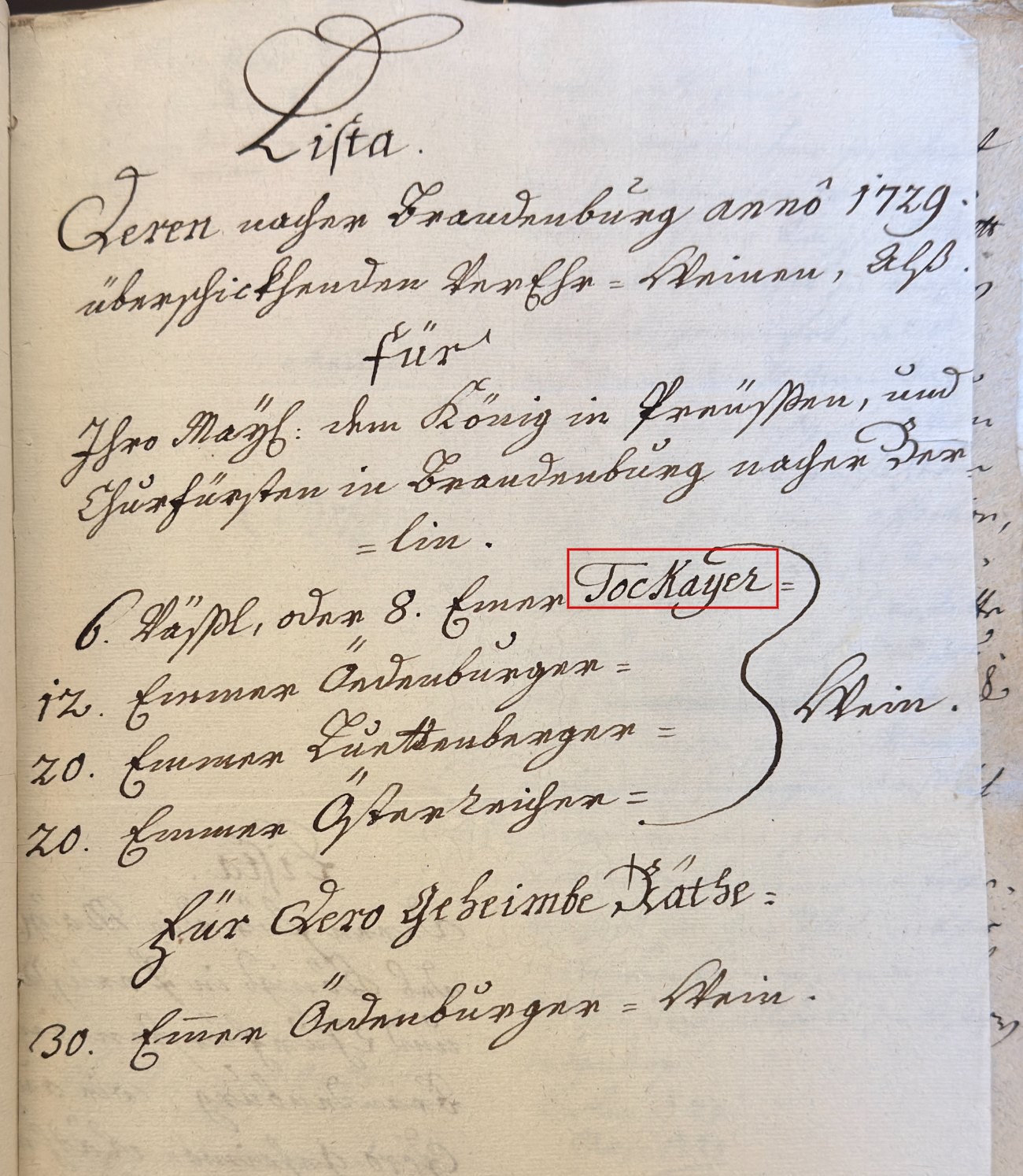
Affection by the Eimer: Vienna, 6 April 1729. Left, the Emperor’s own letter to «Durchleuchtigster Großmächtiger Fürst, besonders lieber Freund, Oheim und Bruder», signed Carl and received in Berlin on 23 May. Right, the enclosed Lista of what was sent to Brandenburg that year: «6. Väßl, oder 8. Eimer TocKayer» at the head, then 12 Eimer Ödenburger, 20 Lüttenberger, 20 Österreicher — and, separately, 30 Eimer of Ödenburger for the Privy Councillors. GStA PK, Geheimer Rat, imperial-relations registry.
There is a metrological by-product. «6 Väßl, oder 8 Emer Tockayer» fixes one Väßl at about 1⅓ Austrian Eimer, roughly 75 litres — the Gönc barrel, the Antal. That is the exchange rate that locks in the arithmetic for every Antal figure in the file. The annual 8 Eimer, about 600 bottles, almost exactly covered the 1718 table burn rate; the purchases built cellar depth.
One spring shows the whole system
16 February 1729 — the Hofkammer stalls the King’s purchased 125 Antal.
1 March — Berlin routes the affair to Gotter.
6 April — the same Emperor whose treasury is stonewalling signs a warm brotherly letter gifting the King 8 Eimer of Tokaji.
23 May — the gift letter arrives in Berlin while the pass affair is still unresolved.
Affection by the Eimer, obstruction by the Antal: the gift channel kept deliberately generous and deliberately small, while the commercial channel that could actually stock a court was tolled, delayed and leveraged. The last delivery arrived in Berlin on the day Friedrich Wilhelm I died; the chancery slip orders thanks for wine «welche kurz nach des höchstseeligen Königs Ableben allhier angekommen», to be signed by the 28-year-old Frederick II — plausibly among the first letters of his reign to the imperial court, five months before he crossed into Silesia.
1738 — 1743
The literary witness: Voltaire and Frederick
Four letters of the printed correspondence carry the same cellar the chancery paperwork describes. In June 1738 Voltaire adduces pleasure as proof of a benevolent deity, and Tokaji is the first exhibit — every man who drinks good Tokaji, he writes, must acknowledge a supreme and beneficent being.
The following year a cask travels end to end. Frederick writes from the Trakehnen stud on 15 August 1739 prescribing Tokaji against Voltaire’s apothecaries, and is glad to learn «que le vin de Hongrie est arrivé à Bruxelles». Voltaire confirms receipt from Brussels on 1 September: the «nectar jaune de Hongrie» has arrived, the Duc d’Aremberg has taken it into his cellar and will hand over «ce divin tonneau» on his return from Enghien. Sender, carrier notice, interim cellar and recipients are all attested.
Pour comble de félicité, / Vous possédez dans votre cave / De ce tokai dont j’ai tâté
Voltaire to Frederick II, The Hague, 28 October 1743, just after his Berlin visit
For the 1740s the cellar therefore has both an administrative record and an eyewitness in verse — and Büsching’s character sketch of 1788 adds the discipline around it: at Frederick’s midday table guests might drink as much Pontac and Mosel as they wished, «Champagner- und ungarischen Wein aber nur alsdann, wenn der König ausdrücklich befahl». The cupbearer monopoly of 1704, continued as a rule of permission.
Nov — Dec 1746
The Alberdahl passport affair
Eight documents, one month, the highest level of the state. Barely a year after the Peace of Dresden, Frederick II sent his cellar master to Hungary for 200 Antal of Hungarian wine and fifty vine stocks — and a genuine passport crisis followed, because Hungarian county authorities refused to honour passes not signed by Maria Theresa herself.
The royal order of 5 November instructs the envoy in Vienna, Otto Christoph von Podewils, to obtain a free pass without delay for the wine and the vine stocks, to be fetched by the royal cellar master Johan Alberdahl with the servants Johann Hoffmann and George Müller. The pass is to be signed by the Empress herself as Queen of Hungary, «weil man sonst dergleichen Pässe in Ungarn nicht zu respectiren pfleget», or at minimum by the Hungarian Chancellery; once obtained it goes to Graf von Münchow in Breslau, since the wine route ran through Prussian Silesia.
The same-day memorandum — very possibly from Alberdahl’s own office — supplies the practical warning behind the order: unless Her Majesty signs as Queen of Hungary, «so respectieren die Herren Ungarn selben nicht». Podewils reports on 16 November that he has already sent a pass, and that expediting anything further in Vienna is slow work. The King’s rescript of 26 November presses him again. On 7 December the file closes.
J’ai parlé… au Comte de Kinsky touchant la difficulté, qu’on faisoit en Hongrie de respecter les Passeports, qui n’étoient pas signés de l’Impératrice. Il m’a dit, qu’on y avoit pourvû, & que je pouvois être sûr, qu’on n’en feroit pas la moindre à l’égard de celui qui avoit été expédié pour le sommelier Alberdahl.
Podewils to Frederick II, Vienna, 7 December 1746
The constitutional wrinkle doing all the work
Viennese ministers’ signatures carried no weight with the Hungarian counties. Only the Empress’s signature as Queen of Hungary, or the Pressburg government’s, did. Hungary’s separate constitutional status, demonstrated on a wine wagon.
1744 — 1786
The Schatullrechnungen: Tokaji in the King’s privy purse
The Schatullrechnungen are the accounts of Frederick II’s Schatulle — his cassette, his privy purse. They are not the state budget and not the accounts of the court household. The Schatulle was the King’s own money, disposed of by him personally and booked outside the general treasury, and it paid for the things he wanted rather than the things the monarchy owed: building at Sanssouci, the porcelain factory, pensions to writers and musicians, snuffboxes, the payments to Voltaire, and the cellar.
Mechanically the series has two layers, and both matter for reading it. The monatliche Rechnungen are the monthly expenditure registers: a numbered list of items with a sum in the money column, headed with the month and often the exact span (vom 24ten Decembr 1750 biß den 24ten Januarÿ 1751). The Belege are the supporting receipts filed behind them — the merchant’s own slip, dated and signed, naming the goods in detail. The register tells you when money left the cassette and how much; the Beleg tells you what was actually in the cask. Where only the register survives, quantities collapse into one total; where both survive, the wine can be named.
The whole series has been edited and published digitally by the Geheimes Staatsarchiv Preußischer Kulturbesitz with the Stiftung Preußische Schlösser und Gärten. What follows is drawn from thirty-two images of that edition and of the manuscript leaves behind it: the wine and quantity phrases are framed in red, as elsewhere on this site.
Why this source rather than another: the privy purse is, as far as I can see, the least ceremonial record the Prussian court left. A gift dossier records what the court wished to display; a cellar inventory records what happened to be in the racks on one day. The Schatulle records what the King paid for out of his own money, month after month, with no audience. If Tokaji mattered to him, it should show up here — and it does, from 1744 to within three months of his death.
The dated series, 1747–1786
Read as search results the entries give a price range by class and no trend, because most carry no year. The manuscript leaves fix that: the register headings date them. Placing each entry by its heading turns the range into a run of four decades.
Hungarian wine in the privy purse · sums in Reichsthaler, Groschen and Pfennig
Date
Entry
Sum
July 1747
5 Anthal Hungarian wine from the merchant Zerbst
760
31 Jan. 1748
1 Antheil Hungarian dry Beerwein, and 1⅜ Eimer Hungarian Ausbruch
70 · 61.21
Jan. 1749
2 Anthale Hungarian wine through the cellarmaster Alberdahl
186.8
Dec. 1750 – Jan. 1751
2 Anthal Hungarian wine, von Friedeburg at Brieg
165.8
Apr. – May 1752
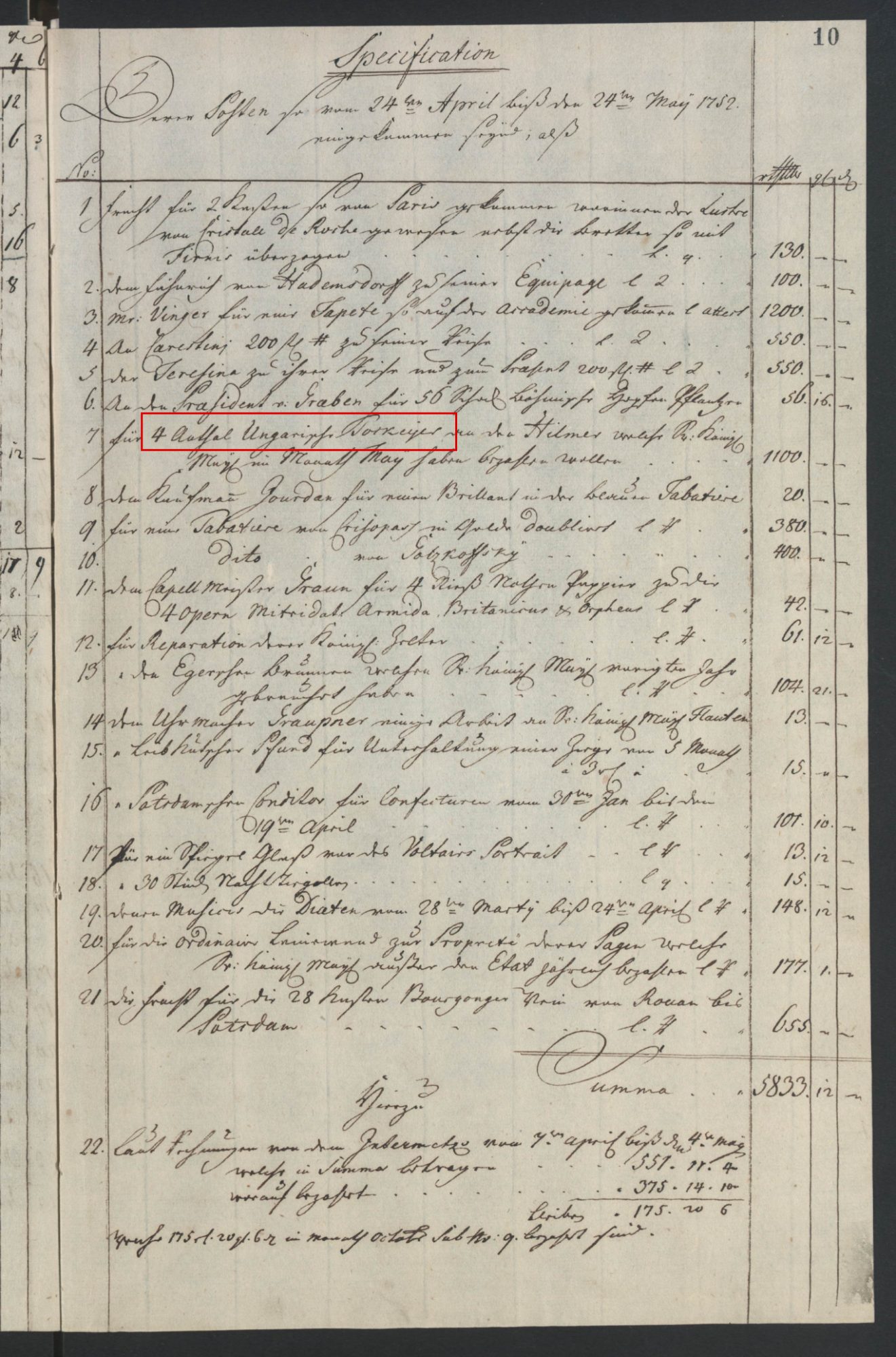
4 Anthal Hungarian Tockeyer, «an den Hilmer»
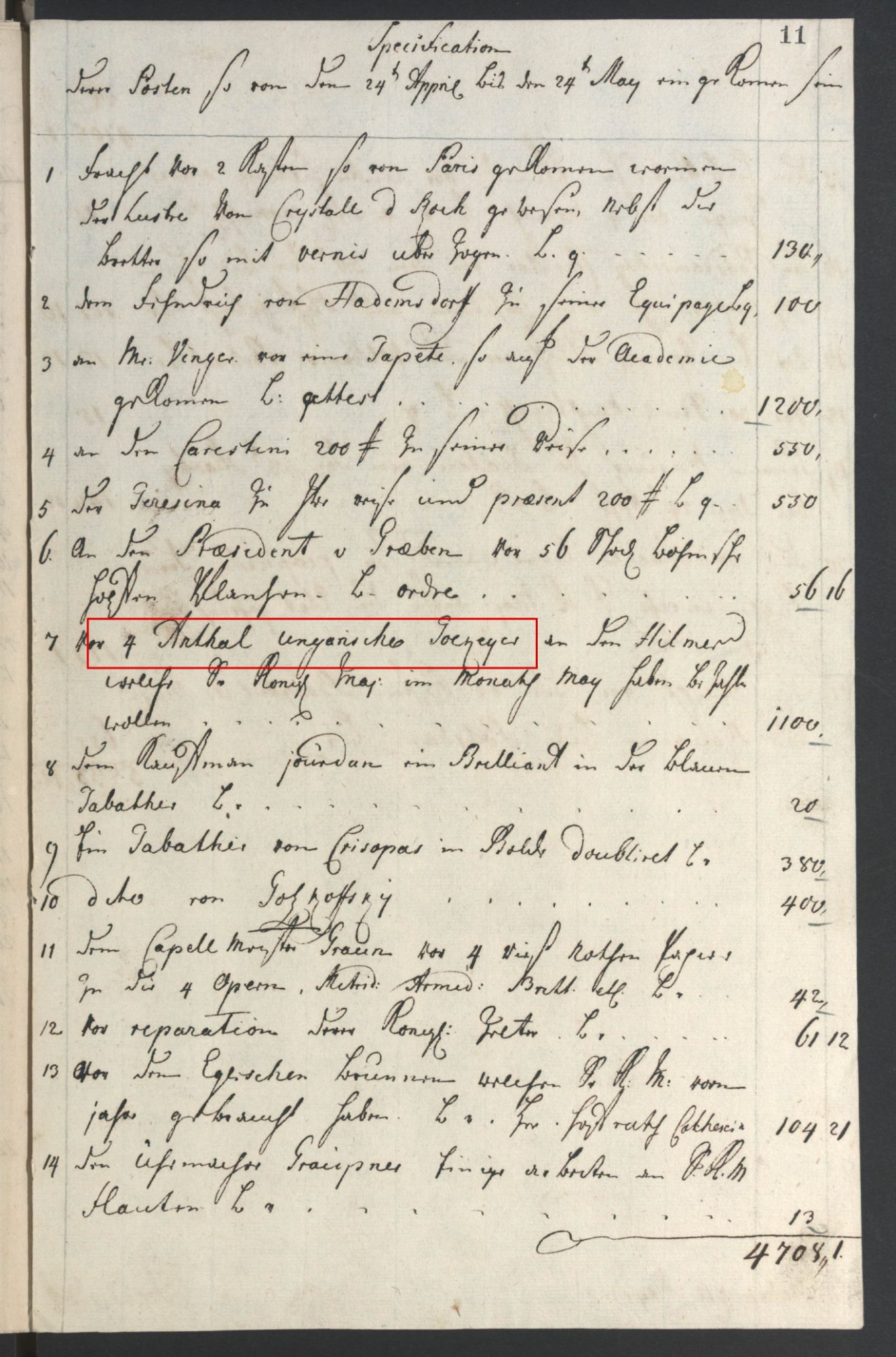
1,100
24 May 1759
3 Anthale Hungarian wine sent to the Austrian General von Beck
370
Mar. 1763
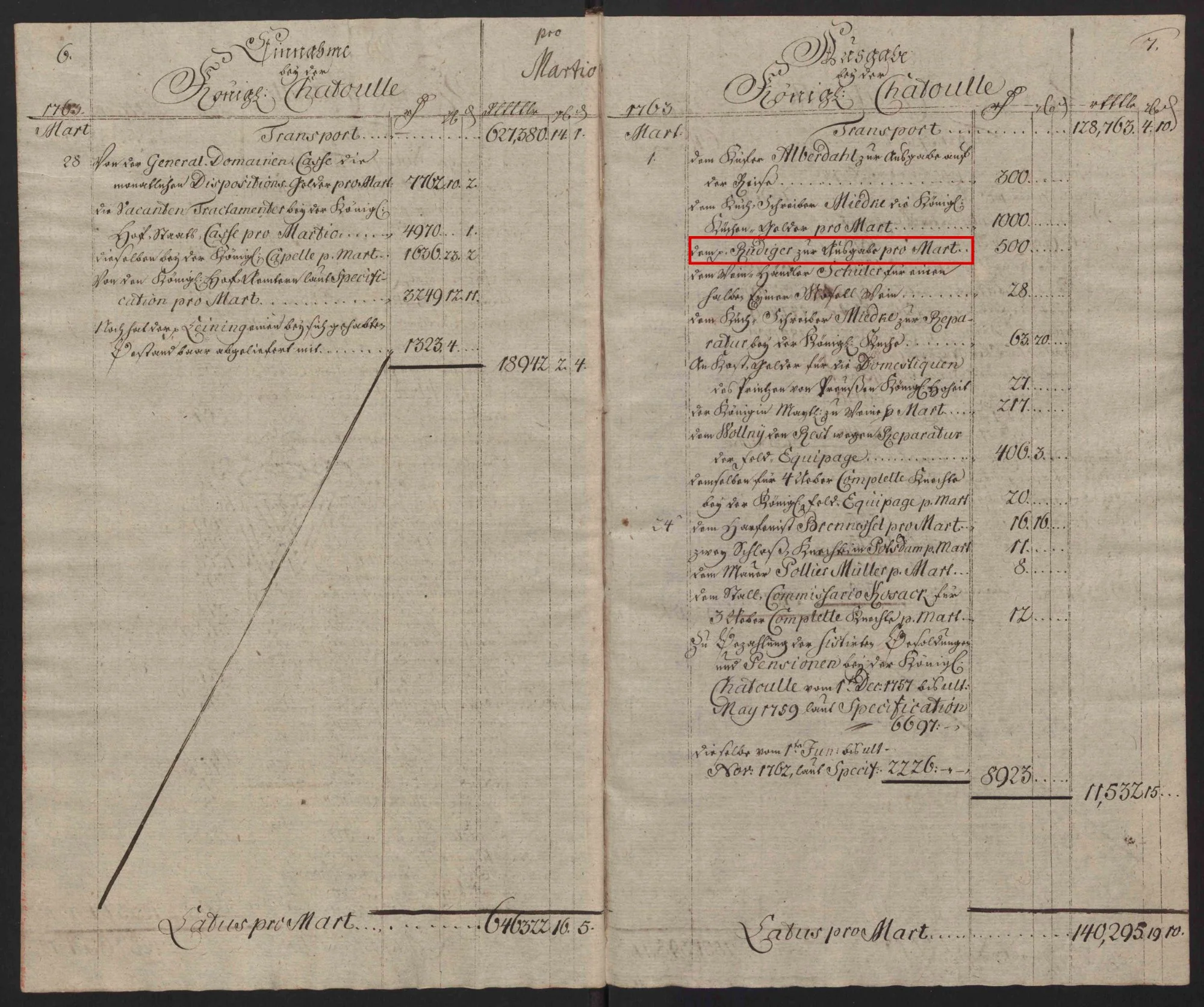
2 Anthale Tokaji Essence delivered by Körner, out of the Rüdiger 500
440
1764
2 Anthälgen Tokaji Essence, General le Grant at Neisse (70 ducats)
215.20
1764
2 Anthälgen Tokaji Essence from Oberst von Nimschefsky (46 ducats)
224
22 Feb. 1764
24 Gebinde Upper Hungarian wines: St. Georger Ausbruch and Essence, Muskateller, Tokajer Ausbruch, Tokajer Essence
not transmitted
1764
Freight on 5 Anthal Hungarian wine from Breslau
31.21
1 Feb. 1768
Freight for Hungarian grapes (ungarische Weintrauben)
49
1 Sept. 1770
4,000 bottles from the glass dealer Brocks, for the 28 Anthal received that January
140
5 Jan. 1771
30 Anthal St. Georger Muskateller: 1 Most at 130, 29 Essence of the 1770er Gewächse at 128
3,712
Feb. 1775
Freight for 7(?) Anthalen Hungarian wine
13.2
Apr. 1781
21 Anthal Hungarian Muscateller Essence, plus 159.10.9 freight and 171.3.6 excise
2,646
Mar. 1784
Excise on 23 Antal, with freight and toll of 162.12.6 and 107.6 for bottles
459.16.6
May 1784
1 Antal Ungar-Wein, Gebrüder Kuh at Breslau, with freight and excise
120 + 14.25
May 1786
2 Anthal Ungar-Wein, Gebrüder Kuh at Breslau
240
undated leaf
1 Anthal Tokaji must (ein Anthal Tockeyer most), Graf Münchow
42
Two of these readings are uncertain and should not be quoted without checking the original. On the July 1747 leaf the edition reads the merchant as Zerbst and the sum as 760; the manuscript can also be read as Herbst and 700. And on a further leaf giving one Anthal at 178 RTl 18 Gr, the manuscript line reads to me as 178.14.
What the entries show about the wine’s standing
Taken together, these look to me like the strongest evidence on this page for how the Prussian court actually rated Tokaji — not because any one entry is remarkable, but because of what the numbers are next to.
The price, against the house wine. On the March 1763 page 440 RTl go on two Anthale of Tokaji Essence. Four lines below, the wine merchant Schüler is paid 28 RTl for half an Eimer of Mosel. That is the comparison I find hardest to argue away.
The company it keeps. On the 1771 leaf the Muskateller Essence is booked immediately above a payment to the Resident von Rougemont in Paris for the bust of Voltaire. In the same ledgers the wine sits among the porcelain factory, the Havana tobacco and the building accounts. To me this suggests it was treated as a treasury-grade acquisition rather than as provisioning.
Forty years without a gap. The purchases run from 1747 to May 1786. Frederick died on 17 August of that year: in the May register his privy purse is still paying the Kuh brothers of Breslau for two Antal. The stock the testament of 1769 had treated as dynastic legacy was still being replenished in his final spring.
A standing bottle line. The 1770 campaign — 4,000 bottles from the glass dealer Brocks for the 28 Anthal received that January — is usually read as a single episode. The March 1784 leaf books für Bouteillen &c. 107 RTl under the Hungarian-wine number, so bottles seem to have been a recurring line of that account fourteen years later.
Aszú as a priced class in Berlin, 1748. The January 1748 Beleg distinguishes 1 Antheil Hungarian dry Beerwein at 70 RTl from 1⅜ Eimer Hungarian Ausbruch at 61 RTl 21 Gr. Berry wine and Ausbruch are separate commercial classes with separate prices, in Berlin, in 1748.
Wine crossing the lines. The May 1759 entry is not a purchase. Of 145 ducats received in April, 111 were repaid, because the Austrian General von Beck would accept no more than 34 ducats’ worth of the three Anthale of Hungarian wine the King had sent him. A gift of Tokaji to an enemy commander in the third year of the Seven Years’ War, partly declined.
Grapes, not only wine. In February 1768 the purse pays freight on ungarische Weintrauben, classed by the editors under Tafel. Fresh Hungarian grapes reaching Potsdam as table fruit is a trade I had not previously documented, and it raises the question of what else came north on the Breslau route.
Vin d’Inde on the same invoice. The 1748 Berlin slip buys 100 bottles of it alongside the Hungarian Beerwein and Ausbruch. That is the same Retour des Indes — wine matured by a voyage to India and back — that Wolanowski’s 1954 Warsaw article describes as a curiosity; here it is a line item in a Prussian court account two centuries earlier.
The unit. The editors note that the quantity statements — Mosel in Eimer, Tokaji in Anthal — suggest the Anthal is being used as a measure rather than as a vessel. That is a small point, but it supports the argument made under the testament that «Antal» is the fingerprint of Hegyalja wine.
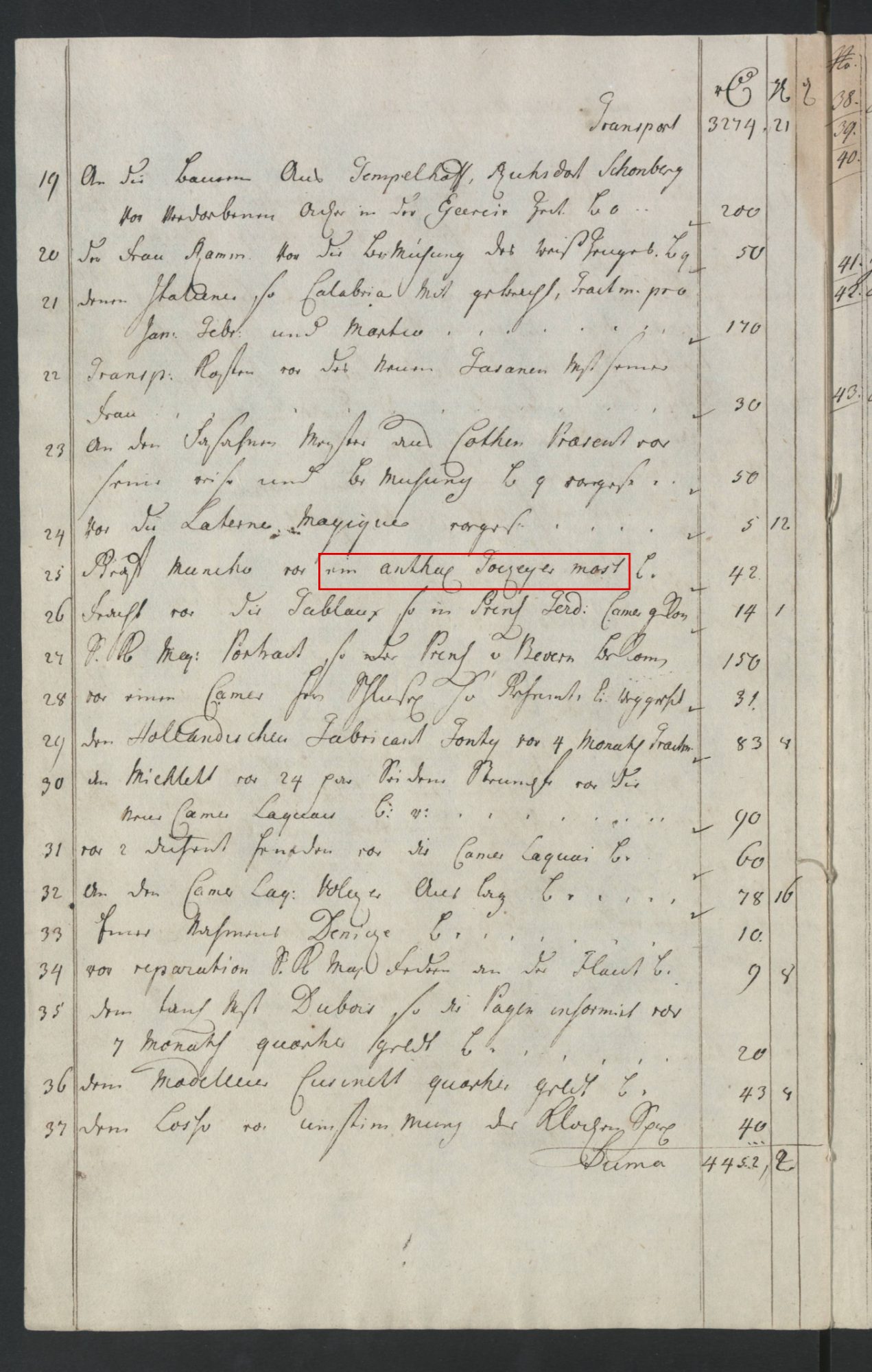
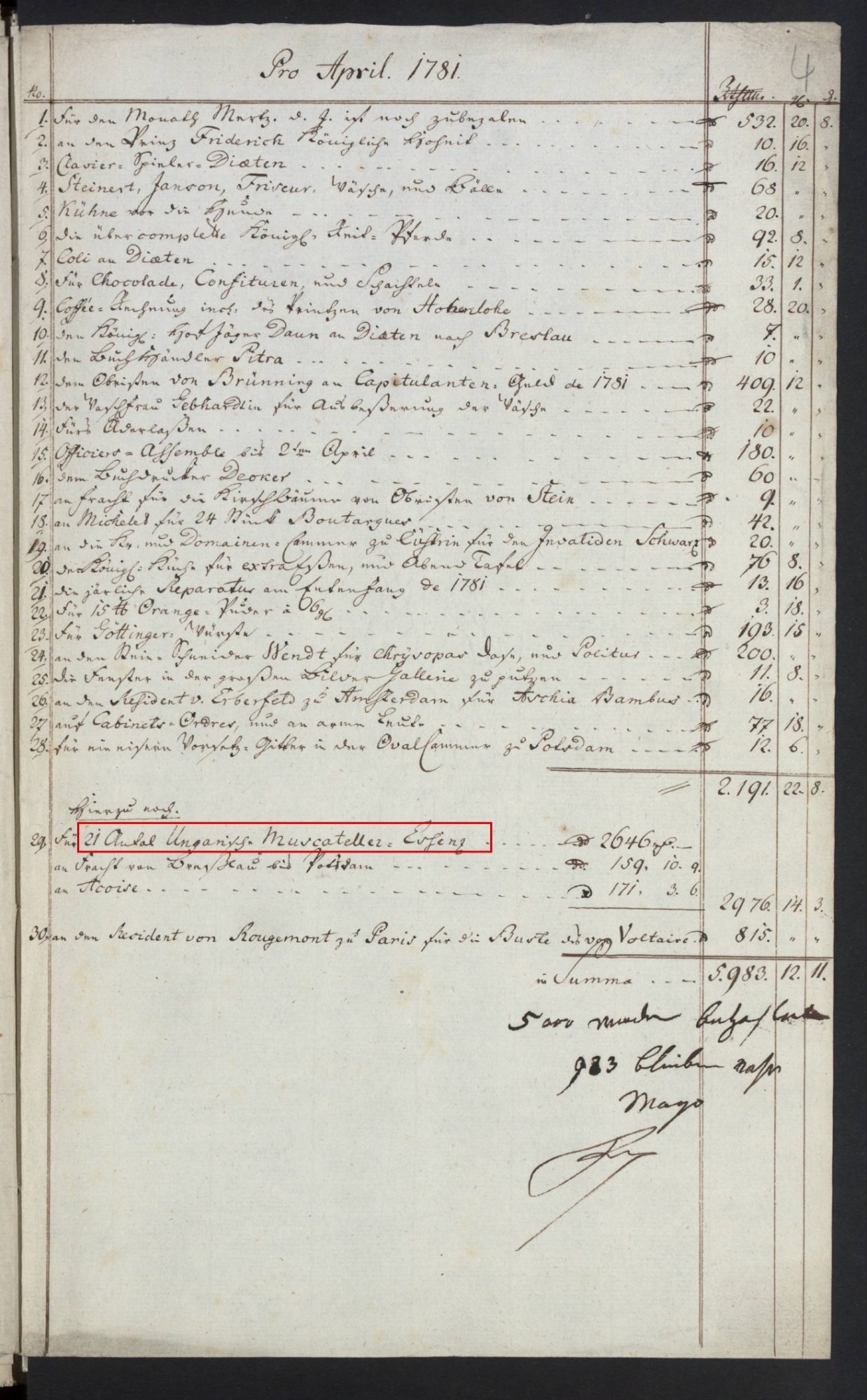
The largest single Tokaji purchase, 1752. «Specification. Derer Posten so von dem 24t April biß den 24t May…», fol. 11, item 7: 4 Anthal ungarisches Tockeyer — 1,100 RTl, bought «an den Hilmer». The edition carries this entry twice, once in the Specification and once in the monthly register.The same money in the register, 1752. «Specification… von dem 24ten April biß den 24ten May 1752», fol. 10, item 7: 4 Anthal Ungarische Tockeyer, 1,100 RTl. Comparing the two leaves is how the doubled entries in the edition can be told apart from two separate purchases.440 against 28, March 1763. «Ausgabe bey der Königl. Chatoulle pro Martio 1763», fols. 6–7: dem p. Rüdiger zur Außgabe pro Mart. — 500 RTl, of which the editors’ footnote assigns 440 to two Anthale of Tokaji Essence delivered by Christian Wilhelm Körner. Four lines below, half an Eimer of Mosel costs 28. No wine word appears on this leaf; the red frame marks the line the footnote hangs on, so it is not itself a manuscript attestation of Tokaji.Tokaji Essence to a general at Neisse, 1764. Ausgabe 1764, fol. 45, item 2: 2 Anthälgen To-/quaier Essenz — the phrase wraps across two lines, so it carries two frames — 70 ducats, entered as 215 RTl 20 Gr. The recipient is General le Grant at Neisse.The same wine, a different price, 1764. Ausgabe 1764, fol. 23, item 4: 2 Anthälgen Tockayer Essenz from Oberst von Nimschefsky, 46 ducats at 4 RTl 20 Gr — 224 RTl. Two Anthälgen of Essence bought twice in one year, at 70 ducats and at 46, which is a useful reminder of how wide the spread on this class could be.Tokaji must, 42 RTl. Item 25 of an undated leaf: ein Anthal Tockeyer most, from Graf Münchow. Unfermented must entering the royal cellar at a twenty-sixth of the Essence price sets the bottom of the Hungarian range, and shows the purse buying the whole spread of the Hegyalja, not only its showpieces.The largest Hungarian entry of all, April 1781. «Pro April. 1781», fol. 4, item 29: 21 Anthal Ungarische Muscateller=Essenz — 2,646 RTl for the wine, 159 RTl 10 Gr 9 Pf freight from Breslau to Potsdam, 171 RTl 3 Gr 6 Pf excise. The three entries stand separately on the leaf but only their total was carried into the money column, which is the sort of thing that makes the series easy to misread.
Source
Die Schatullrechnungen Friedrichs des Großen, digital edition, Geheimes Staatsarchiv Preußischer Kulturbesitz with the Stiftung Preußische Schlösser und Gärten Berlin-Brandenburg, on perspectivia.net. Belege 166, 664, 855, 1173, 1408; Monatliche Schatullrechnungen Nrn. 9, 23, 123, 177, 191, 206, 207, 222, 465, 490, 885, 944, 1007 and others; journal entries j_3 and j_7. One entry is cross-cited by the editors to GStA PK, I. HA Geheimer Rat, Rep. 36 Hof- und Güterverwaltung, Nr. 569 (5 April 1763). Transcriptions preserve the original orthography; readings marked (?) are uncertain, and where manuscript and printed edition differ both are given.
1769 — 1786
The testament: Hungarian wine as dynastic legacy
Frederick II’s holograph French testament of 8 January 1769 — the will opened after his death in August 1786 — contains one consumable and one only. Wine appears in the legacy formulas beside diamonds, snuffboxes priced at 10,000 écus, Berlin porcelain services and parade carriages: treasury assets all. Ten clauses bequeath vin de Hongrie.
The Hungarian wine legacies
Legatee
Antal
Court
Sister Amalie, Abbess of Quedlinburg
20
Prussia
Brother Ferdinand of Prussia
50
Prussia
Niece Wilhelmina, Princess of Orange
40
Orange-Nassau
Brother Prince Henry
50
Prussia (Rheinsberg)
Sister Lovisa Ulrika, Queen of Sweden
20
Sweden
Niece, Duchess of Württemberg
20
Württemberg
Nephew, Margrave of Ansbach
30
Ansbach
Nephew Karl Wilhelm Ferdinand, Hereditary Prince of Brunswick
10
Brunswick
Friedrich Eugen of Württemberg
20
Württemberg
Brother-in-law Prince Ferdinand of Brunswick
20
Brunswick
Total
280
≈ 210 hectolitres, on the order of 28,000 bottle-equivalents
The register is legible in a single clause: to Prince Henry, two hundred thousand écus, fifty Antal of Hungarian wine, a rock-crystal chandelier from Potsdam, the green diamond from the King’s finger, two riding horses with their equipage and a team of six Prussian horses. Fifty casks of wine, listed between the money and the ring.
Why «vin de Hongrie» here means Tokaji
The word Tokaj never appears, so the honest formulation is Hungarian wine, in context almost certainly Tokaji. The case rests on three legs. The unit: the Antal is the half-Gönc cask of the Hegyalja, about 75 litres, used in the export trade essentially only for Hegyalja wine — ordinary Ofner or Erlauer table wine did not ship in Antal. The series: the 1746 passport is for «200 Antheil Ungarischen Wein» fetched at source in Upper Hungary, and the cellar ledgers treat Ungarwein in Antal as the Tokaji line. And court usage across the wider corpus, where «Antal Tokajer» and «Antal Ungarwein» are used interchangeably. The unit is the fingerprint.
The dispersal hypothesis, and what narrows it
If some 280 Antal left the Berlin cellar as legacies in 1786–87, Frederick’s accumulated Tokaji was physically dispersed across ten princely households, and the nineteenth-century relic series then begins — tellingly — with the Essenz 1788, the first acquisition after the drain. Two findings narrow that. The inventory of late 1777 enters «ungers. wein — 10. anthal, 1312 b.», roughly 22 to 23 Antal-equivalents, against 280 bequeathed eight years earlier: even allowing for later purchases and other residences, the gap makes wholesale delivery in kind improbable and raises the alternative that the legacies were valued and commuted, or honoured only in part. And the Berlin inventory of 1839 still lists pre-1786 Hungarian wine. Status: hypothesis, not finding. The executor’s accounts are the decisive missing document.
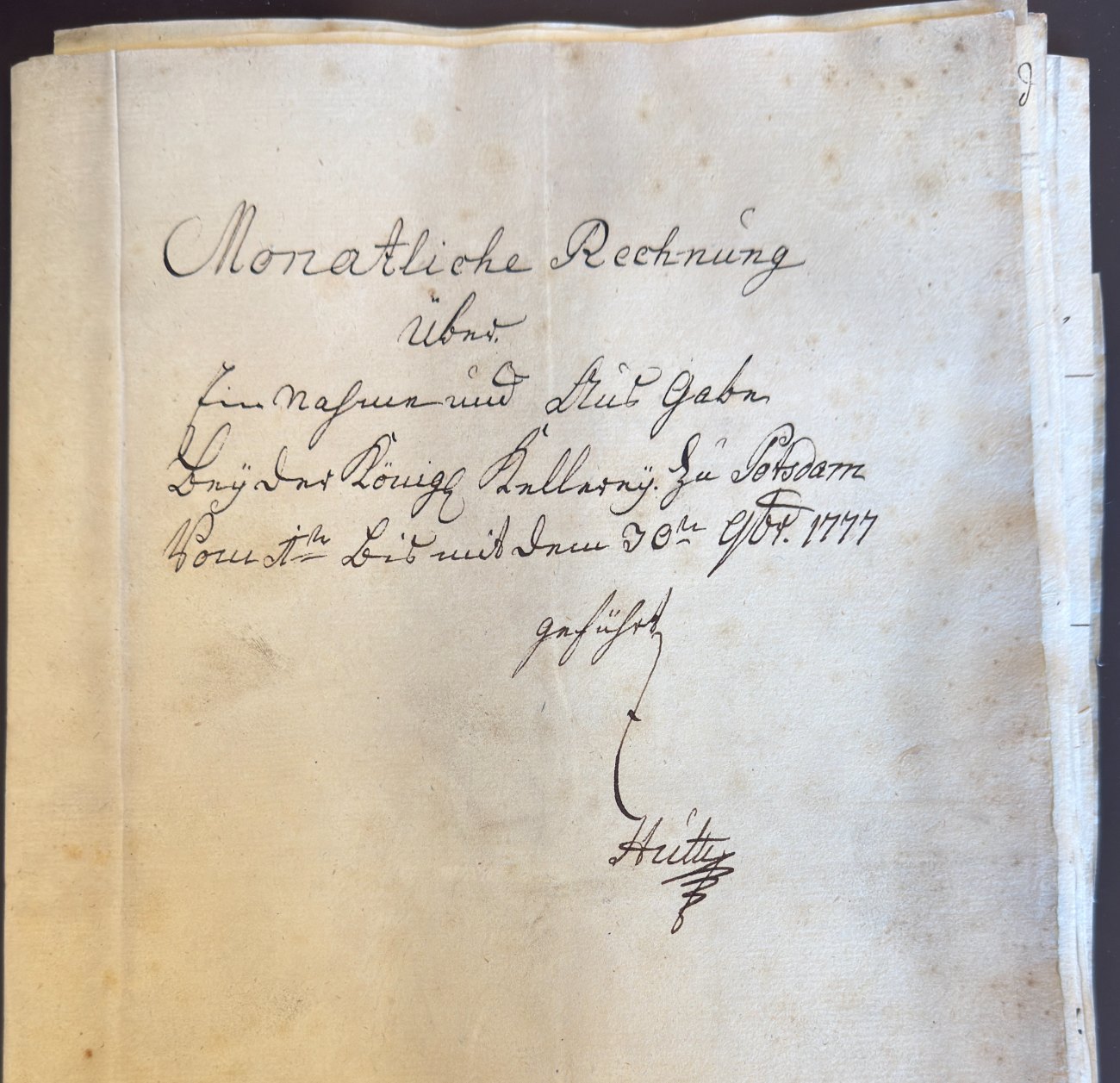
The one quantified snapshot, 1777. «Monatliche Rechnung über die Nahmen und Aus Gaben bey der Königl. Kellerey zu Potsdam» — the account whose stock line reads «ungers. wein — 10. anthal, 1312 b.» Ten casks and 1,312 bottles: about 22 Antal-equivalents, against the 280 Antal the testament had bequeathed eight years earlier. GStA PK, I. HA GR Rep. 36 Nr. 1163.
1838 — 1921
The nineteenth-century afterlife: dynastic relics
The Oberhofmarschallamt cellar files show old Tokaji held as relics while commercial wine was turned over. The transcribed Hungarian lines of the Berlin stock count of July 1839 make the pattern precise.
Hungarian wine in the Berlin royal cellar, July 1839
Bottles
As listed
Vintage
14
Alter Ungar v. Friedrich II. — attributed to the King by name
—
2
Ungar
1788
50
Tokajer
1779
127
Ungar. Ausbruch
1804
59
Ungar. Essenz
1811
355
Ungar. Ausbruch — the largest single lot
1822
168
Tokajer
1822
100
Ober Ungar
1822
181
Tokajer
none given
1,056
Total Hungarian wine
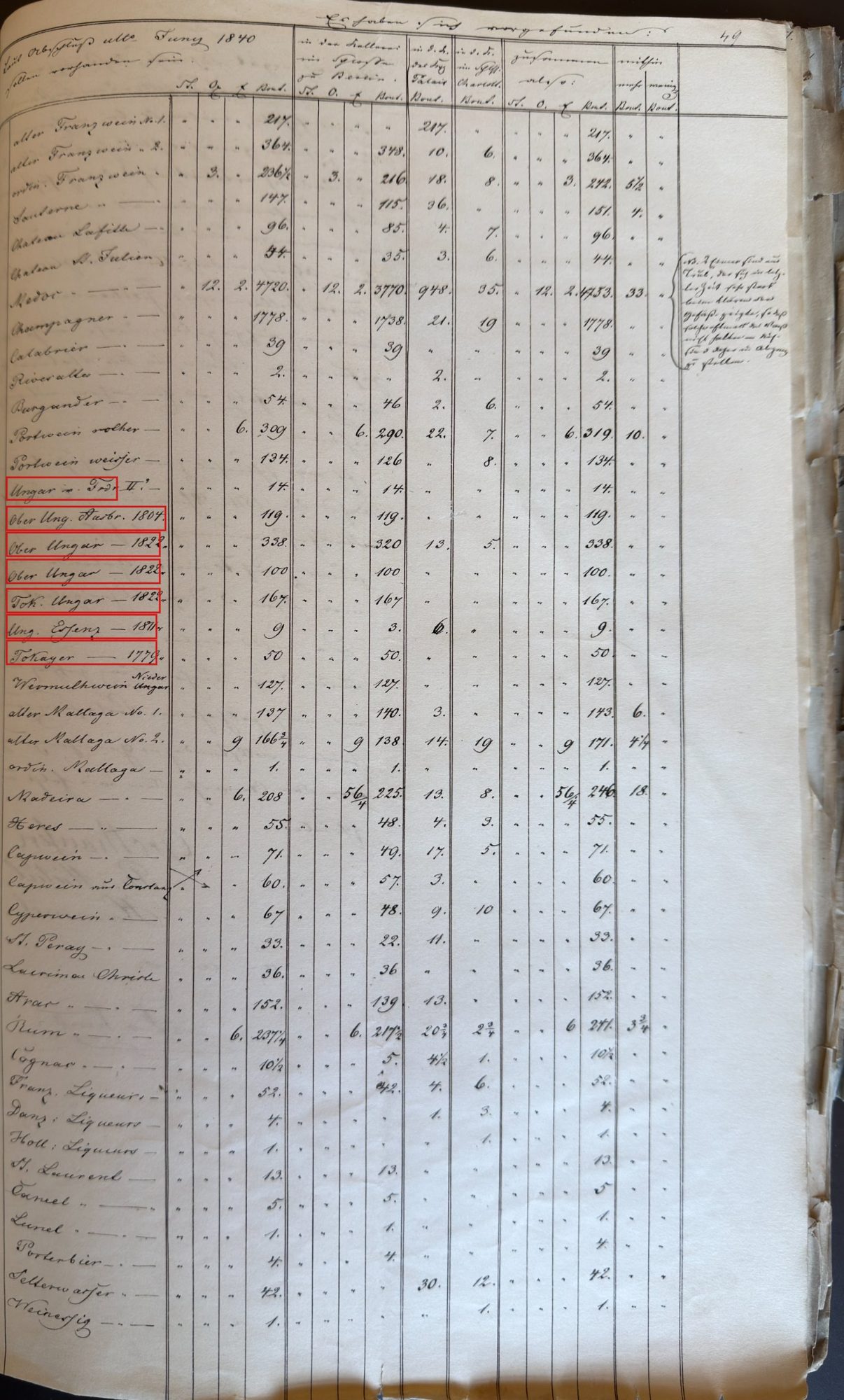
The pre-1800 items are tiny and one is attributed to a person; the nineteenth-century Ausbruch, Tokajer and Essenz lots run to hundreds. Relic status attaches specifically to the eighteenth-century wines, while the younger Tokaji was a substantial working stock. And «Alter Ungar v. Friedrich II.» is the clearest documentary instance of Tokaji held as a dynastic relic in the strict sense: identified not by vintage or vineyard but by the monarch who laid it down.
The relics, in the clerk’s own hand. A revision sheet of the royal cellar files. Read down the Hungarian block: «Ungar v. Fdr. II.» — 14 bottles, «Ober Ung. Ausbr. 1804» 119, «Ober Ungar 1822» 338 and 100, «Tok. Ungar 1822» 167, «Ung. Essenz 1811» 9, «Tokayer 1779» 50. The eighteenth-century lots are counted in tens, the nineteenth-century ones in hundreds — and one of them is catalogued not by vintage but by the King. GStA PK, BPH Rep. 113 Nr. 2211.
The counter-image sits in the same file. A negotiated exchange with the Berlin merchant Gebrüder Habel sold 1811 and 1822 Rhine wine casks by lot against young Bordeaux and Sauternes — Rhine wines of the very vintages held as Tokaji relics, liquidated because they were merely commercial stock.
A negative finding closes the physical side: the seventeen surviving Prussian Hofkellerei wine-rack labels were checked object by object, and all are Rheingau Rieslings of the 1880s and 1890s. No Tokaji label survives in the set. The administrative end comes on 13 May 1921, when the Ober-Hofmarschallamt asks the Finance Minister for permission to remove the Kaiser’s glasses, glass cabinets and monogrammed carafes from the palace cellars to the furniture depot in Charlottenburg.
Image withheld pending permission.What the cellar left behind. Left, the surviving rack labels of the imperial period, each under the Prussian eagle: one 1883er Rüdesheimer and seven 1893ers — Rüdesheimer, Marcobrunner, Hallgartener, Steinberger. Not one names a Tokaji, which is why the physical evidence for the relic stock has to be sought elsewhere. Right, the Sanssouci stock list of 1860, where the Rheingau growths now run into the hundreds and thousands. Labels reproduced from Prüfer (2006), Abb. 22, after SPSG Potsdam; the 1860 list Abb. 20.
The Prussian arc in one line
Procurement (1561–1758), accumulation (1746, 1748), dispersal (1769/1786) and relic formation (1788 onward, catalogued under the King’s name in 1839) form one documented life cycle of a royal Tokaji cellar. That is the central result of the Prussian file, and the Saxon record has no equivalent to it.
Open, and worth stating
Whether the 1786 wine legacies were delivered in kind — executor’s accounts, or receipts in the recipients’ archives, the Württemberg pair being traceable in Stuttgart from material already in hand. A cellar week recording the arrival of Tokaji in bulk, which would connect a pass physically to a receipt. The 1728 manifest, the one Verehr-Wein list still missing. And the Potsdam-or-Schönhausen discrepancy between two consecutive cellar sheets of June 1704.
1745 — 2004
The royal cellars today
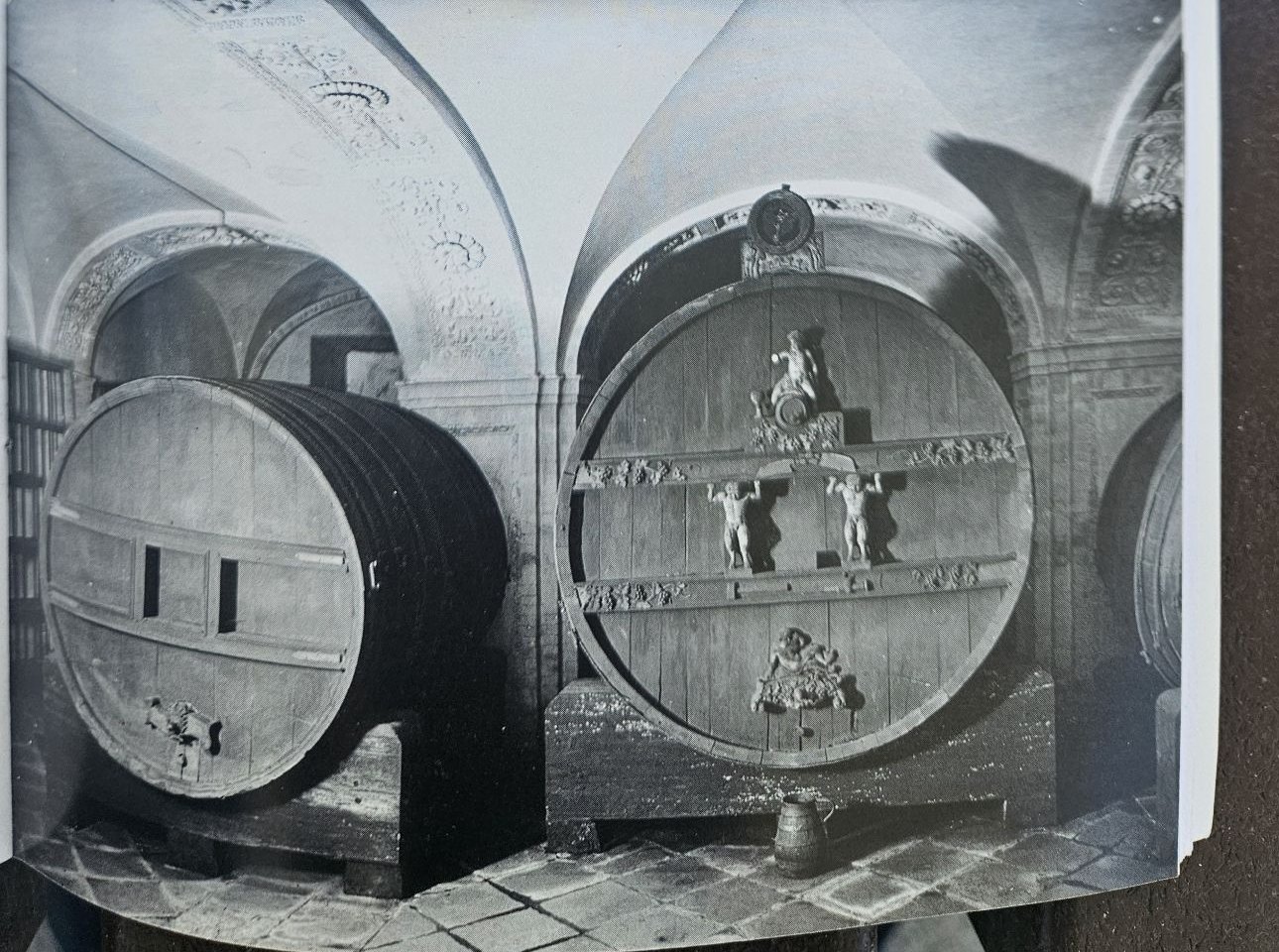
The wine cellar of Sanssouci was built under the eastern side wing of the palace. After lying dormant for 140 years it was reopened to the public in 2004, following a seven-month restoration, and its three-storey iron bottle rack was refilled with the fine wines that had been drunk at the table of Frederick II and later at the court of Frederick William IV (1795–1861).
A second court cellar no longer exists. In 1726 the Prussian court had parts of the cellar vaults of the Potsdam Stadtschloss fitted out as a wine cellar. The palace was demolished in 1960 and later reconstructed externally as the seat of the Landtag Brandenburg; in the course of the modern rebuilding and its use as a parliament building the historic underground room structures were heavily altered or given over to other purposes, among them the “Raum der Stille”.
Source
Stiftung Preußische Schlösser und Gärten Berlin-Brandenburg, press release on the Sanssouci palace wine cellar, spsg.de.
Apparatus
Sources
Berlin and Potsdam. GStA PK, XX. HA Hist. StA Königsberg, microfilm ser. “50, b”, fol. 37–40: the patents of Ferdinand I, 1561 and 1563, and the Genderich commission of 1566.
GStA PK, I. HA Rep. 9 FF 9: the wine-pass registry, with the printed toll ordinance of 1684/1718 and the passes of 1720, 1728 and 1729; Rep. 9 C 1 b 3 Fasc. 24: forwarded correspondence, 1748–49; Rep. 9 (old signature “R 9 FF. 6”): the Alberdahl passport dossier, November–December 1746.
GStA PK, I. HA Rep. 36 Nr. 1065 and Nrn. 1084, 1103, 1132, 1160, 1163: Hof-Kellerei purchase records and weekly cellar ledgers, Cölln/Berlin c. 1680, Schönhausen 1704, Hoff-Wein-Keller 1718, and the stock of 1777.
GStA PK, Geheimer Rat, imperial-relations registry (old signature R. 1. n. 13. b. 3): the Verehr-Wein correspondence and manifests, 1728–1740.
Testament of Frederick II, Berlin, 8 January 1769: manuscript facsimile and printed edition, pp. 35–39; edition still to be identified.
GStA PK, BPH Rep. 113 Nr. 2211: Oberhofmarschallamt cellar files, 1838–1841, incl. fol. 29; Nr. 2235, fol. 321, for the letter of 13 May 1921. SPSG, Varia collection, via museum-digital:brandon: the Hofkellerei wine-rack labels — a negative finding for Tokaji.
Voltaire, Œuvres complètes, Correspondance, nos. 890, 1189, 1193 and 1626, text per the Moland edition (Garnier frères, Paris 1877–1885).
Lutz H. Prüfer, Potsdam und der Wein (Schriften zur Weingeschichte 152), Wiesbaden 2006 — printed corroboration from the same fonds, with facsimiles; used here as corroboration and, where it reproduces documents, as access.
Frank Strzyzewski · very-old-tokaji.com
Compiled August 2026 from the working dossier on the Prussian cellar. Transcriptions preserve the original orthography; readings marked uncertain in the dossier are reported as uncertain here. Facsimiles credited to Prüfer are photographs of the printed study; the archive photographs are my own. If you hold a bottle, a certificate or a cellar list from the Prussian court, I would like to hear from you.