Bottles from the century the wine was made famous17th century bottles
The oldest vintage the Fukier house ever sold, a small bottle mounted in tsarist silver, three bottles of one vintage from a single cellar, and the bottle whose 1646 label nobody has been able to explain.
Silver-mounted
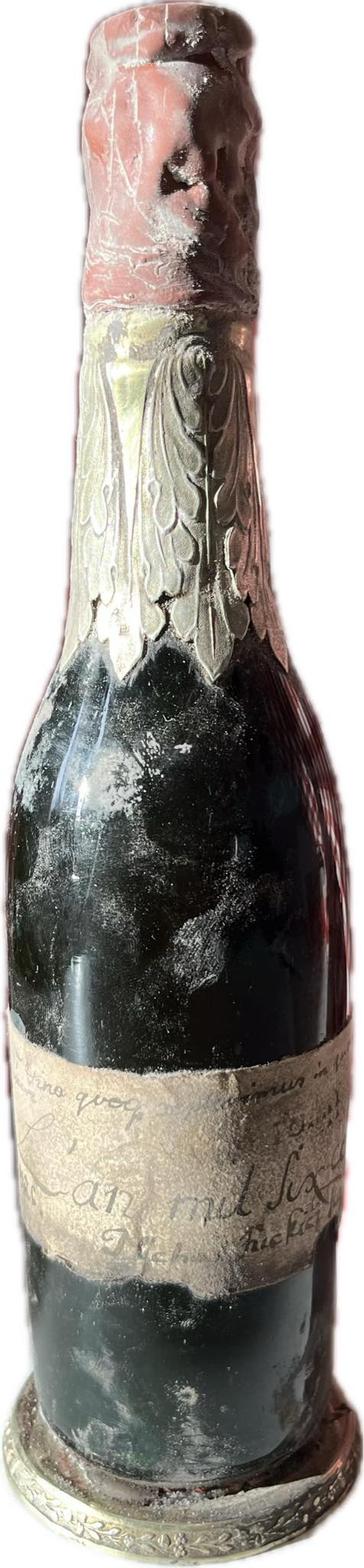
1620Michal Fuckier kapka, mounted in tsarist silver
1606 Fukier
8Bottles known today, in four shapes and sizes
Len Evans, 1977
1646Bought at Christie’s in 1977 for £300; the Guinness auction record is a second 1646, sold in 1984
Garai bottle
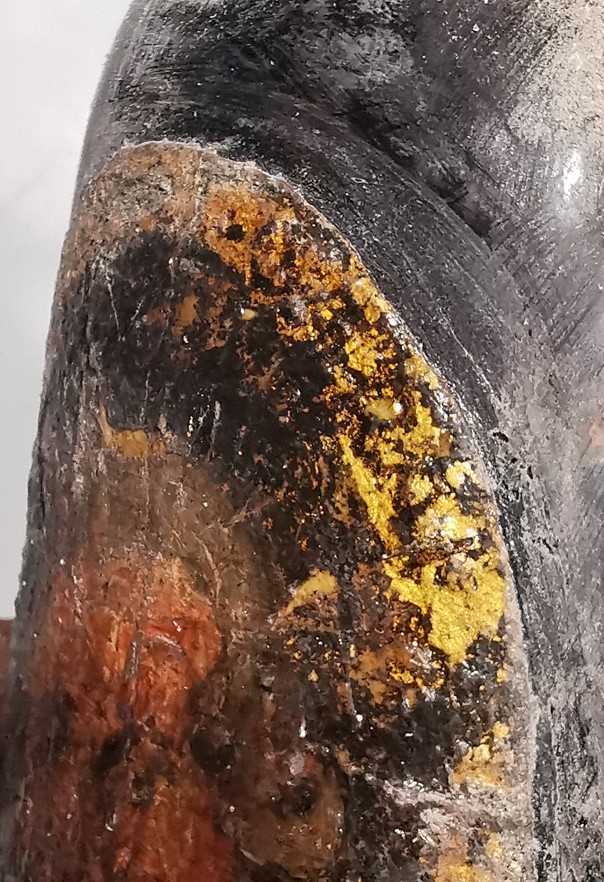
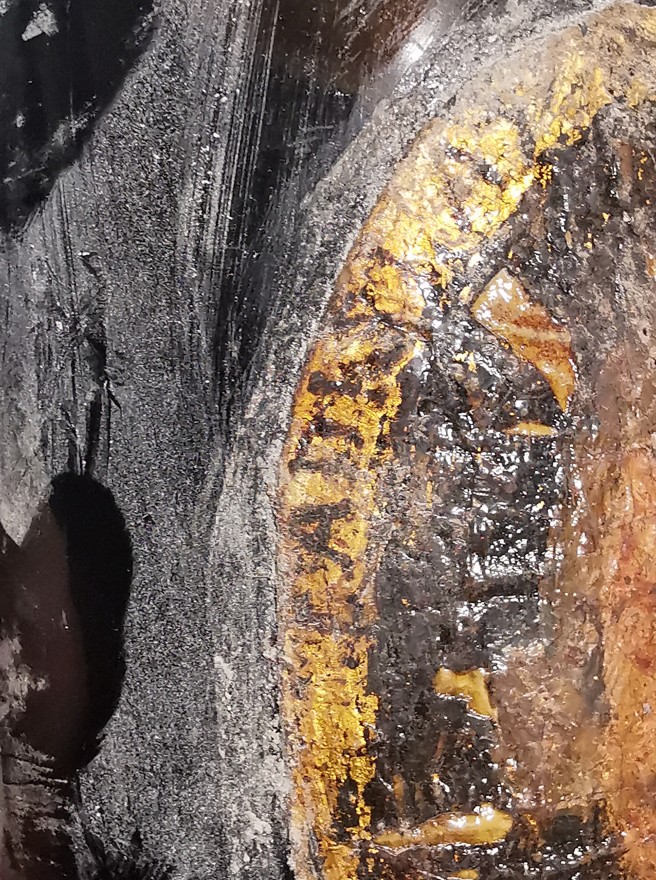
1690Leather label, portrait of captain János Garai
1606
1606 Fukier
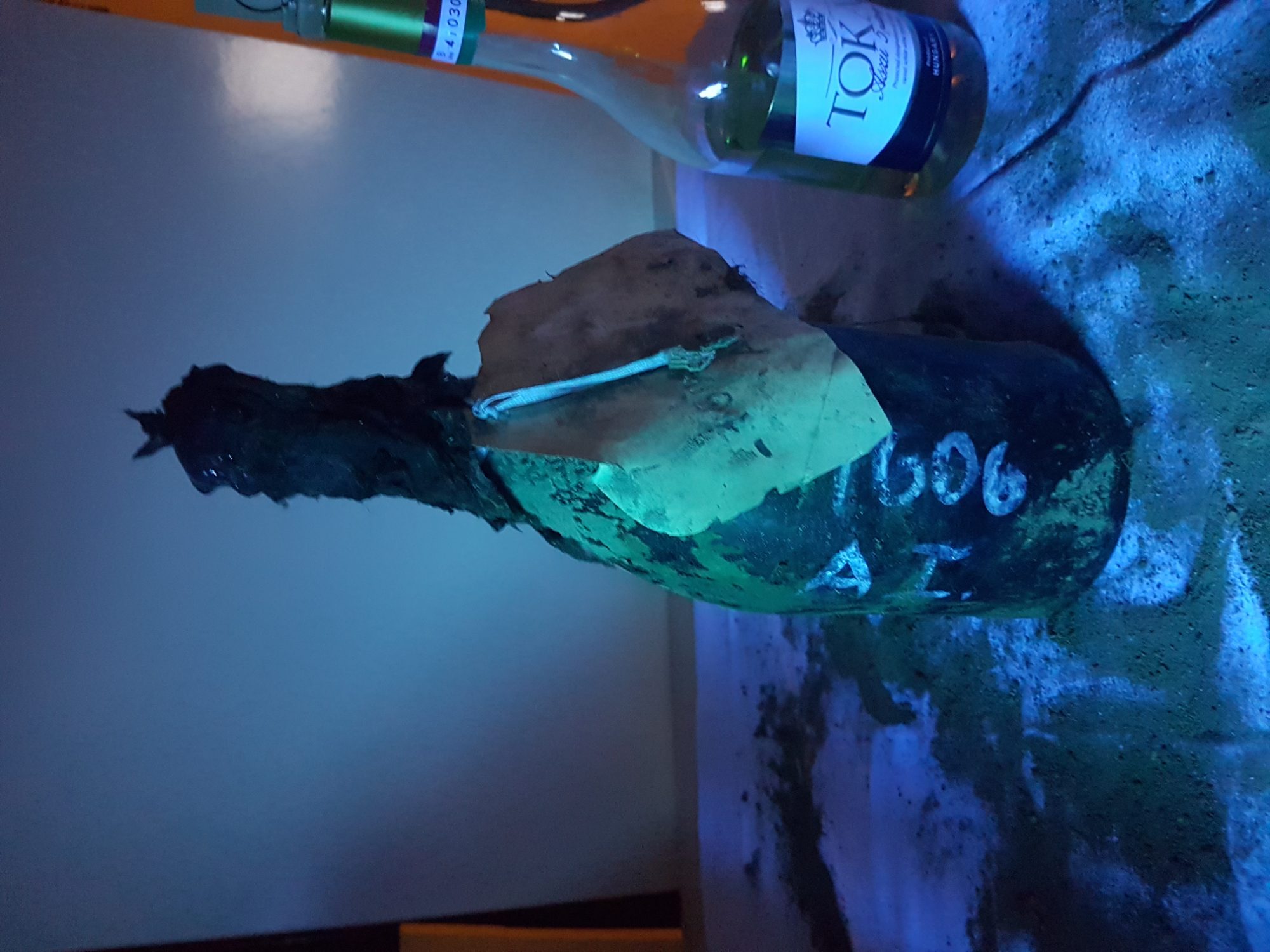
The oldest vintage officially sold in the famous Fukier cellar. Of the more than 300 bottles of this vintage in the Fukier inventory in total 8 bottles are known today, owned by different unrelated owners in different countries, including one cellar discovery. The 8 bottles have 4 different shapes and sizes, 6 of them share exactly the same labeling/identification pattern (painted) and identical element spectrum of the paint composition. The other two bottles are different but well verified, too. The bottle owners can present documents related to the bottle, including Fukier invoices, postcards, cellar book pages, Wilanow inventory lists, Wehrmacht documents, original documents from the 1927 Dresden auction and even items from the Fukier restaurant.
This is one of the very few Fukier bottles carrying the shelf section label visible on old photographs of the Fukier cellar; the photographs of it now sit in the 1646 article.
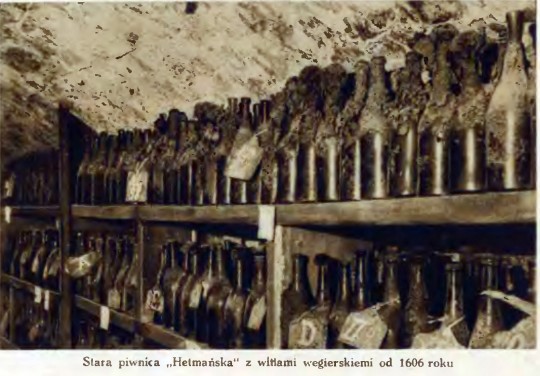
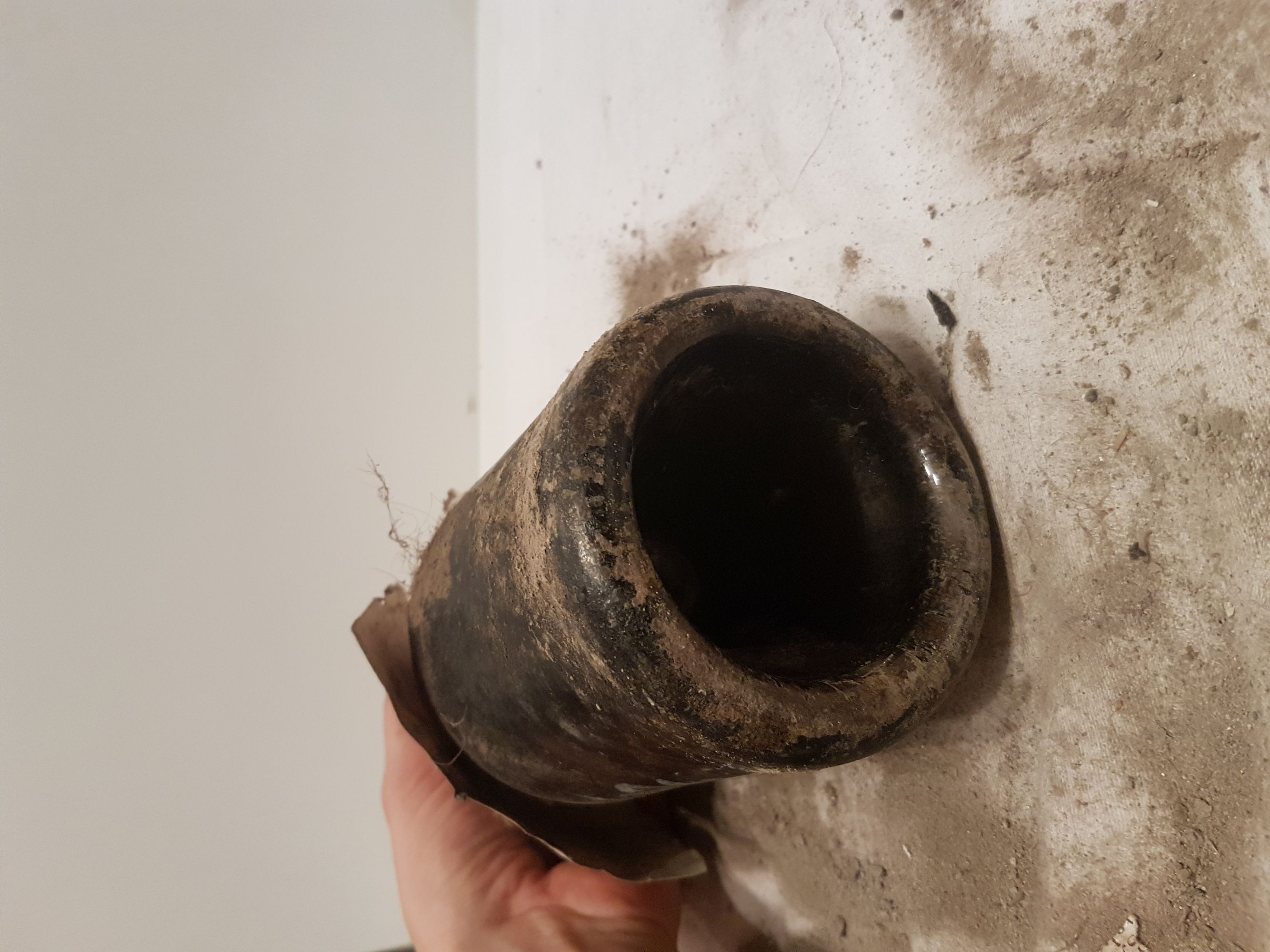
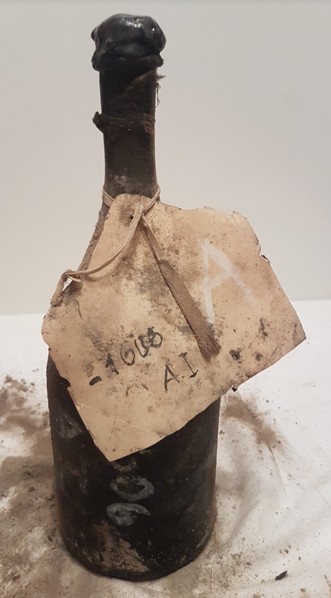
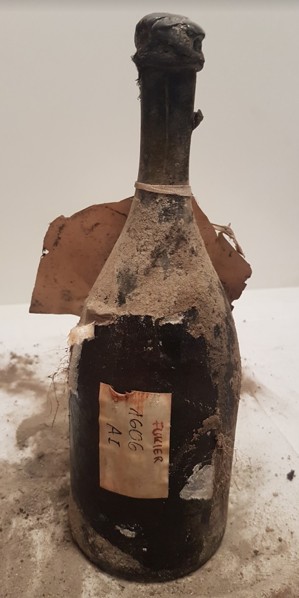
A 1606 Fukier bottle: the paper neck tag and the FUKIER 1606 A1 label, the painted marks on the glass under UV light next to a modern Tokaji bottle for comparison, and the mouth and base in the hand. The old photograph shows the Hetmańska cellar — captioned Stara piwnica „Hetmańska” z winami węgierskiemi od 1606 roku, the old Hetmańska cellar with Hungarian wines from the year 1606 — the shelves from which these bottles come. Click any image to enlarge.
1620
1620 Bottle (Michal Fuckier, kapka)
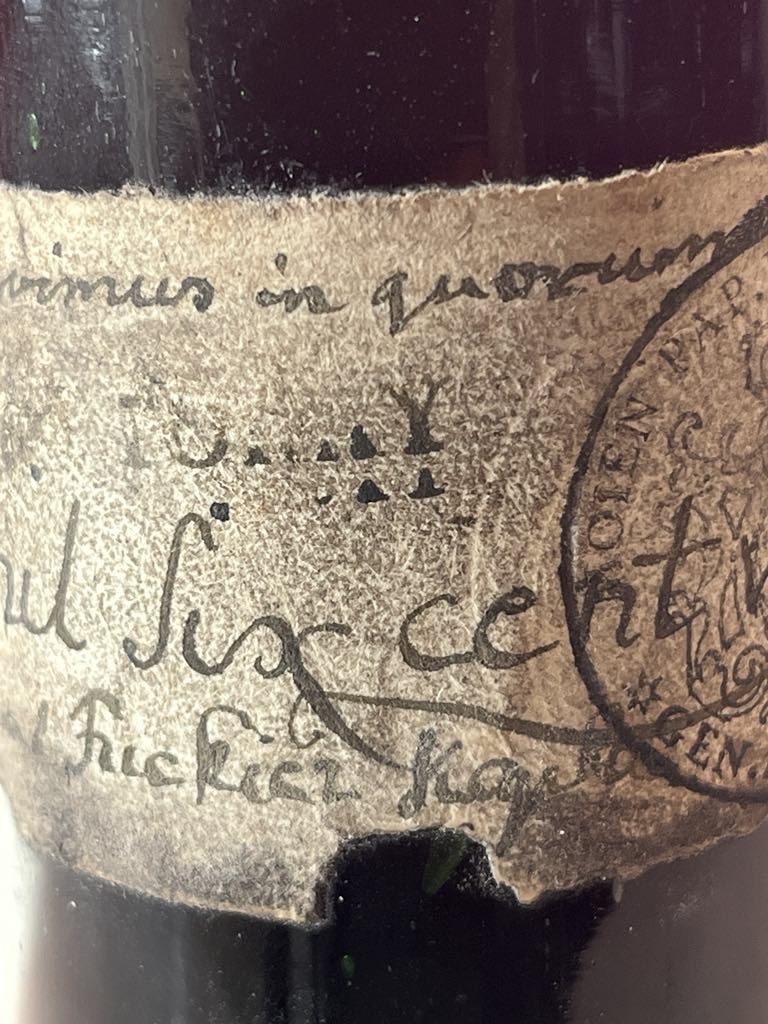
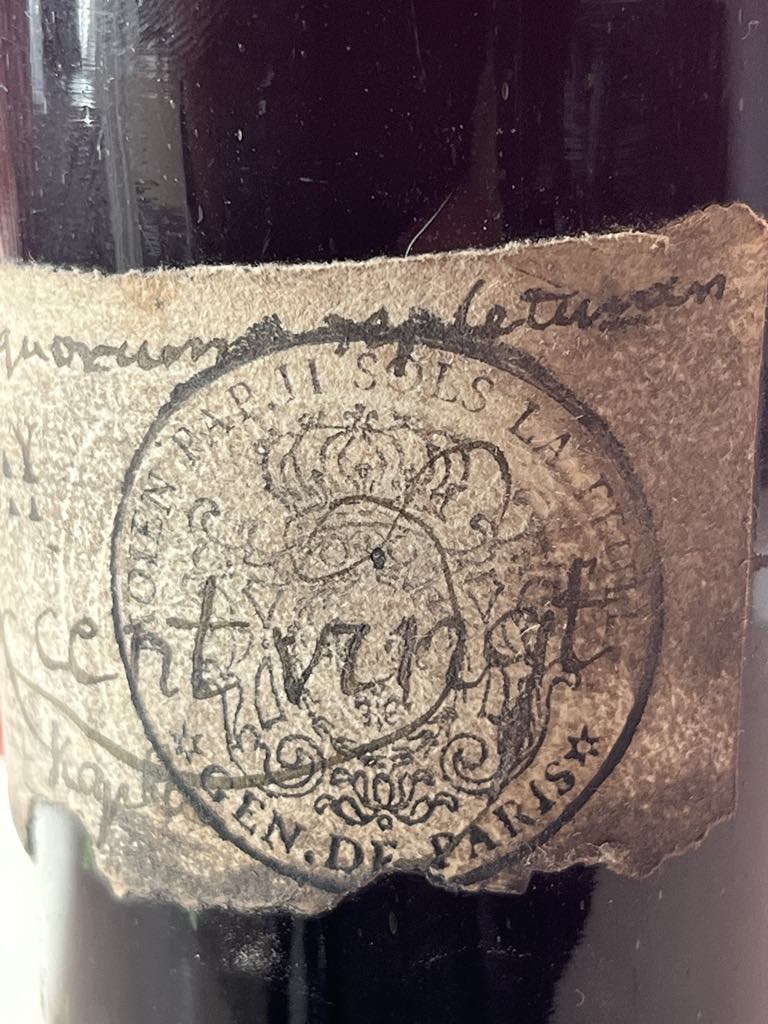
A small bottle of about 4 dl, mounted in gilt silver at the neck and on the foot, and carrying its whole history on paper, wax and metal: vintage 1620 — so given in the document of the 1853 Potocki auction — refilled in 1715, label of about 1714, from the cellar of Michal Fuckier.
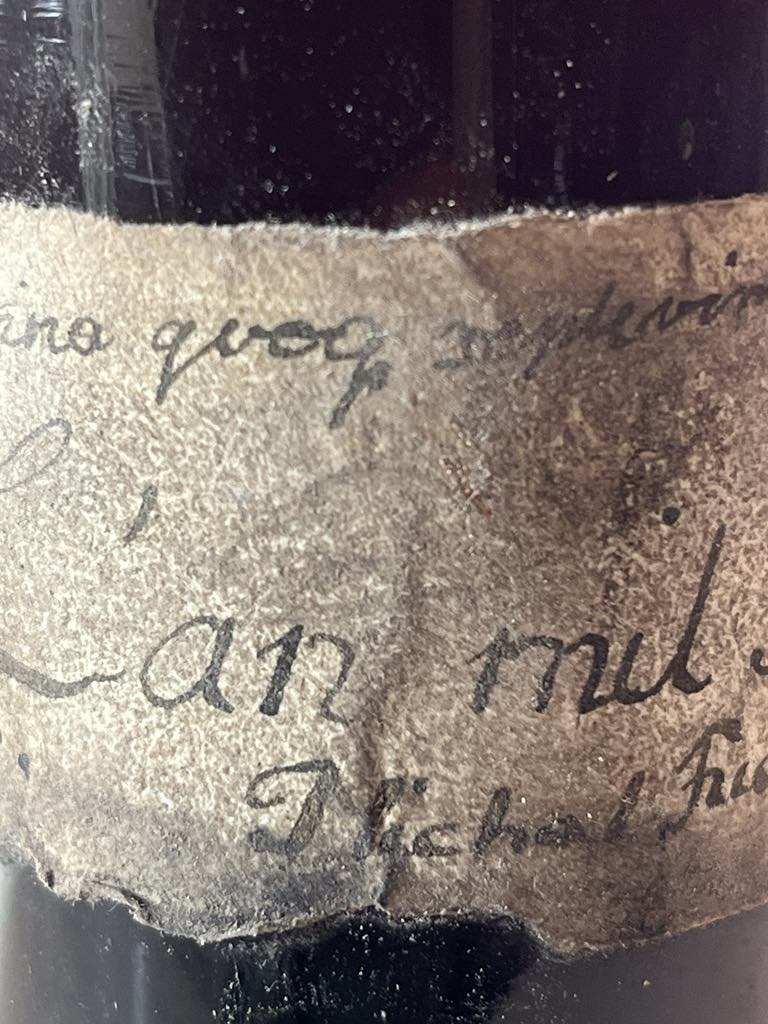
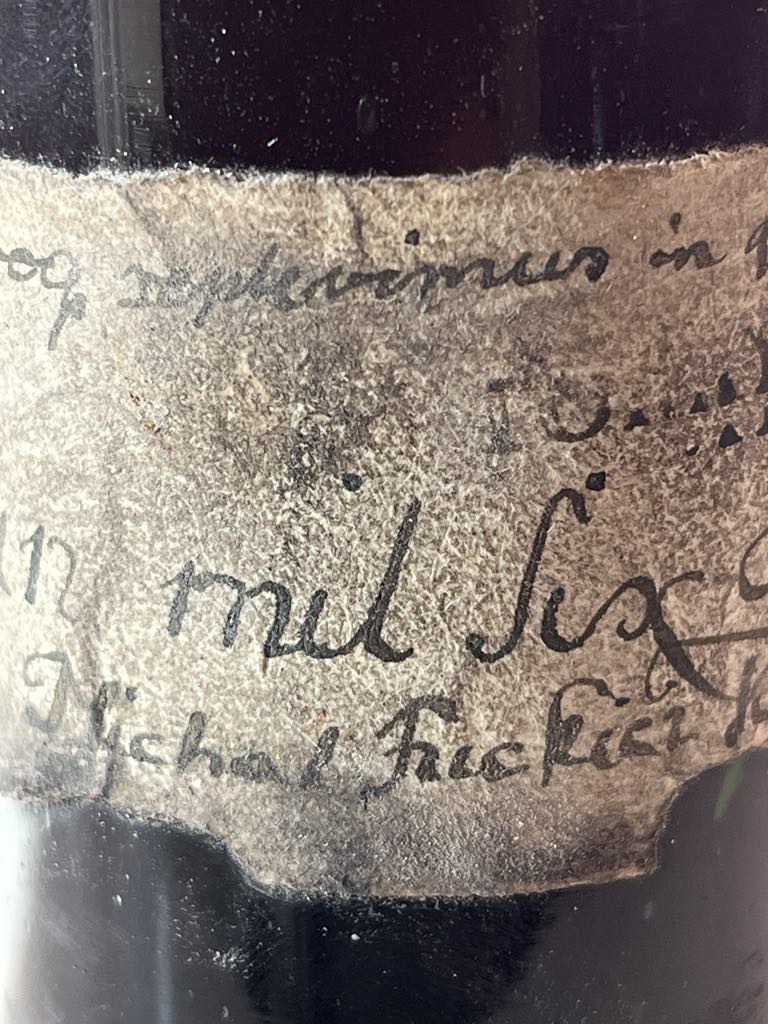
The label. Upper left, in Latin: 1715 vina quoq replevimus in quorum repleturam efluxere — we refilled the wines, into whose refilling they ran out, or words to that effect. The timbre stamp of the paper is of about 1714, and reads …par II sols la feuille … gén. de Paris. In French: L’AN MIL SIX CENT VINGT — the year 1620. Below it 1826, and below that MICHAL FUCKIER KAPKA. Above the French inscription, a TOKAY stamp.
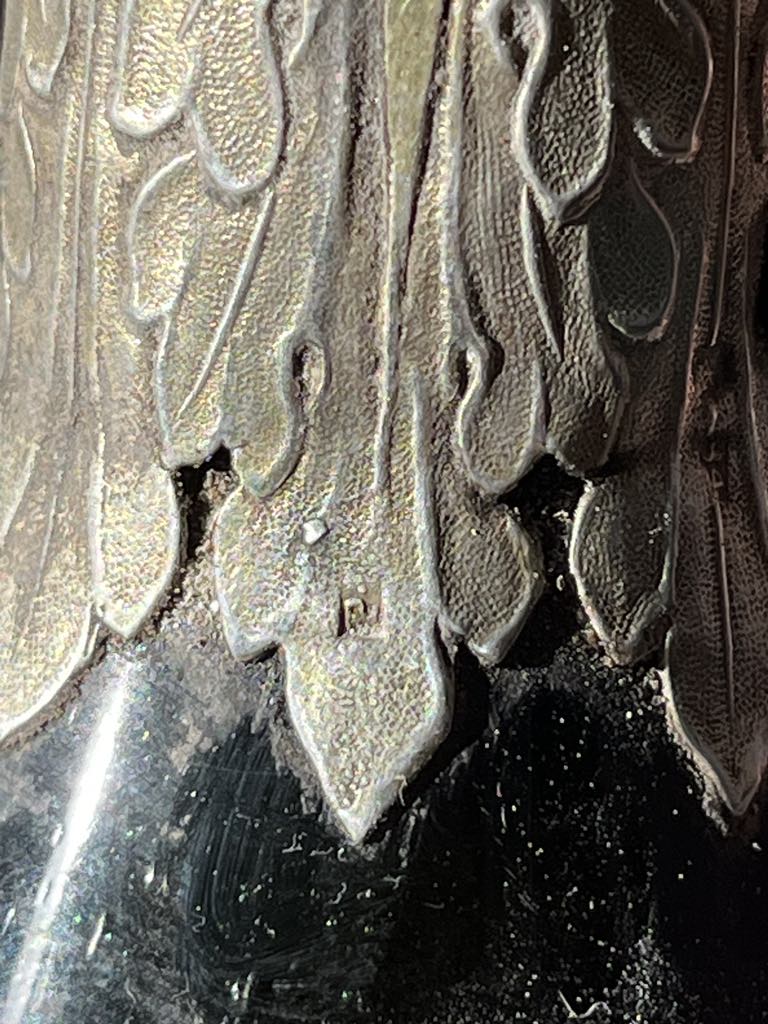
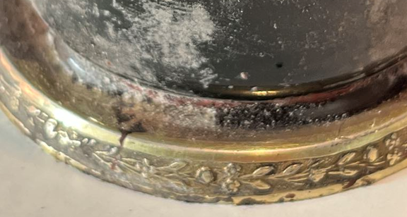
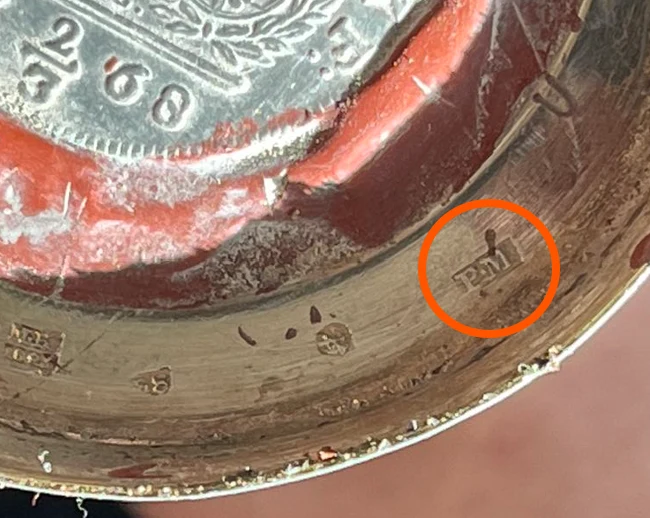
The silver neck. Gilt silver leaves, struck 84 for the silver standard and with the tsarist round assay mark; on another leaf PM — Piotr Müller, goldsmith to the Russian court.
The foot. A gilt silver foot was waxed to the base of the bottle. It has been repaired: it is re-fixed with a plastic-based adhesive. Struck into the underside: M.K 1826 — Mikhail Karpinski, tsarist goldsmith, in 1826 — with 84, the tsarist assay mark, and PM again.
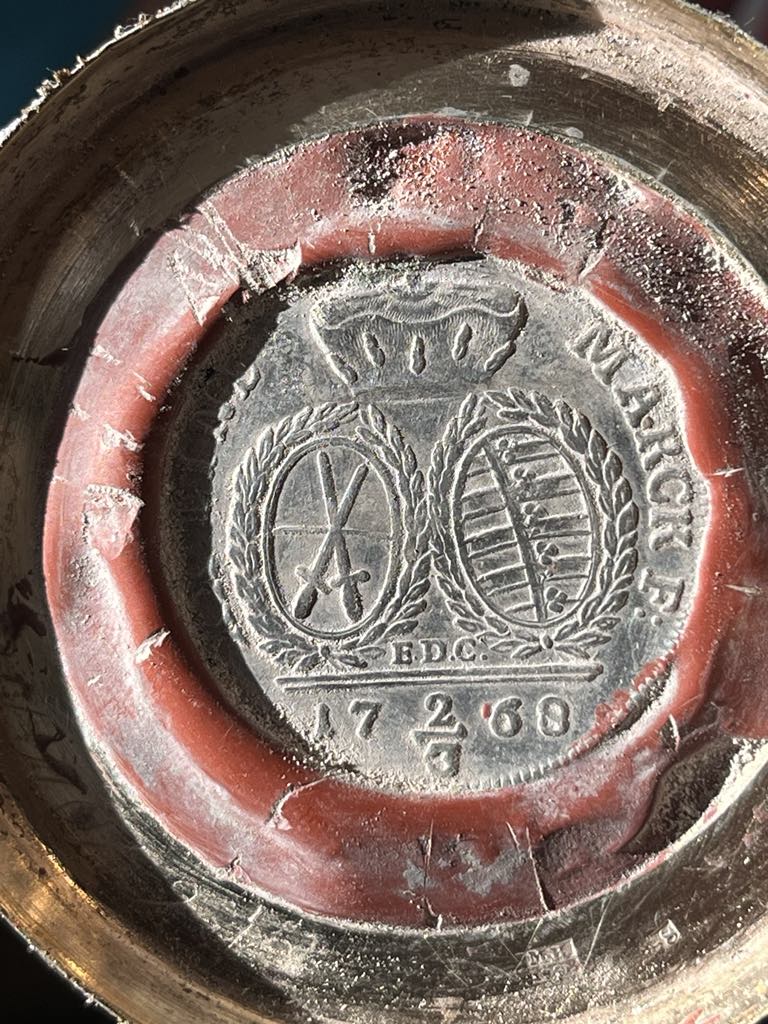
The coin. Set into the silver foot, a coin of 1768 bearing the Saxon arms, waxed in place.
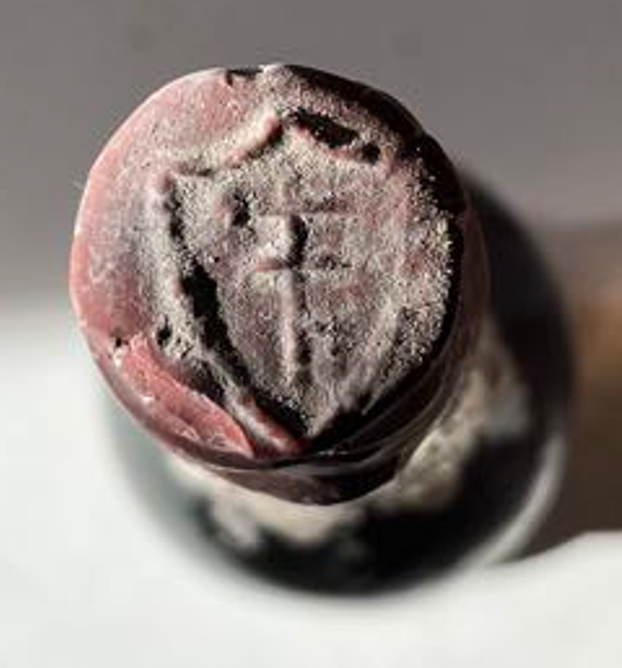
The wax. On top of the wax over the cork, the Pilawa arms — the arms of the Potocki family.
The dates on the object stand in a legible order: the vintage of 1620, carried by the 1853 auction document; the refilling recorded in 1715 on paper stamped about a year earlier; and the silver of 1826, by which time the bottle was being dressed as a treasure rather than stored as wine.
There is more background on this decorated bottle and on its connection to the Russian empire — the court goldsmiths, the assay marks and the route by which a Warsaw cellar bottle came to be mounted in St Petersburg silver — and it will be set out here.
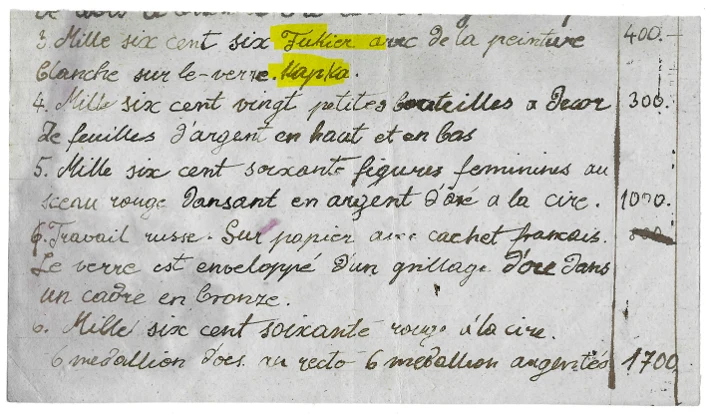
The document of the 1853 Potocki auction, entries 3 to 6. Point 4, highlighted, is this bottle; point 3 above it is the 1606 Fukier with the white paint on the glass, and point 5 the 1660 with the dancing female figures in gilt silver over the red wax.
Point 4, transcribed and translated
“4. Mille six cent vingt. Petites bouteilles à décor de feuilles d’argent en haut et en bas — 300.”
“4. Sixteen hundred and twenty. Small bottles with a decoration of silver leaves at the top and at the bottom — 300.”
The 1620 bottle — the label with the Latin refilling note, the French year and the Paris timbre; the gilt silver neck and foot with the PM and M.K marks; the Pilawa arms in the wax; and the 1768 Saxon thaler waxed into the foot. Click any image to enlarge.
1646
1646 Bottle
The Australian wine authority Len Evans (1930–2006) bought this bottle at Christie’s in London in 1977 for £300. He described the taste as “extremely rich and of incredible intensity and complexity”, and wrote to me that two large tears came to his eyes as he thought about everything that had happened since the wine was made.
How the bottle was identified as Tokaji, I do not know, and it remains unclear what evidence Christie’s had to authenticate the bottle and its vintage.
A Fukier bottle carrying the cellar shelf-section label. Click any image to enlarge.
1646
1646 Imperial Tokay (the Guinness record)
A second bottle of the 1646 vintage, and the one that holds a record: according to Guinness World Records it is the oldest wine ever sold at auction.
The record, as published
“The oldest bottle of wine to have been sold at auction was a bottle of 1646 Imperial Tokay, which was bought by John A. Chunko of Princeton, New Jersey, USA and Jay Walker of Ridgefield, Connecticut, USA for SFr 1250 (£405) including buyers premium at Sothebys, Geneva, Switzerland on 16 Nov 1984.”
Vintage and style. 1646, catalogued as Imperial Tokay.
Sale. Sotheby’s, Geneva, 16 November 1984.
Price. SFr 1,250, given as £405, buyer’s premium included.
Buyers. John A. Chunko of Princeton, New Jersey, and Jay Walker of Ridgefield, Connecticut.
No photograph
I have contacted both Sotheby’s and the buyers of the bottle for a photograph of it, without success. If anyone holds an image of this bottle, or of the 1984 catalogue entry, I would be glad to hear from them.
1652
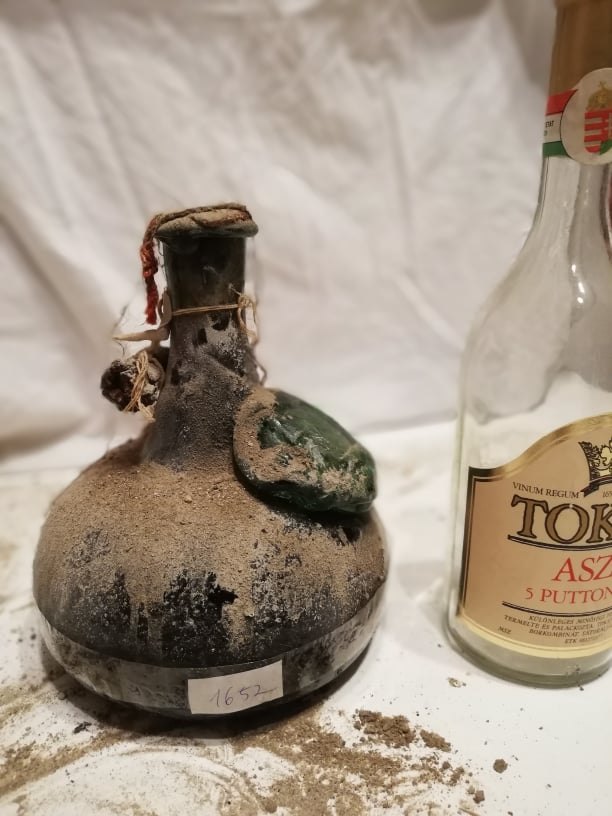
Three 1652 bottles from the Fukier cellar
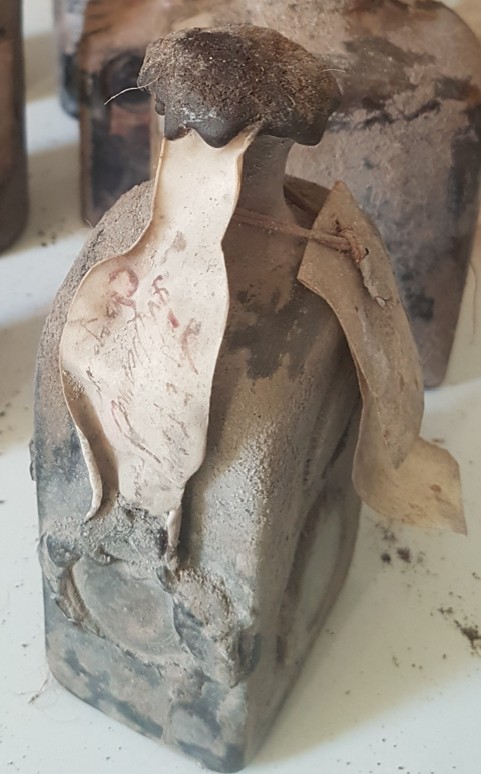
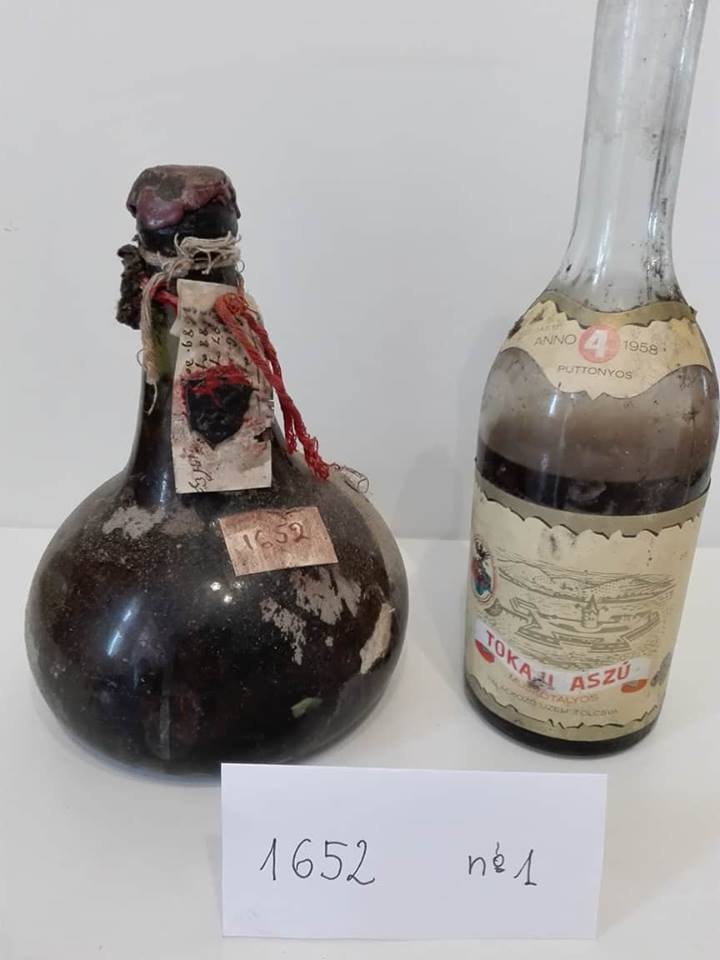
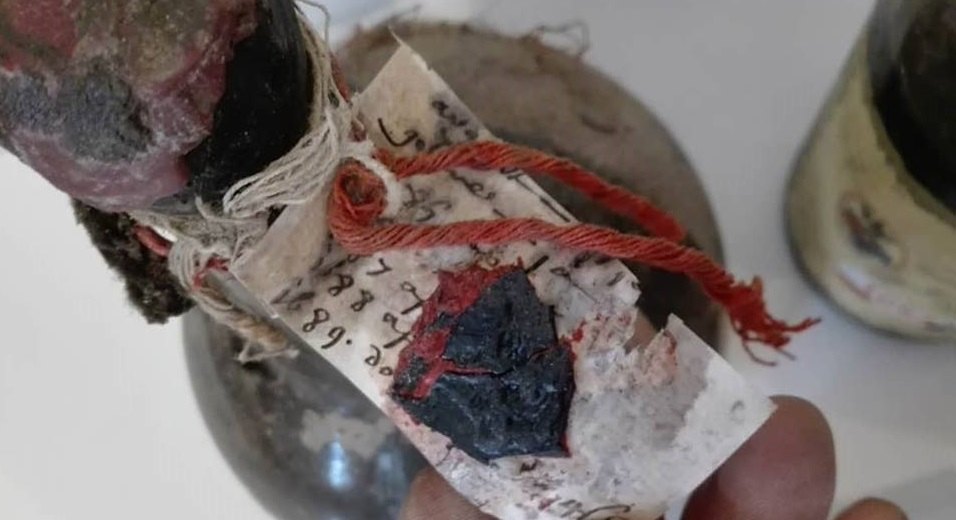
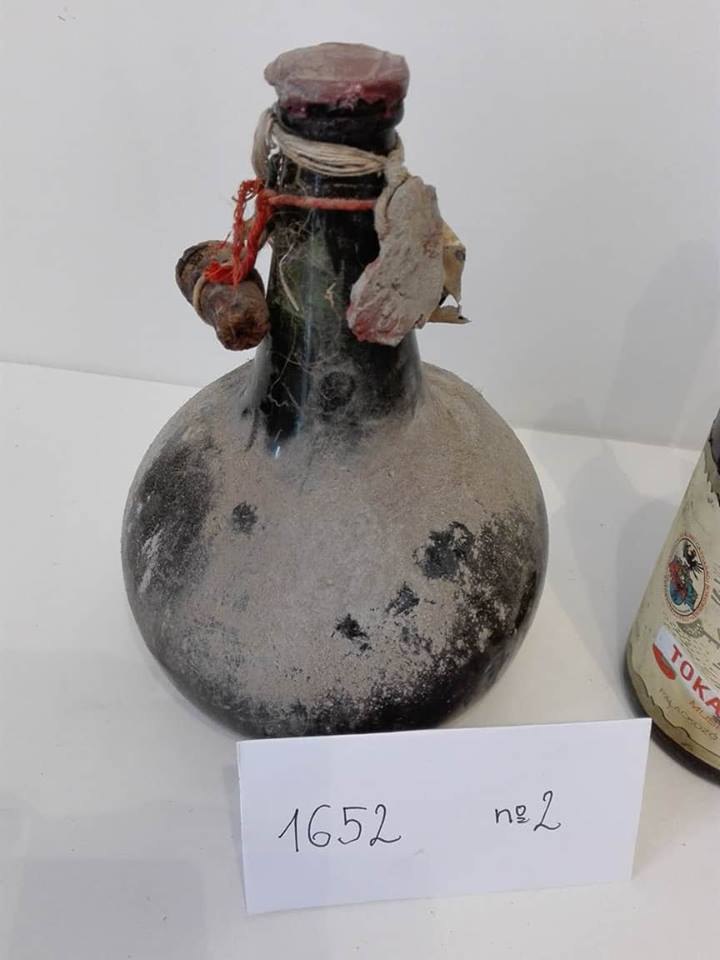
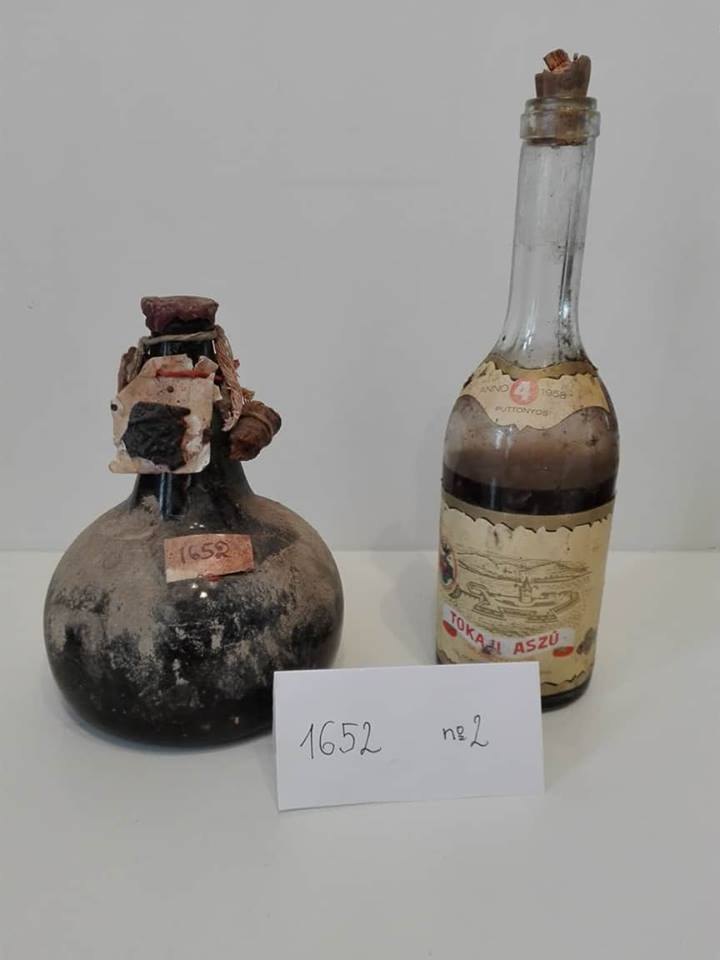
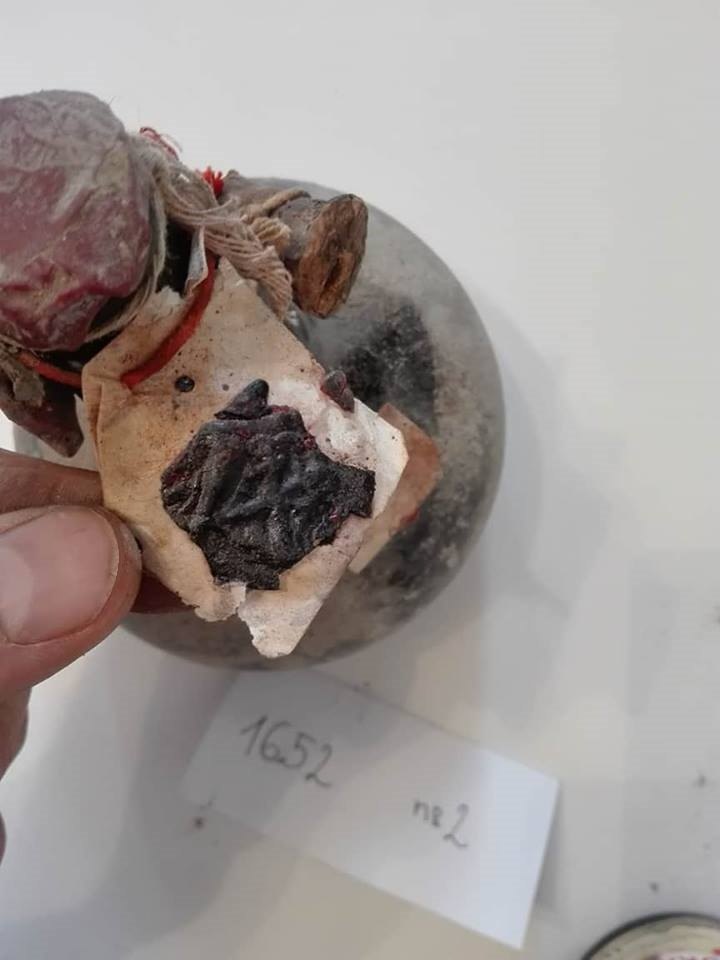
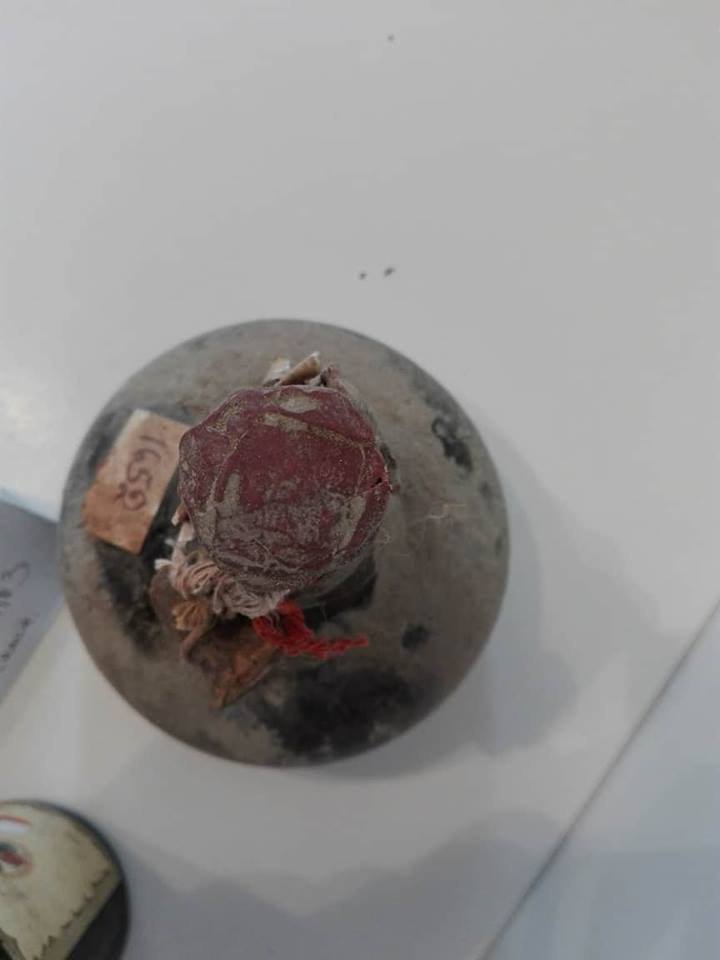
Three bottles of the 1652 vintage from the Fukier cellar are known, numbered here 1 to 3 as they were photographed. All three are hand-blown onion-shaped bottles, sealed with wax over a cloth or leather cap and bound at the neck with hemp cord and a red silk thread. Each carries a paper tag written in ink with cellar numbers, closed with a black wax seal, and a small pasted paper label reading 1652.
The three are close enough in glass, closure, cord and labelling to have come from one cellar and one bottling campaign. Bottles 1 and 2 are full; bottle 3 differs in one important respect, discussed below.
Bottle 1
Bottle no. 1, shown beside a 1958 four-puttonyos Tokaji Aszú for scale. The tag detail shows the inked cellar numbers, the black wax seal and the red silk thread · click any image to enlarge
The tag is the most legible of the three. Under the ink numbers a second, older set of figures shows through, which is consistent with a bottle that was re-inventoried at least once during its time in the cellar.
Bottle 2
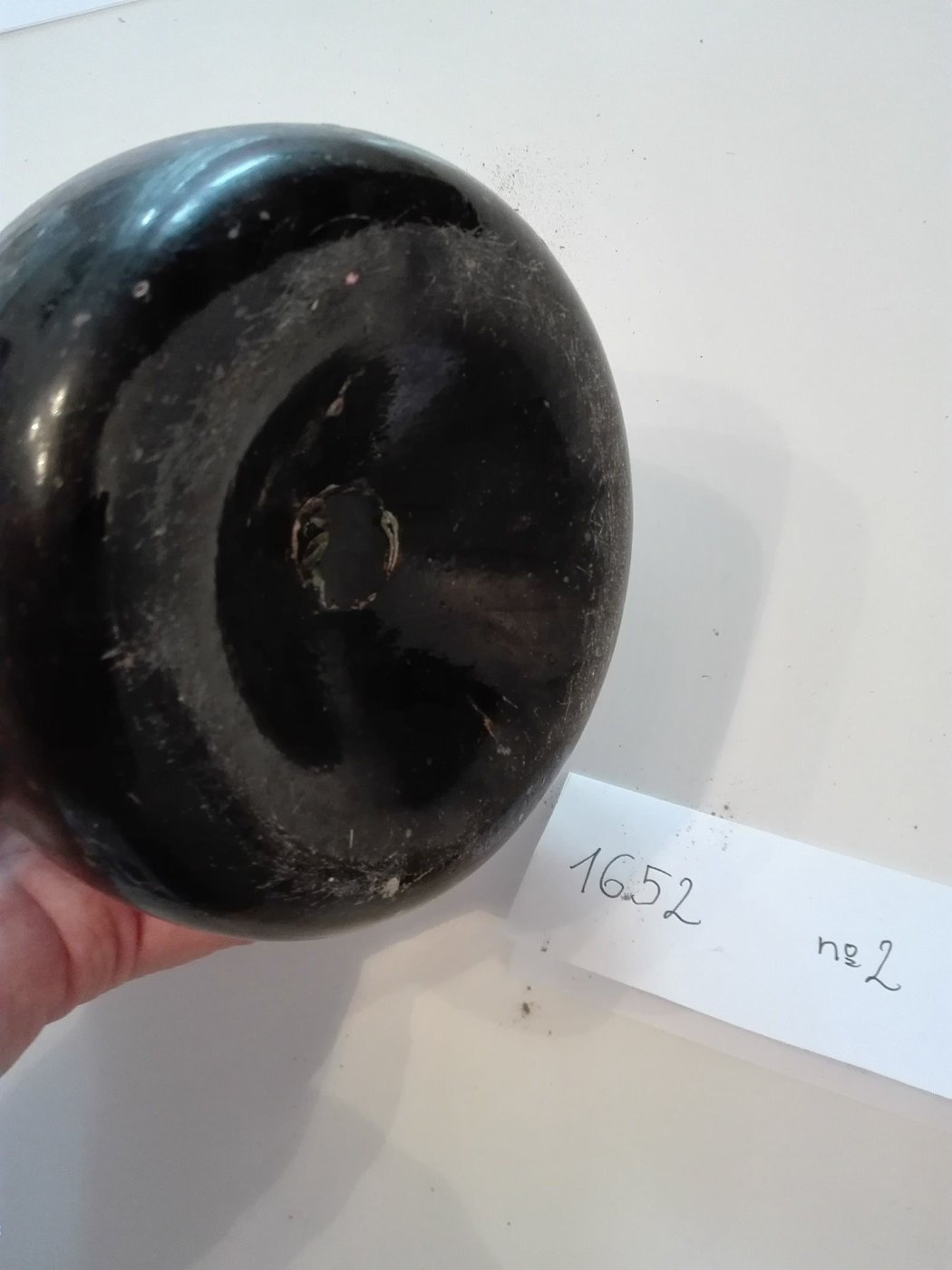
Bottle no. 2. The body is heavily encrusted with cellar deposit; the wax capsule, the sealed tag and the deep kick-up in the base are all intact · click any image to enlarge
The base shows the deep kick-up and rough pontil scar of free-blown seventeenth-century glass. The wax capsule is unbroken and the tag still hangs on its original cord.
Bottle 3, and a glass seal
Bottle no. 3. Same closure and cord, same pasted 1652 label — but with an applied glass seal on the shoulder, which the other two bottles do not have · click any image to enlarge
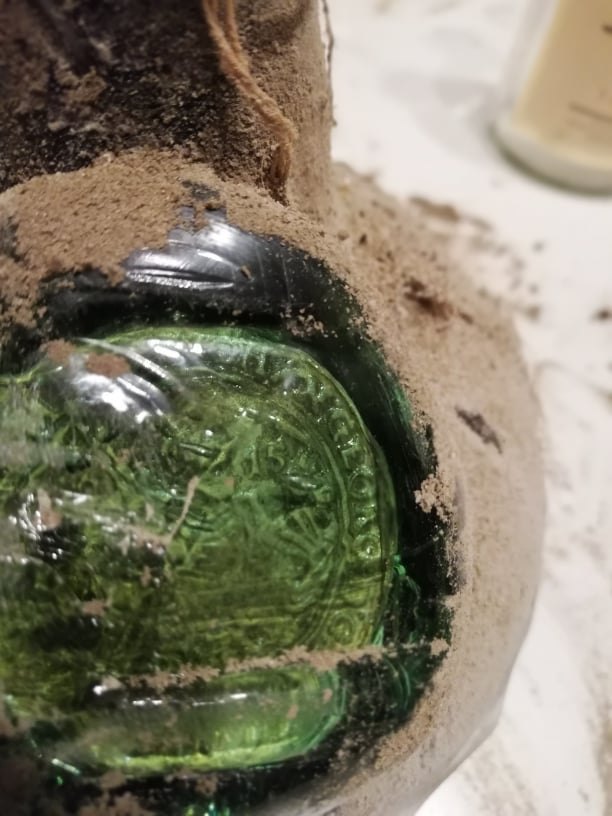
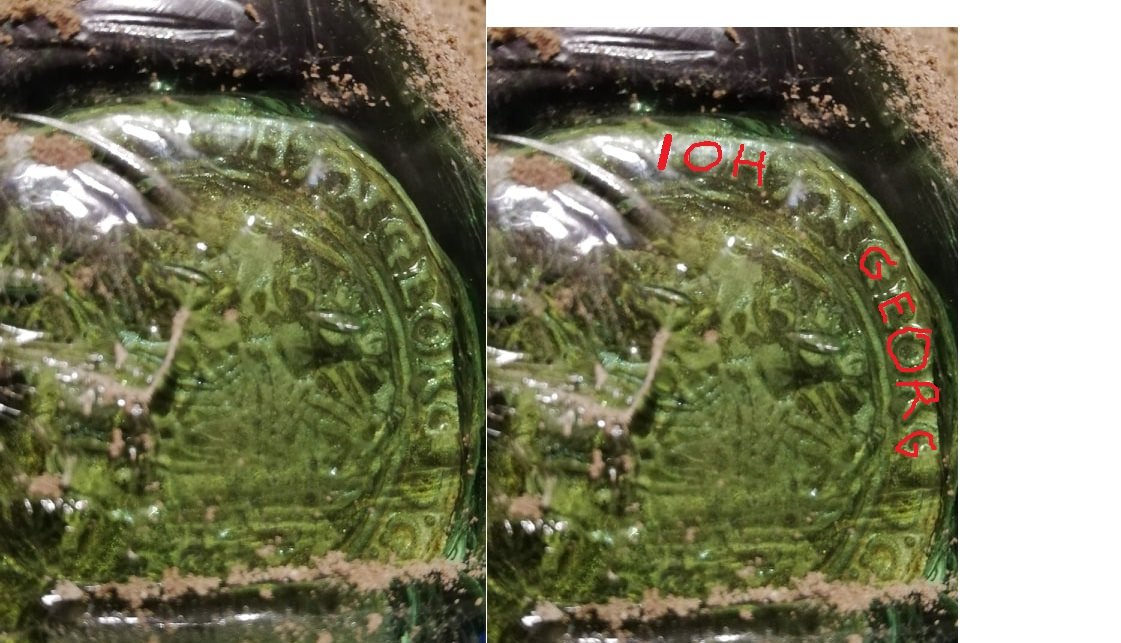
Bottle 3 shares the closure, the cord and the pasted 1652 label, but carries something the other two do not: an applied glass seal on the shoulder, pressed into the still-hot glass from a metal die. The seal shows a bust in profile within a legible circular legend.
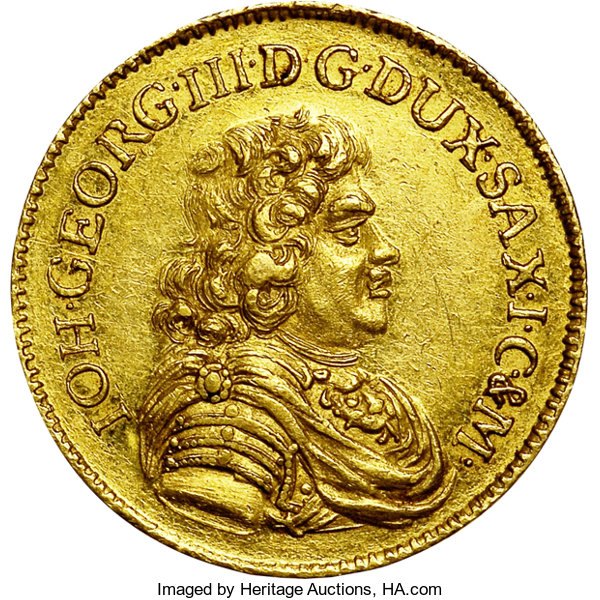
Left: the seal with the legible letters traced. Right: a gold ducat of Johann Georg II of Saxony, whose legend runs IOH·GEORG·II·D·G·DUX·SAX (image: Heritage Auctions) · click any image to enlarge
Traced out, the legend reads IOH … GEORG, and the arrangement of bust and circular inscription follows the pattern of Saxon coinage of the period closely enough that the die may well have been cut from a coin or after one.
An open question about the date
If the name on the seal is Johann Georg II of Saxony, then it postdates the vintage: he became Elector in 1656, four years after 1652. That is not in itself an objection — bottles were commonly filled long after the harvest, and the Dresden court is known to have bottled Tokaji decades into barrel age. But it does mean the glass cannot be older than the wine it holds, and the seal should be read as evidence of when and by whom the bottle was filled, not of the vintage. The reading is also not yet secure: only part of the legend is legible, and Johann Georg I, III and IV all carry the same first two names.
To settle
Your text for this article: the provenance chain for each of the three bottles, the cellar numbers as transcribed from the tags, current ownership, and whether the seal has been examined against a dated die. Send it and I will replace this placeholder commentary with your own.
1663
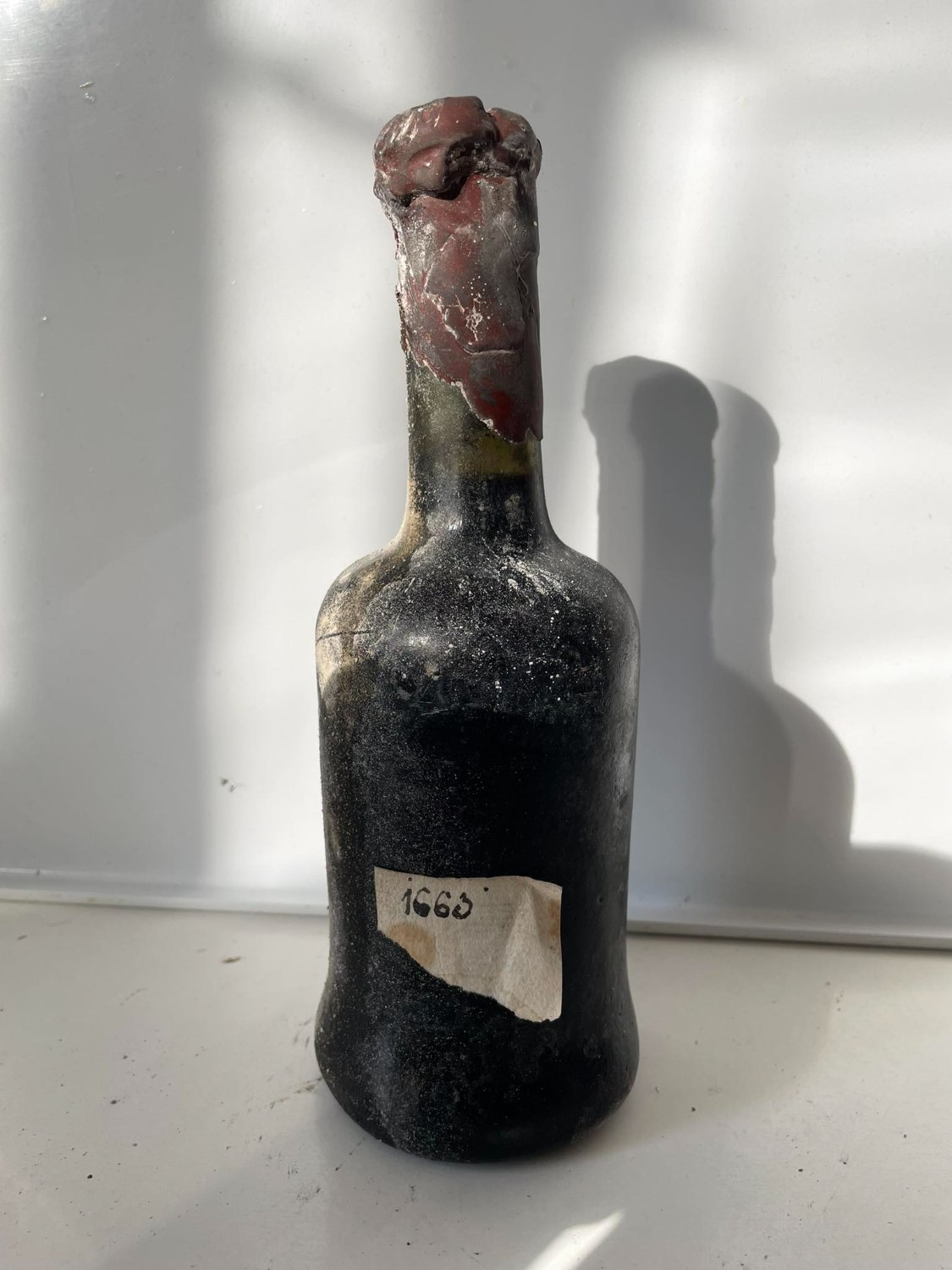
1663 Esterházy Bottle
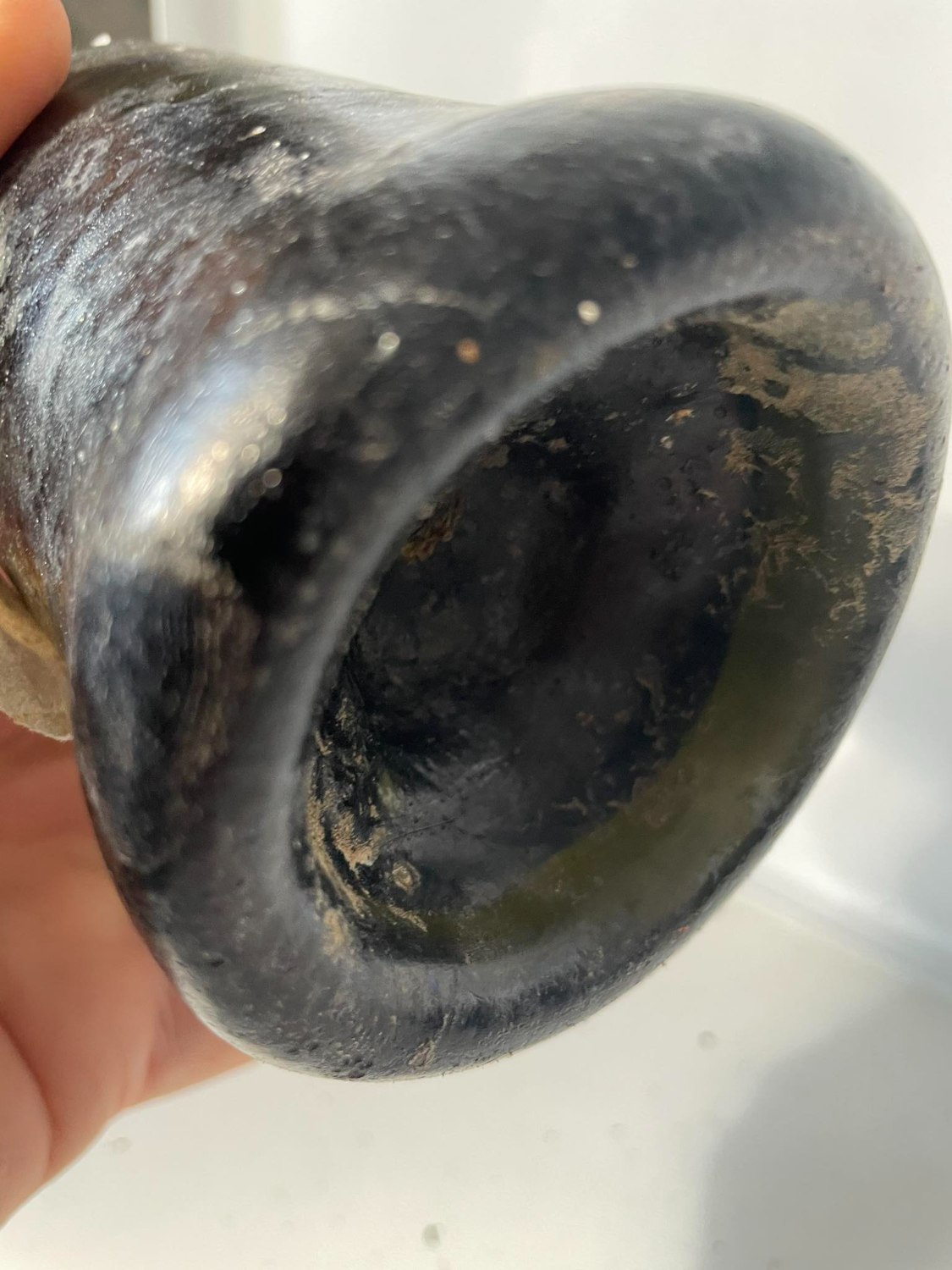
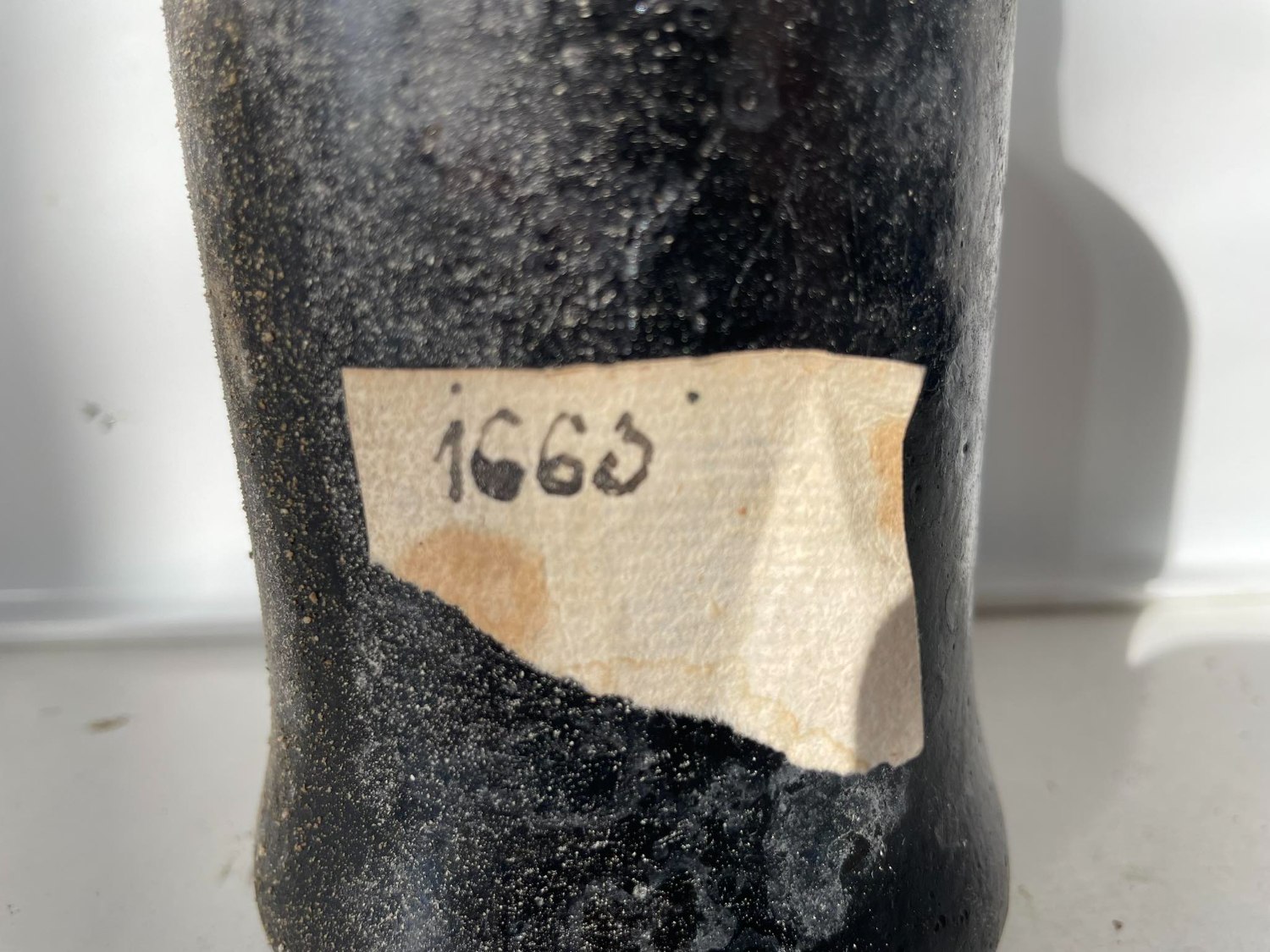
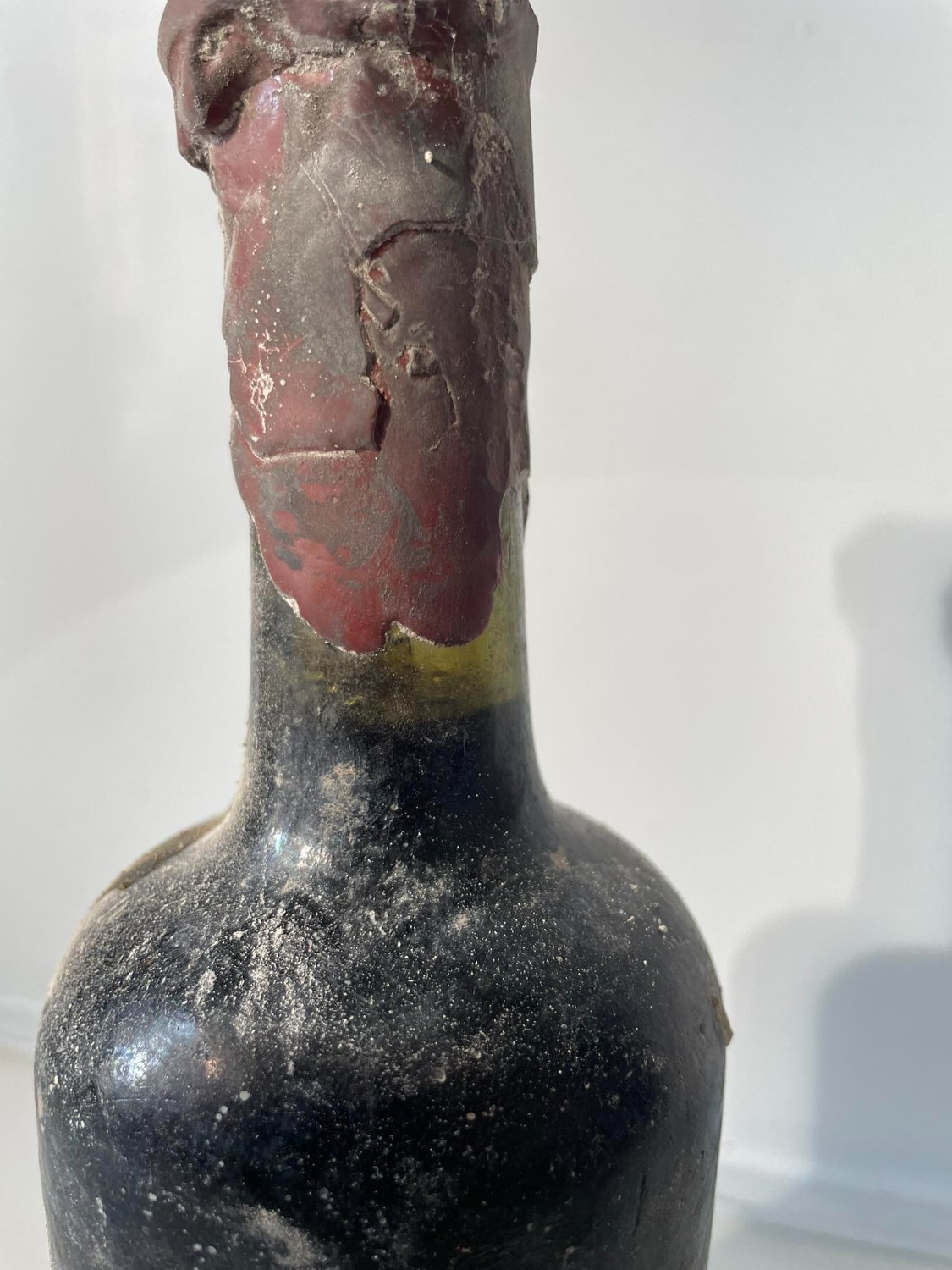
A squat, thick-walled black glass bottle with a deep kick-up, sealed under red wax over the cork and a band of yellow wax at the base of the neck. The wax capsule carries an armorial seal, and a small paper strip on the body bears the hand-written year 1663.
The bottle form is consistent with the period: mould-blown, uneven in the shoulder, with the heavy pontil-marked base typical of seventeenth-century cellar bottles. The glass surface carries a fine white bloom from long storage.
The bottle, the wax capsule and its armorial seal, the paper vintage strip, and the deep kick-up in the base · click any image to enlarge
To settle before publication
The bottle is described from the photographs only. Send me the provenance, the reading of the seal, and any archival reference and I will write them in.
1668
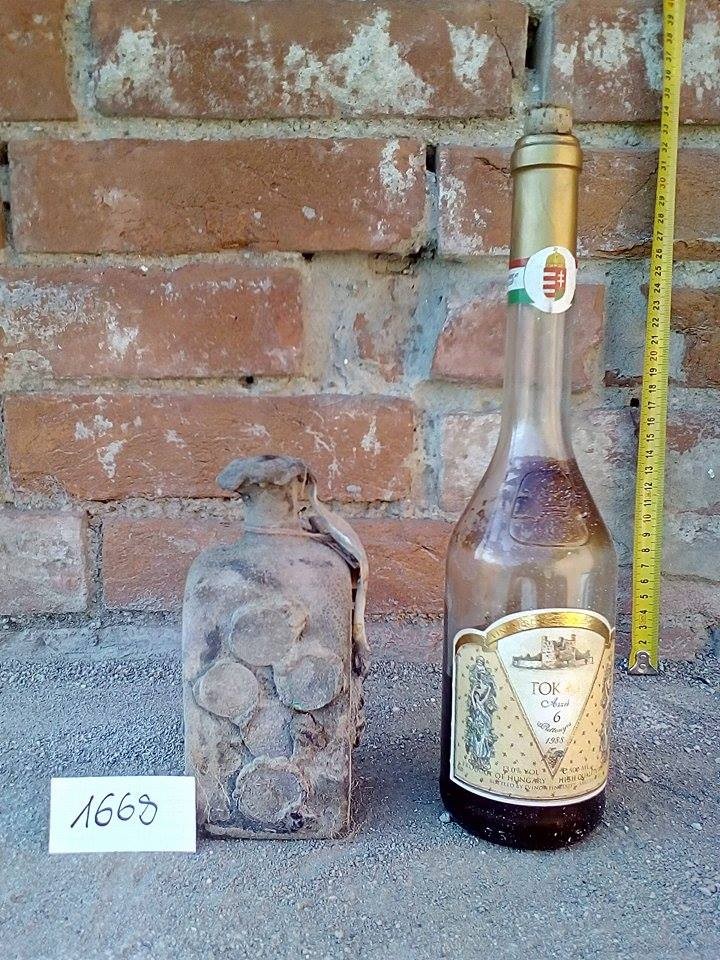
1668 Zamoyski Bottle
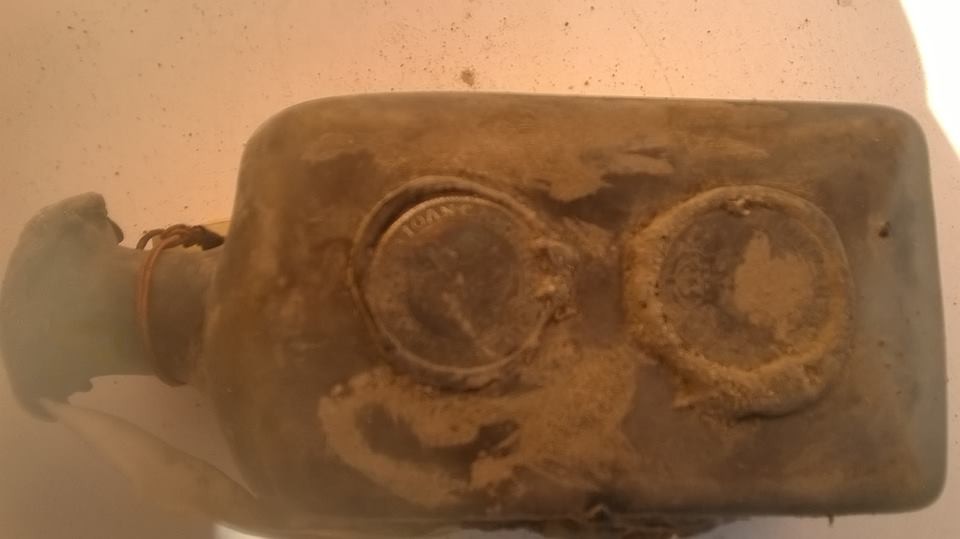
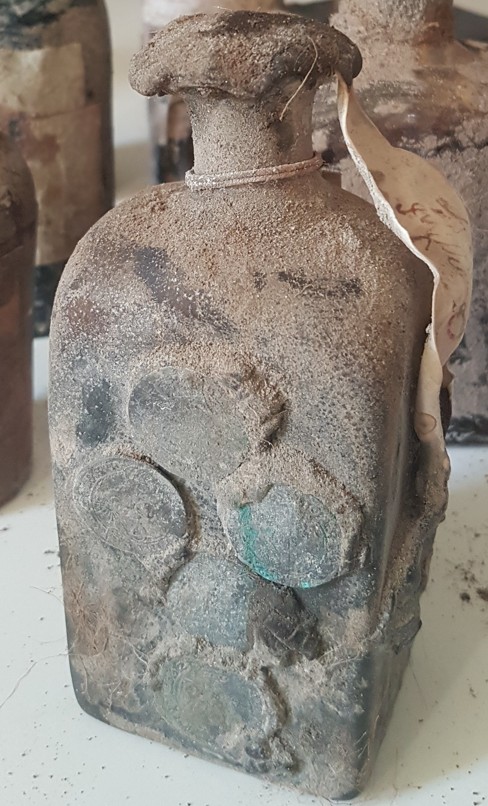
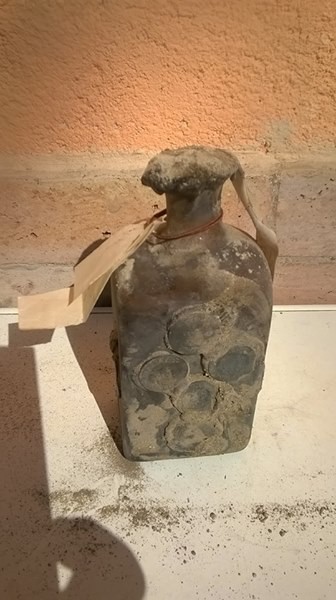
A square, coin-studded bottle whose markings point in three directions at once: Poland in the coins, Hungary in the handwriting, and England in a paper seal from Bath.
The coins in the glass, the bottle at scale, the neck strip and its inscriptions · click any image to enlarge
The coins
The silver coins on the bottle are from Poland (Joan Casimir, 1662 to 1667).
The inscriptions
A text on the bottle contains the year number 1931 and the Hungarian text “ZAMOYSKI ÁNGLIÁBÓL HOZVA”. (Zamoyski brought from England). Below the text is a paper seal (a crown) with the word “BATH”. We contacted the post museum in Bath and received the following answer:
“The fact that a machine was produced bearing the name BATH with possibly a crown on it which could be used to emboss items would seem to have come that from the19 th century Bath City Council.”
Another text on the bottle reads in latin: “Aszu szőllő borat.millesimo sexcentesimó sexagosimo octovo.” (= 1668)
The Zamoyski link
Jan Zamoyski was a Great Hetman of the Polish Crown, and this bottle is therefore directly linked to the Hetman Cellar collection mentioned on the Fukier pages (see also Fukier provenance).
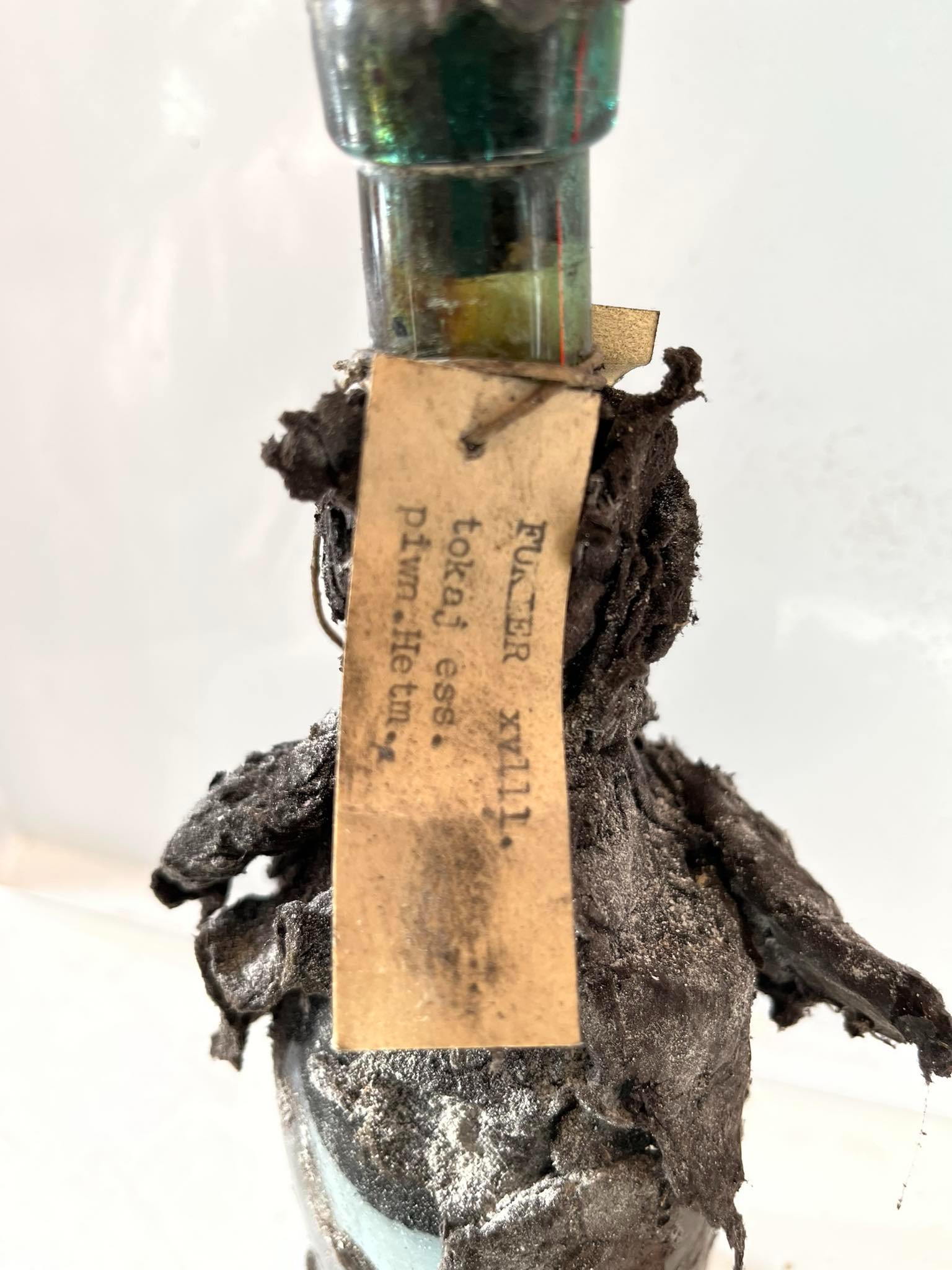
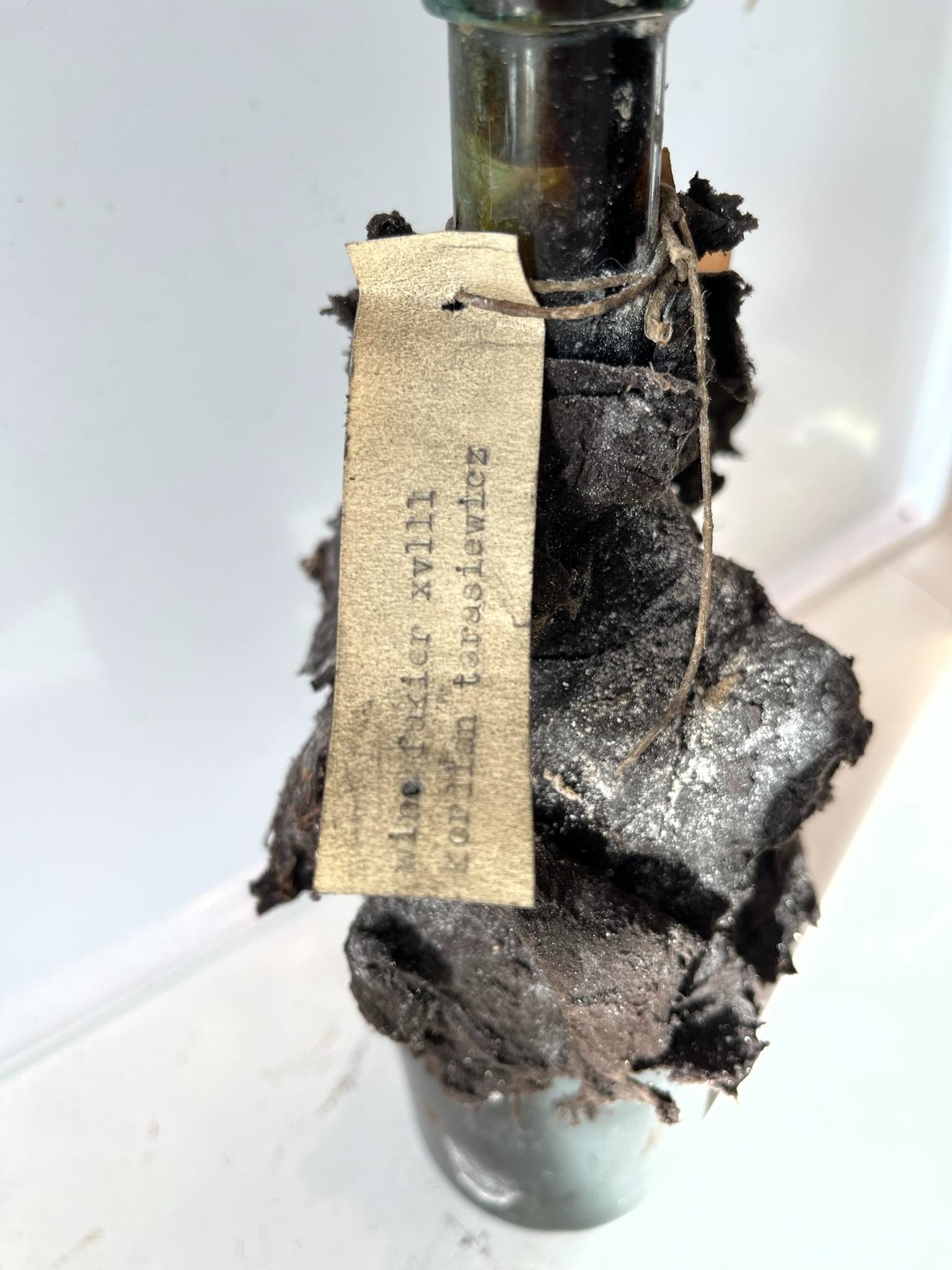
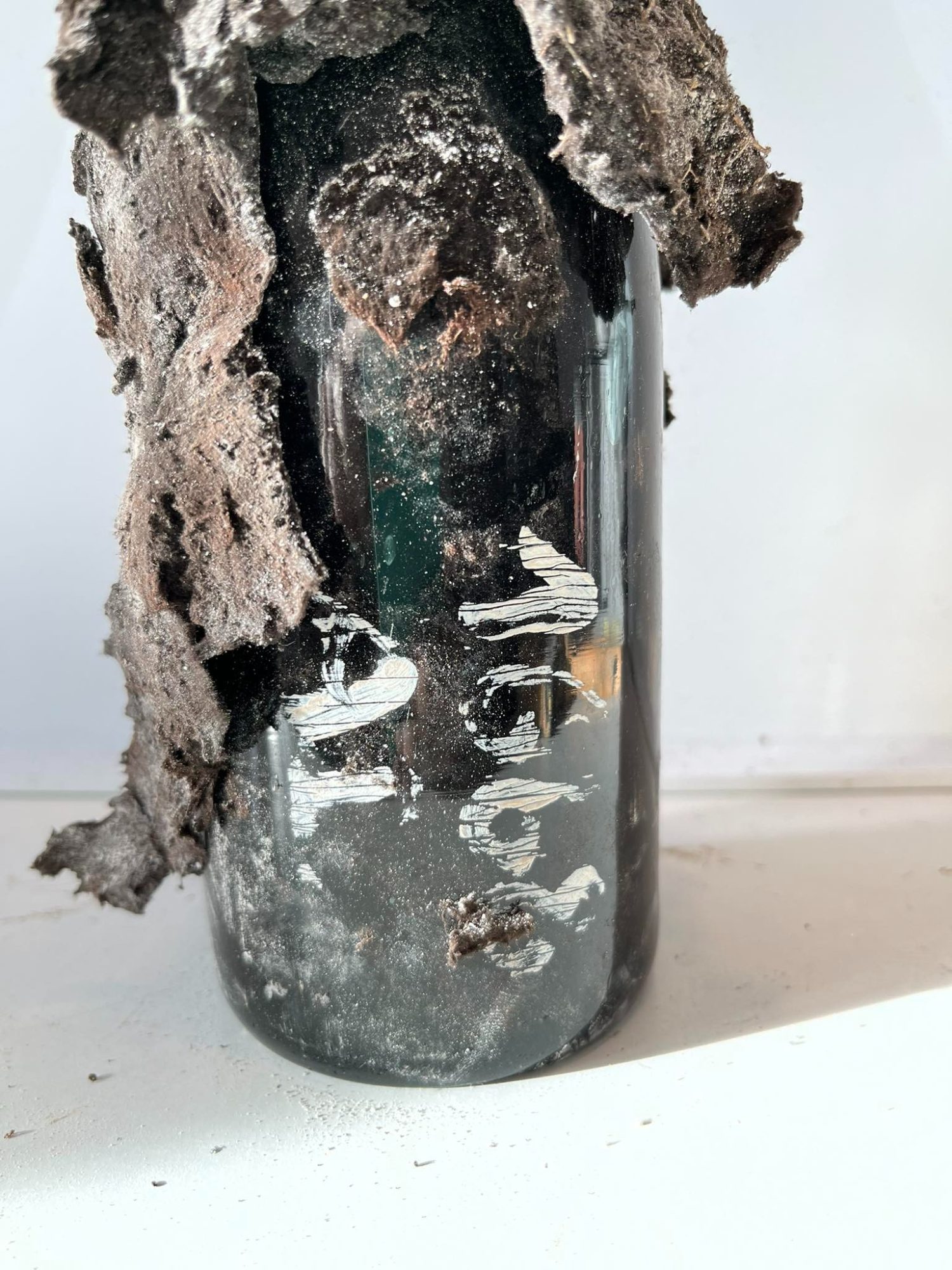
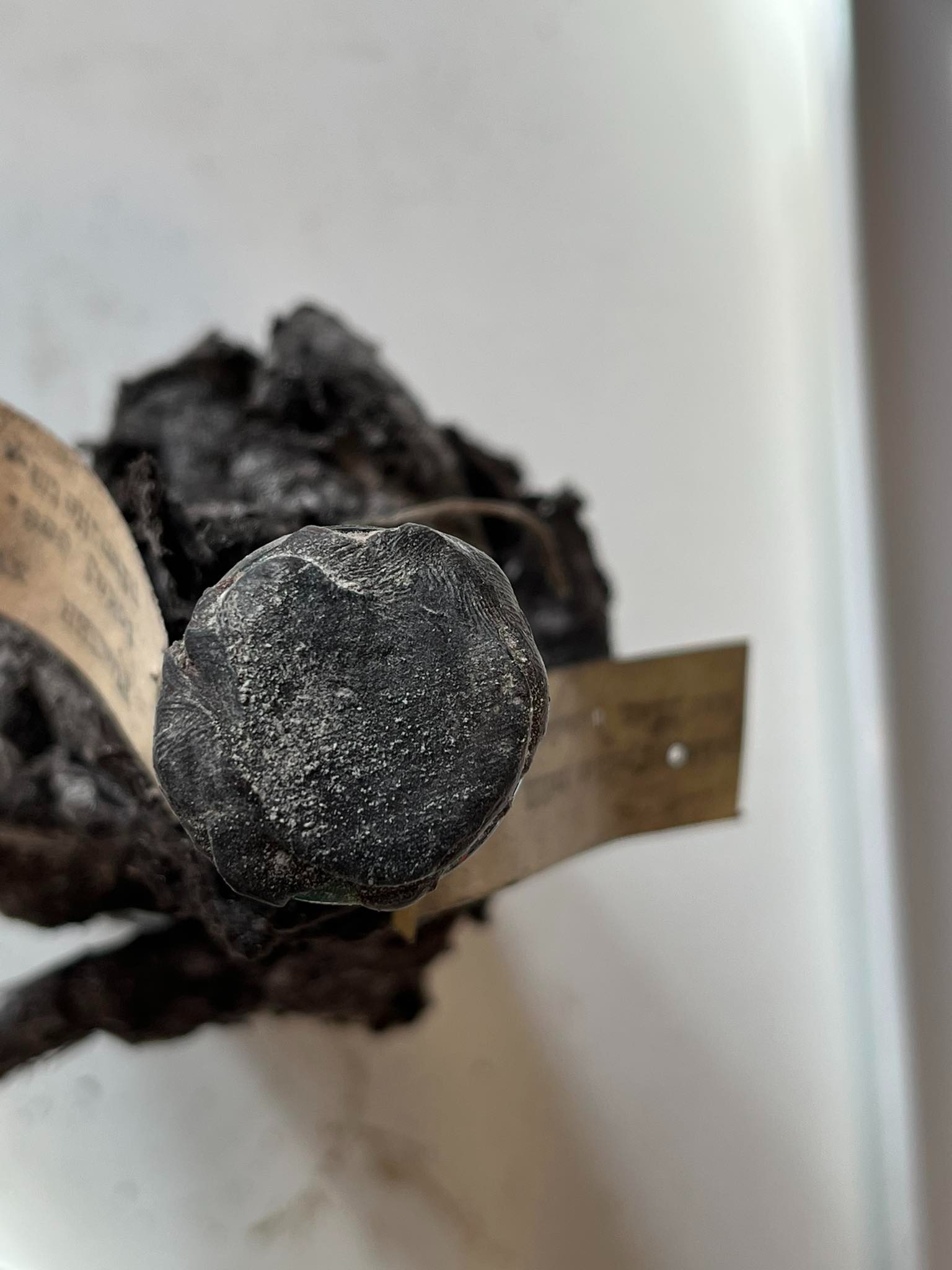
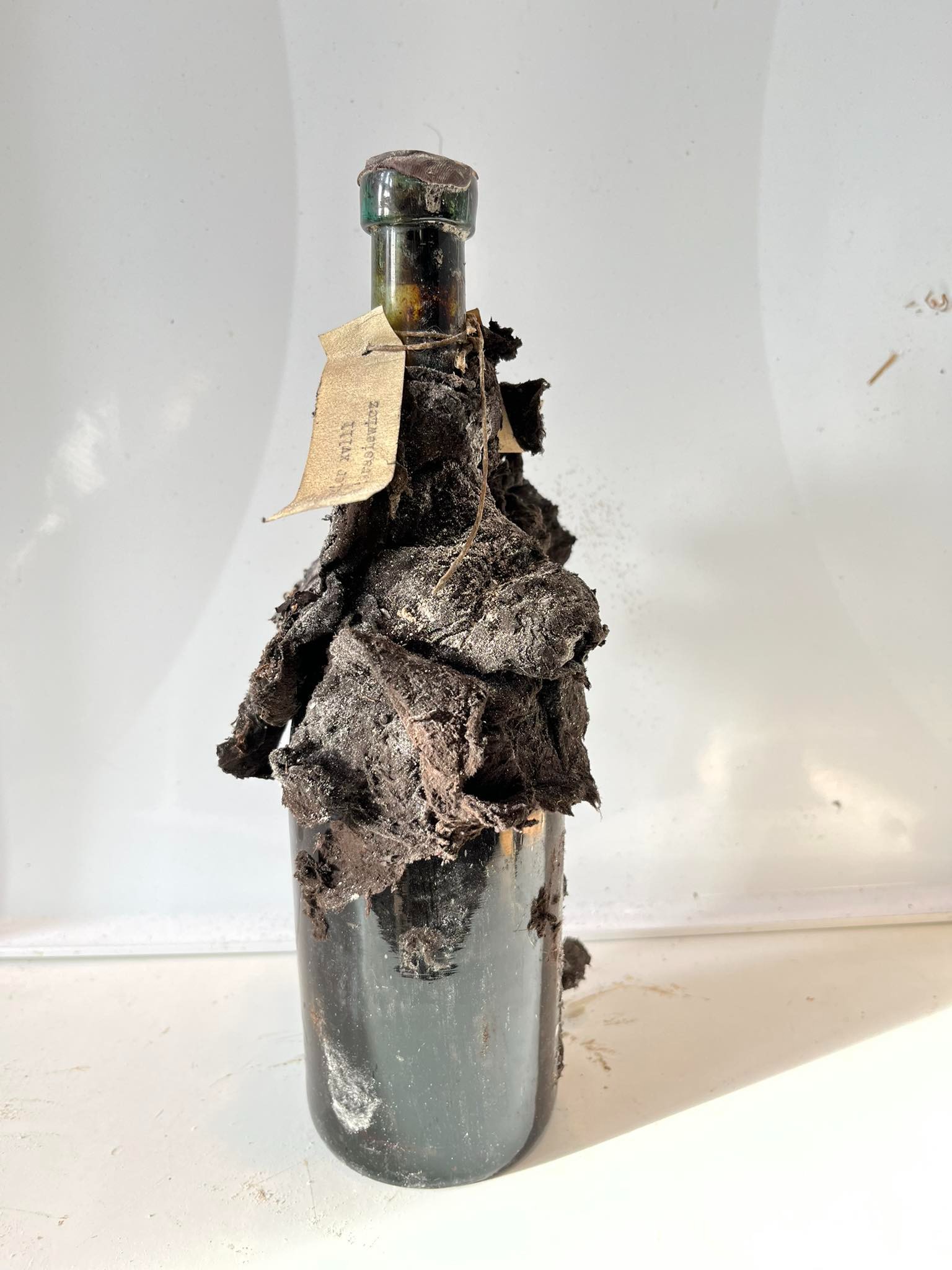
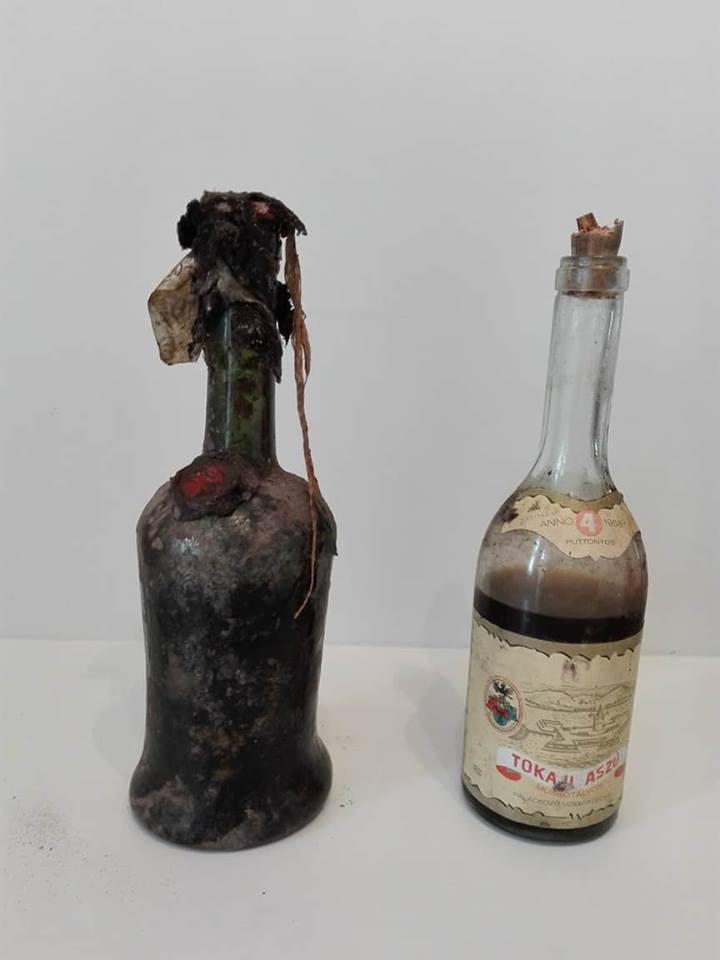
A cylindrical bottle in dark green glass, still carrying the heavy cellar dressing it came out with: layers of blackened, mould-encrusted paper wrapped over the shoulder, a wax-sealed cork, and two typewritten paper strips tied to the neck with cord. Where the wrapping has fallen away, the glass shows the smooth, slightly uneven surface of free-blown manufacture, with the deep sea-green tone visible against the light at the neck.
The bottle comes from the Hetman cellar of the Fukier house in Warsaw, the section of the cellar holding the oldest Tokaji, and according to the paper strips it was part of the Tarasiewicz collection.
The bottle as received, the two neck strips, the glass body and the sealed cork · click any image to enlarge
The paper strips
Two typewritten strips are tied to the neck. The first reads FUKIER xvlll. tokaj ess. piwn. Hetm. — Fukier, Tokaji essence, Hetman cellar. The second reads wino fukier xvlll korolin tarasiewicz, naming the Tarasiewicz collection. The Roman numeral on both strips was typed as a century indication rather than a vintage; the year of the wine itself is not given on the strips.
The dressing and the seal
The cork is capped with a dark sealing compound, worn but unbroken, and the shoulder is wrapped in several layers of paper that have blackened and grown a fine white bloom over decades of cellar humidity. A thin brass tag sits under the cord at the neck, the kind used in the Fukier cellar to mark bins and individual bottles.
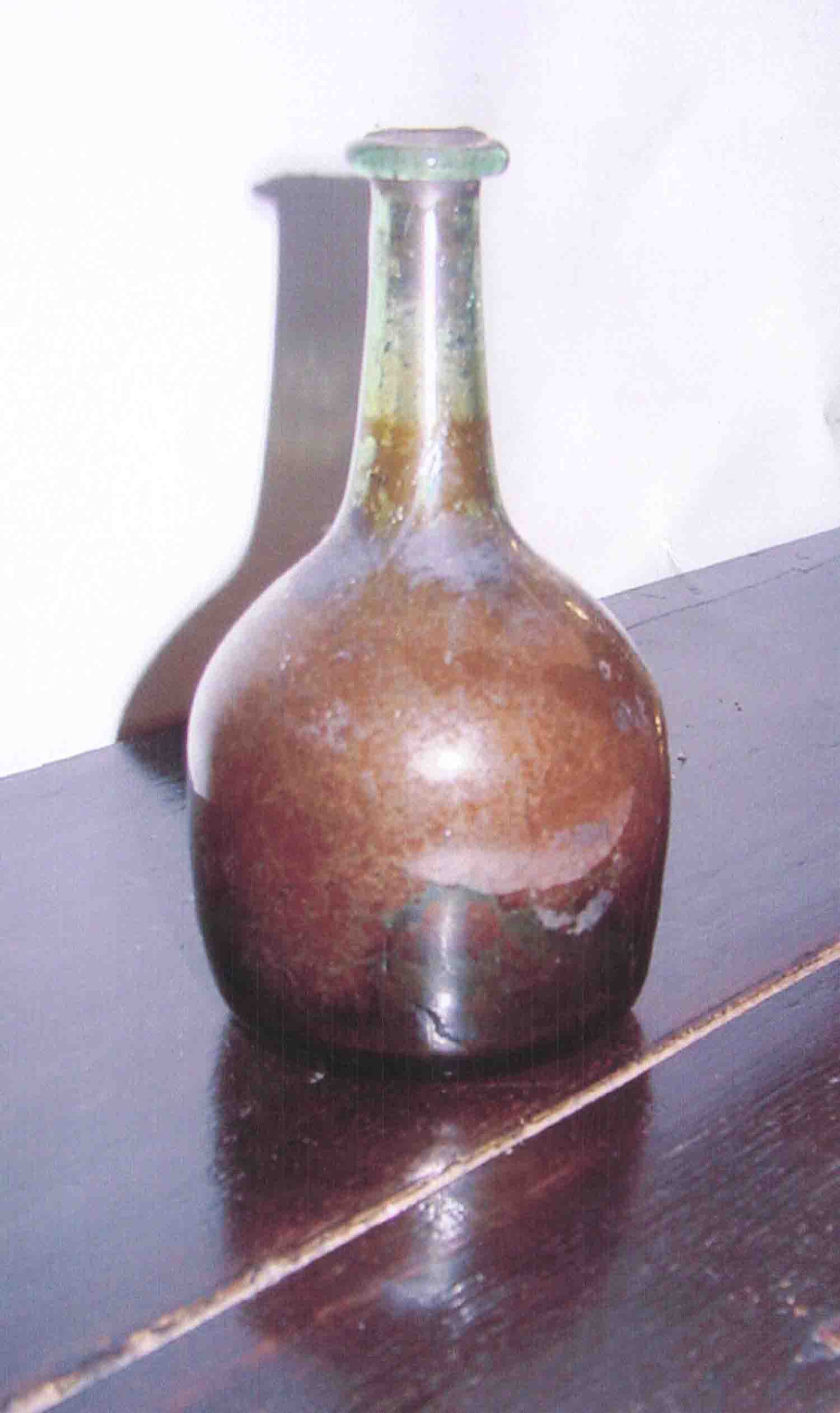
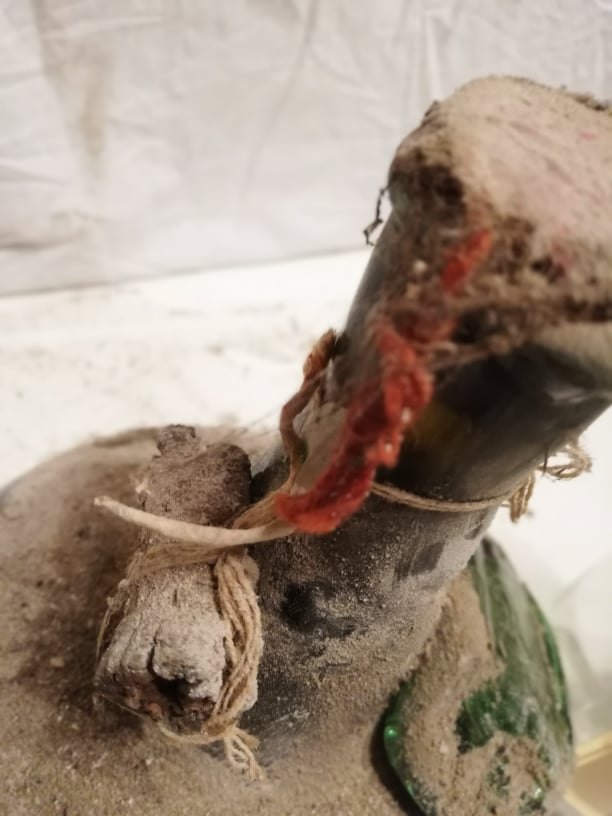
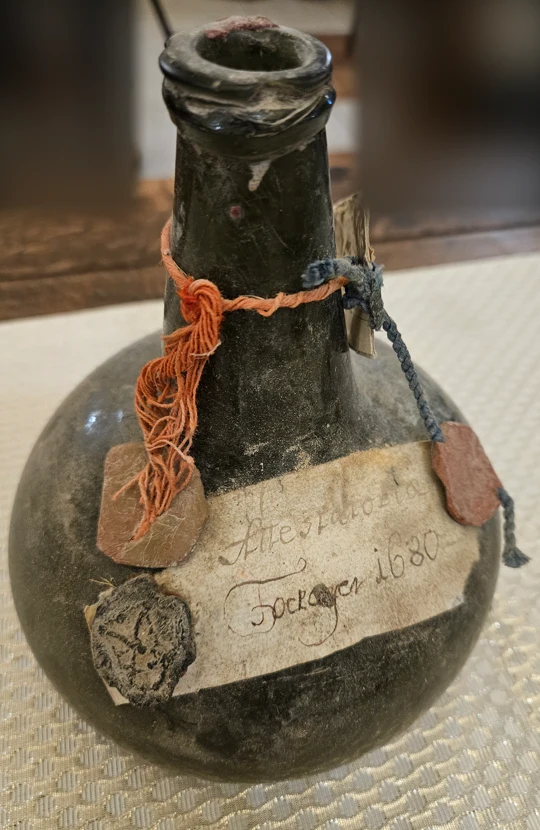
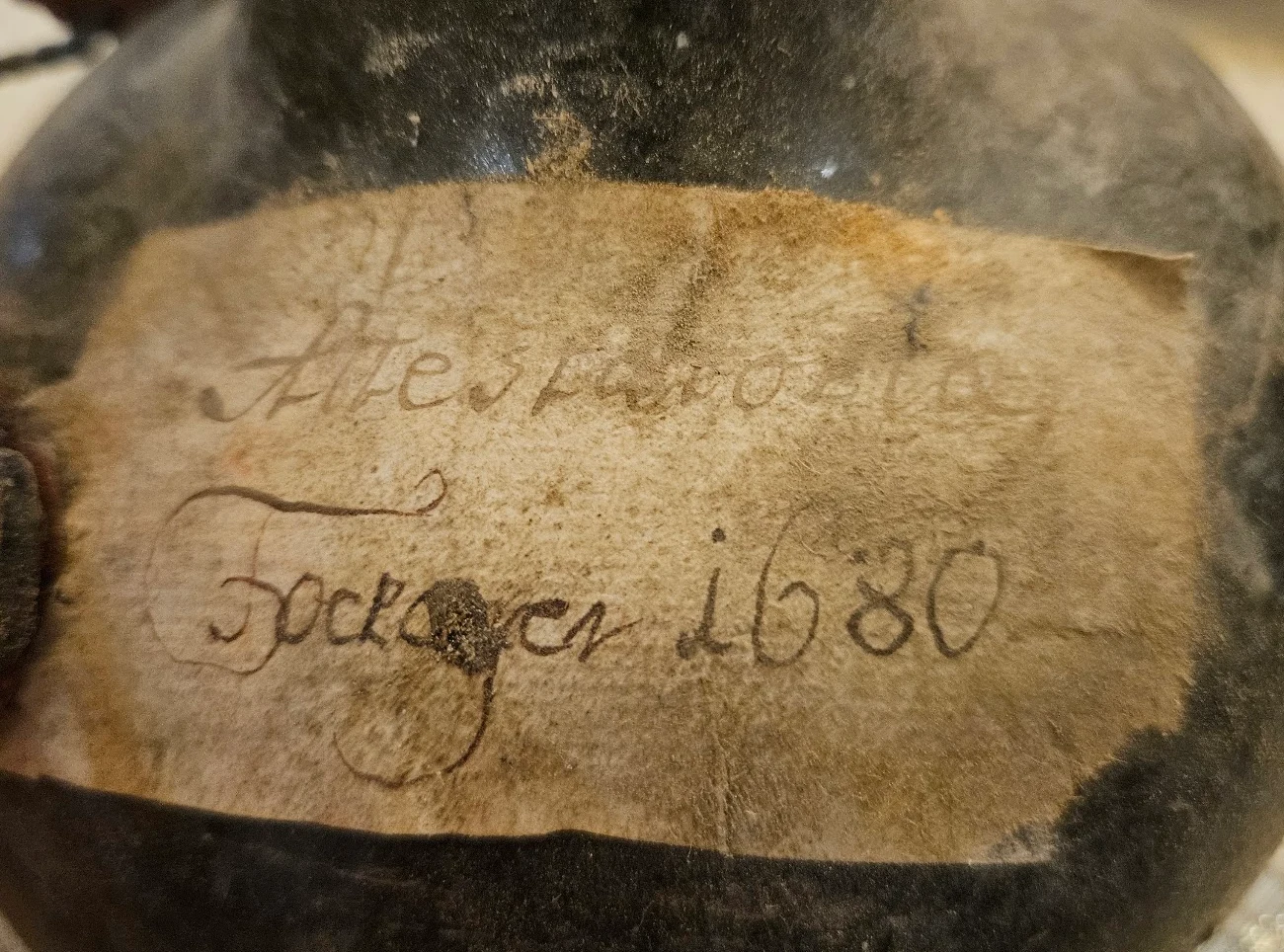
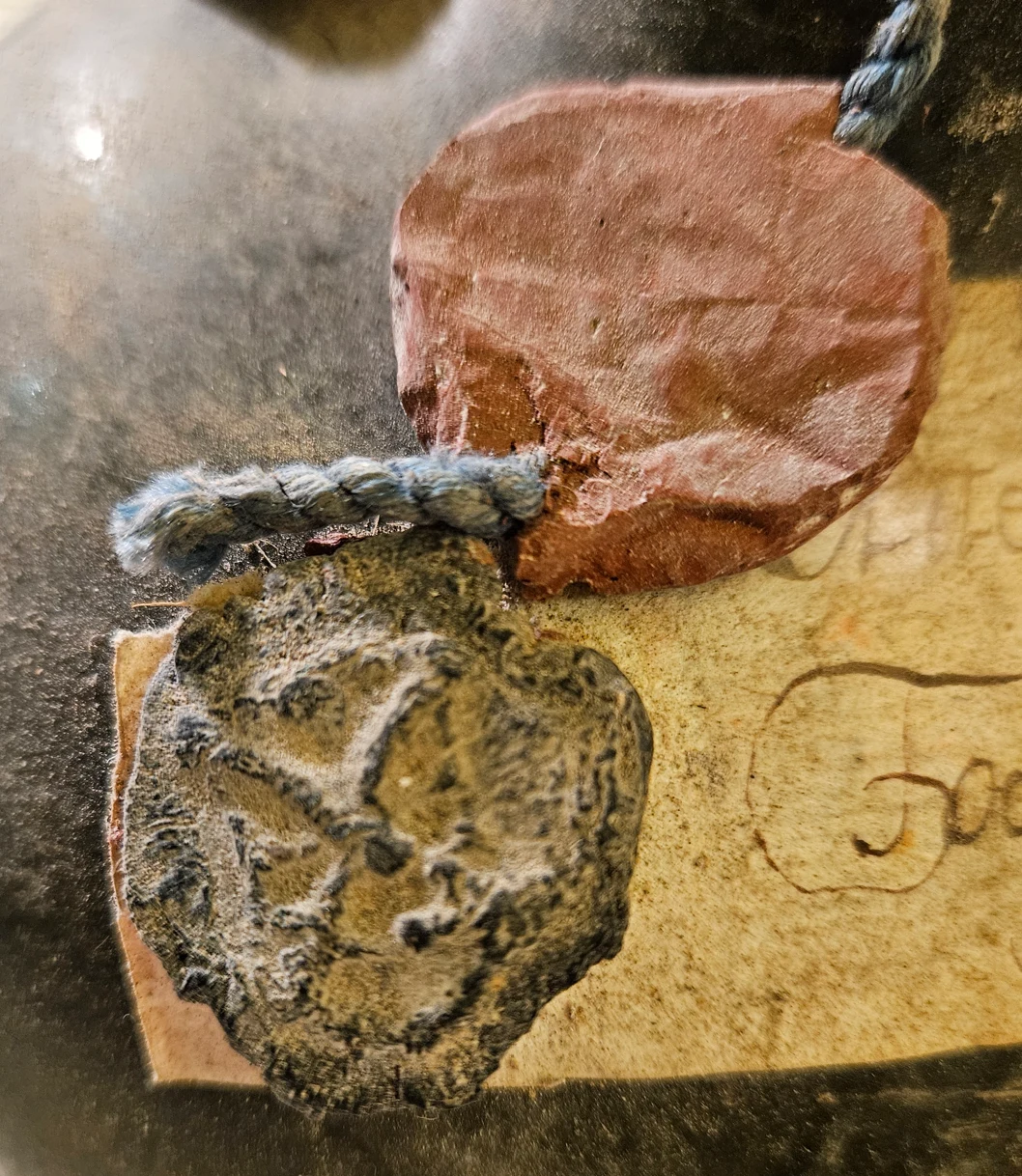
An empty shaft-and-globe bottle in near-black glass, with a parchment label in a German hand, three wax seals on the shoulder and two cords still tied at the neck. Everything on it points away from Poland and Hungary and towards Dresden.
The bottle, the label and the dark seal. In the full view the background above the table has been blurred and darkened, so that the room the photograph was taken in does not compete with the object; the bottle itself, the label and the seal are unretouched. Author’s collection. Click any image to enlarge.
The form
A globular body on a short foot with a long tapering neck and a heavy applied string rim — the shaft-and-globe or onion form, the standard European wine bottle of roughly 1650 to 1700. On the form alone the glass is right for the date on the label, which is not something that can be said of most bottles carrying a seventeenth-century year. The bottle is empty, the mouth open, no cork or capsule remaining; what survives is the labelling apparatus, and that is the interesting part.
The label
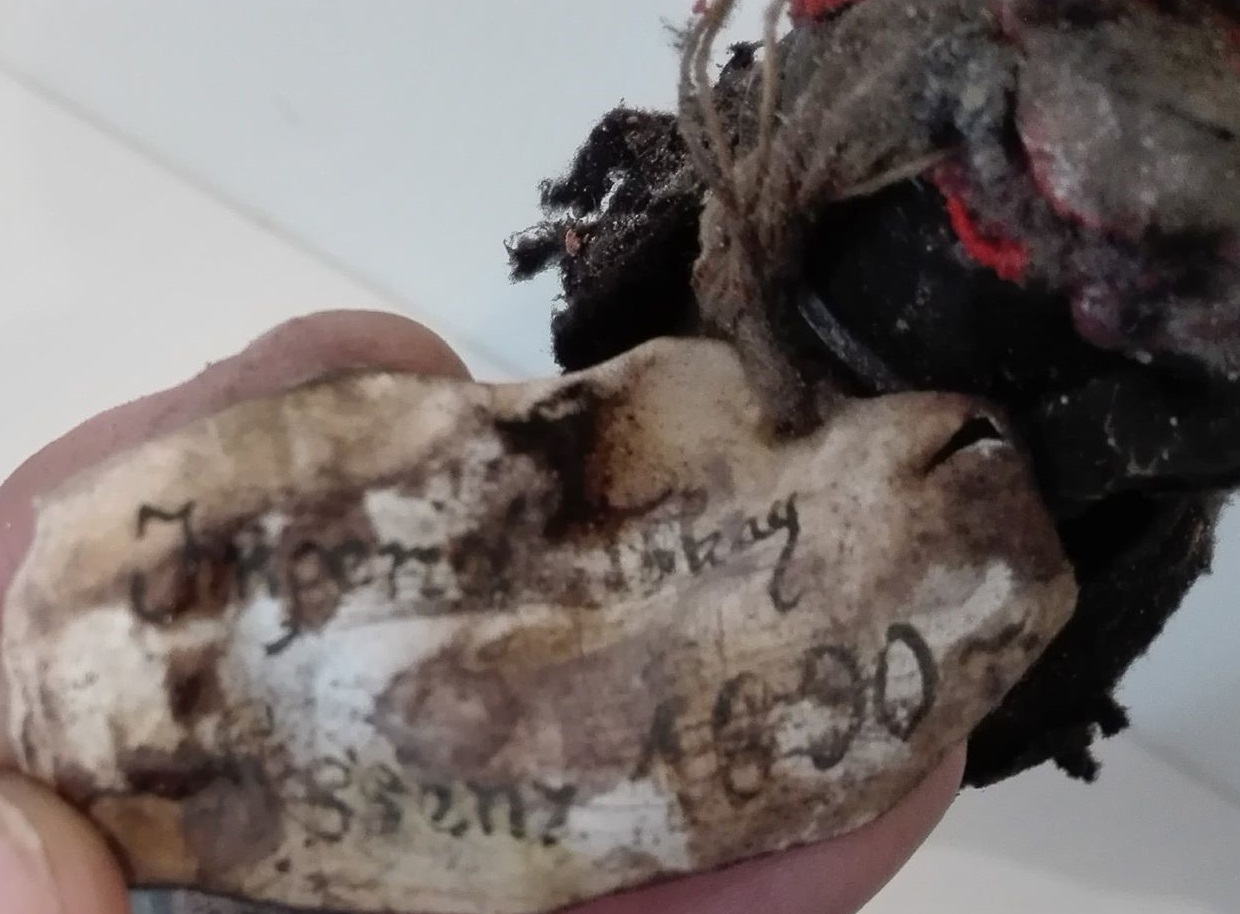
Two lines in brown ink on parchment. The second reads clearly „Tockayer 1680“. The first is harder: it appears to begin Altes, old, and the rest of the word resists the photograph. Altes Tockayer would be the ordinary German cellar formula, and if the reading holds, the label was written when the wine was already old — that is, well after 1680.
The spelling is the point. Tockayer, with the ck and the German agent ending, is not how the wine was written in Hungary, Poland or Latin; it is how German court cellars wrote it, and it is the form that appears in the Saxon and Prussian cellar papers. A label in German, on a bottle of Tokaji, in a German hand, places the bottle in a German cellar at the time it was labelled, whatever its origin before that.
The seals, and the Saxon reading
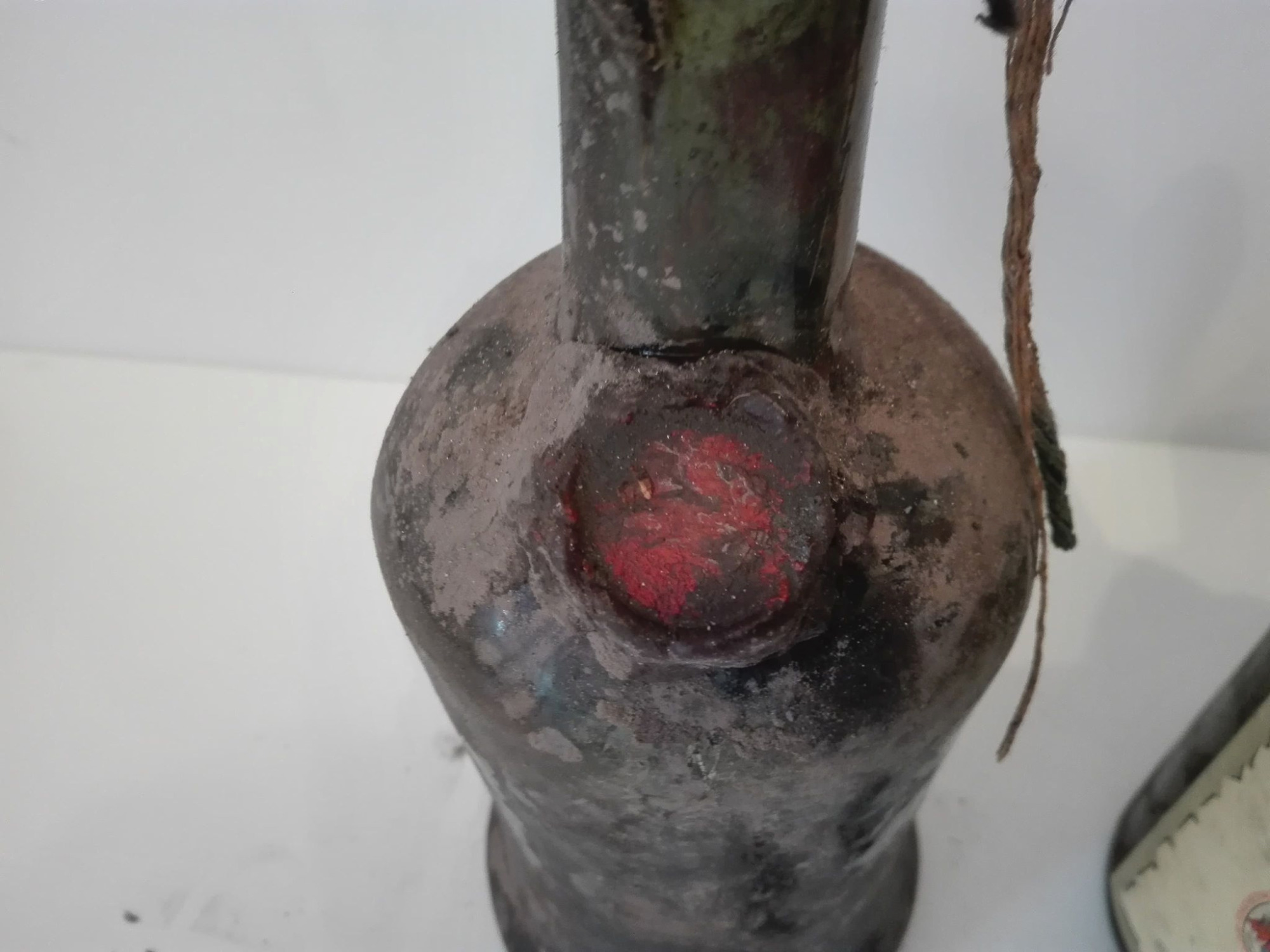
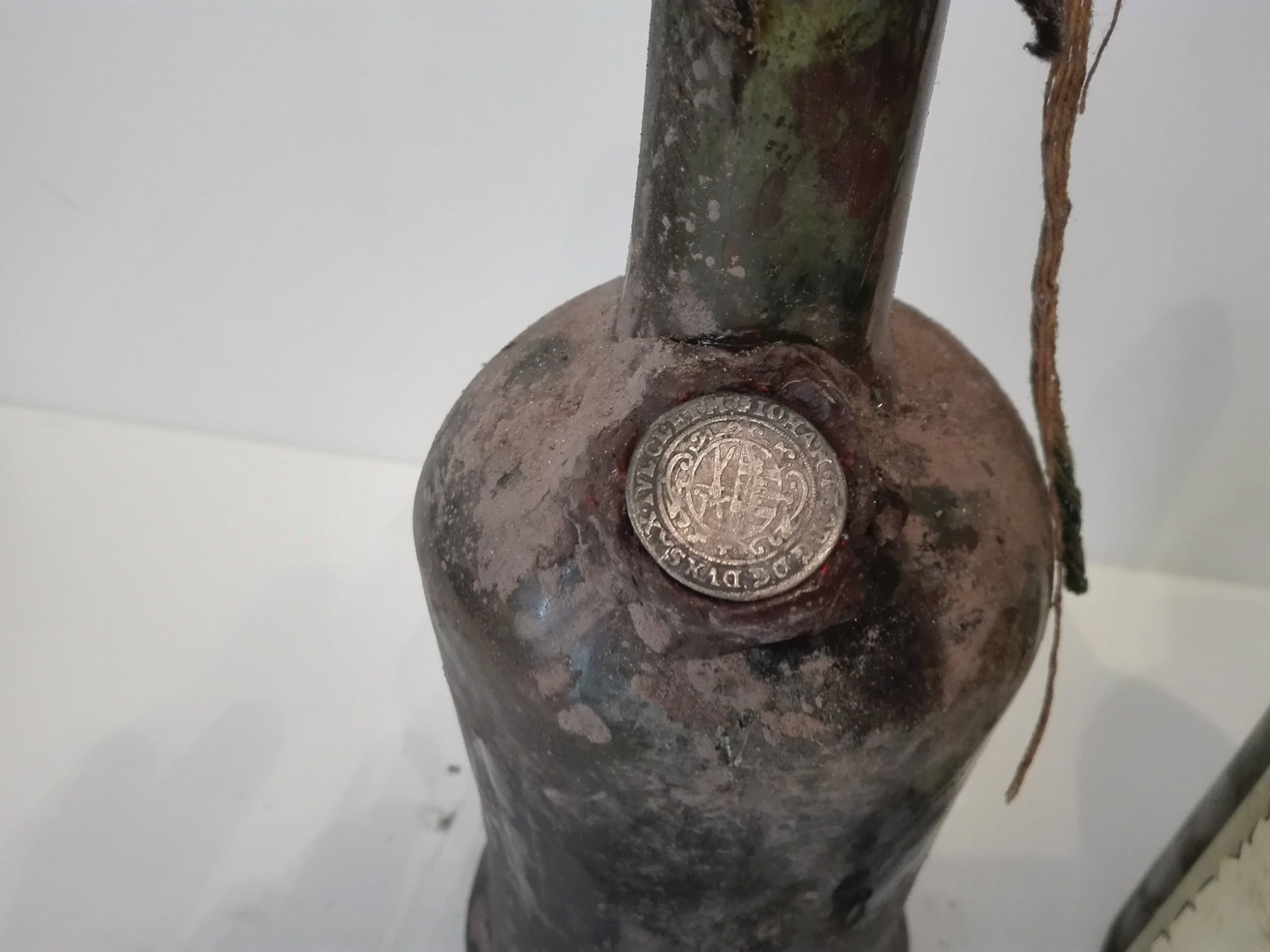
Three seals sit on the shoulder: one in red wax, one in a dark grey-black wax, and a third, lighter one further round the body. The dark one carries an impression, and under raking light it resolves into two crossed diagonal bars — which is the shape of the Kurschwerter, the crossed electoral swords of Saxony, the arch-marshal’s arms borne by the Saxon Electors and later the Kings of Saxony, and the mark familiar from Meissen porcelain.
Taken with the German label, that makes the Dresden court cellar the obvious candidate. The Saxon cellar bought Hungarian wine by the cask for generations, kept it for a very long time, and is documented on this site as having still been describing seventeenth-century Tokaji as drinkable in the early nineteenth century. A bottle labelled Altes Tockayer 1680 in German, sealed with crossed swords, is exactly what a Dresden bottle of that stock should look like.
What I am not claiming
The seal impression is worn, and two crossed bars can be many things — a saltire, a monogram, a merchant’s mark, a pair of keys. I have read it as the electoral swords because of the German label, not independently of it, and that is a weaker argument than it looks: two pieces of evidence pointing the same way are worth less when one of them was used to interpret the other.
Nor is the terminology quite right. In 1680 Saxony was an Electorate; the royal title came only in 1806. If the attribution holds, the bottle began as electoral and became royal where it stood.
Open questions
The first word of the label, which needs the parchment in hand under raking light rather than a photograph. A clean impression of the dark seal, ideally by silicone cast, to settle whether the crossed bars are the Kurschwerter and whether an electoral crown or initials sit above them. The paper tag still tied to the neck, which is folded and unread. And the Dresden cellar registers themselves: if this bottle came out of that cellar, its removal ought to have left a trace in the accounts, and the 1927 dispersal of the Saxon cellar is the likeliest moment for it.
1688
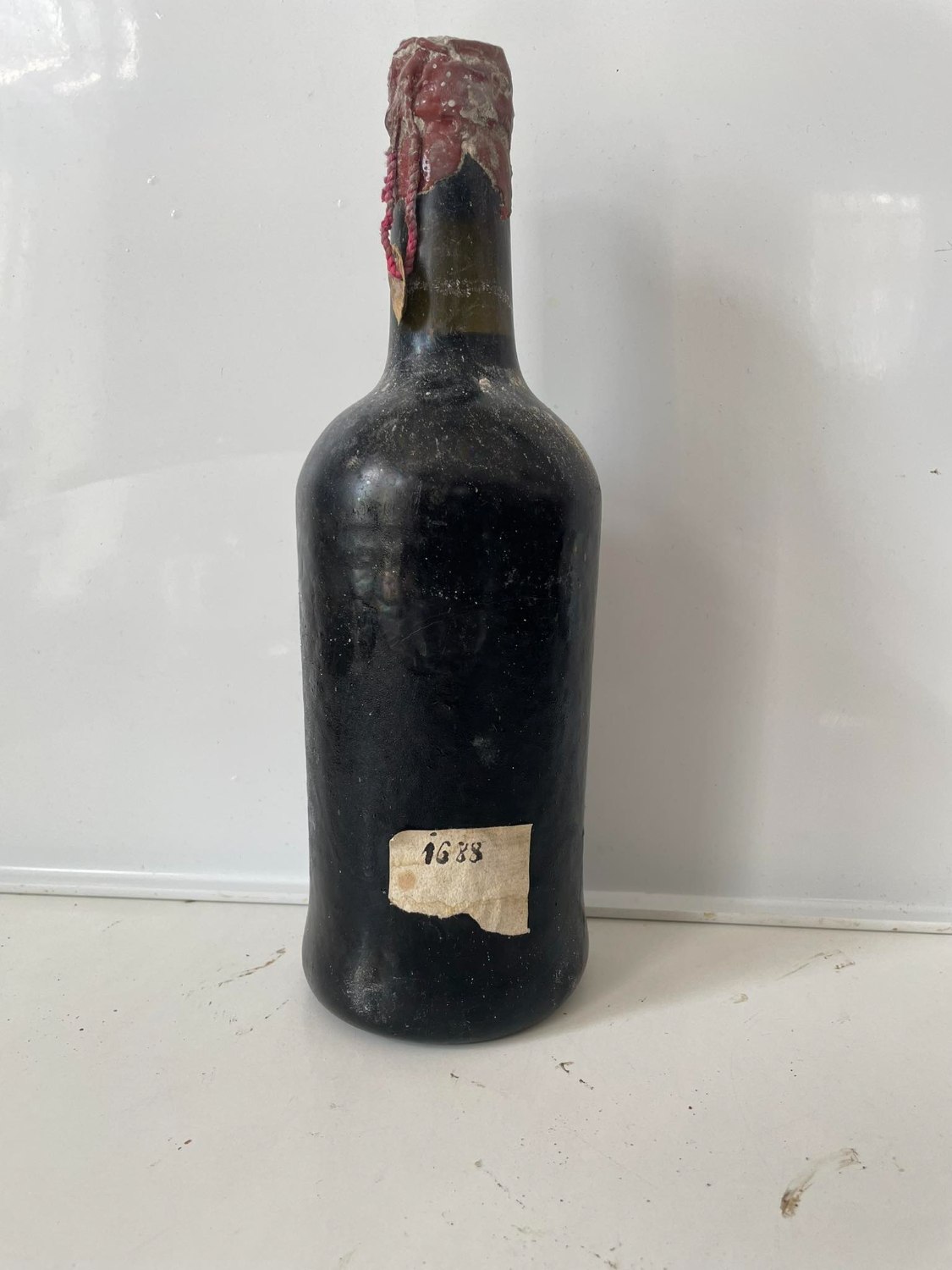
Two 1688 Esterházy Bottles
Two bottles of this vintage survive. The first is described below and shown in the first six photographs; the second appears in the last.
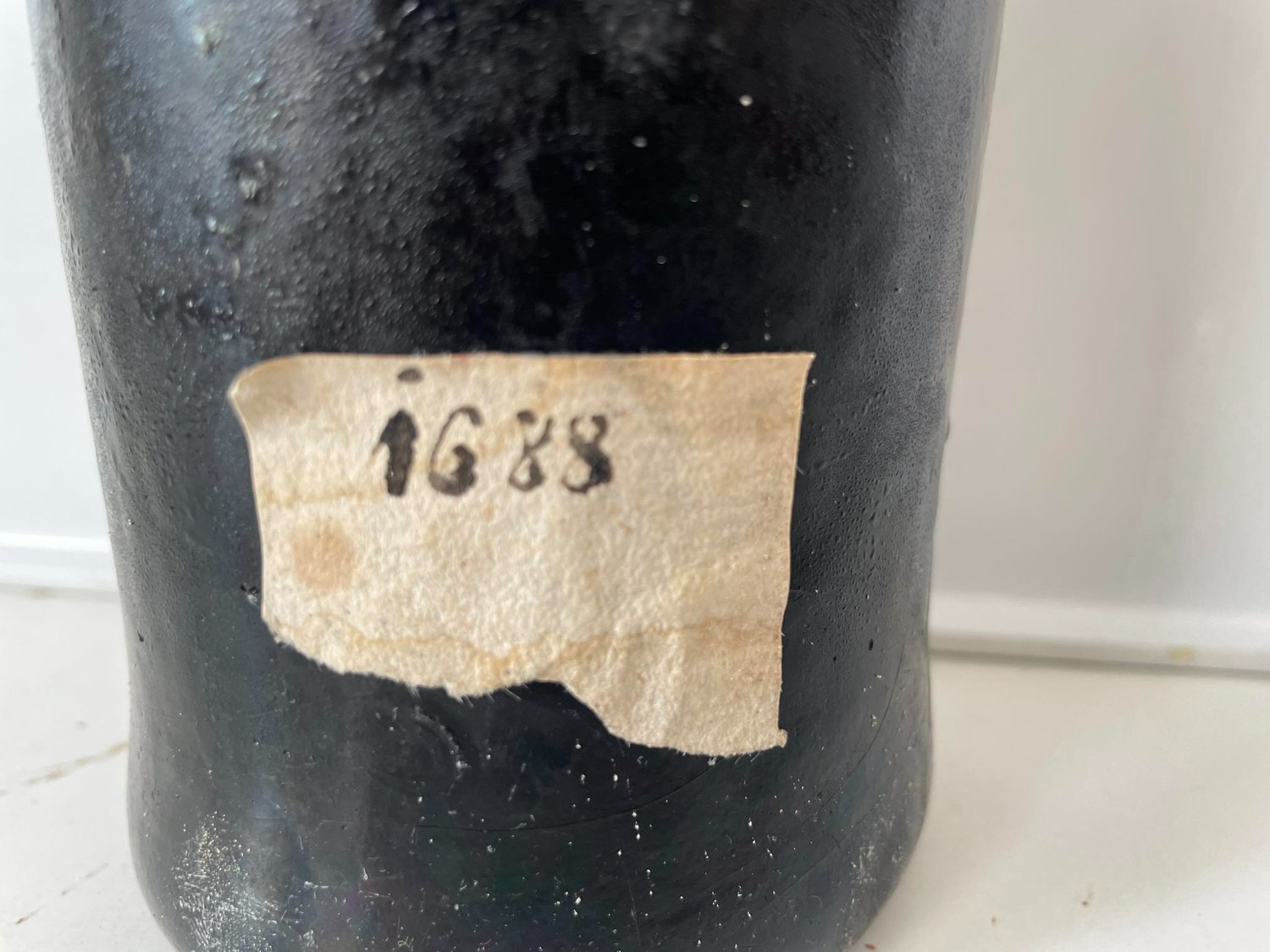
The paper strip on the body reads 1688, written on the same kind of old laid paper with its characteristic chain lines as on the 1663 bottle.
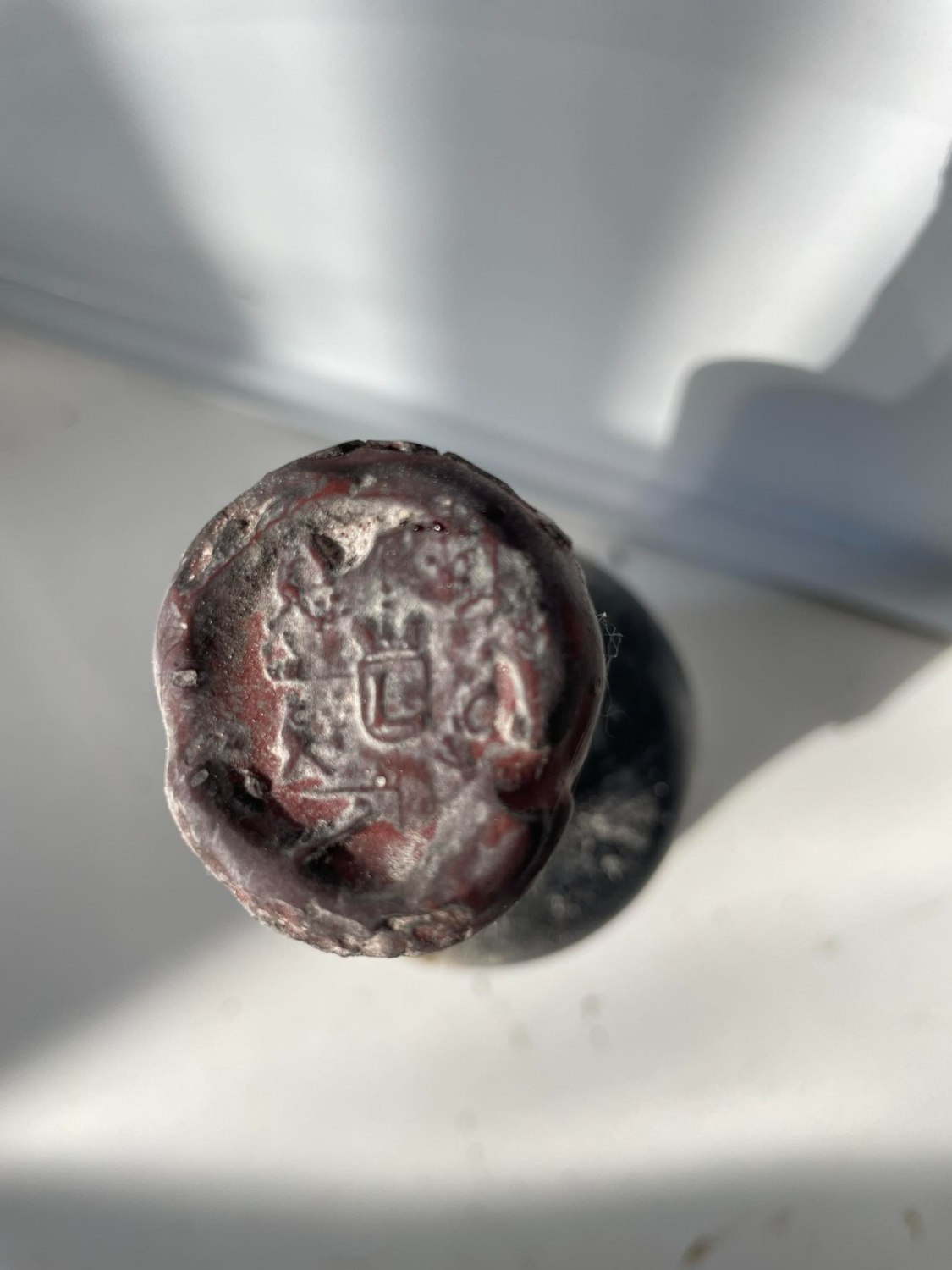
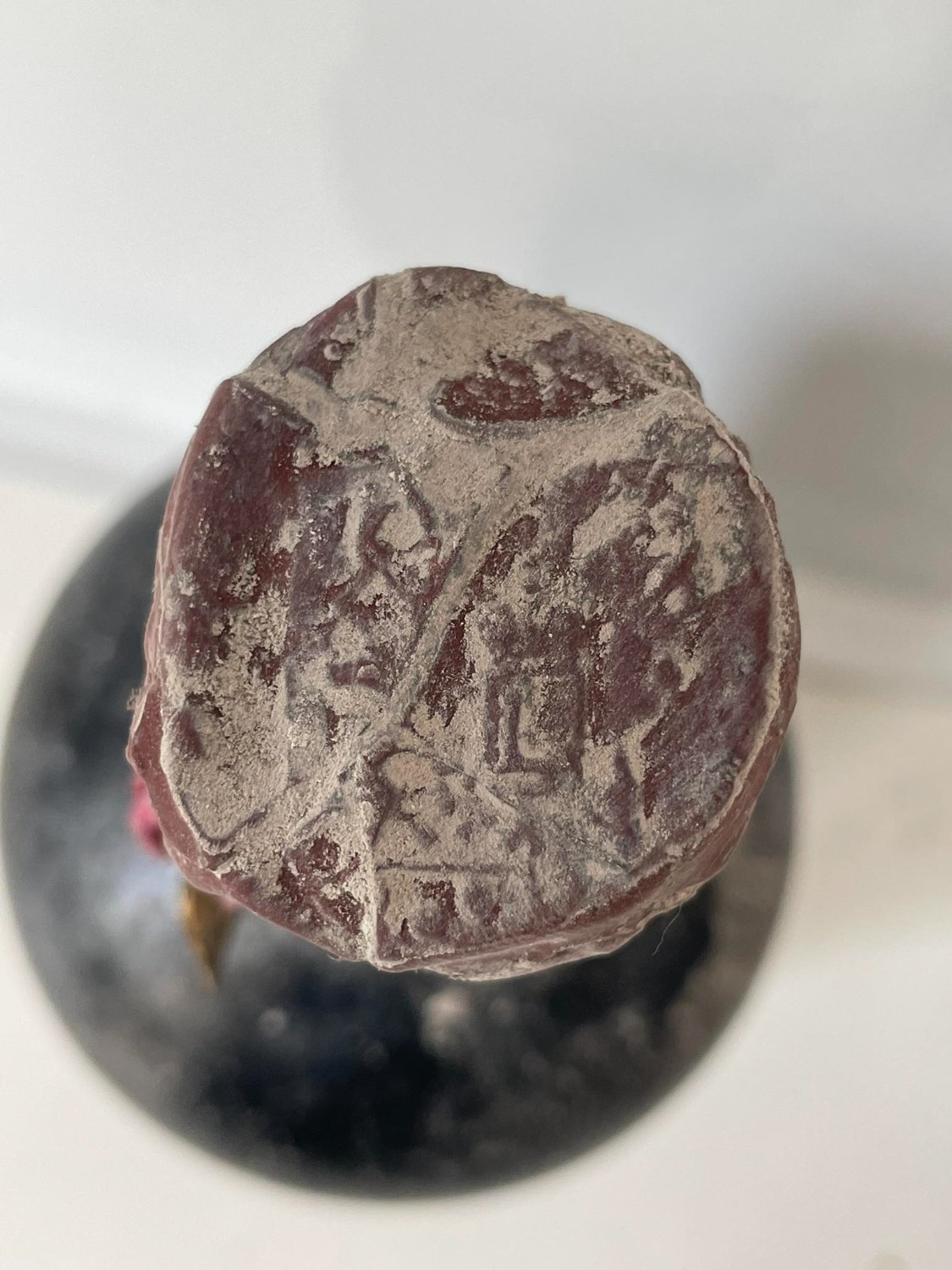
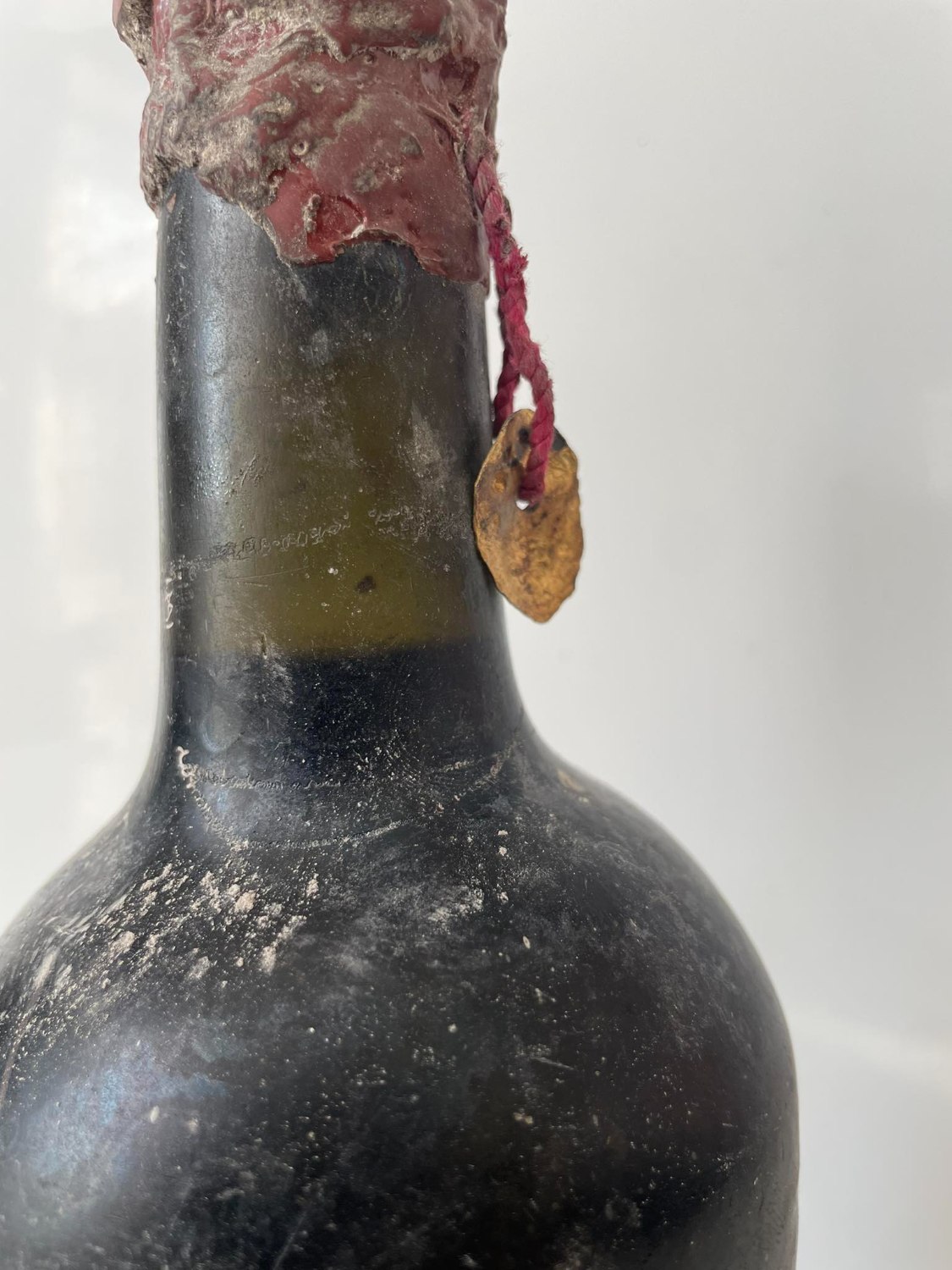
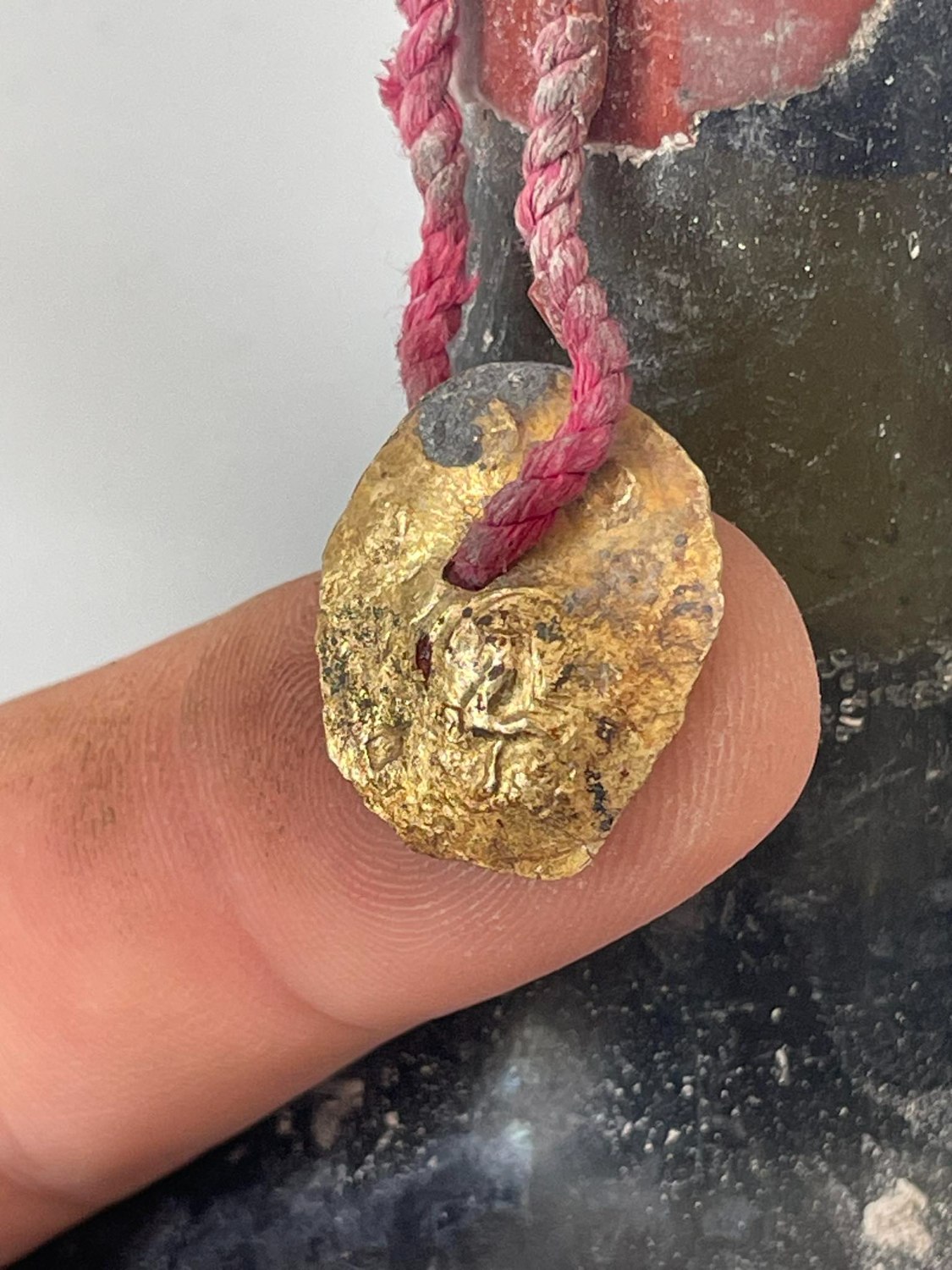
On the wax seal at the top, the arms of Pál Esterházy are more clearly visible than on the 1663 bottle: in the centre the letter L, on the left the griffin with the sword holding the three roses, and at the bottom the three rose heads side by side. Here they can be made out distinctly.
A gilt tag hangs from the neck on a crimson silk cord, itself impressed with a small device. The neck carries an engraved inscription, now largely worn.
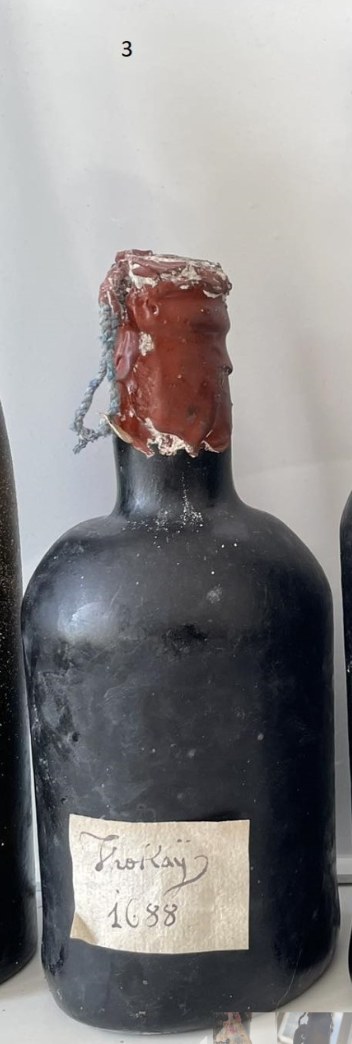
The second bottle carries a fuller strip, reading Tokay 1688 in a cursive hand above the year — one of the earliest written attestations of the wine's name on a bottle in the collection. Its wax capsule is a lighter brick red and the cord beneath it survives as a grey-green remnant.
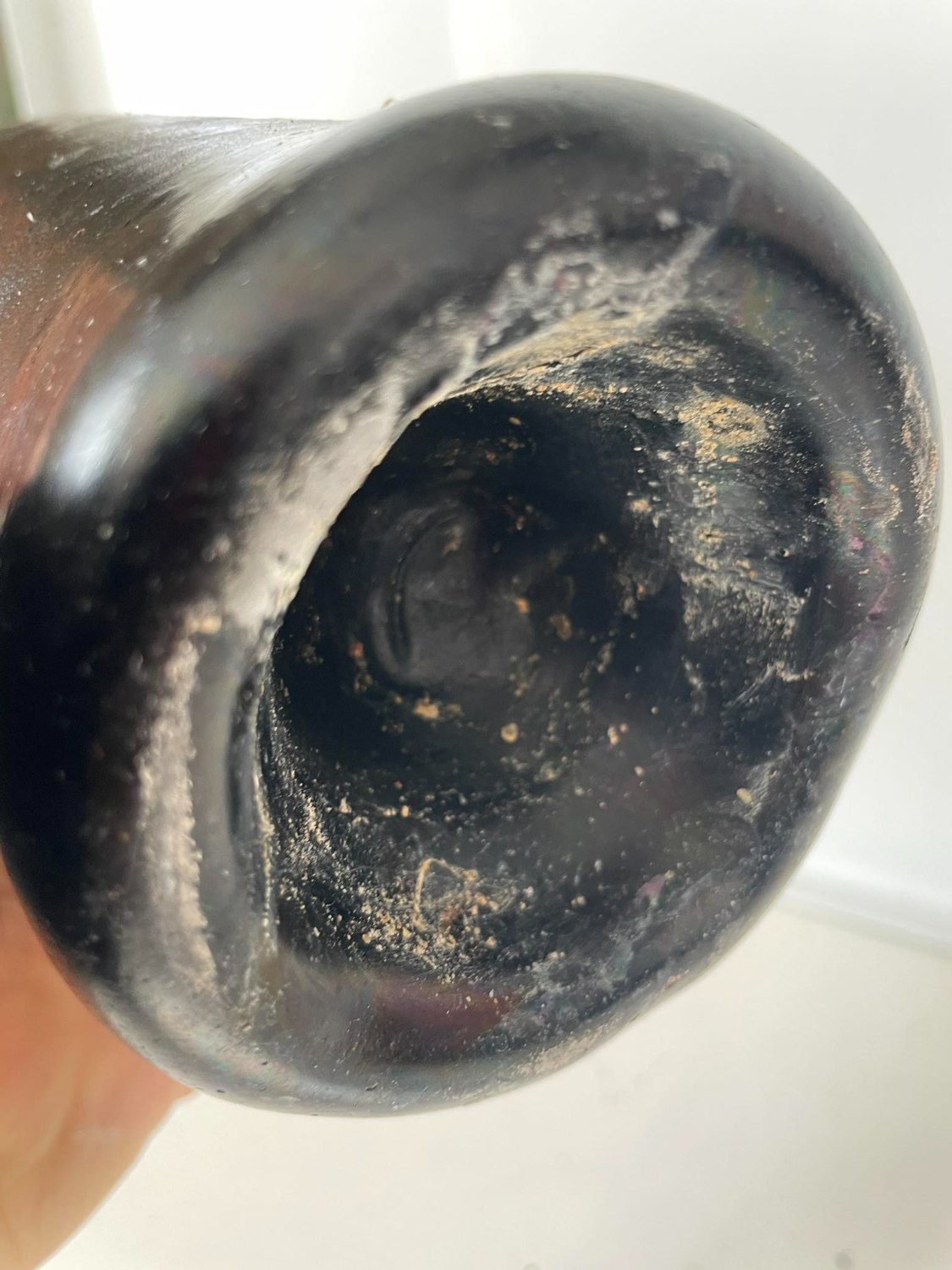
First bottle (images 1–6): the bottle, the seal with the Esterházy arms, the neck with cord and gilt tag, the tag itself, the paper vintage strip, and the base. Second bottle (image 7): the strip reading Tokay 1688 · click any image to enlarge
1690
1690 Imperial Tokay bottle (presumably János Garai)
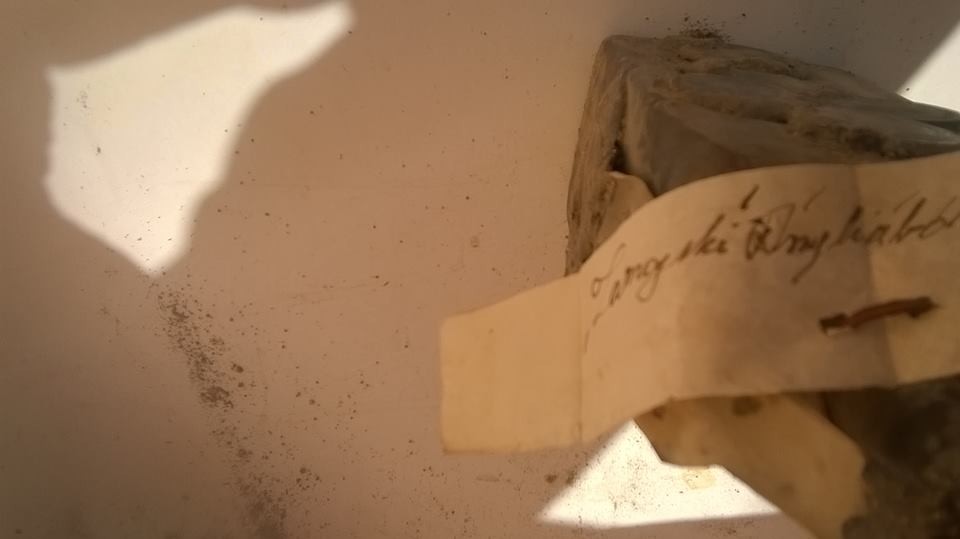
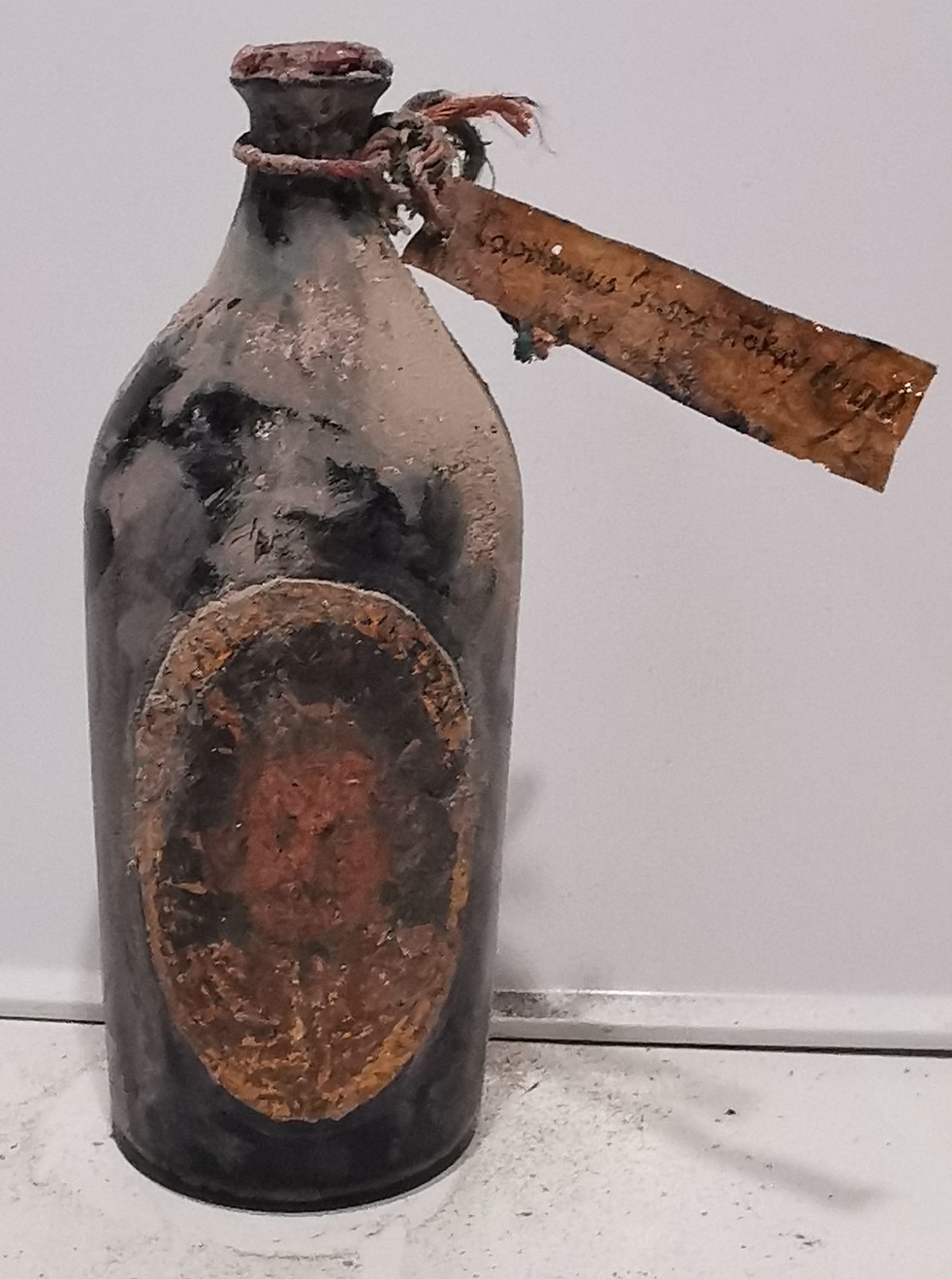
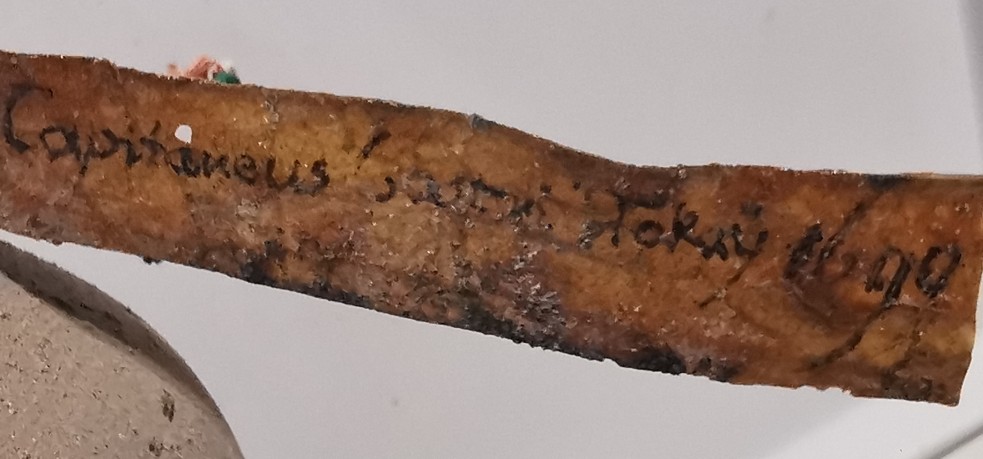
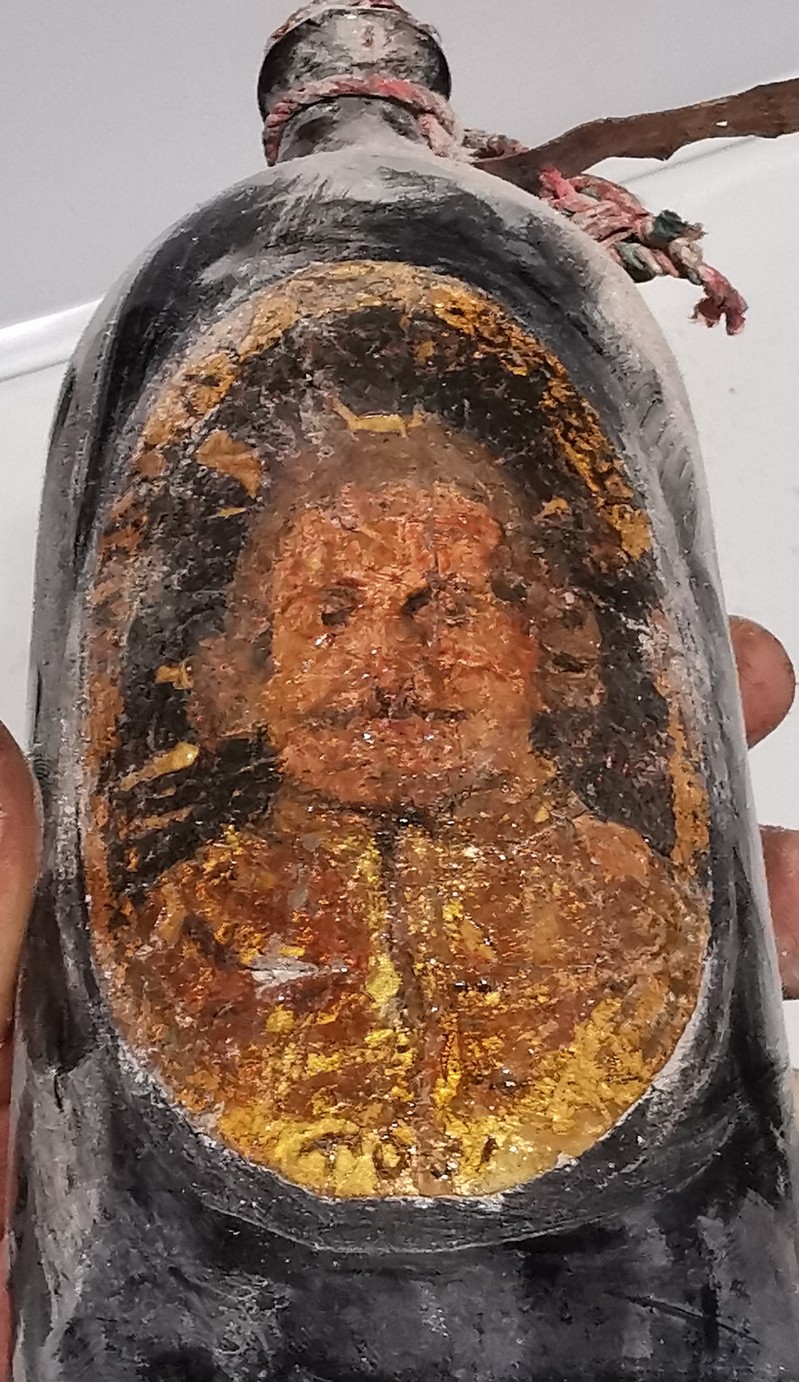
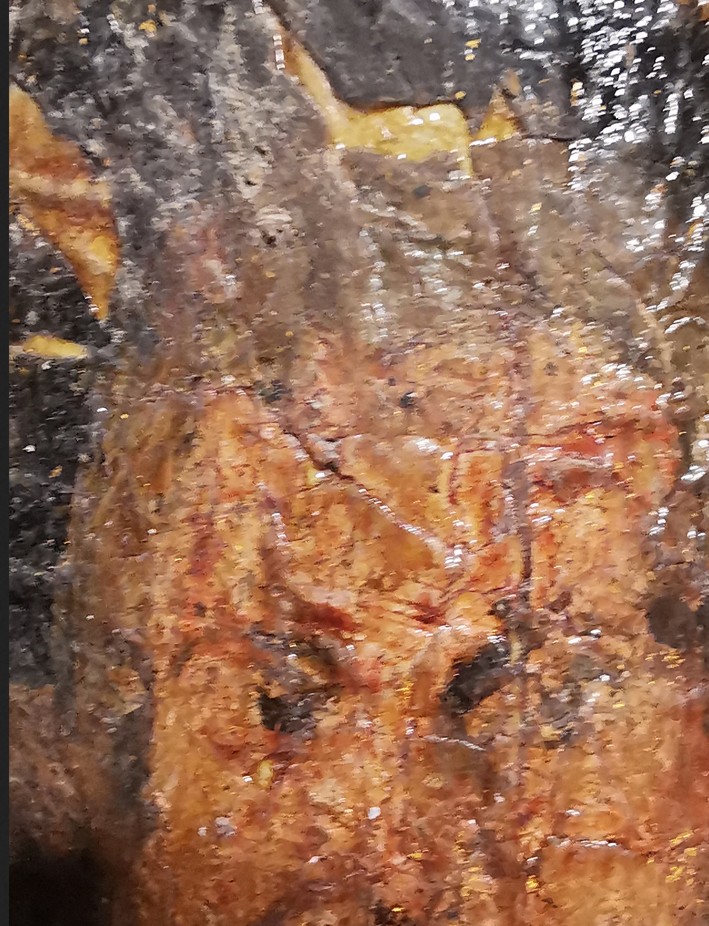
A very special bottle most probably paying tribute to captain János Garai, whose portrait is depicted on the bottle label. The label is made of anmimal skin/leather. Garai is definitely a name to remember in the history of Tokaji.
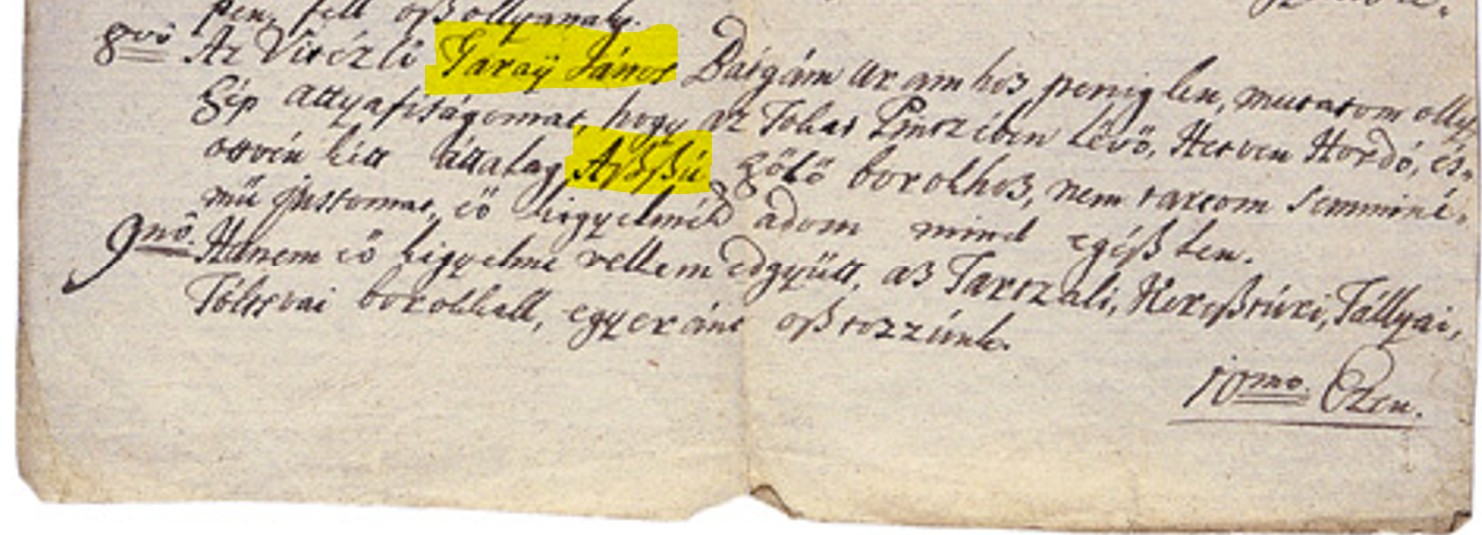
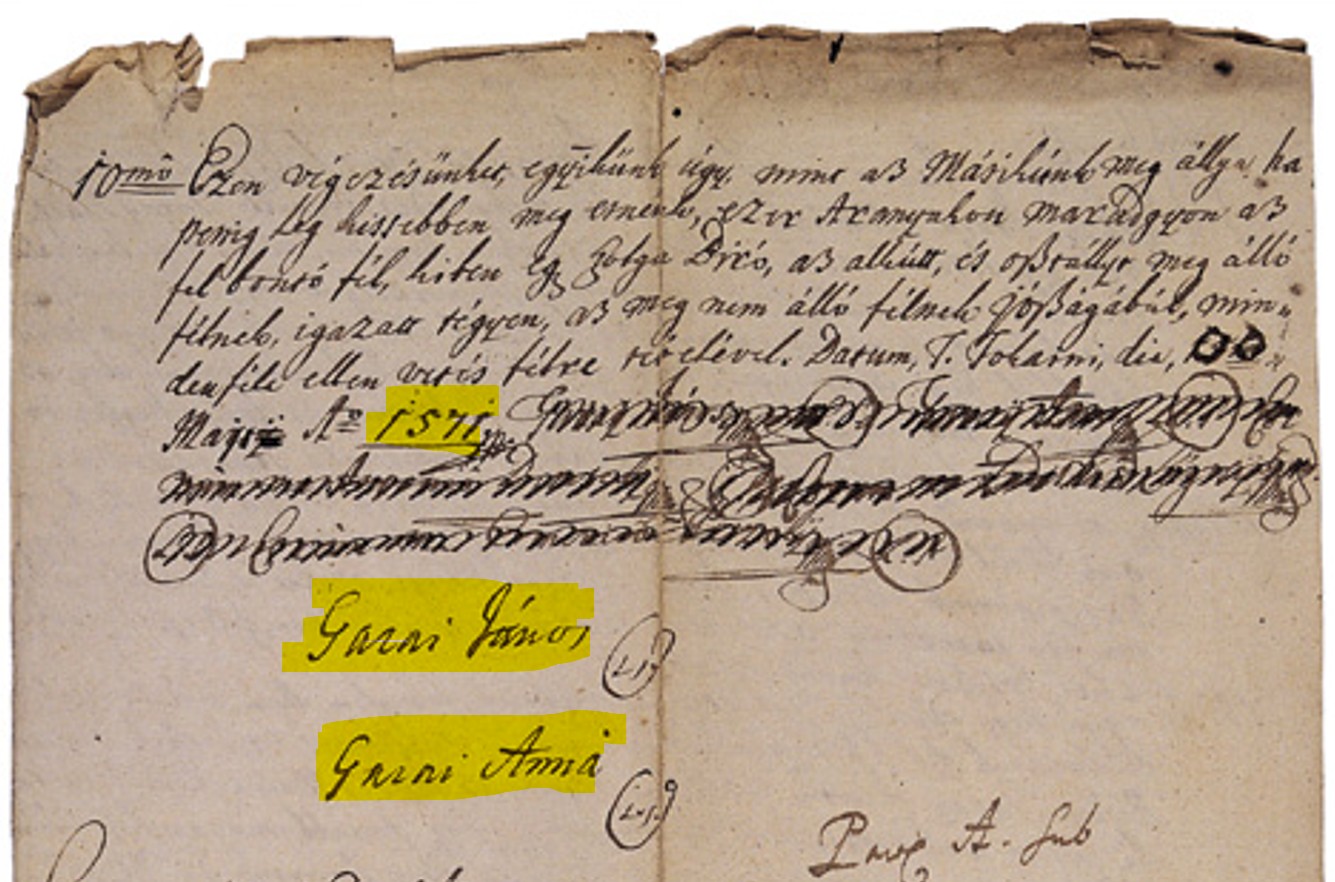
János Garai is mentioned in the oldest known document to contain the word Aszú (1571), a contract about 70 larger and 52 smaller barrels of aszú. Until older evidence is presented we should remember that the first Tokaji Aszú was a Garai wine (and not a wine made by Spepsy Laczkó Máté as popular belief and marketing brochures will tell you.) As Mr. Zelenak points out this 1571 aszú was probably vintage 1566 when the events of the Habsburg-Ottoman war in the Tokaj region delayed the vintage.
2 vineyards in Tokaj bear the Garai-name: Garai and Kis-Garai
János Garais sister Anna, also mentioned in that document, was married to Gáspár Károlyi, the first to provide a complete Hungarian translation of the Bible (1590).
The 1690 bottle, presumably János Garai. Click any image to enlarge.
1690
Imperial Tokay
One of the rare bottles with a coin attached, in this case a Saxon coin suggesting that it originates from the Royal Saxon cellar. The “Imperial” category is impossible to define exactly as no description exists, and only a handful of historic bottles of this category are known. Several explanations seem plausible:
Tokaji of the highest quality (very high sugar content, 6p aszú or eszencia) worthy of Imperial tables
Tokaji coming from the (top) Tokaji vineyards owned by the Habsburg Emperors. Although I am not sure if the Habsburgs actually owned vineyards in Tokaj in 1690
Tokaji from the Imperial Cellars in Vienna
Just a marketing instrument to sell Tokaji for a higher price
The 1690 Imperial Tokaji bottle. Click any image to enlarge.
1698
The lost Royal Prussian Cellar bottle
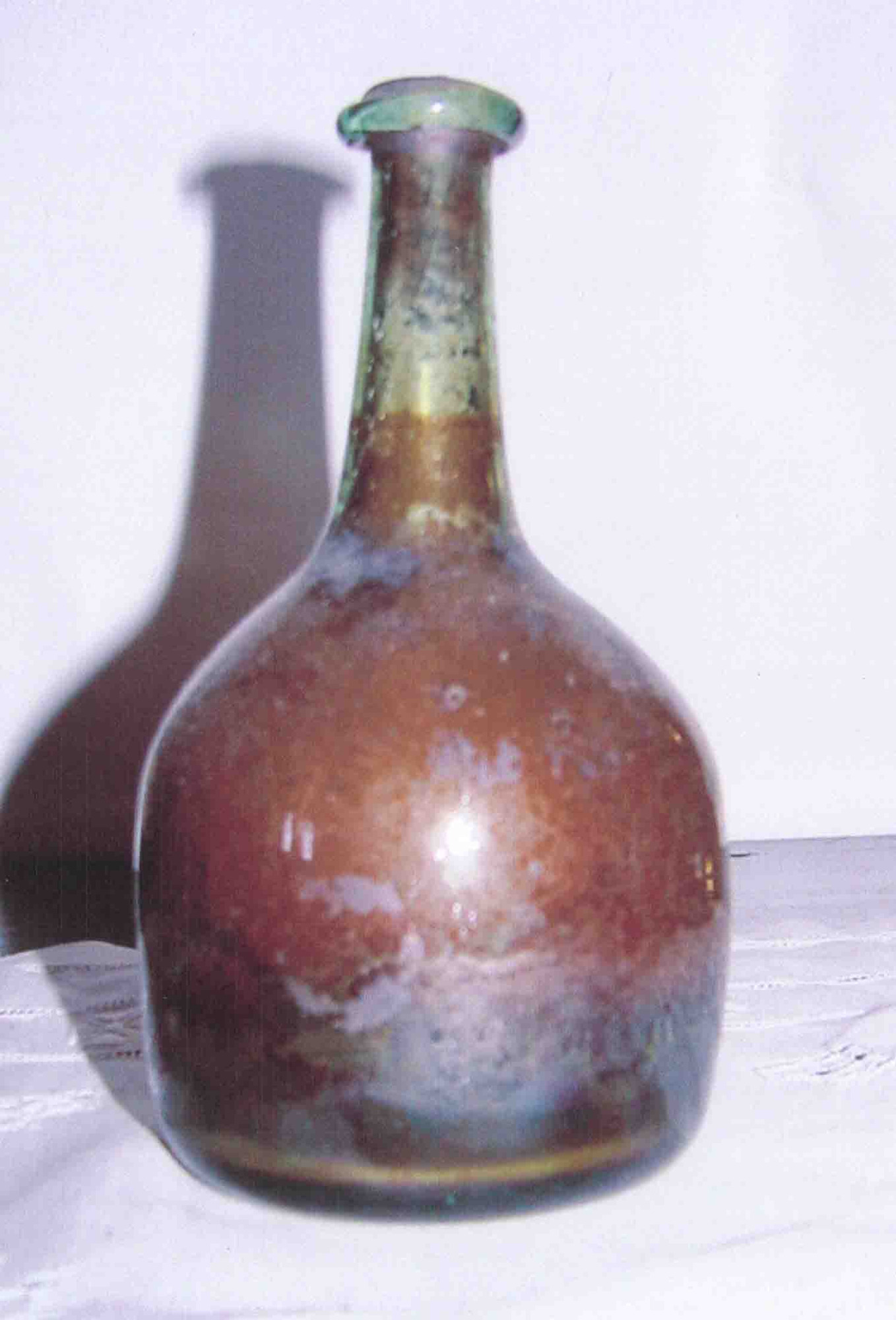
This is the only known Tokaji bottle from the Royal Prussian Cellar. An English publication reports a seventeenth-century Tokay taken from the imperial cellar in Berlin in 1918 and sold at Sotheby’s in London in December 1978 for £1,300; Hungarian sources put the sale on 13 December 1978 as lot 678. The buyer, C. S. Chadwick, donated it to Tokaj-Hegyalja through the Hungarian embassy in London, and in 1979 it was brought to Hungary and placed in the wine museum at Tolcsva. From there it passed to the Hungarian Museum of Agriculture in Budapest, and there — inexplicably, in a state museum — it has been considered lost since 2010.
The bottle as photographed before it was lost: dark green, pear-shaped, with a seal on the shoulder. This is the only image of the bottle I have been able to obtain, and its resolution is nowhere near good enough to analyse the glass seal. Click to enlarge.
The English notice of the sale
“Among the curiosities was a 17th century Tokay bottle believed to contain the original wine and removed from the imperial cellar in Berlin in 1918. It fetched £1,300 at Sotheby’s in December.”
From the review of the 1978 London saleroom year in Christie’s Wine Review. Vintage, cellar, price and month all agree, so this is almost certainly the same bottle — and it identifies the cellar as the imperial cellar in Berlin, that is the Royal Prussian Cellar, emptied in 1918. No other bottle from that cellar is known, which makes this lost one unique.
The Hungarian reports agree on this much:
The bottle. A dark green bottle of less than half a litre, dust-covered, holding a Tokaji aszú of roughly three hundred years.
A German imperial cellar. It is said to have come out of one of the German emperor’s cellars, and to have reached that cellar at the end of the seventeenth century as a gift from the Habsburg ruler of the day or from a Hungarian aristocrat.
Sotheby’s, London. After a long and adventurous passage through many hands it came up at Sotheby’s, where after lively bidding the English businessman Chadwick bought it for £1,300 — one paper puts that at about US$2,800.
The seal. A report from Tolcsva describes the seal on the bottle as bearing the arms of the hereditary Marshal of the Holy Roman Empire, and the custodian of the exhibition telling visitors that the wine still moves in the bottle, standing roughly to the shoulder of the glass.
The gift. Chadwick did not keep it long. Out of regard for the wines of Tokaj he handed it over at the Hungarian embassy in London to the ambassador, János Lőrincz Nagy, asking that it be brought home to Tokaj, and it was given to the wine museum there. He told the embassy party that he had holidayed in Hungary several times, that he had come to like the people, the warm summers and the sunlit hillsides of Tokaj, and that he had noticed the auction advertisement; having bought the wine, he thought better of drinking it and decided it should stand in a fitting place, where it came from.
Where the reports disagree
The vintage. Most say only “nearly” or “around” three hundred years old; Kertészet és Szőlészet gives the vintage as somewhere between 1680 and 1700. The year 1683 appears only later.
The buyer’s name.George Chadwick in most of the papers, C. S. Chadwick in one.
1918. Given both as the year the bottle was found in the German imperial cellar and as the year it was first auctioned.
The sale date. Nowhere stated; the June 1979 reports say only “a few months ago”, while Chadwick himself, in 1997, put it in March 1979.
The destination. Given as the wine museum at Tokaj in the 1979 reports; from 1980 onward the bottle is described as being on display at the wine museum in the Rákóczi castle at Tolcsva.
The cellar. “One of the German emperor’s cellars” in 1979 and 1980; by 1981 named as the Berlin imperial cellar, reached either by purchase or as the homage gift of a Hungarian magnate to the emperor.
The buyer, eighteen years later
In 1997 the Új Dunántúli Napló interviewed him in Pécs, where he was by then living and teaching at the university: Clifford Chadwick, sixty years old, born near Manchester, a graduate in German, English and French from Durham, who had worked as a dye trader before turning to teaching. He is not the oil magnate of later retellings.
His own account of the purchase differs again from the newspapers of 1979. He puts the auction in March 1979 and calls the wine a Tokaji aszú essence of 1698. He bought it, took it home, did not know what to do with it, and then thought it would stand in a worthier place among Hungarians; a month later he brought it to Tolcsva. In the same article the wine expert András Urbán, president of the National Council of Wine Communities, estimated the bottle might be worth several million forints.
Ungváry’s account
Krisztián Ungváry gives the wine as the vintage of 1683, long kept in the Berlin imperial cellar in a green, pear-shaped bottle bearing the seal of that cellar. He dates the sale precisely: Sotheby’s, London, 13 December 1978, lot 678, bought for £1,300 by Mr C. S. Chadwick, described there as an oil magnate, who donated it to Tokaj-Hegyalja through the Hungarian embassy in London out of respect for the wines of Tokaj.
The bottle was brought to Hungary in July 1979 by Mr John Lipitch, representative of R+C Vintners, the distributor of Tokaji wines in England. Sándor Bodnár, head of the Tokaji Borkombinát, received it and placed it in the wine museum at Tolcsva.
From Tolcsva the bottle passed to the Hungarian Museum of Agriculture in Budapest. According to the Hungarian historian Krisztián Ungváry it has been missing since 2010: it could no longer be found there — see his “Egy kutatás kérdőjelei: mikori a legidősebb tokaji aszú címke?” in Zempléni Múzsa.
Reports in Déli Hírlap (29 June 1979), Népszava (29 June 1979), Kisalföld (29 June 1979), Kertészet és Szőlészet (16 August 1979 and 10 January 1980), Esti Hírlap (15 January 1980), Utazási Magazin (1 September 1980), Észak-Magyarország (22 November 1981) and Új Dunántúli Napló (16 December 1997), consulted through Arcanum.