Inventories, registers and undated fragmentsDocuments
Maps, letters, inventories and price lists that name Tokaji — from two sixteenth-century plans of the fortress in Dresden to a register of 109 grape varieties in 1854, arranged in order of date.
Earliest document here
c. 1560Angielus’s plans of the Tokaj fortress
Grape varieties listed
109In the Tokaj region, 1854
Animal-skin fragments
3One naming Mézesmály
Verification
2Content analysis, then material analysis
—
What is collected here
Old Tokaji rarely travels alone. Bottles arrive with paper: cellar inventories, contracts of sale, gift cards, inheritance papers, vineyard registers, tax stamps, letters. Some of that paper is the only reason a bottle can be dated at all; some of it stands on its own as a source, describing cellars and vineyards whose bottles are long gone.
This page collects the documents that are worth reading as documents. Papers that belong to one specific bottle stay with that bottle, on the century pages. How documents are tested — content analysis first, then paper, watermark, ink and wax — is set out under Services.
In my research I naturally come across a large number of old documents related to Tokaji, in private collections as well as in state and church archives. On this page I present a small selection of those documents, hoping to provide some new and interesting insights into the topic of old Tokaji for the reader.
Undated
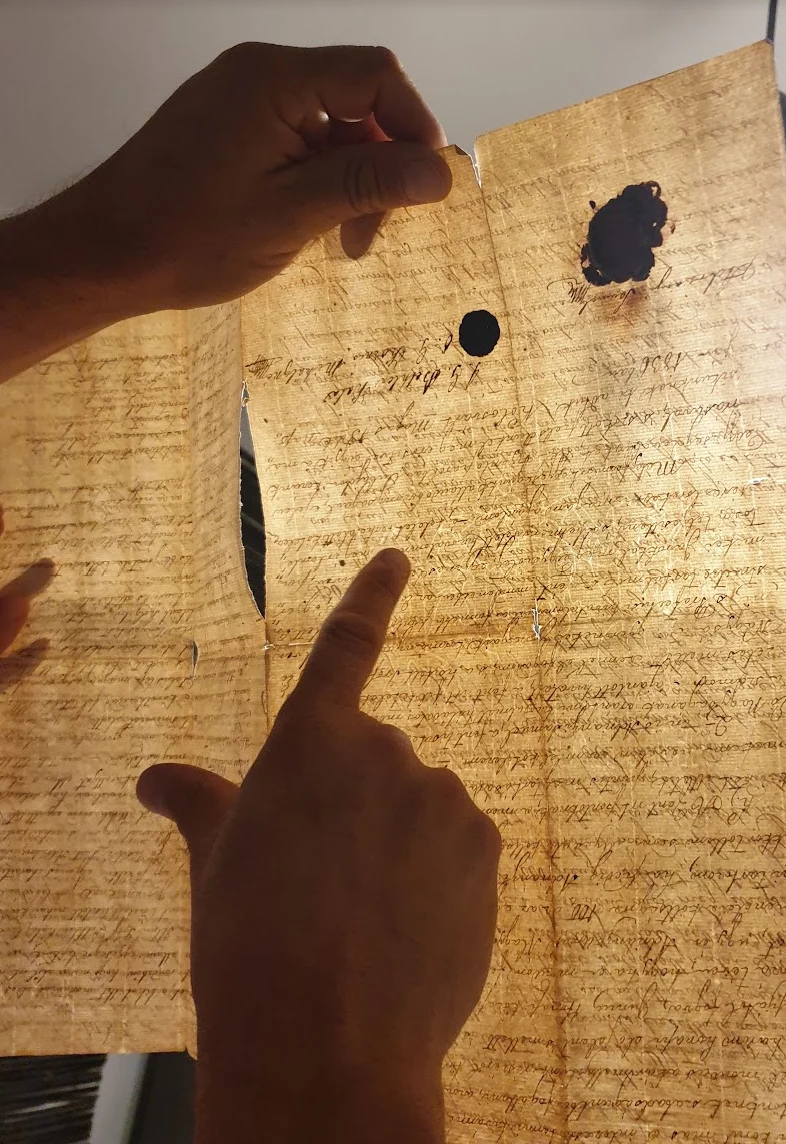
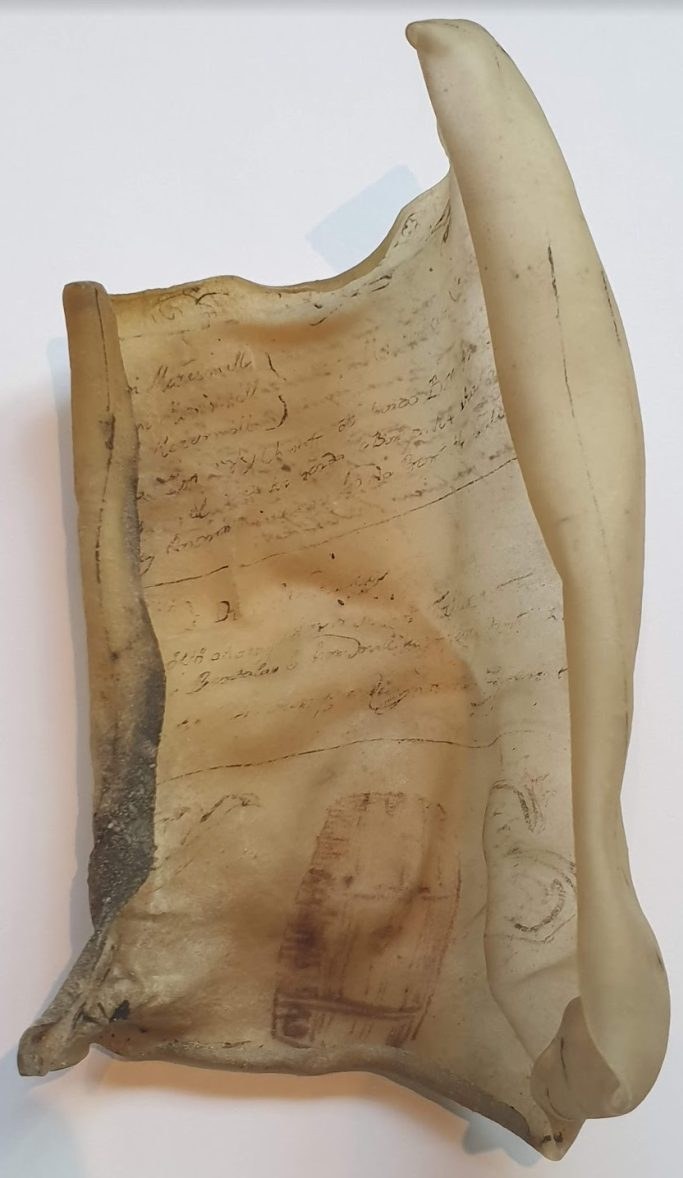
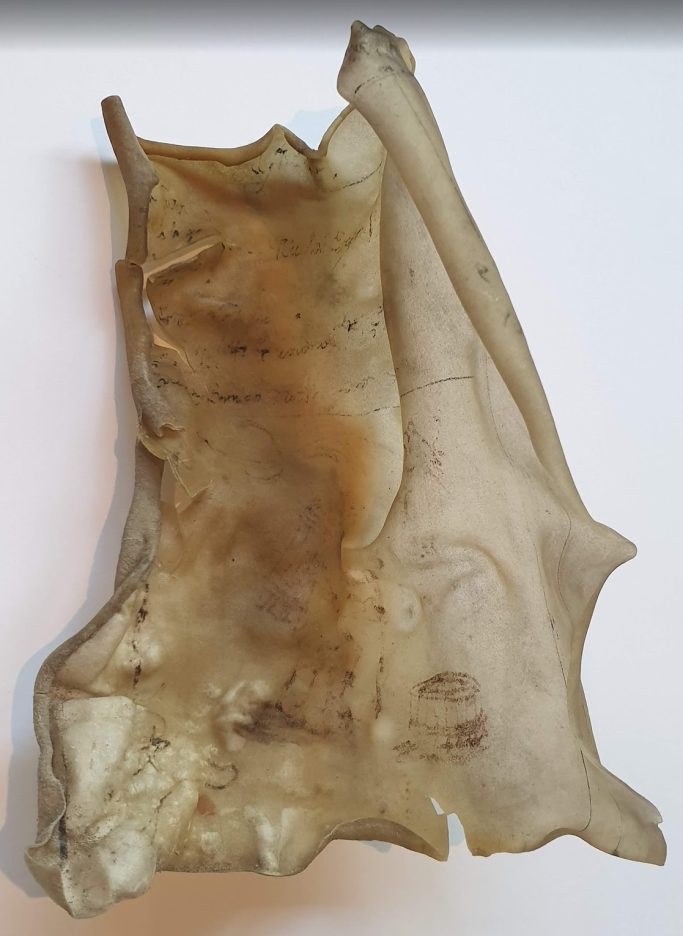
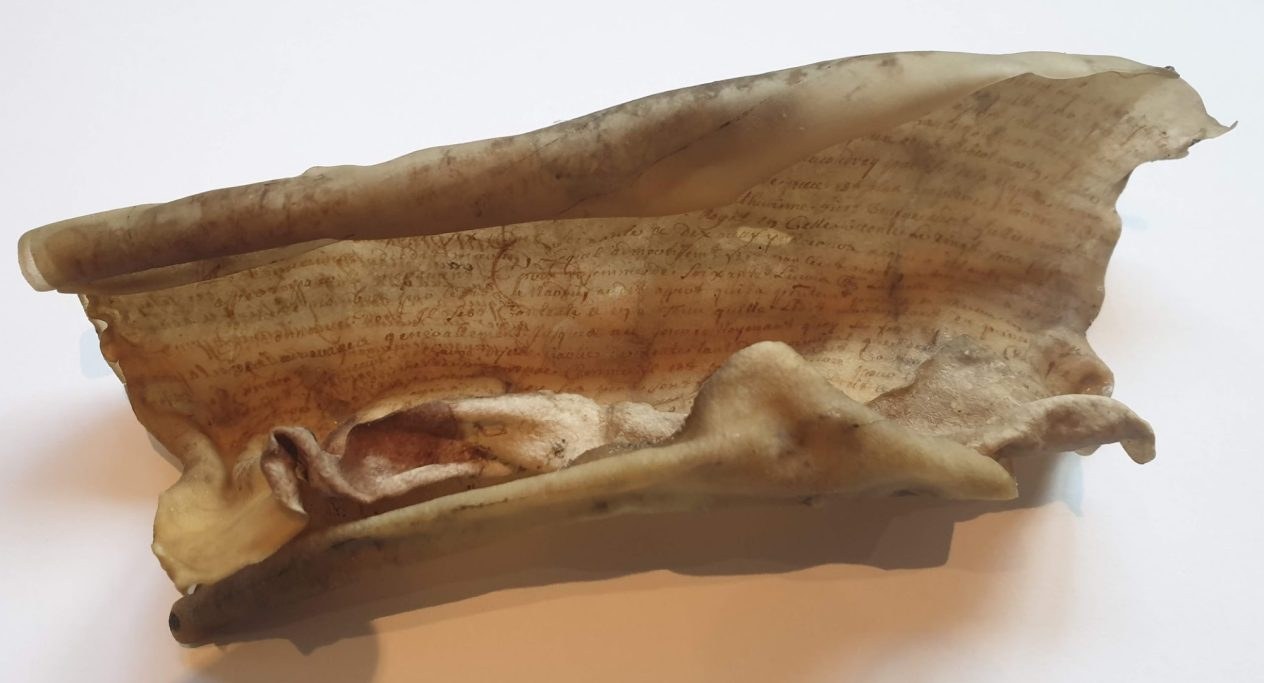
Undated tokaji document made from animal skin
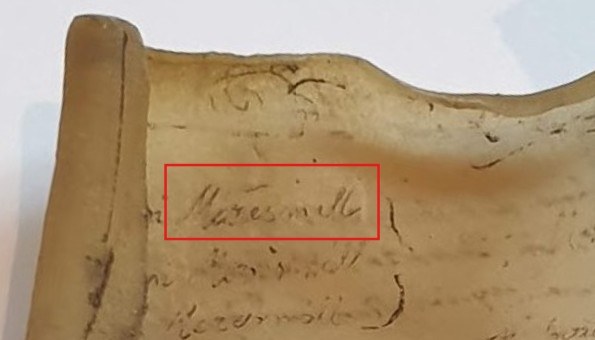
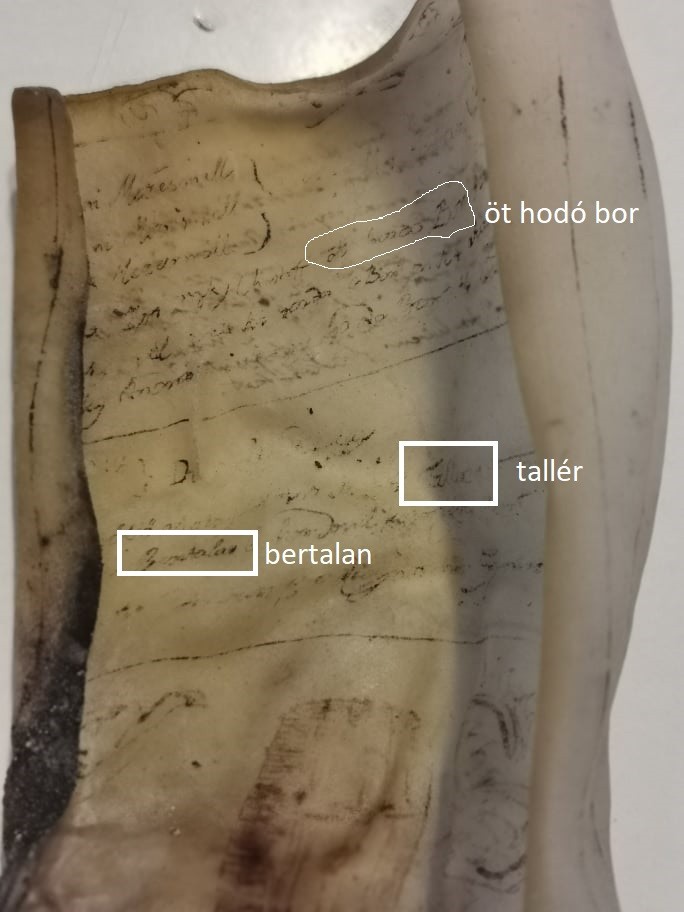
Three document fragments of unknown age, one mentioning Mézesmály, a famous vineyard name that is no longer used. Ongoing research ...
The three fragments. The skin has shrunk and curled, and the ink has faded into the surface, but a barrel is drawn on two of the sheets and the writing on the third runs to some twenty lines · click to enlargeDetail of the first fragment: the word read as Mézesmály, boxed. The vineyard name has fallen out of use · click to enlargeThree further readings marked on the same skin: öt hodó bor, tallér and bertalan — a quantity of wine, a coin, and a name or a feast day · click to enlarge
c. 1560 · 1711–32
Two little-known plans of Tokaj in Dresden
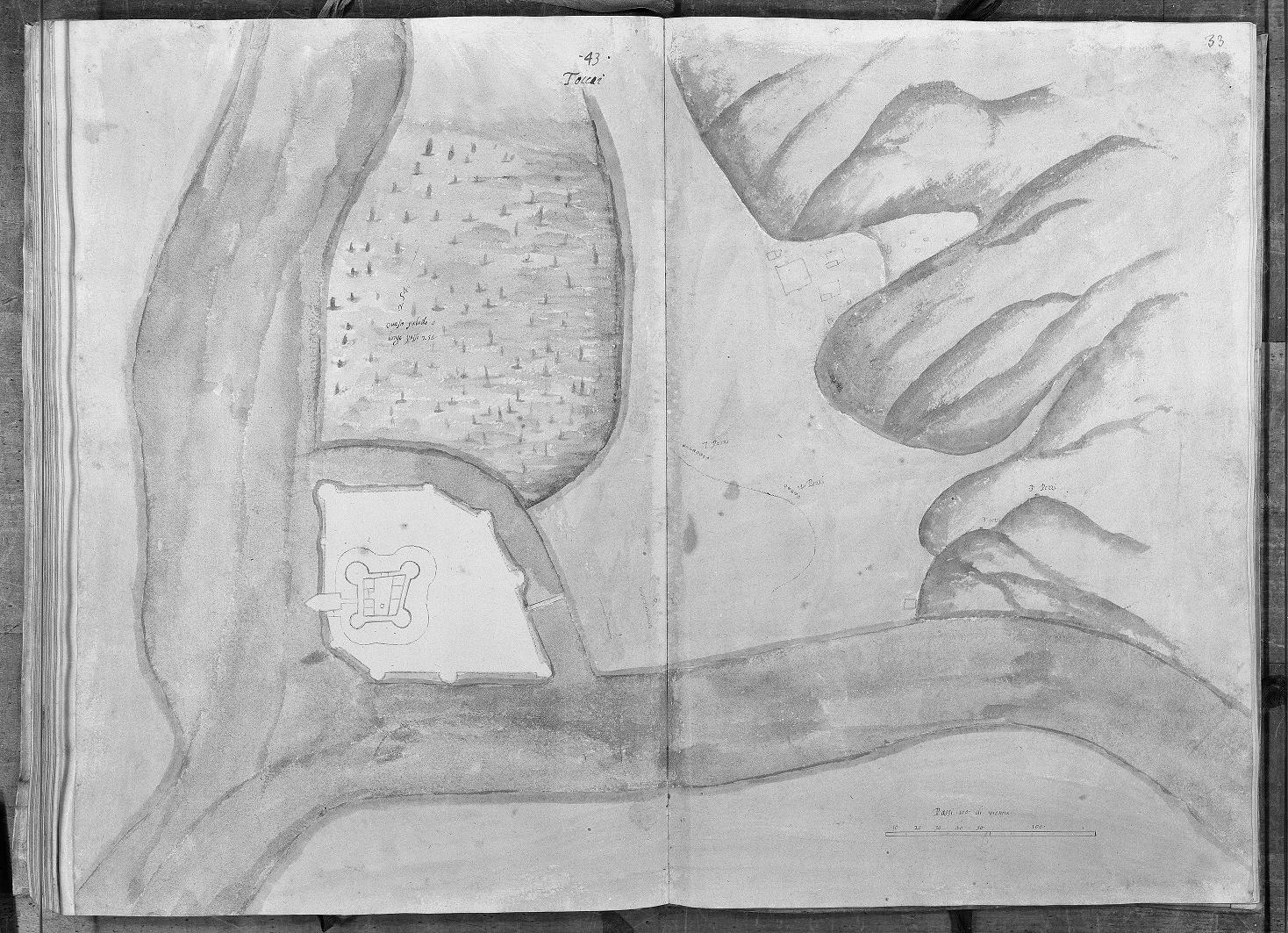
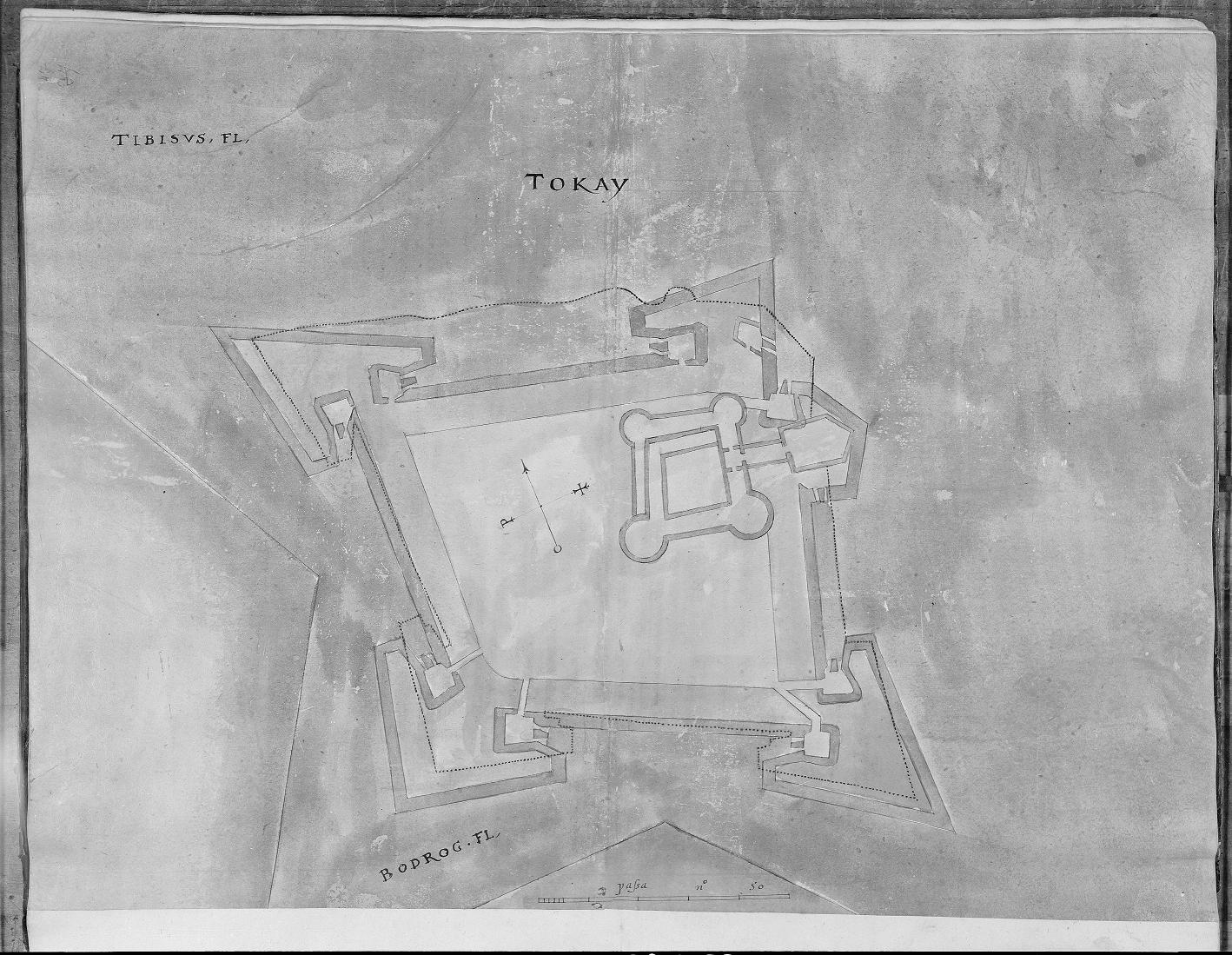
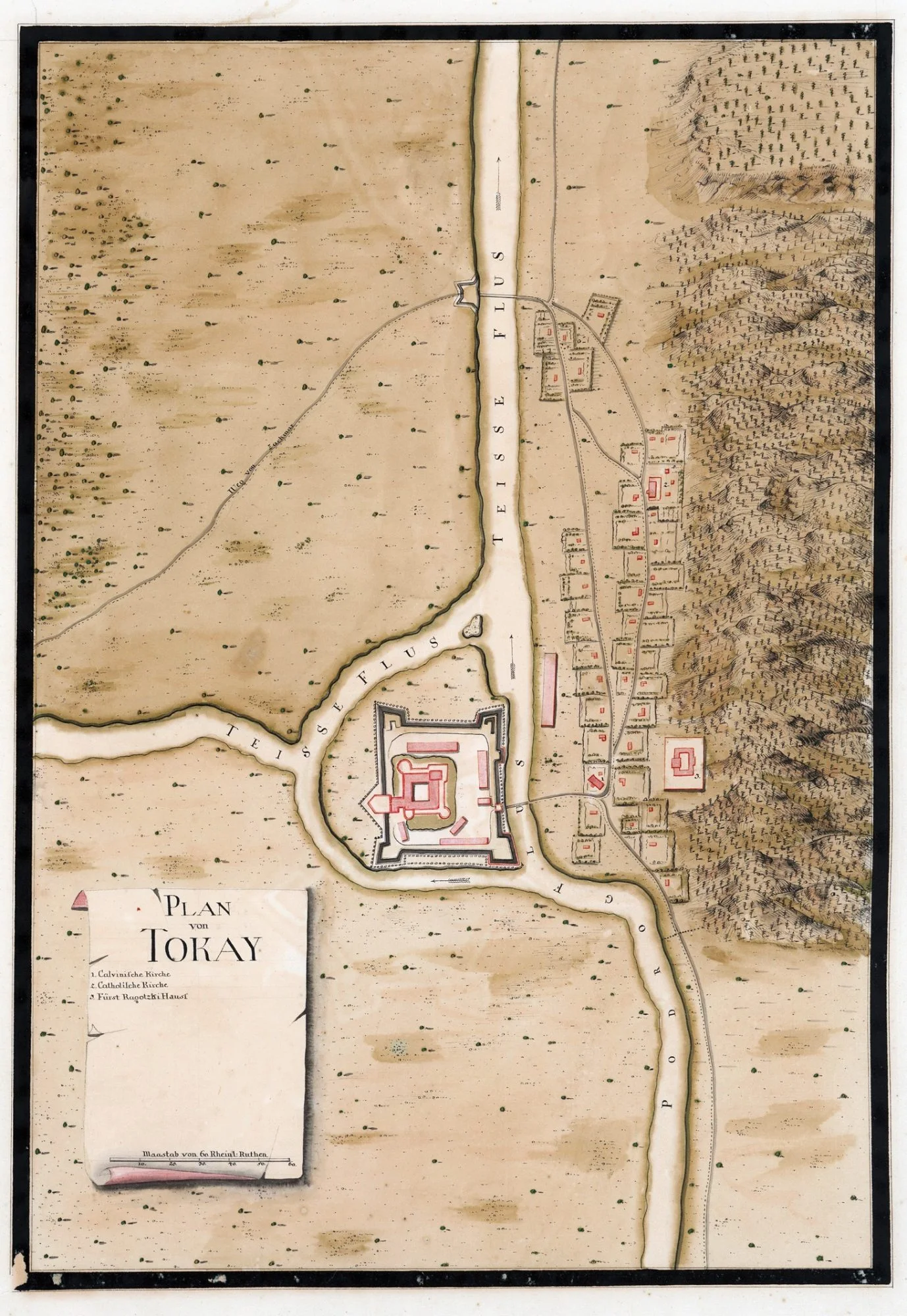
Both are in the Sächsische Landesbibliothek in Dresden, in collections catalogued as military rather than viticultural, which is why they are almost never cited in the literature on Tokaj. Between them they show the fortress and the town roughly a hundred and fifty years apart.
The two sources
Städteatlas des Nicolaus Angielus, c. 1560. Three sheets concern Tokaj: Blatt 33, a site plan, coloured drawing, 425 × 565 mm; Blatt 34, a plan, same size, only partly finished; and Blatt 47, a plan in coloured pen and ink, 435 × 560 mm, also only partly finished.
Sammlung von Festungsplänen, II: Planes von Italien, Ungarn, Pohlen und denen Nordischen Königreichen, drawn by Johann Georg Maximilian von Fürstenhoff, 1711–1732. Blatt 60, paper, ink and watercolour in pen and brush, 625 × 457 mm.
Angielus, c. 1560
The atlas sheets are the earlier record. Blatt 33 sets the fortress in its landscape: the confluence of the two rivers, the walled enclosure with its inner keep on the tongue of land between them, the hills drawn in wash on the right, and — the detail that matters here — a large hatched enclosure immediately north of the fortress, dotted with rows of small plants and annotated in the same hand. Blatt 47 is the fortification plan proper, titled TOKAY with TIBISVS FL. and BODROG FL. lettered at the margins: the square castle with its four round corner towers inside a bastioned outer trace, with a scale bar in passi at the foot.
Nicolaus Angielus, Städteatlas, c. 1560. Blatt 33 (site plan) and Blatt 47 (fortification plan). Sächsische Landesbibliothek, Dresden. Click either image to enlarge.
Fürstenhoff, 1711–1732
The Plan von Tokay is the more informative of the two for anything other than siegecraft. It is drawn in colour, with a cartouche keying three buildings: 1. Calvinische Kirche, 2. Catholische Kirche, 3. Fürst Ragotzki Hauss — the Rákóczi house, named as such on a Saxon military plan. The town is laid out as a single street of walled plots running north from the fortress along the Bodrog, and the whole eastern edge of the sheet is hill slope drawn as planted rows: the vineyards of the Tokaj hill, mapped as land use rather than as scenery.
Johann Georg Maximilian von Fürstenhoff, Plan von Tokay, Blatt 60 of the Sammlung von Festungsplänen, 1711–1732. The cartouche keys the Calvinist and Catholic churches and the Rákóczi house; scale in Rhenish rods. Sächsische Landesbibliothek, Dresden. Click to enlarge.
What both sheets offer the wine historian is a dated picture of where the vines actually stood. The Fürstenhoff plan puts the planted slopes hard against the town on the east and the open flood plain on the west, exactly the division the Hegyalja still works with; the Angielus enclosure, if the rows are vines, would push a mapped planting at Tokaj back to about 1560. That the Saxon court kept these sheets is not incidental: Dresden was one of the great consumers of Tokaji, and the Saxon cellar accounts run alongside these plans in the same city.
1595–96
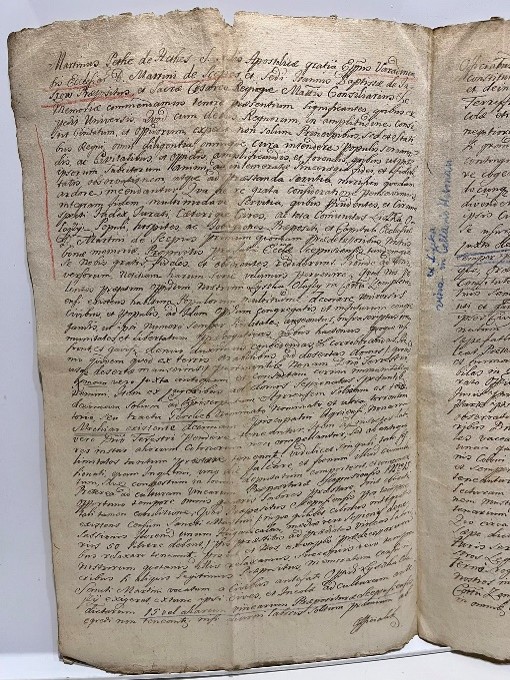
The privilege charter of Liszka Olaszi
A Latin privilege charter for the Hegyalja market town of Liszka Olaszi — today Olaszliszka, in Zemplén county — issued in 1595/96 by Martinus Pethe de Hethes, Bishop of Várad, Provost of St Martin of Szepes and of Jászó, and Imperial-royal councillor. The Szepes chapter was the town’s ecclesiastical landlord.
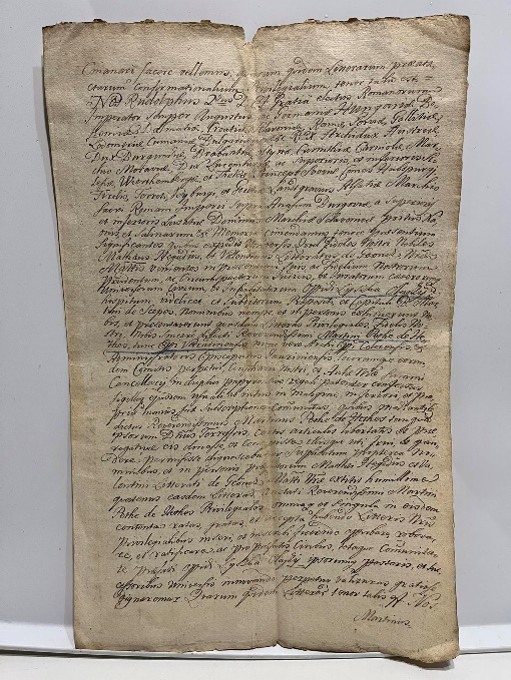
Confirmed by the Emperor. One page opens Nos Rudolphus Secundus Dei gratia electus Romanorum Imperator…, with the propalatine Nicolaus Istvánffy named among the officials.
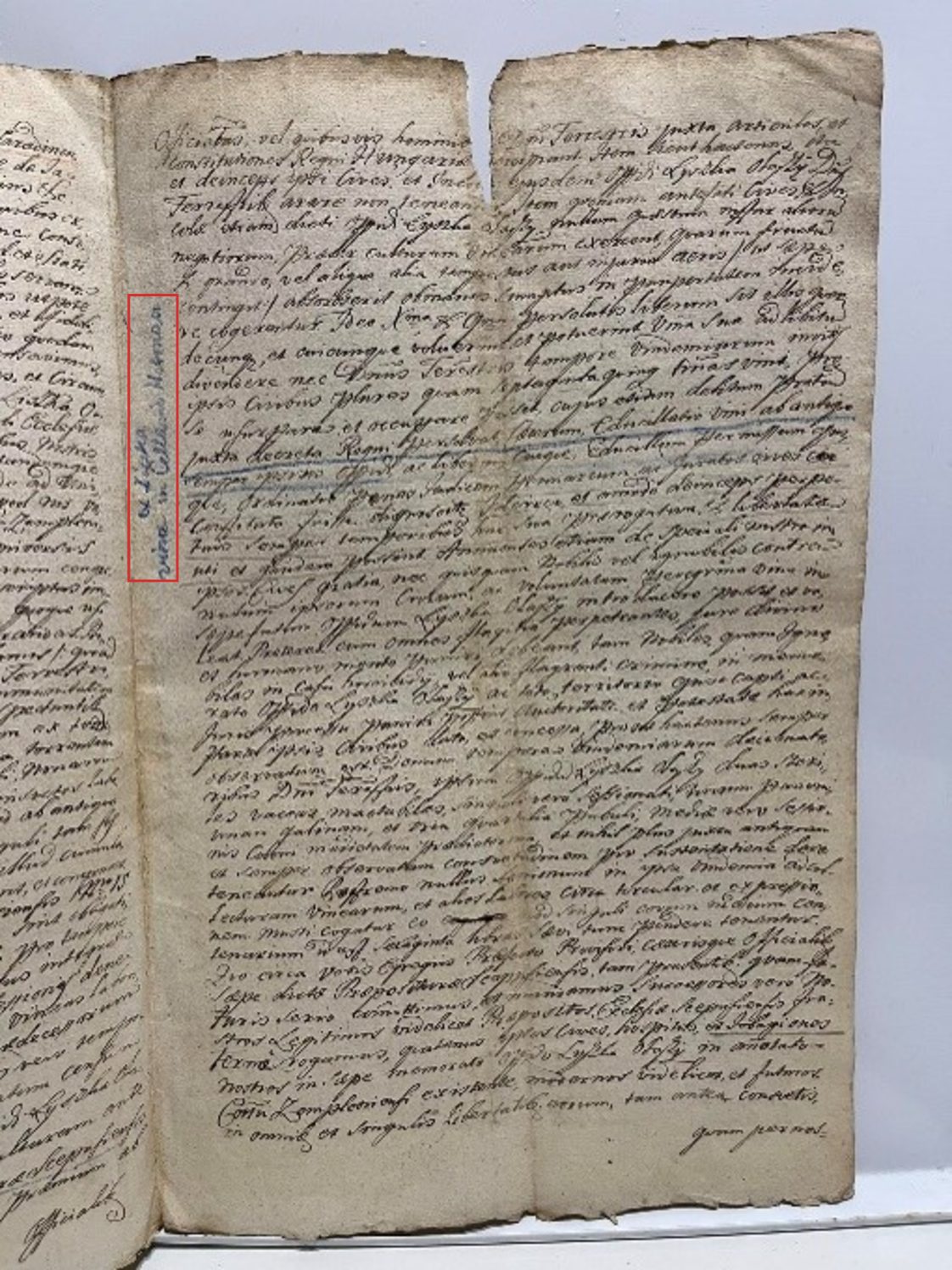
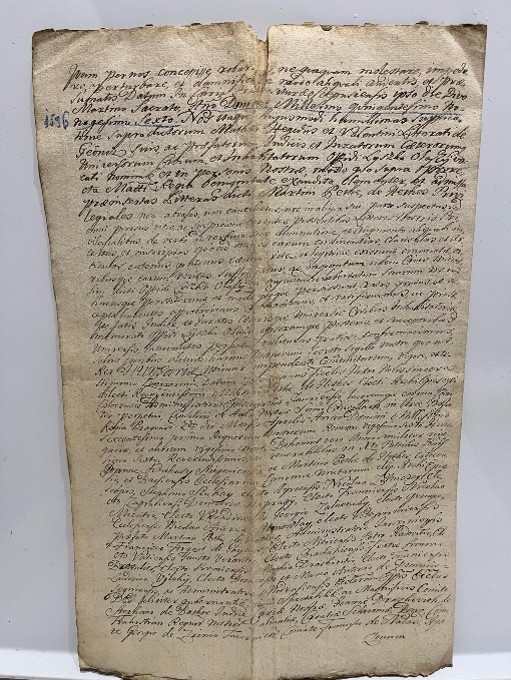
Not the original. An eighteenth-century copy: one bifolium, four written pages in a chancery hand, damaged along the folds, with a red pencil mark on one page and blue-ink annotations of the nineteenth or twentieth century on two others.
Addressed to the community.Judex, Jurati caeterique cives ac tota Communitas — the judge, jurors, all citizens and the whole community — described as hospites ac jobagiones of the Provost and Chapter of Szepes.
What it regulates — all of it wine
The citizens’ obligation to work the provostship’s vineyards — ad culturam vinearum Praepositurae Scepusiensis … labores praestare — with a stated number of vineyards and deliveries around St Martin’s day and mid-September.
Their right to sell their own wines (vina sua … vendere / divendere), limited only as the decrees of the Realm allow (juxta decreta Regni).
Restrictions on the landlord’s own tavern (educillum).
Dues owed at vintage time (tempore vindemiarum).
The preamble justifies the grant in the standard humanist manner — the glory of kingdoms rests on the flourishing of their towns, so lords must foster and enlarge them — and rewards the townspeople’s fidelity to the provost’s predecessors. The word Tokaj does not occur. The charter is nonetheless a first-rank early source on how one of the classic Hegyalja villages organised vineyard labour, wine sale and vintage dues in the 1590s: a decade before the first aszú records, and at the moment Polish demand for Hegyalja wine was taking off.
The annotations, and the Fukier connection
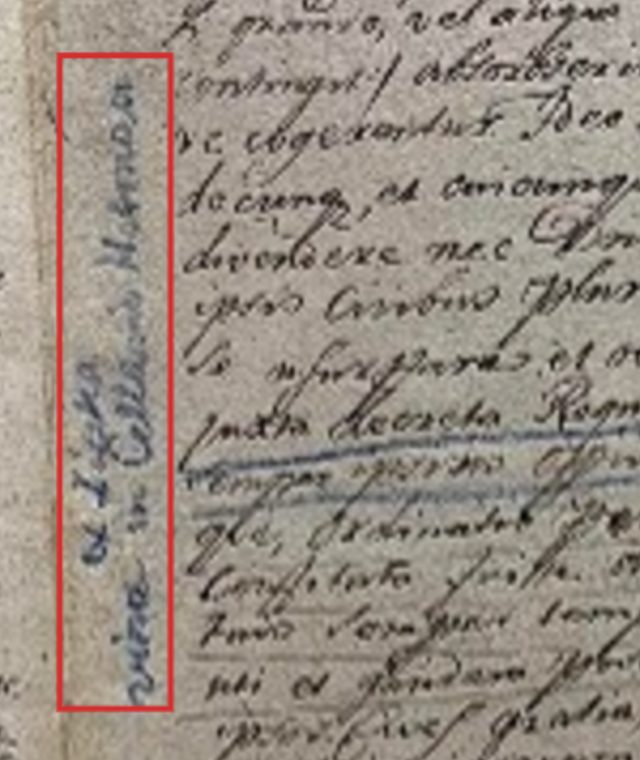
In blue ink a later hand has written in the margin “a Liszka — vina in Cellario Hetman”, underlined the adjacent clause on the citizens’ wine-selling rights, and noted “1596” beside the dating clause. That links the charter to the wina hetmańskie, the legendary oldest Tokaji stock of the Warsaw Fukier and Rozmanith cellars: Krajewski’s report of 1870 states that Fukier’s wines “already old in 1606” came, according to their pedigree and armorial seal, from the cellars of Hetman Stefan Potocki.
The annotator was evidently using this charter as part of that pedigree — as evidence that the Hetman’s wines were Liszka wines of the 1590s. It makes it likely that the copy travelled in Polish hands, plausibly in the Fukier house archive, as a provenance document for the wine rather than as a Hungarian estate record.
The annotation, enlarged and marked in red: a Liszka — vina in Cellario Hetman. The blue underlining beside it runs under the clause on selling wine juxta decreta Regni. Click to enlarge.
The four written pages of the bifolium: the opening with Pethe’s titles, the annotated page, the imperial confirmation, and the closing page with the marginal 1596. Click any image to enlarge.
1683
A gift of Hegyalja wine to Palatine Pál Esterházy
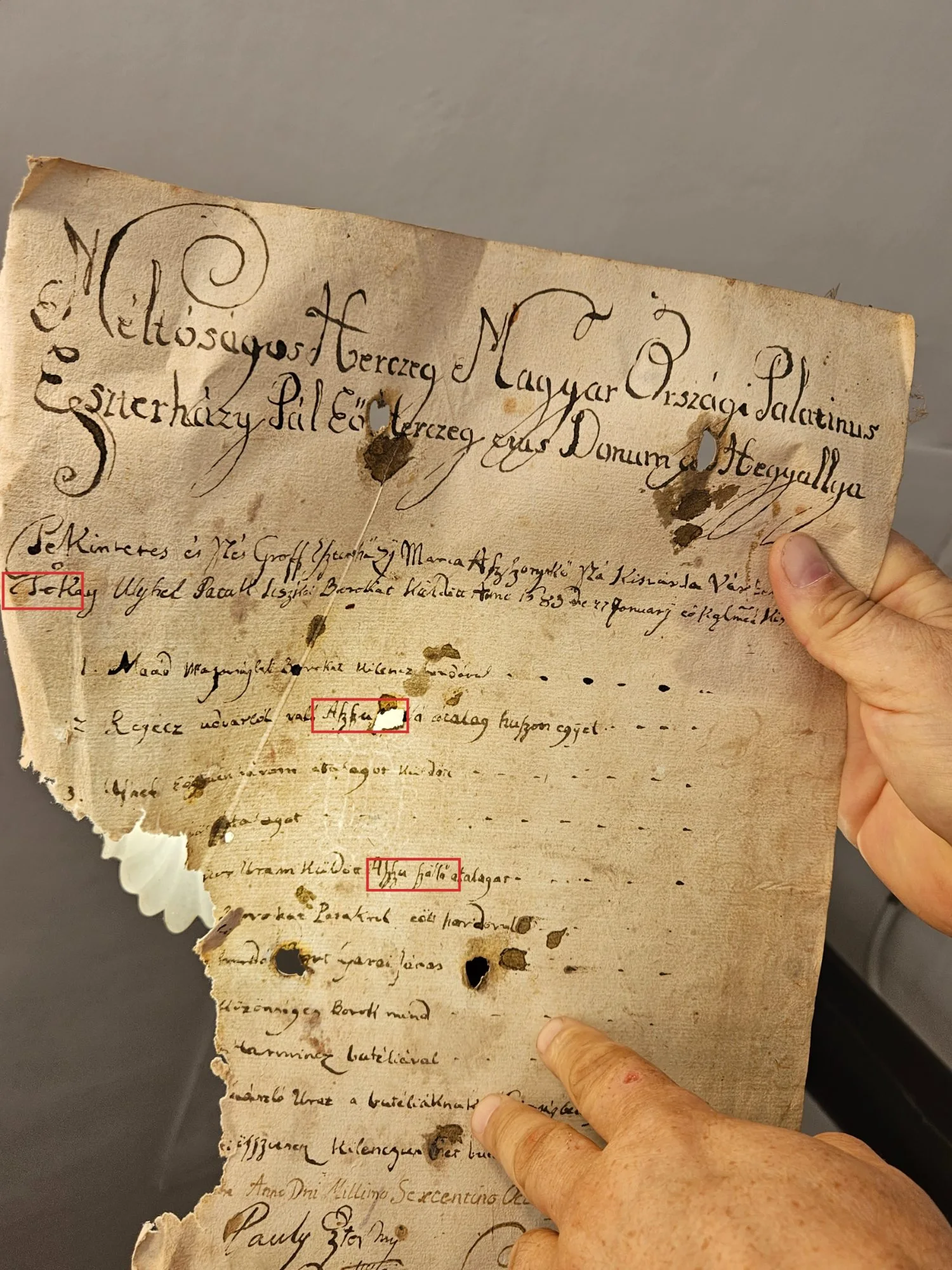
A wine-shipment list in Hungarian, recording Hegyalja wines sent from Kisvárda castle to the Palatine of Hungary, Pál Esterházy, on 27 January 1683. The sheet is a notarially attested copy made in 1688, one leaf of paper, torn at the lower left and pierced by several ink and burn holes which have taken parts of lines four to eleven.
The heading
Méltóságos Herczeg, Magyar Országi Palatinus Esterházy Pál Eő Herczeg[ségének] — eius Donum a Hegyallya.
Beneath it, the Countess Mária Esterházy is named as the sender of the Tokay, Ujhely, Patak, Liszkai wines from Kisvárda castle — the four names that defined the Hegyalja in the 1680s.
The consignment, as far as the holes allow it to be read:
Mád demesne wines — nine barrels (kilencz hordóval).
From the Regéc manor, aszú-szőlő — twenty-one átalag (átalag huszon egyet).
From Újhely — three átalag.
A further consignment of aszú-szőlő, the sender’s name lost in the tear.
Wines from Patak — five barrels.
Common wines (közönséges borok), and thirty bottles (harmincz butéliával), with the steward held accountable for the demesne bottles.
In all, ninety-odd bottles of wine.
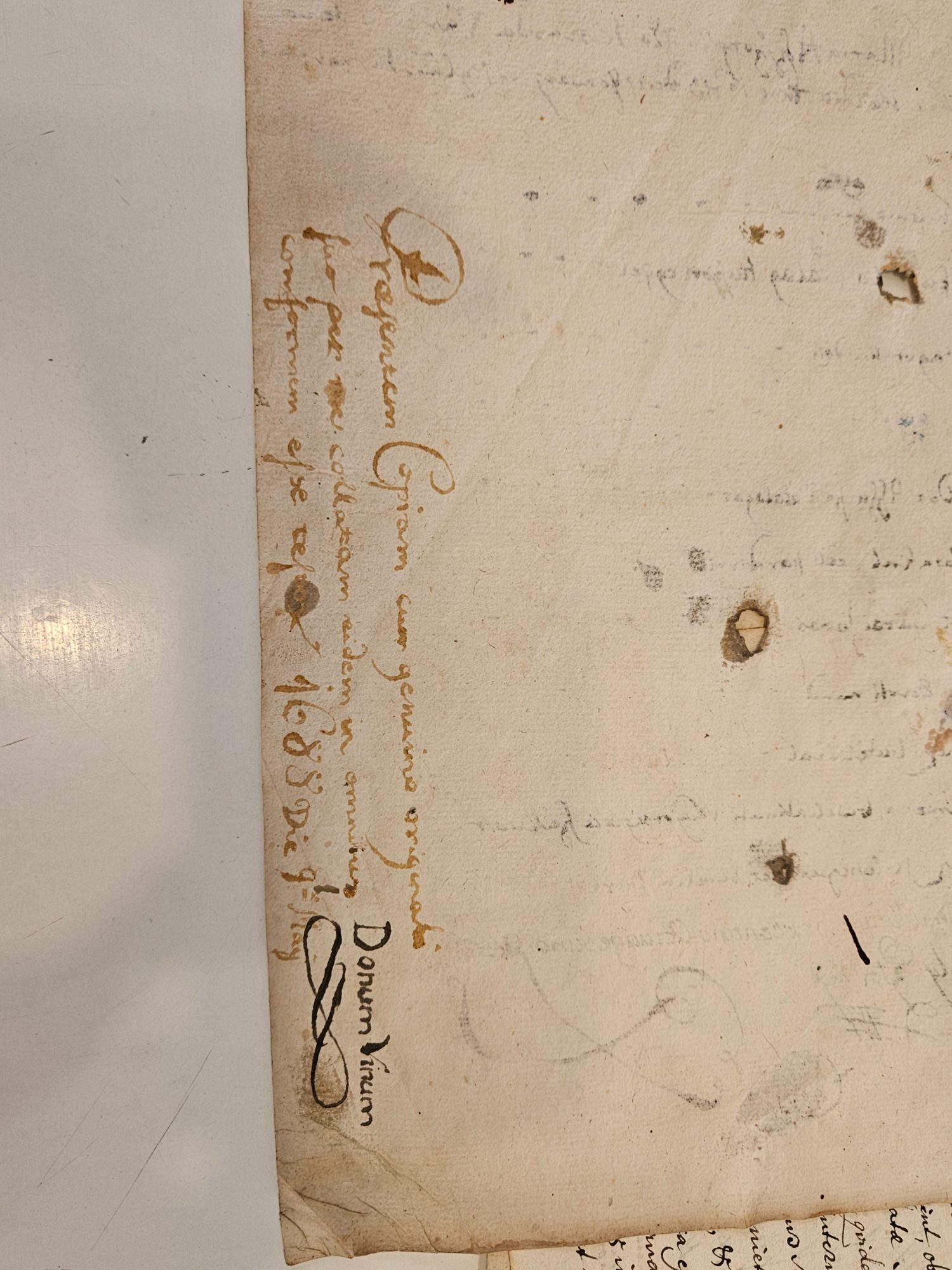
It closes Anno D[omi]ni Millesimo Sexcentesimo Octuagesimo Tertio with a signature reading Pauly Est[erhá]zy and a wax seal. On the verso, in a different Latin-writing hand: “Praesentem Copiam cum genuino originali suo per me collatam, eidem in omnibus conformem esse testor. 1688 Die 9 Maij”, with the docket Donum Vinum.
Recto and verso. Tokay in the header line and both occurrences of Aszszú Szőlő are marked in red. Click either image to enlarge.
Why it matters
Aszú by name, 1683. Two lines name aszszú szőlő explicitly — twenty-one átalag from the Regéc manor alone. Dated, quantified, estate-attributed mentions of aszú from the seventeenth century are rare, and this one predates the classic Rákóczi-era sources. The attribution matters too: Regéc was the Rákóczi domain, Ilona Zrínyi’s, in 1683 under Thököly’s control, and its manor wines were the best of the Hegyalja.
Bottles, 1683. Wine counted in butélia — thirty from one source, ninety-odd in all, with a steward answerable for them. Glass bottles as a unit of shipment for Hegyalja wine at this date is very early, and it sits alongside the glass-making tradition of the Regéc and Sárospatak forests.
A hierarchy of packaging.Hordó (barrel) for the Mád and Patak demesne wines, átalag — the small Hegyalja cask — for the aszú, bottles for the finest. The three tiers already mirror quality.
The people. Mária Esterházy at Kisvárda was the Palatine’s sister, widow of Count György Homonnai Drugeth, whose family held Hegyalja and Upper-Tisza estates; Kisvárda itself was an Esterházy–Nyáry inheritance. The docket Donum Vinum and the heading eius Donum a Hegyallya make the sheet the record of a family gift — sent in the winter of the year of the siege of Vienna, with the Hegyalja in rebel hands, across the lines.
The title dates the copy. Esterházy was Palatine from 1681 but became a Prince of the Empire only in 1687, so the Herczeg of the heading belongs to the attested copy of May 1688 rather than to the original.
Two things remain to be checked: whether the seal at the foot shows the Esterházy griffin, and whether it authenticates the copyist rather than Esterházy himself; and where the sheet has been kept, since a document of this kind would normally be expected in the Esterházy archive (MNL OL P 108, Repositorium).
1693
A cask of Tokaji, sent by Rákóczi’s hand
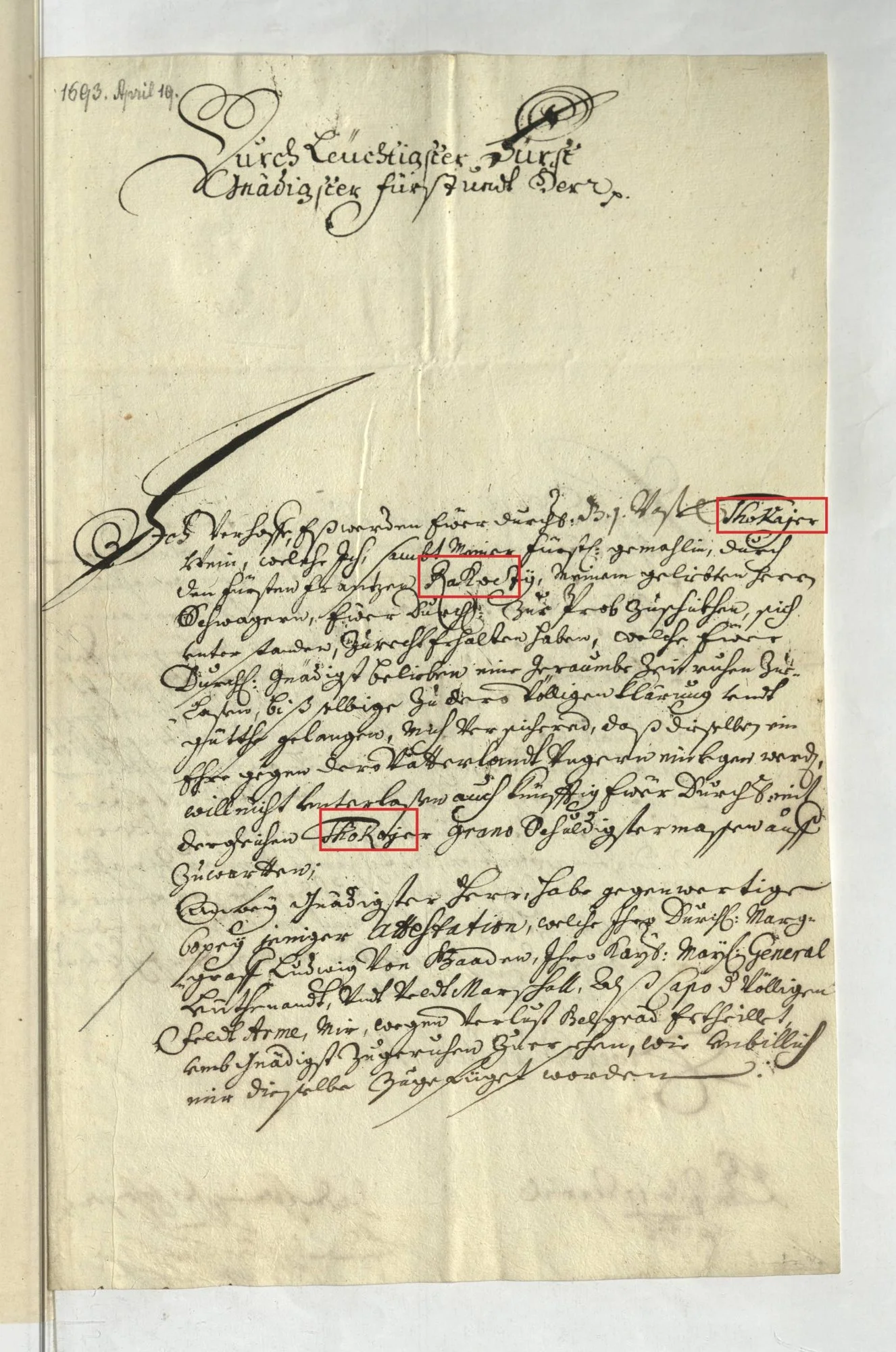
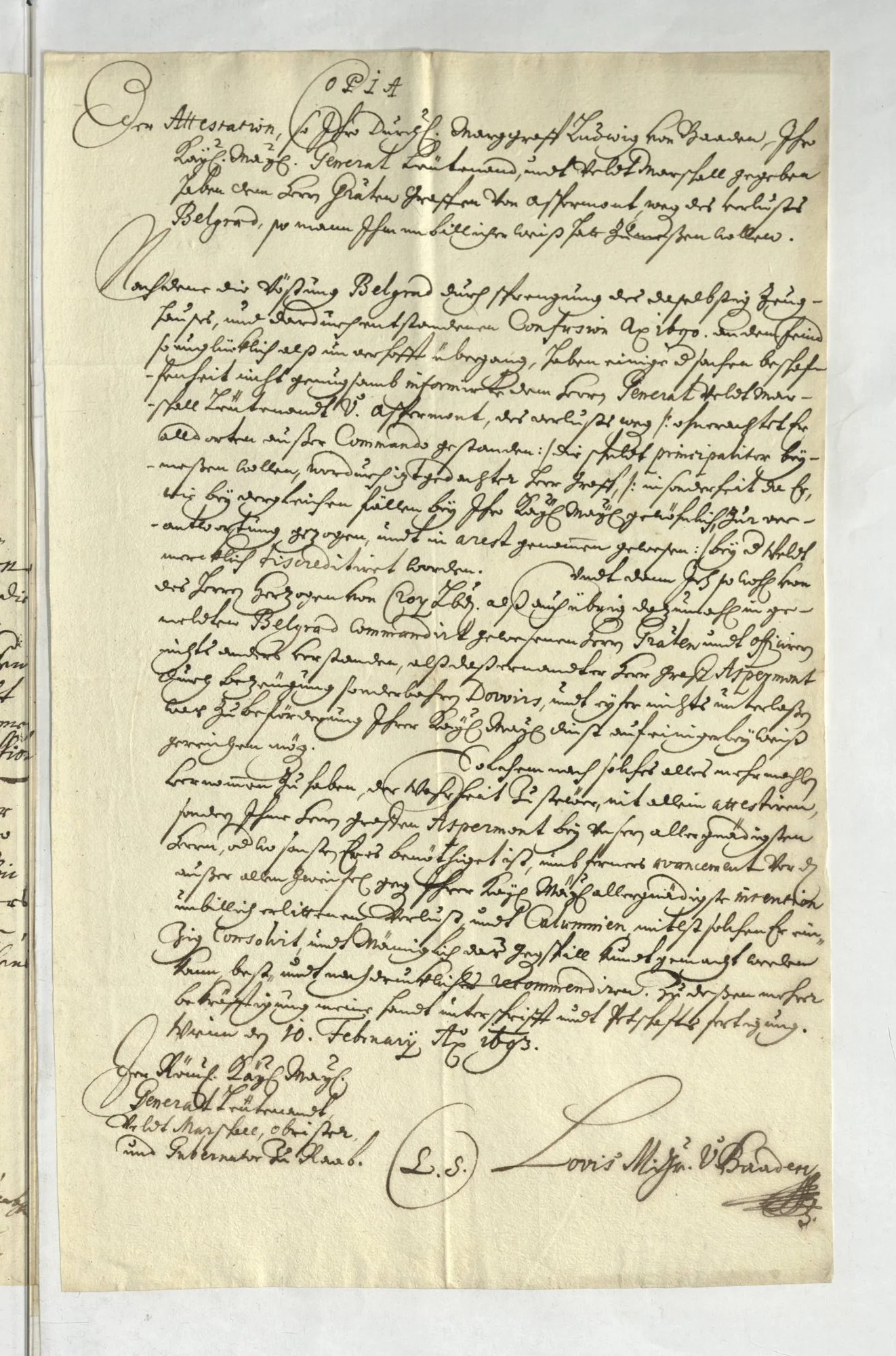
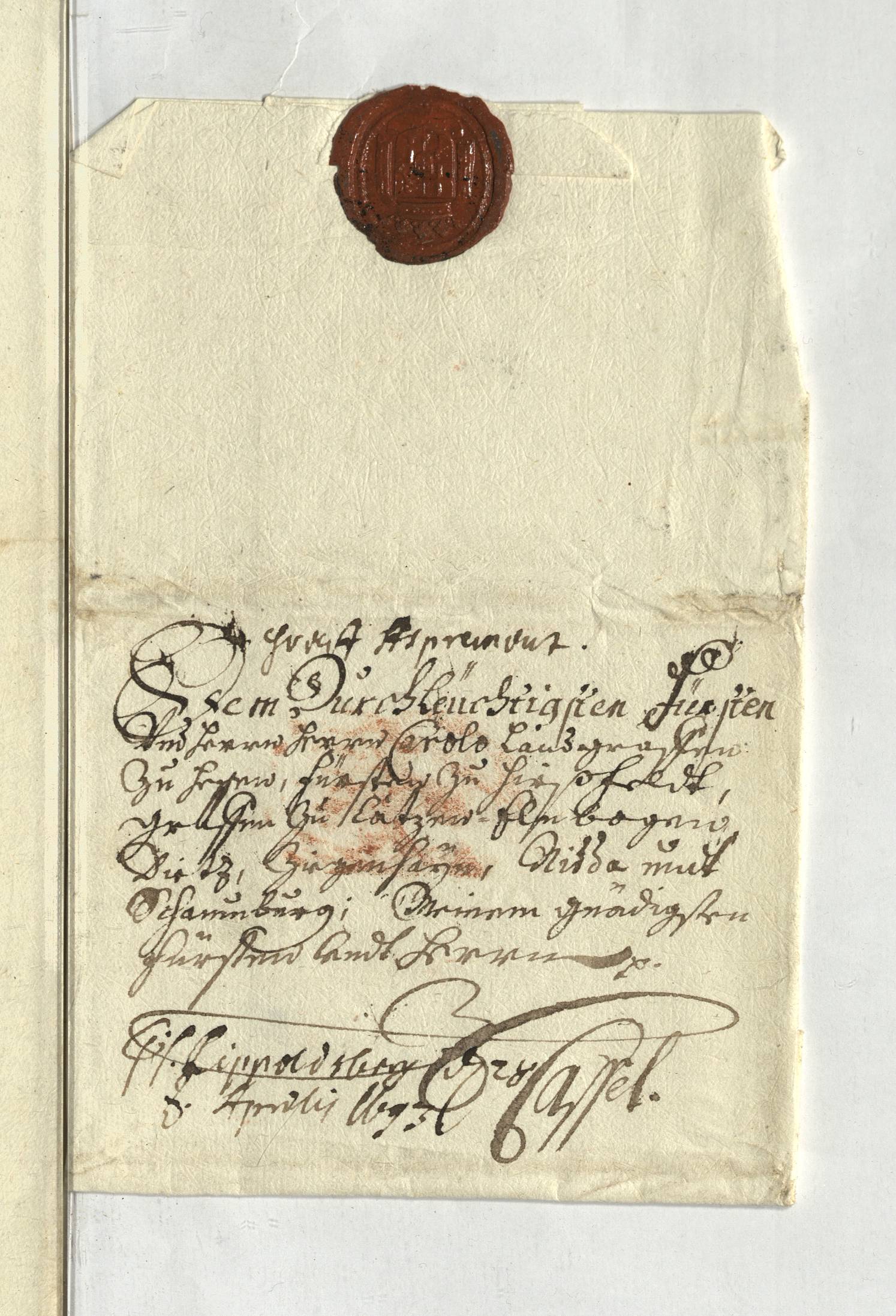
A letter of 19 April 1693 from Count Ferdinand Gobert of Aspremont to Landgrave Karl of Hesse-Kassel, announcing a cask of Tokaji carried to Kassel by the writer’s brother-in-law — Prince Francis II Rákóczi, then seventeen. With it goes a copy of the certificate clearing Aspremont of blame for the fall of Belgrade.
Aspremont had married Juliana Barbara Rákóczi in Vienna in 1691 without the Emperor’s consent, and in April 1693 was travelling to take possession of her half of the Rákóczi inheritance — the estates that included the Tokaj vineyards. The letter is written from the lordship of Lednitz on that journey.
The wine
“I hope that Your Serene Highness has duly received the cask of Tokaji wine which I, together with my princely consort, took the liberty of sending Your Highness as a sample through Prince Francis Rákóczi, my beloved brother-in-law. May it please Your Highness to let it rest for a good long while until it reaches its full clarity and quality; I assure myself that it will do honour to its fatherland, Hungary.”
A sample, not a sale.Zur Prob — the opening move of a supply relationship, with a promise of “more Tokaji of the same kind” to follow. The gift channel, not the trade, is how Tokaji reached the German courts in this period.
Cellaring instructions, in 1693. The wine is to lie until it falls bright and reaches its Klärung undt Gütthe: shipped young and turbid, meant to be laid down rather than drunk on arrival.
Sent as an ambassador. The Landgrave is invited to judge Hungary by the wine — from a couple then fighting for their Hungarian inheritance.
Carried by Rákóczi himself. The greatest Tokaj vineyard owners of the age, one year before Francis II married Charlotte Amalie of Hesse-Wanfried.
The enclosure is the other half of the errand. Margrave Ludwig Wilhelm of Baden — “Türkenlouis”, imperial field marshal and Governor of Raab — certifies in Vienna on 10 February 1693 that the fortress of Belgrade fell in 1690 through the explosion of its powder magazine and the confusion that followed, not through Aspremont’s negligence; that the Duke of Croÿ and the other officers present confirm he omitted nothing in the Emperor’s service; and that his arrest followed the customary procedure rather than any verdict. Aspremont explains why he had held the paper back for two months: had he published his rehabilitation before the estates were secured, his enemies at court would have blocked the succession.
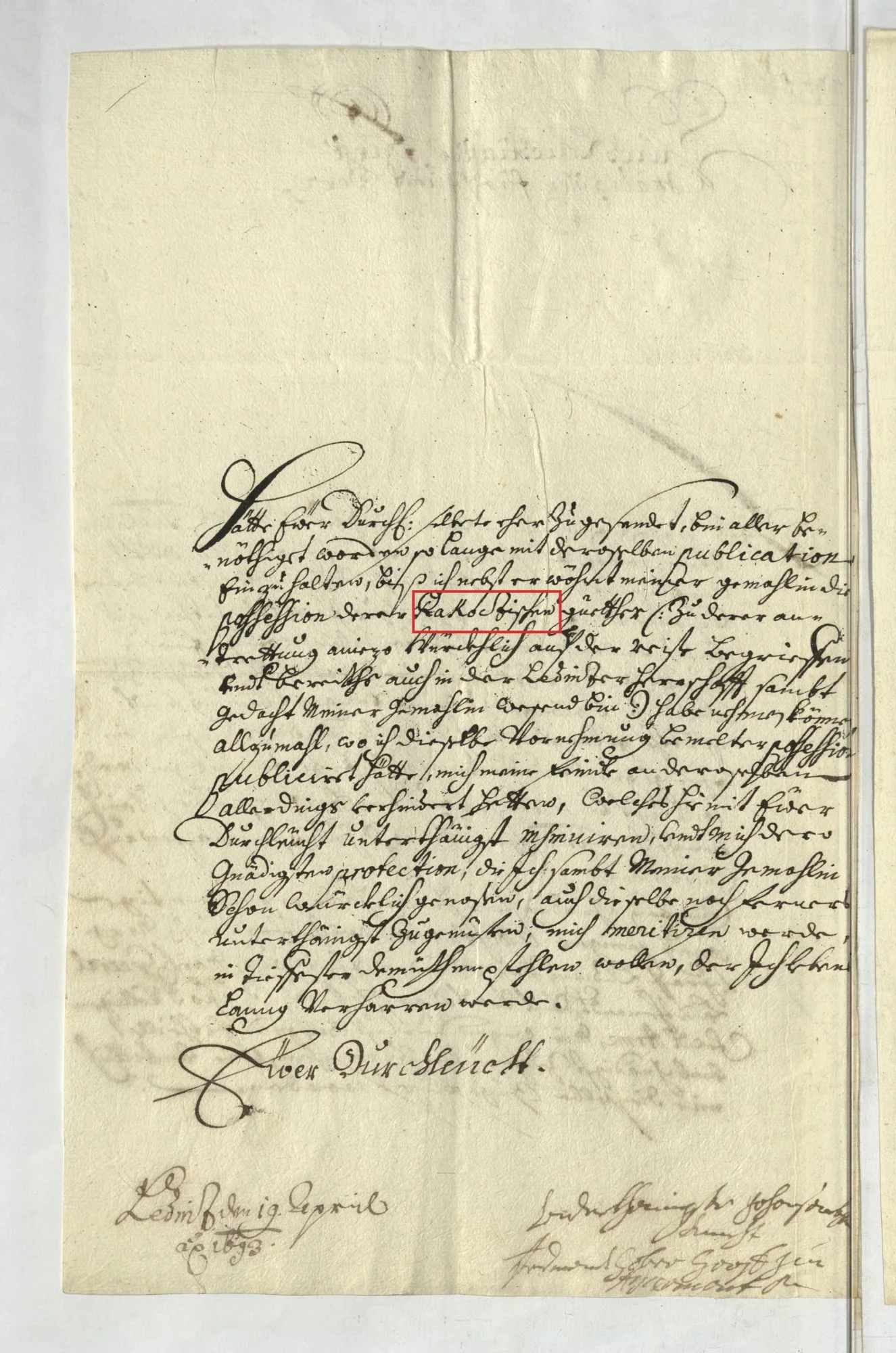
The letter of 19 April 1693 and its second page, with every occurrence of Thokäyer and Rakoczÿ marked in red, the enclosed copy of the Baden attestation, and the address leaf with Aspremont’s armorial seal. Hessisches Staatsarchiv Marburg, Cassel’er Cabinets-Acten, “4 f. Graf von Aspermont Nr. 5”. Postal notes: Lippoldsberg 28 April, presented at Veckerhagen 29 April 1693 (Julian). Click any image to enlarge.
1718
A printed map of Hungary turned into a sealed attestation
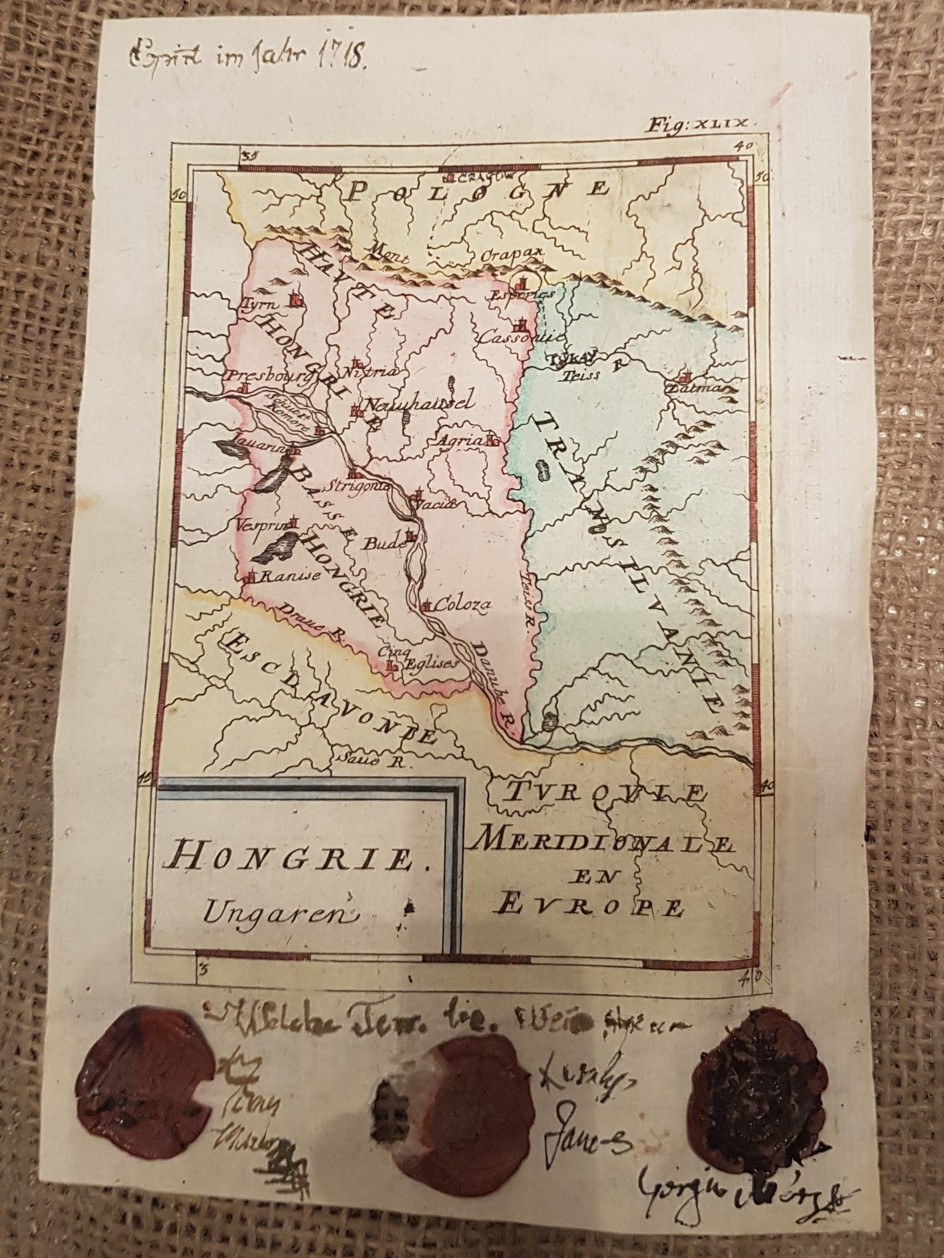
Alain Manesson Mallet, Hongrie. Ungaren., plate Fig. XLIX, from Description de l'Univers — specifically the Jean David Zunner edition, Frankfurt 1686, the one with French text and German titles. About 150 × 110 mm, copper engraving, issued uncoloured, so the colouring here was added by hand afterwards. That gives a firm floor: the sheet cannot be older than 1686, and the manuscript work on it is dated 1718 — a generation after printing.
Mallet's Hungary, hand-coloured, with the 1718 note in the top margin, the caption cutting across the printed border at the foot, and the three red wax seals beneath it. TOKAY is lettered in capitals on the Teiss · click to enlarge
Transcription of the manuscript additions
Top margin, German Kurrent: „Copirt im Jahr 1718.“ — copied in the year 1718. The first word is the least secure thing on the sheet; the initial capital swallows its second letter, and Geprüft (examined) is a possible alternative reading.
Across the foot of the plate, cutting over the printed border: „Welche Terr. die Wein …“ — which territor[ies] the wine …. The last two or three words sit on abraded, discoloured paper and I cannot read them. Terr. is an abbreviation and expands to Territorien, Terrena or Terrae — territories, lands, or grounds.
Below that, three red wax seals, each with a signature. Left, three cramped lines ending in what is probably Mihály. Centre, two lines: a surname reading something like Kiszely or Keszely, then János. Right, over the best-impressed of the three seals, György or Georgi[us] followed by a surname beginning M or W. All three are Hungarian, written surname-first in the Hungarian manner.
What the object is
A printed map turned into a legal exhibit. Three seals with three signatures beneath a written caption is the standard form of a Hungarian attestatio or testimoniales — sworn testimony given under seal, typically by county jurors or sworn men. The 1718 note tells you the sheet is functioning as an verified copy, not as a book plate. Someone took a thirty-two-year-old Mallet engraving, coloured it, wrote a question or statement about wine and territories across its foot, and had three men seal and sign it.
What it is probably about
The caption pairs territories with wine, the map has TOKAY lettered in capitals on the Teiss, and the date is 1718. That decade is exactly when the extent of the Hegyalja was contested: the Rákóczi estates had passed to the crown after the Peace of Szatmár in 1711, and the great settlement of the question — Charles VI's decree closing Tokaj-Hegyalja as a district, routinely called the world's first wine appellation — comes in 1737. A sealed attestation of 1718 asking which territories belong to the wine would sit nineteen years upstream of that decree, and would be a document of real significance.
But that is where the evidence runs out and inference begins. The operative words cannot be read. Welche Terr. die Wein … could as easily introduce a statement about wine tithes, duties, trade routes or rights of sale as about district boundaries. The map is also the wrong scale for a boundary exhibit — it shows the whole kingdom at about 1:4,000,000 and marks no Hegyalja village except Tokay itself, which argues for a general illustrative purpose rather than a survey.
1736 · 1739
Tokaji for Cardinal Fleury: the Württemberg gift to Paris
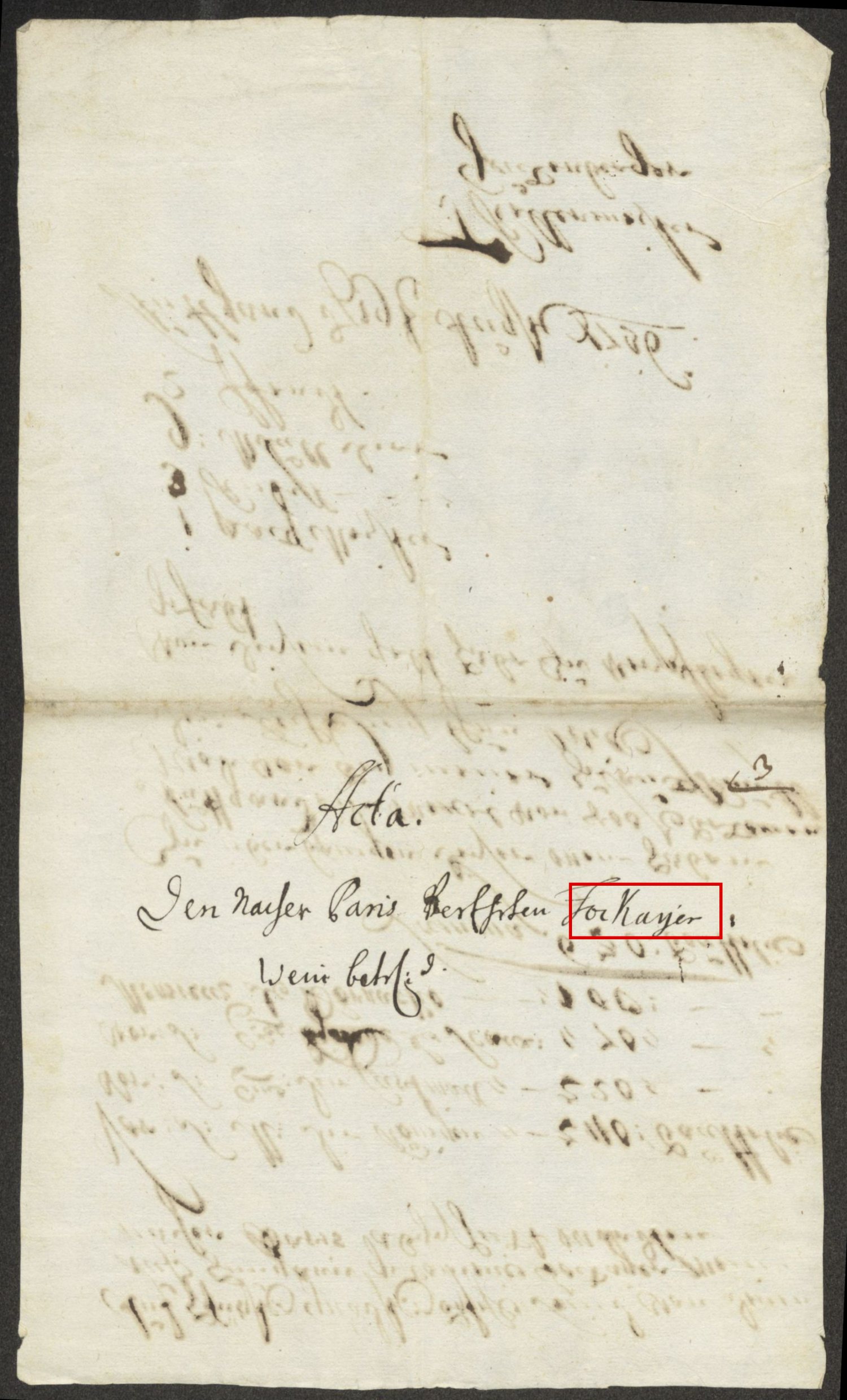
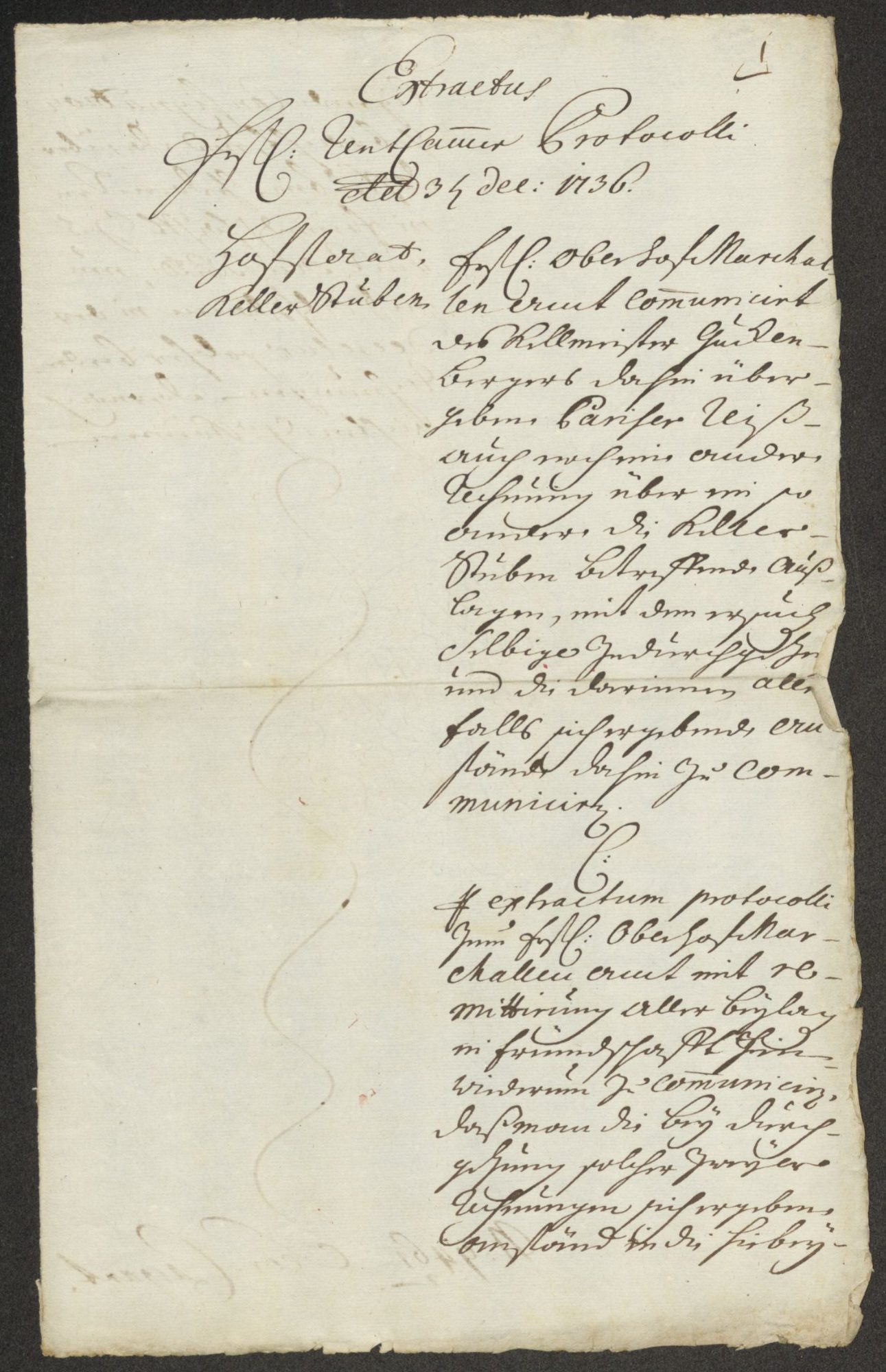
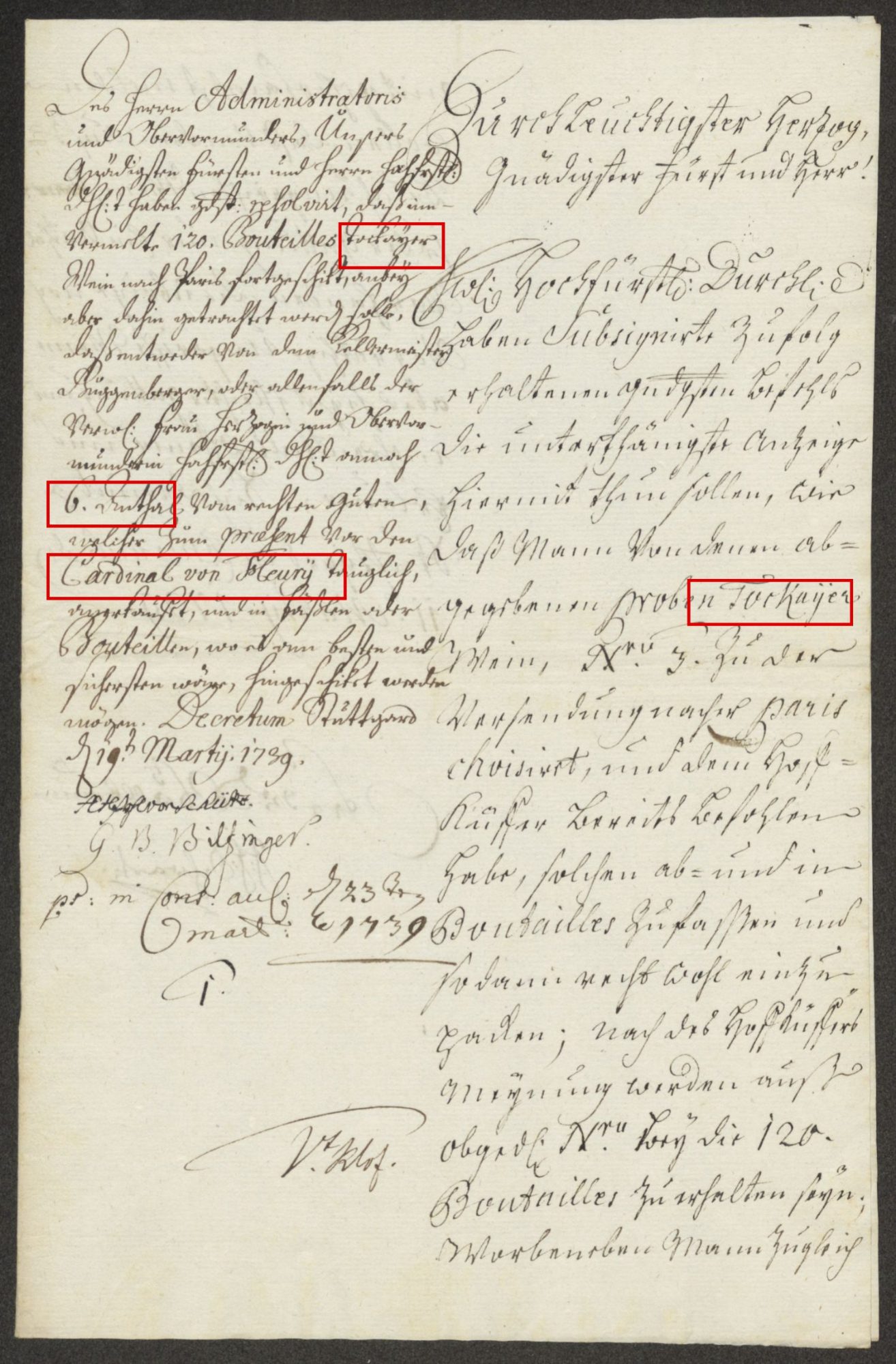
A sub-fascicle of twelve leaves in the Hauptstaatsarchiv Stuttgart, Bestand A 21 (Oberhofmarschallamt), Bü 474, Acta Hoffküfferey Fremde Weine, headed Acta. Den nacher Paris verehrten Tockayer Wein betr. — acts concerning the Tokaji wine presented to Paris. Reports of the Württemberg court marshal’s office with the regency government’s decrees written in the margins, running from August 1736 to May 1739.
In March 1739 the Württemberg regency government decided to send Tokaji to Paris as a present for Cardinal Fleury. The occasion was a negotiation being conducted in Paris by the privy councillor von Keller. Behind it lay Montbéliard, Württemberg’s French-speaking county under constant pressure from France: the wine was an instrument for keeping French goodwill.
The two courts
The Württemberg regency. Duke Carl Alexander died suddenly in March 1737, leaving a minor as his heir. The duchy was therefore governed for the eleven-year-old Duke Carl Eugen by an Administrator, Duke Carl Rudolf of Württemberg-Neuenstadt, with the Dowager Duchess Maria Augusta as guardian. It is the Administrator who decrees the gift; the papers call him des Herrn Administratoris und Obervormunders … Hochfürstl. Durchl.
The recipient.André-Hercule de Fleury (1653–1743), cardinal since 1726 and first minister of Louis XV, was the effective ruler of France from 1726 until his death. In 1739 he stood at the height of his influence, having just concluded the Treaty of Vienna. Any German court with business in Paris had to go through him.
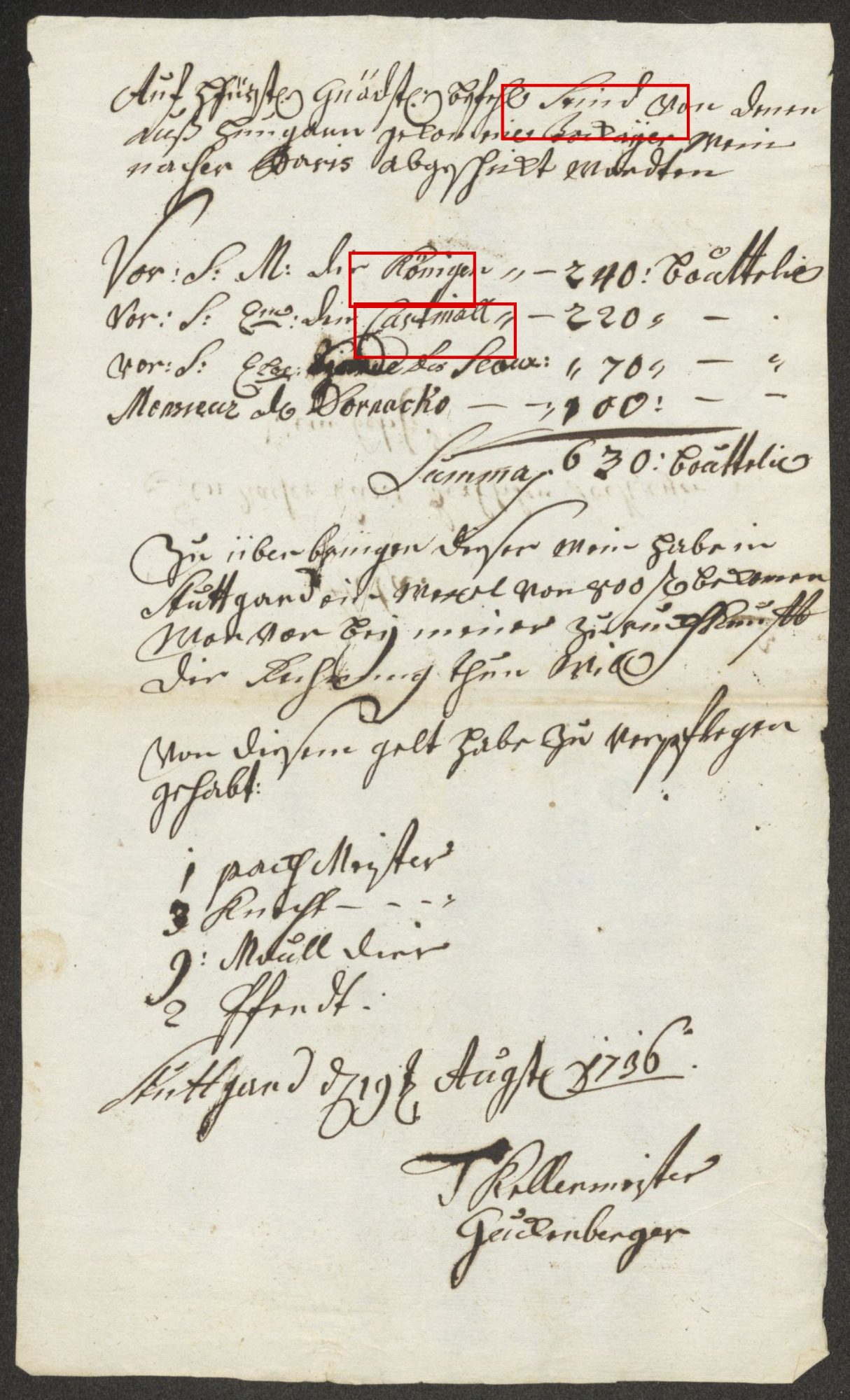
There was a precedent in the family. Duke Carl Alexander, Carl Eugen’s father, had already sent 630 bottles of Tokaji to Paris in August 1736 — 240 of them for the Queen of France, Marie Leszczyńska, wife of Louis XV, and 220 for Cardinal Fleury. The 1739 gift consciously repeats it.
The precedent · Stuttgart, 19 August 1736
“Auf Hochfürstl. gnädst. Befehl seind von denen auß Ungarn gekommenen Tockayer Wein nacher Paris abgeschickt worden: Vor S. M. die Königin — 240 Bouteille. Vor S. Em. den Cardinall — 220. Vor S. Exc. de Seau — 70. Monsieur de Dorsacko — 100. Summa 630 Bouteille.”
“By most gracious princely order there have been sent to Paris, of the Tokaji wine that came from Hungary: for Her Majesty the Queen 240 bottles; for His Eminence the Cardinal 220; for His Excellency de Seau 70; Monsieur de Dorsacko 100; total 630 bottles.” Signed by the cellar-master Geidenberger, who escorted the wine himself on a bill of exchange of 800 florins, maintaining a pack-master, three servants, a mule and two horses. The Queen is Marie Leszczyńska; the Cardinal is Fleury. The last two recipients remain unidentified.
Left, the list of 630 bottles, 19 August 1736, with der Königin and den Cardinall marked. Centre, the cover of the sub-fascicle, with Tockayer marked. Right, the Rentkammer protocol of December 1736 sending the cellar-master’s Paris travel account to be audited — the administrative tail of the first gift. Click any image to enlarge.
March 1739: 120 bottles, and six Antal to buy
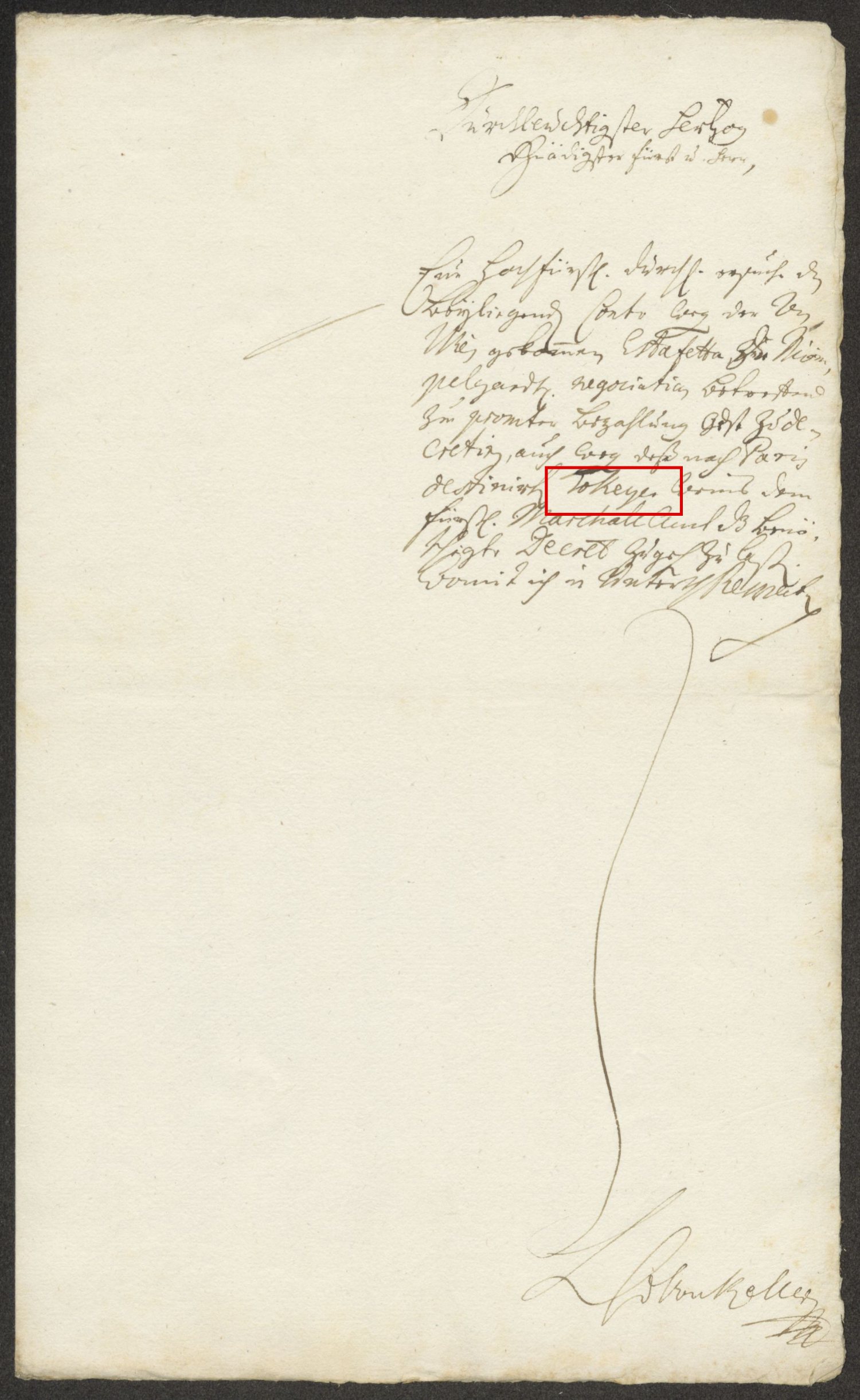
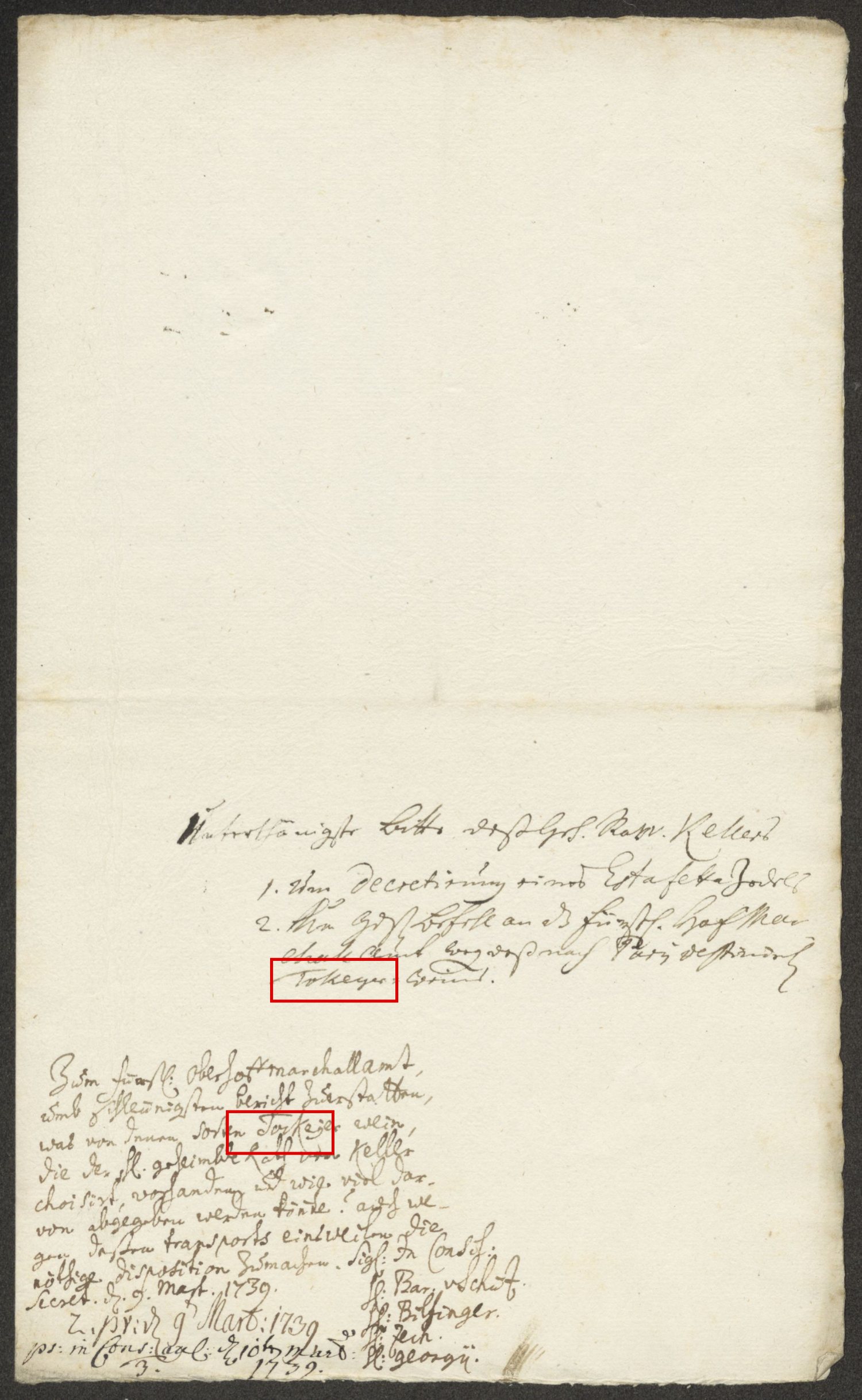
Keller writes from Paris asking for the Tokaji he has chosen and for payment of an express courier to Montbéliard. On 9 March 1739 the Privy Council — Schütz, Bilfinger, Zech, Georgii — orders the Oberhofmarschallamt to report with all speed what is in stock of the sorts Keller had selected, and meanwhile to arrange the transport.
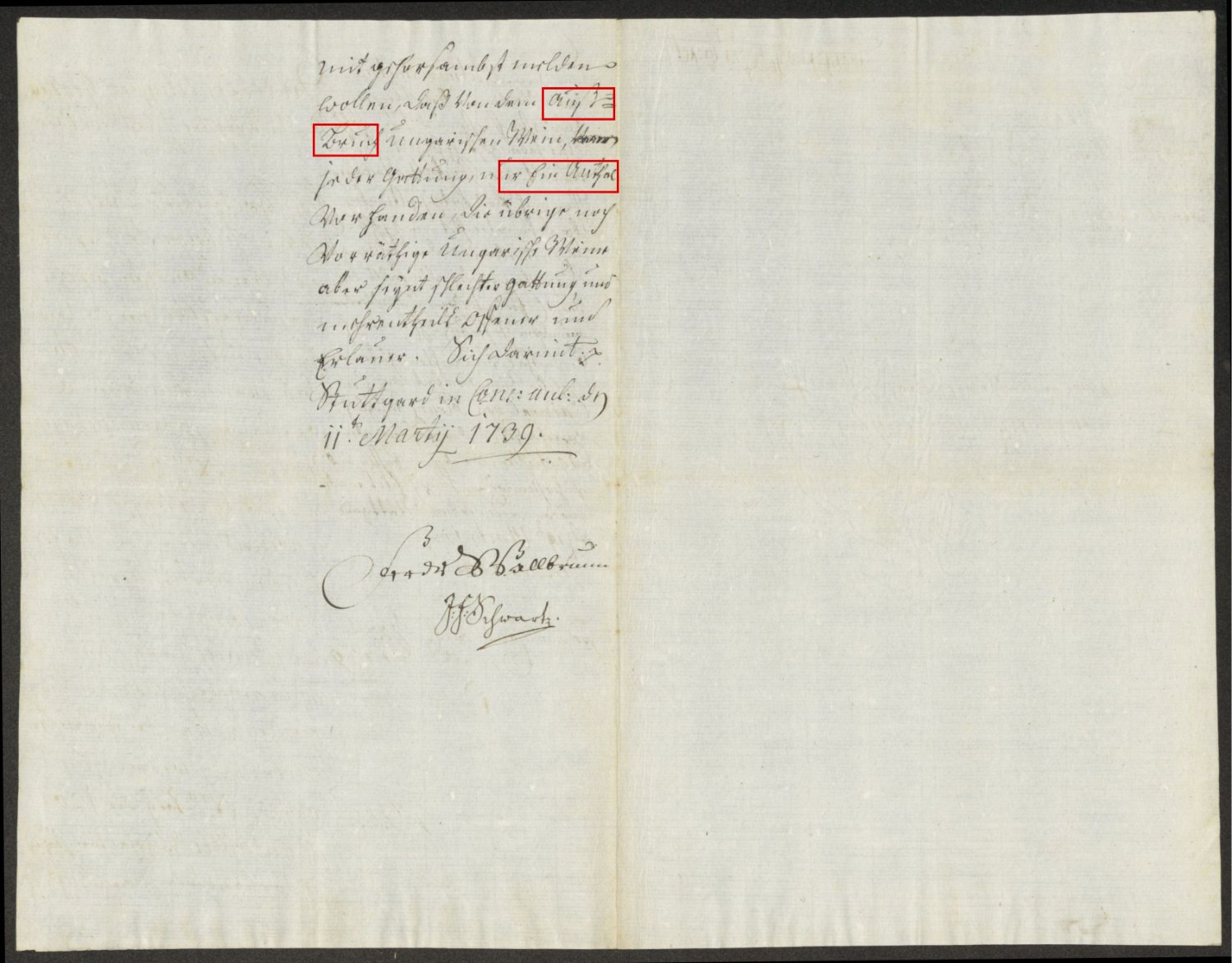
The marshal answers on 11 March: sample No. 3 has been chosen, the court cooper has been ordered to draw it into bottles and seal them well, and about 120 bottles should be got from it. He adds a warning about the cellar itself — of the Hungarian Ausbruch only one Antal of each kind is left, and what remains besides is of poor quality, mehrentheils Ofener und Erlauer. Two years earlier the same cellar had taken in 49 Antal of Ausbruch.
The Administrator’s decree of 19 March, signed by the philosopher-councillor G. B. Bilfinger, stands in the margin of that report: send the 120 bottles to Paris, and buy a further six Antal vom rechten guten, welcher zum Präsent vor den Cardinal von Fleury tauglich — of the truly good kind, fit for a present to Cardinal Fleury — in casks or bottles, whichever is safest.
The March papers, with every mention of Tokaji, of the Antal cask and of Fleury marked in red. Left, Keller’s petition from Paris. Centre, its rubrum with the Privy Council’s order of 9 March. Right, the report of 11 March, the decree of 19 March written down its left margin — the decision itself. Click any image to enlarge.The end of the same report, marked: Ausbruch Ungarischen Wein jeder Gattung nur ein Anthal vorhanden — one Antal of each sort of Hungarian Ausbruch left — the rest of poor quality, mostly Ofner and Erlauer. Signed by the Oberhofmarschall Freiherr von Wallbrunn and by Schwartz, Stuttgart, 11 March 1739. Click to enlarge.
May 1739: 200 florins the Antal, and casks instead of bottles
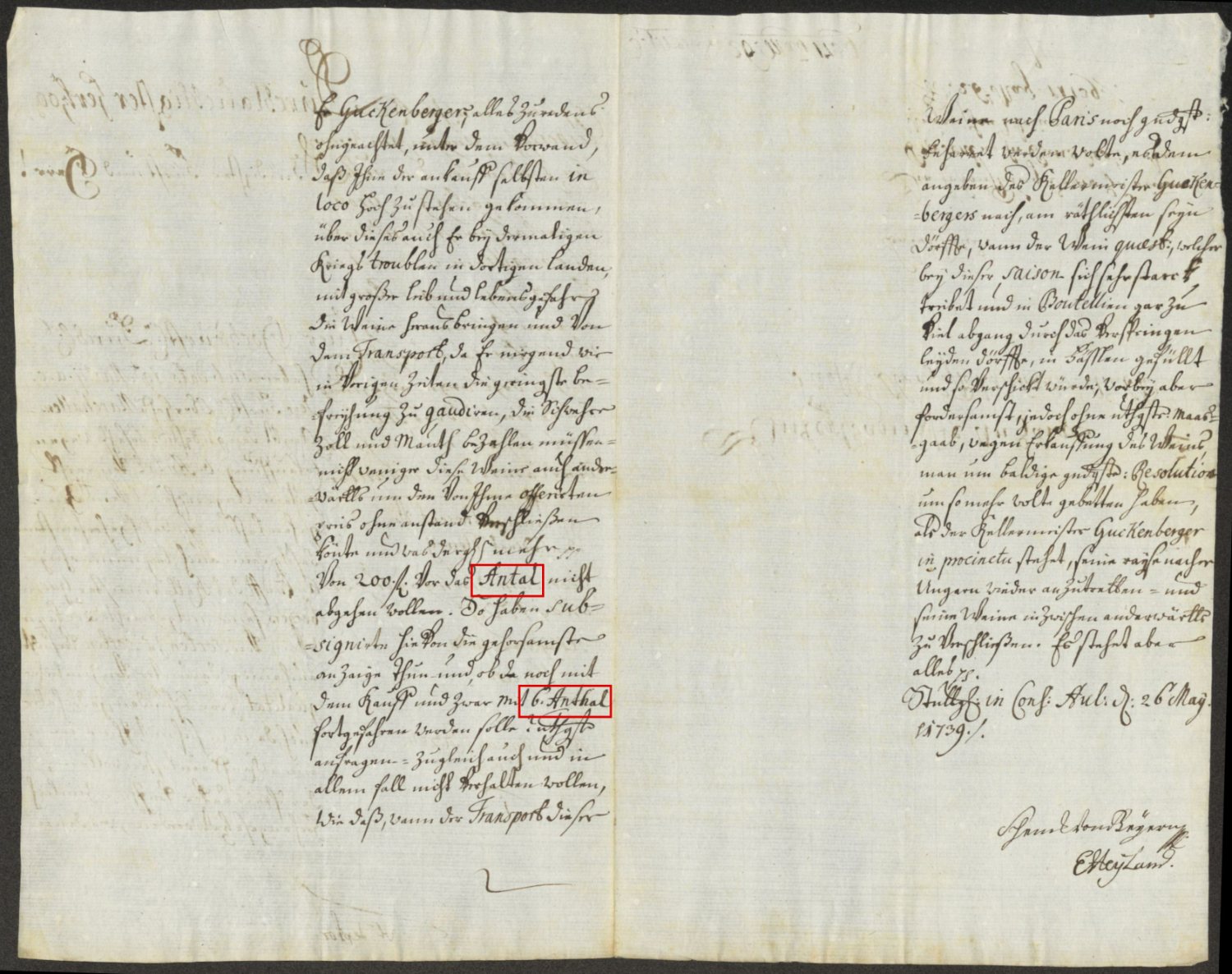
The cellar-master Guckenberger — the Geidenberger of 1736 — comes back from Hungary in May with new Tokaji. The court tastes it von Sorten zu Sorten, finds some of fair quality, and cannot beat down his price. He will not come below 200 fl. per Antal, and his reasons are a short economic history of the year: the wine cost him dear on the spot; the war then being fought in Hungary meant he brought it out mit großer Leib- und Lebensgefahr, at great risk to life and limb; he had to pay the heavy tolls and customs without the exemptions once enjoyed; and other buyers would take the wine at his price without argument.
Why casks and not bottles · 26 May 1739
“…der Wein quaest., welcher bey dieser Saison sich sehr starck treibet und in Bouteillen gar zu viel Abgang durch das Verspringen leyden dörffte, in Fäßlen gefüllt und so verschickt würde.”
“…the wine in question, which at this season ferments very strongly and would suffer far too much loss in bottles through bursting, should be filled into small casks and sent in that form.” A cellar-master’s technical judgement on young Tokaji in summer, written down in 1739.
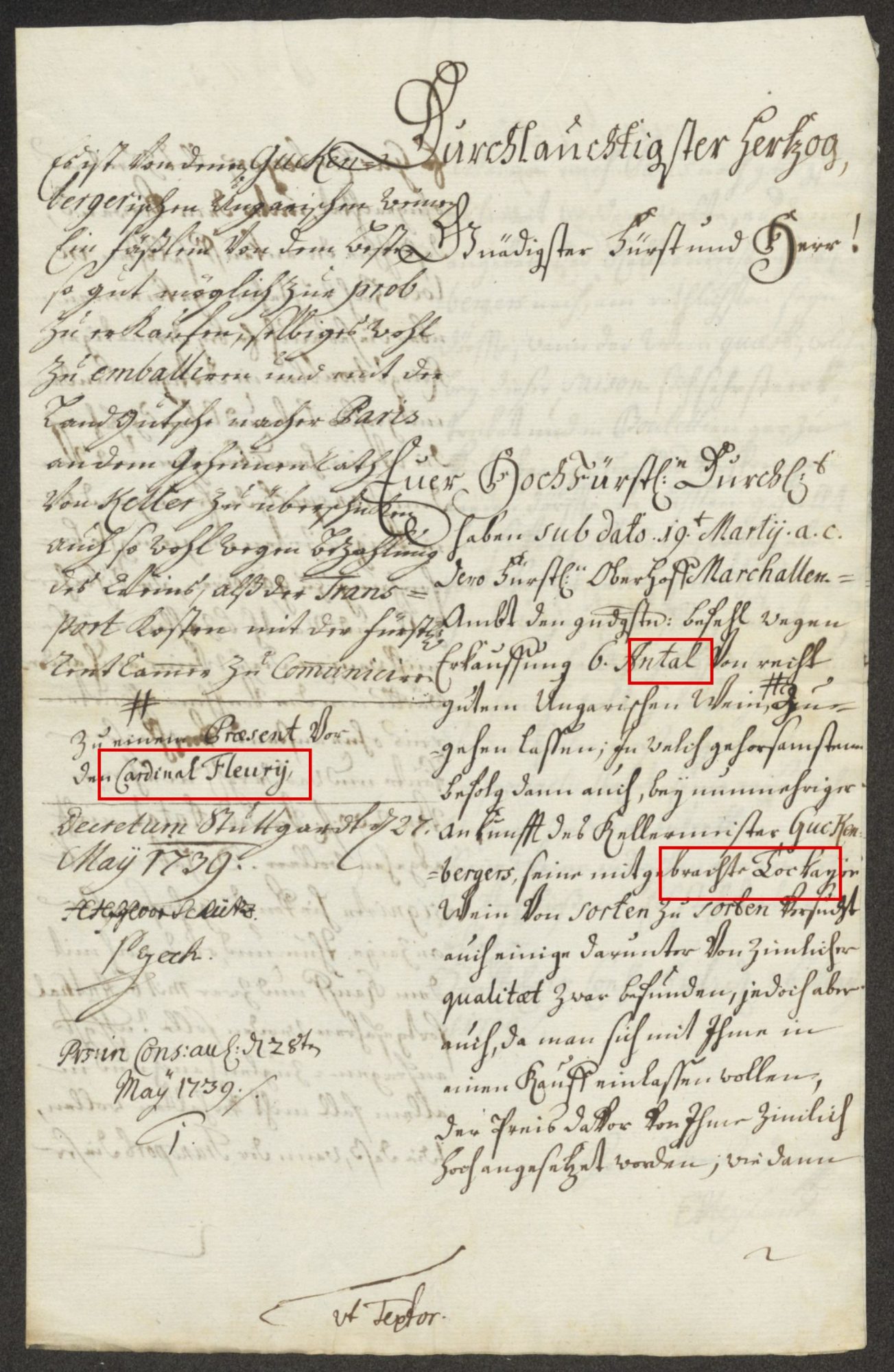
The decree of 27 May 1739 answers in the margin: buy one small cask of the best as a sample, pack it well, send it by the Landkutsche to Keller in Paris, and settle the wine and the freight with the Rentkammer. Above the signature stands the purpose, in four words — Zu einem Präsent vor den Cardinal Fleurij. Whether the six Antal were ever bought is not recorded in this sub-fascicle; the Rentkammer accounts for 1739 would show the payment.
Above, the first page of the 26 May report, with the decree of 27 May down the left margin and its purpose — Zu einem Präsent vor den Cardinal Fleurij — marked in red. Below, the following opening: the 200 fl. price per Antal, the six Anthal in question, and the passage advising casks against bursting bottles. Click either image to enlarge.
What the file shows
Twice within three years a middling German court sent Tokaji to Versailles as its standard diplomatic present: 630 bottles in 1736, 120 bottles plus six Antal — roughly another four hundred bottles — in 1739. Württemberg could supply what the French court could not obtain through its own channels, having its own buyer in Hungary; the wine was worth a courier, an escort of five men and three animals, and a bill of exchange of 800 florins.
The file also fixes a price and a practice. At 200 florins the Antal in 1739, Tokaji stood at the limit of what a princely buyer would pay, and the court bought one sample cask rather than six. The word Aszú does not appear anywhere in these papers: the eighteenth-century German sources say Ausbruch throughout.
Source: Hauptstaatsarchiv Stuttgart, Bestand A 21 (Oberhofmarschallamt), Bü 474, Acta Hoffküfferey Fremde Weine, sub-fascicle no. 3. Red frames mark Tokaji and Ausbruch, the Antal cask unit and the Hungarian wines, and the Paris connection; they were placed by hand from the readings above. Some names in the 1736 list are uncertain.
1757 · 1758
Two Hadik letters: Tokaji in the Seven Years’ War
Both letters are addressed to András Hadik (1710–1790), the Hungarian-born hussar general in Austrian service who is still remembered for the raid of 16 October 1757, when he took a light corps into Berlin while Frederick II was in the field, held the capital for a day and left with a contribution. Both mention Tokaji directly, and each shows it doing a different job.
Gotter to Hadik · Berlin, 16 October 1757
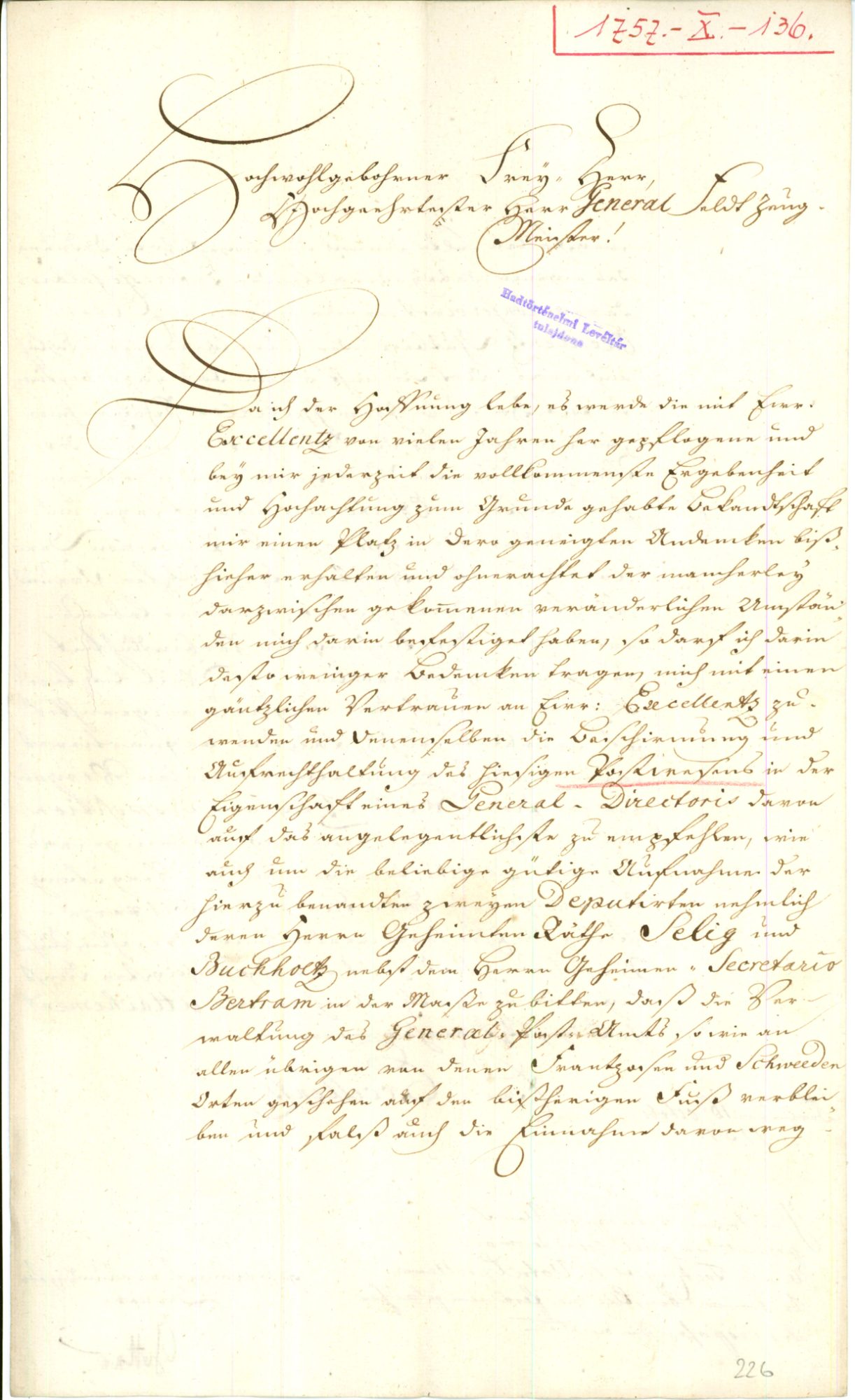
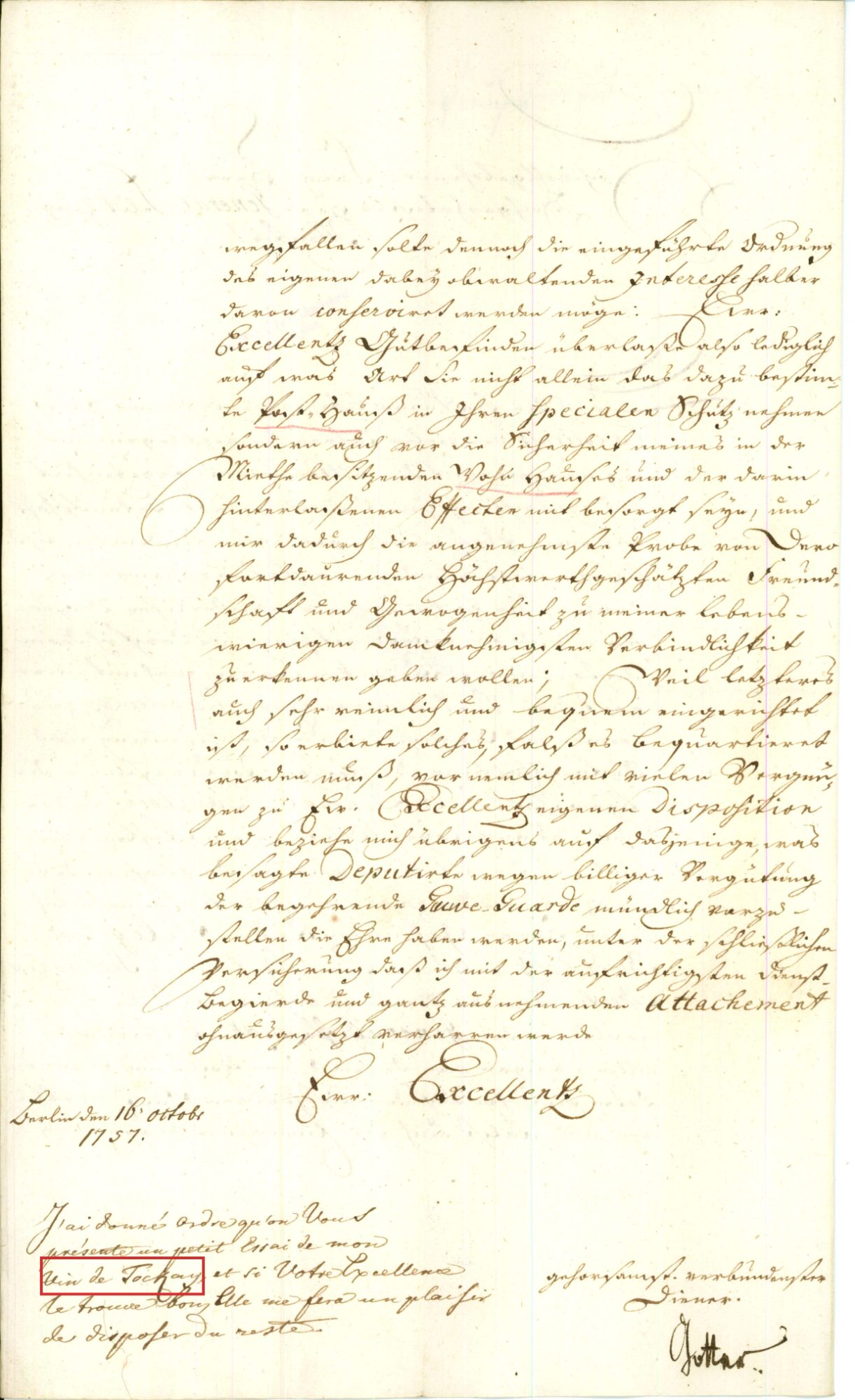
Written on the day of the raid itself by Gustav Adolf Graf von Gotter, Frederick’s minister and Generalpostmeister. The body asks Hadik to take the Berlin post office and its administration under a General-Director into his special protection, to receive the deputies Geheime Räte Selig and Buchholtz with the secretary Bertram, and to spare Gotter’s rented house and the effects left in it — which he offers as Hadik’s quarters.
The Tokaji is in the French postscript: “J’ai donné ordre qu’on Vous présente un petit essai de mon vin de Tockay, et si Votre Excellence le trouve bon, Elle me fera un plaisir de disposer du reste.” — “I have given orders that a small sample of my Tokay wine be presented to you, and if Your Excellency finds it good, you will do me the pleasure of disposing of the rest.”
A Prussian minister buying immunity from a Hungarian general with his own cellar, on the day of the raid. Gotter had been envoy in Vienna and was a famous bon vivant, so a well-stocked Tokaji cellar in Berlin is entirely in character.
Gotter to Hadik, Berlin, 16 October 1757. Hadtörténelmi Levéltár, Hadik papers, 1757-X-136. The postscript naming vin de Tockay is marked in red. Click either image to enlarge.
Nádasdy to Hadik · Warasdin, 19 June 1758
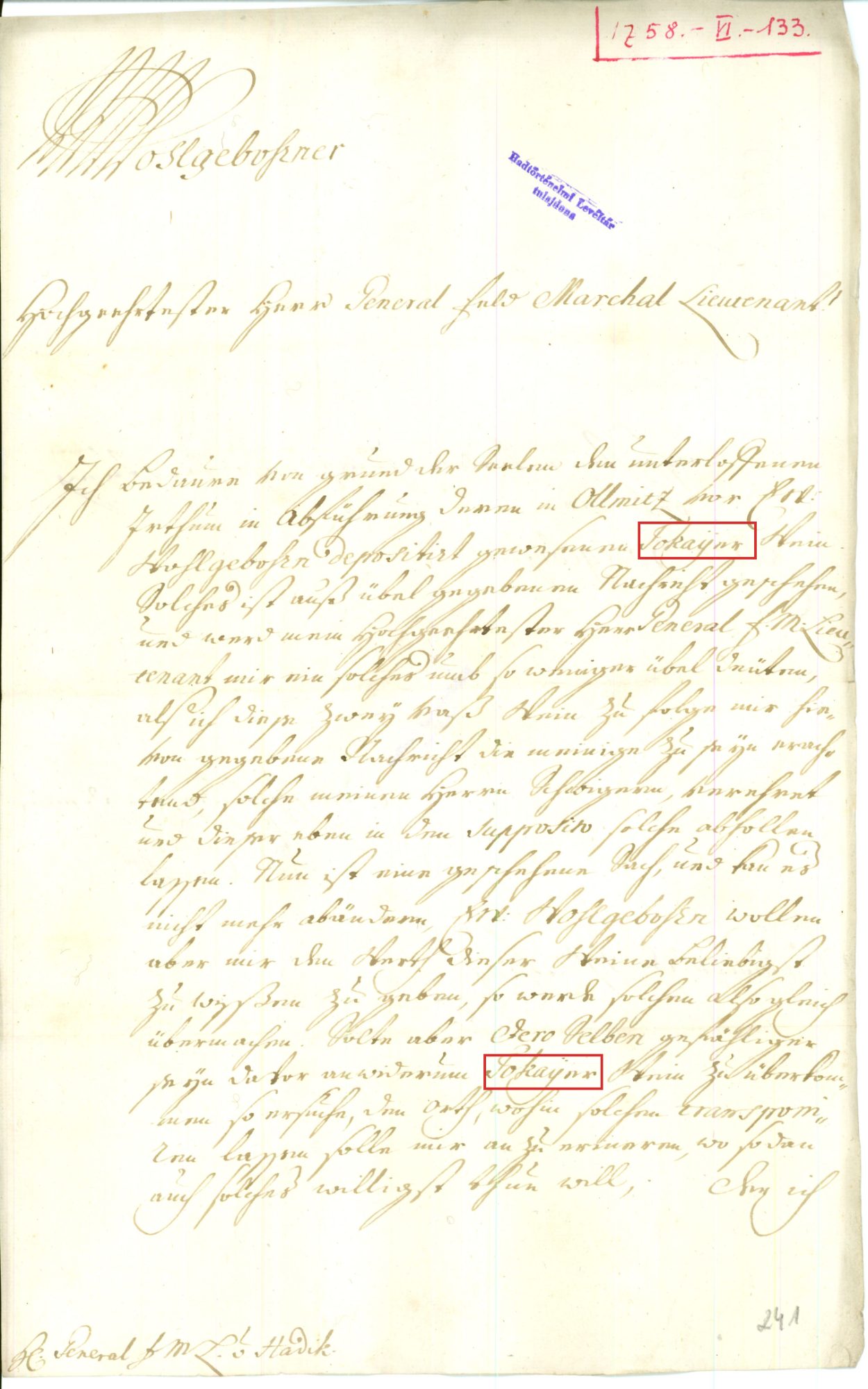
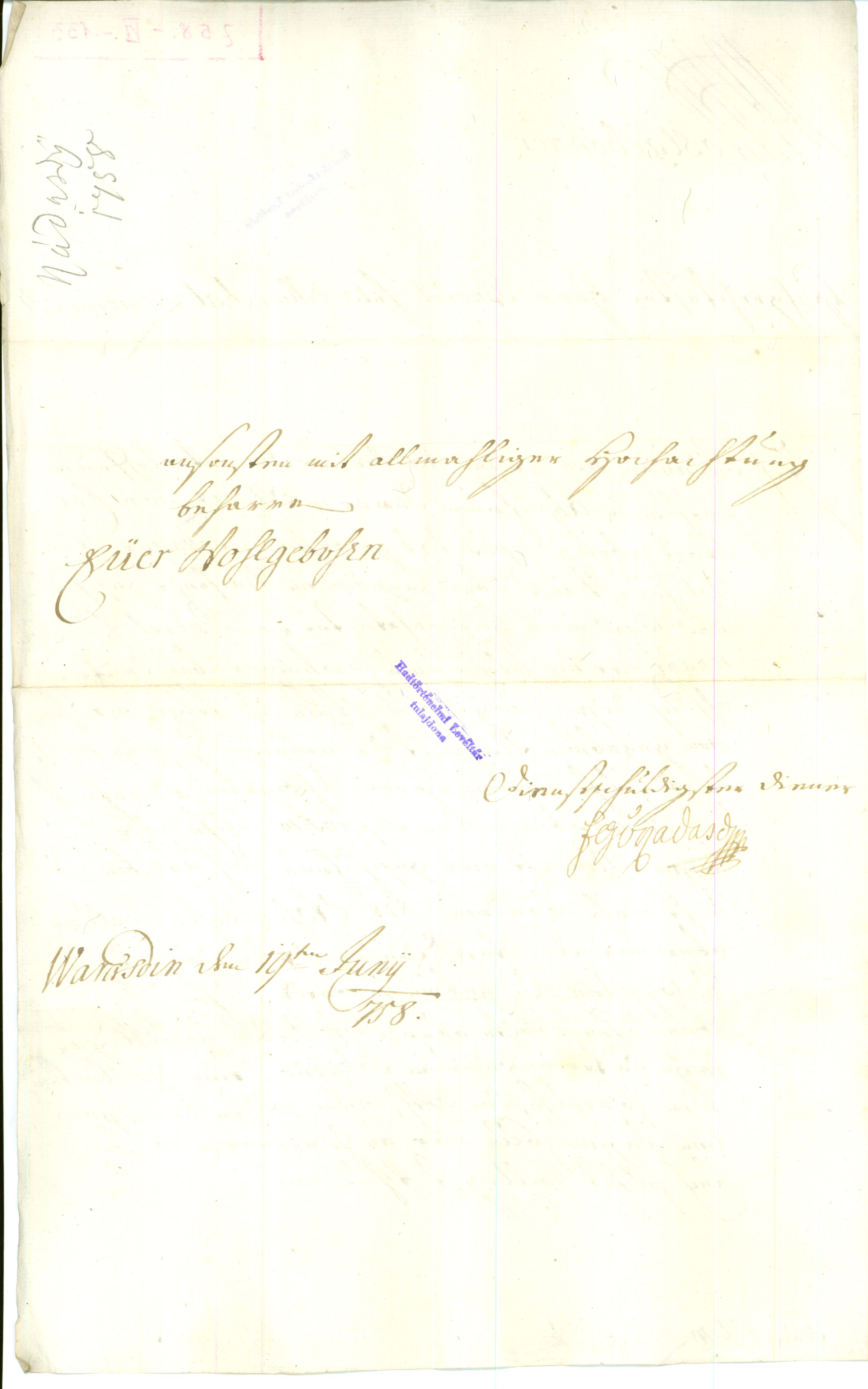
From Franz Leopold Graf Nádasdy, Ban of Croatia, writing from his seat at Varaždin to “An General F.M.L. v. Hadik”. He apologises from the bottom of his heart for the mistake in the removal of the Tokaji wine Hadik had deposited at Olmütz: on false information he took two casks to be his own, presented them to his father-in-law, and the father-in-law, in the same belief, had them bottled.
“Ich bedauere von Grund der Seelen den unterloffenen Irrthum in Abführung deren in Ollmütz vor Ew. Hochgebohren depositirt gewesenen Tokayer Wein … Solten aber Deroselben gefälliger seyn dafür anwiederum Tokayer Wein zu überkommen, so ersuche den Orth, wohin solchen transportiren lassen solle, mir anzuerinnern.”
Since it cannot be undone, he asks Hadik to name the value and he will remit it at once — or, if Hadik would rather have Tokaji in return, to say where it should be delivered. The date and place tie the letter to the siege of Olmütz (May–July 1758), where officers’ wine stores were evidently kept inside the fortress.
Nádasdy to Hadik, Warasdin, 19 June 1758. Hadtörténelmi Levéltár, Hadik papers, 1758-VI-133. Both mentions of Tokayer Wein are marked in red. Click either image to enlarge.
Taken together the pair is a nice one: Tokaji as a general’s personal store, carried on campaign and deposited in a fortress, valued highly enough that a Ban of Croatia writes a formal apology and offers cash or replacement for two casks; and Tokaji as a bribe-cum-courtesy, offered by a Prussian minister to the man who had just taken Berlin.
1792
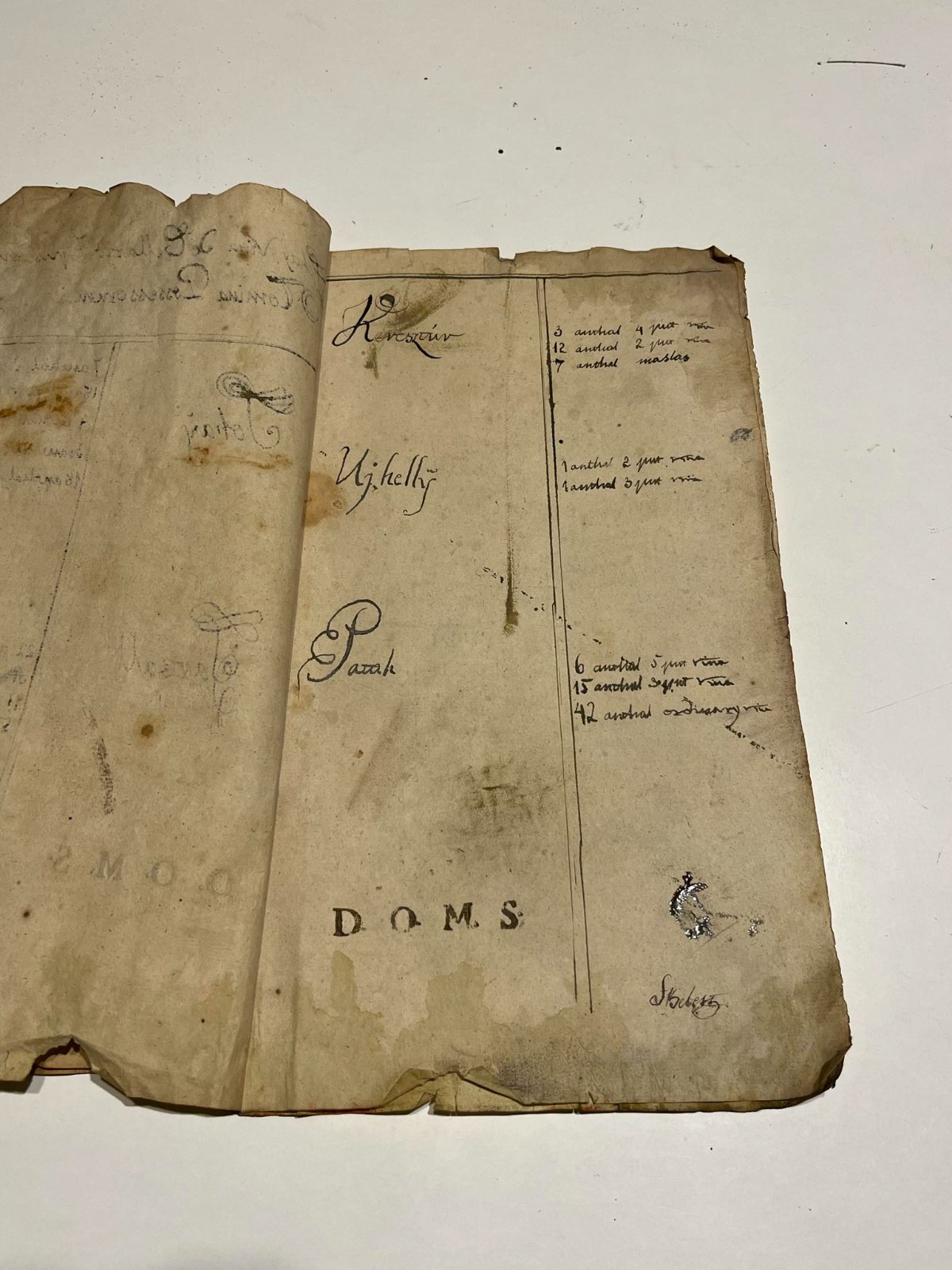
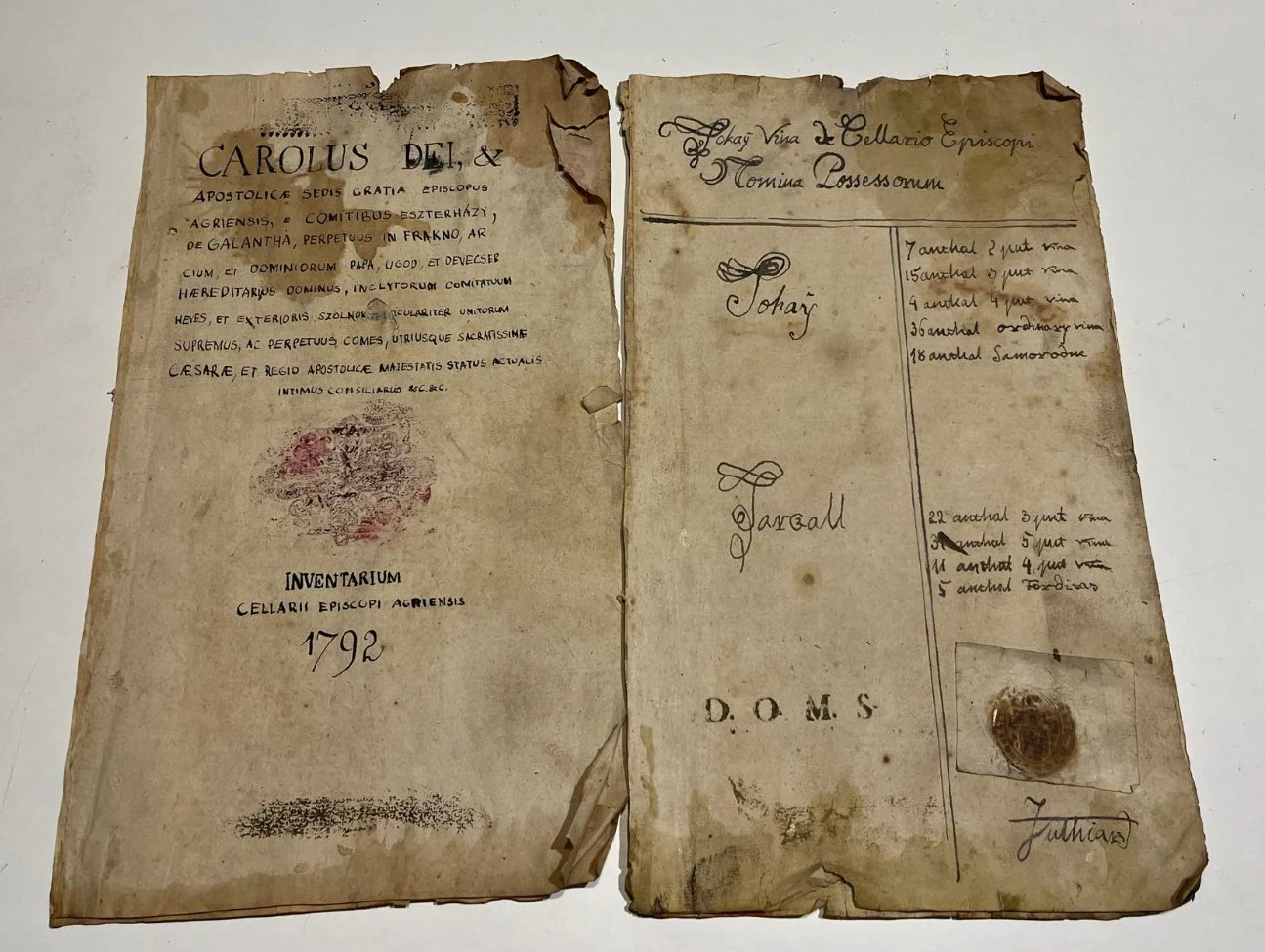
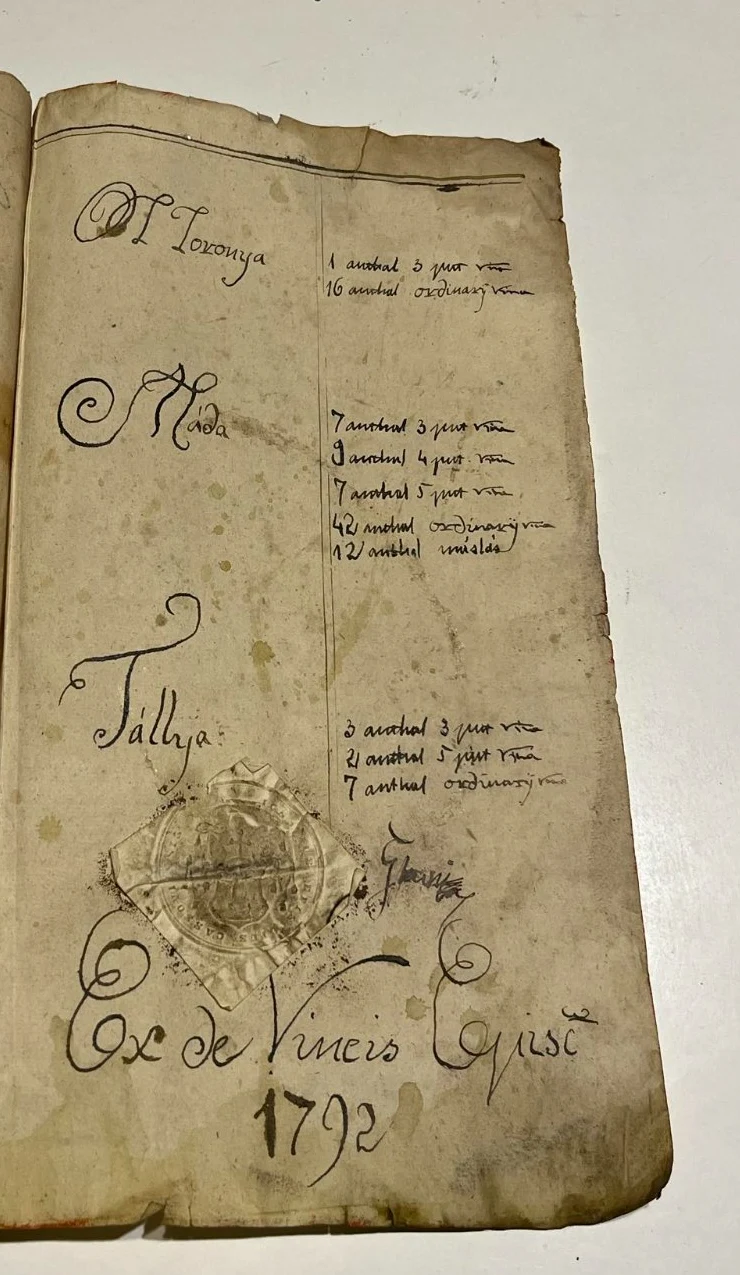
1792 Cellar Inventory listing various categories of Tokaji wine
The only very old document I am aware of that lists almost all important categories of Tokaji wine:
Aszú (2, 3, 4, 5 puttonyos) - called “vina” in the document, but the puttony quality clearly makes it Aszú
Szamorodni
Fordítás
Máslás
Ordinary Wine (unclear what exactly this is)
The quantities are impressive. 1 anthal (ántalag, átalag, antalfa, ántalfa) is a barrel of 75.6 liter. The two pages alone list 119 barrels of Aszú, the equivalent of some 18.000 bottles! The cellar still exist today, and I have visited it. Unfortunately, it is completely empty.
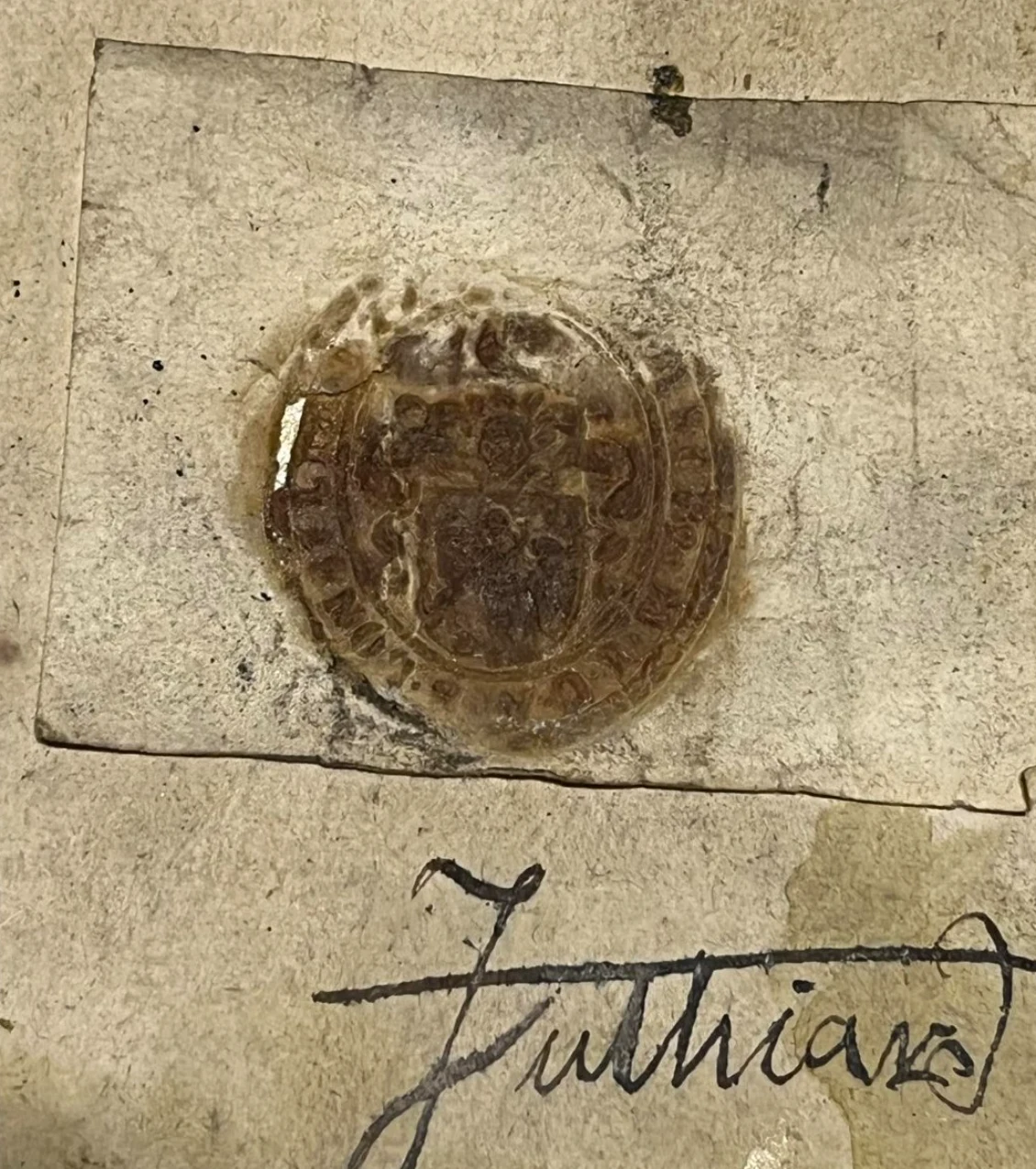
The 1792 inventory of the cellar of the Bishop of Eger, photographed page by page · click any image to enlarge
1797
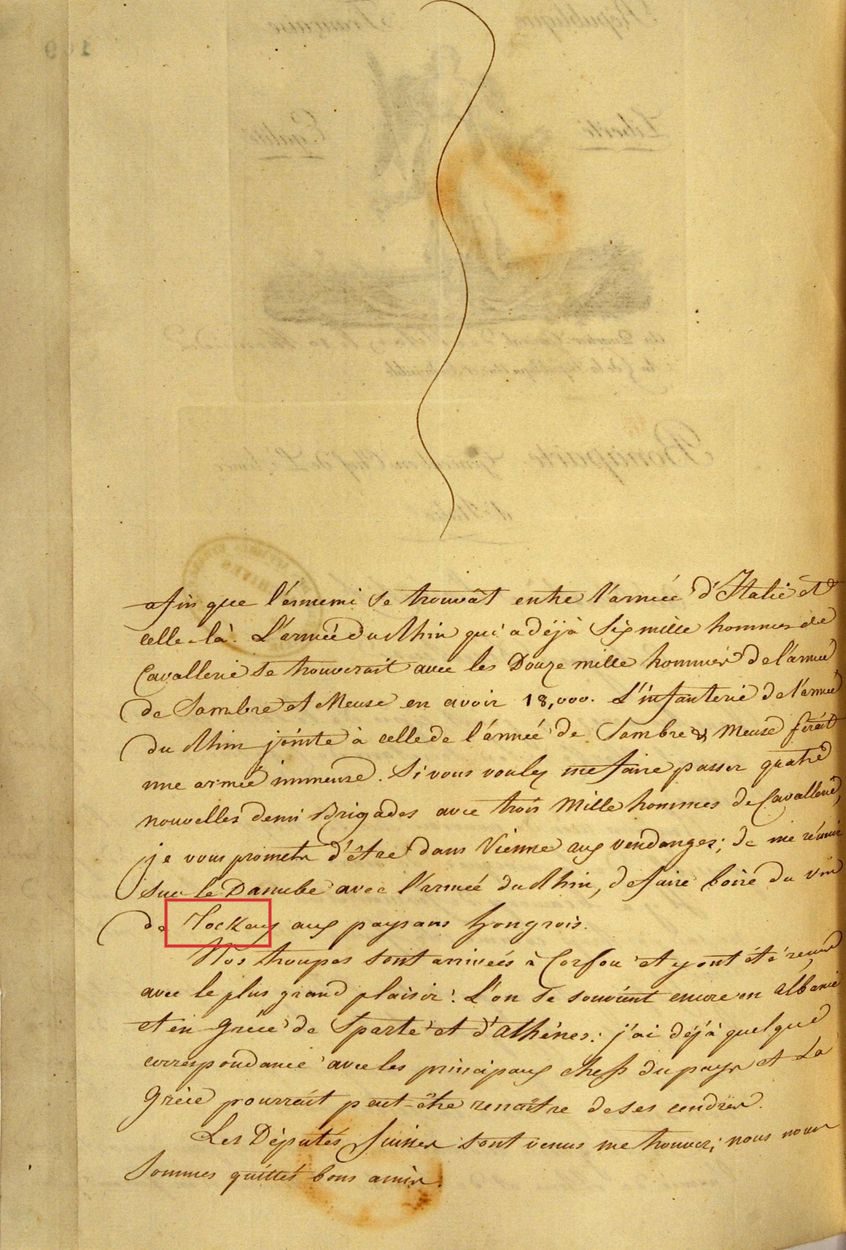
Bonaparte promises Tokaji to the Hungarian peasants
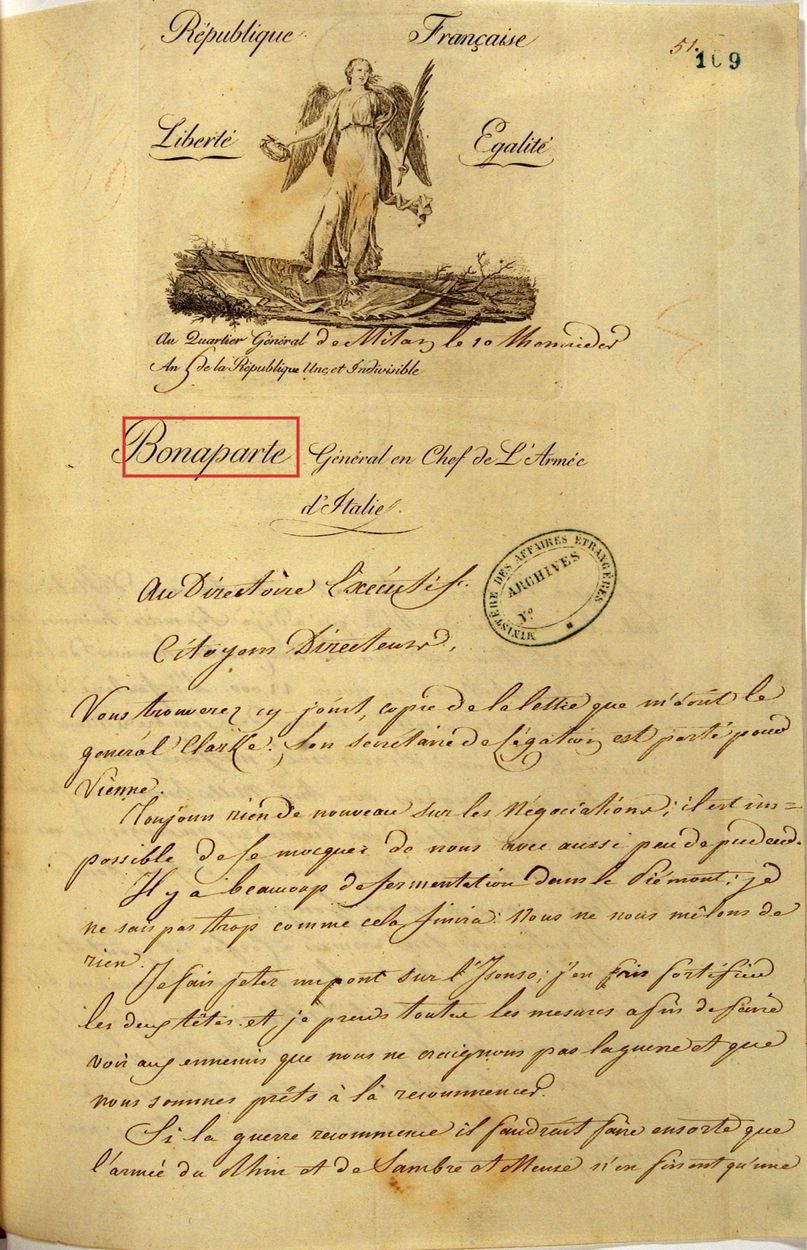
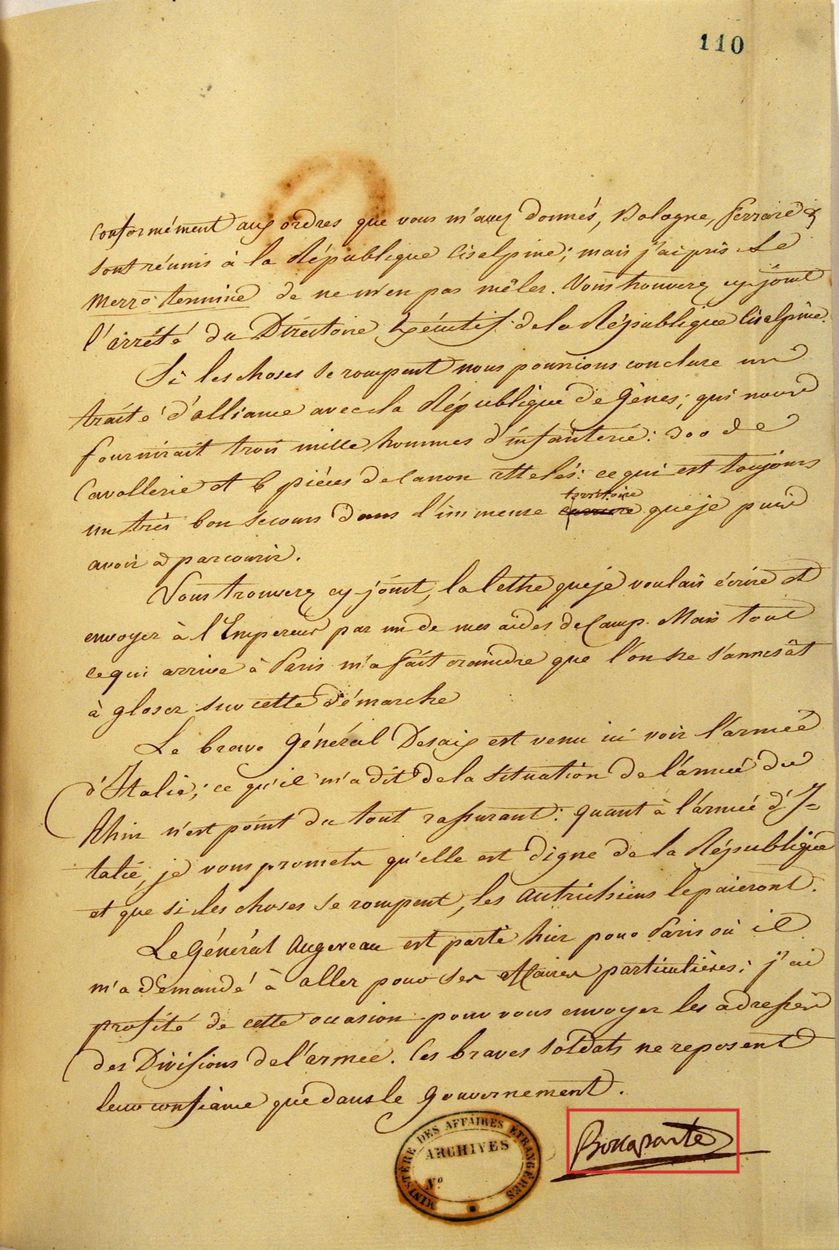
A despatch to the Directoire from the Quartier Général de Milan, le 10 Thermidor An V — 28 July 1797 — signed Bonaparte, Général en Chef de l’Armée d’Italie. It is in the archives of the Ministère des Affaires étrangères, fol. 109–110. The signature is Bonaparte’s; the body of the letter is in the hand of his secretary, Louis Antoine Fauvelet de Bourrienne. The Tokaji passage stands on the second page, in the paragraph on what he would do if the negotiations with Austria collapsed.
The passage
“Si vous voulez me faire passer quatre nouvelles demi-brigades avec trois mille hommes de cavalerie, je vous promets d’être dans Vienne aux vendanges; de me réunir sur le Danube avec l’armée du Rhin, de faire boire du vin de Tockay aux paysans hongrois.”
“If you will send me four new demi-brigades with three thousand cavalry, I promise you to be in Vienna by the grape harvest, to join the Army of the Rhine on the Danube, and to make the Hungarian peasants drink Tokay wine.”
The lines as written: “…je vous promets d’être dans Vienne aux vendanges; de me réunir sur le Danube avec l’armée du Rhin, de faire boire du vin de Tockay aux paysans hongrois.” The word Tockay is marked in red; the spelling is the secretary’s. Click to enlarge.
The context makes the line sharper than it looks. The Leoben preliminaries had been signed, but the Austrians were stalling at Udine, and the letter opens with “Toujours rien de nouveau sur les négociations; il est impossible de se moquer de nous avec aussi peu de pudeur.” What follows is a sketch of a renewed offensive: a bridge over the Isonzo with both bridgeheads fortified, the Armies of the Rhine and of Sambre-et-Meuse combined into 18,000 cavalry and “une armée immense”, and the Army of Italy marching on Vienna aux vendanges — September and October, exactly the Tokaj harvest.
The Tokaji clause is a political jest with an edge. The wine of the magnates’ and the Habsburg court’s cellars would be poured for the peasants: a French army as the liberator of Hungary, and Tokaji as the emblem of the order to be overturned. It also says how completely, by 1797, Tockay stood in a French general’s mind for Hungary itself and for Habsburg luxury.
The three pages: the heading, the Tokaji paragraph and the signature, each marked in red. Archives du Ministère des Affaires étrangères, fol. 109–110. Click any image to enlarge.
The rest of the letter runs on to Corfu — “l’on se souvient encore en Albanie et en Grèce de Sparte et d’Athènes… la Grèce pourrait peut-être renaître de ses cendres” — the Swiss deputies, the union of Bologna and Ferrara with the Cisalpine Republic, a possible alliance with Genoa, the letter to the Emperor he decided not to send, Desaix’s visit with his gloomy report on the Army of the Rhine, and Augereau’s departure for Paris “hier” — 27 July — carrying the army’s addresses. That is the mission which ended six weeks later in the coup of 18 Fructidor.
The text is printed in the Correspondance de Napoléon Ier, vol. III, under 10 thermidor an V, so the published version can be cited alongside the archival image. Two months before Campo Formio, Tokaji is in the mouth of the future Emperor as the drink he would hand to Hungarian peasants after taking Vienna.
1807 · 1829
The Archbishop of Eger’s cellar, room by room
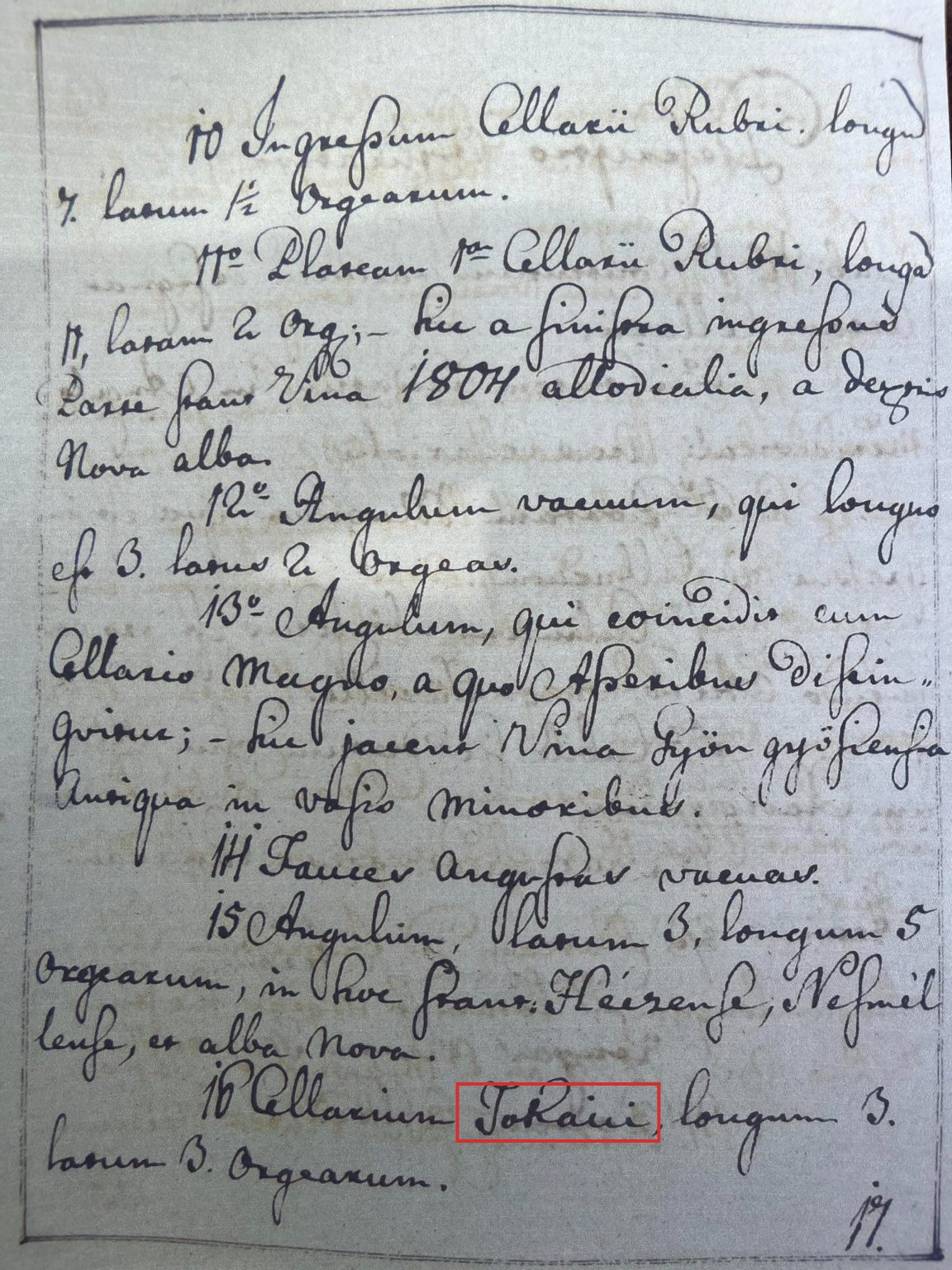
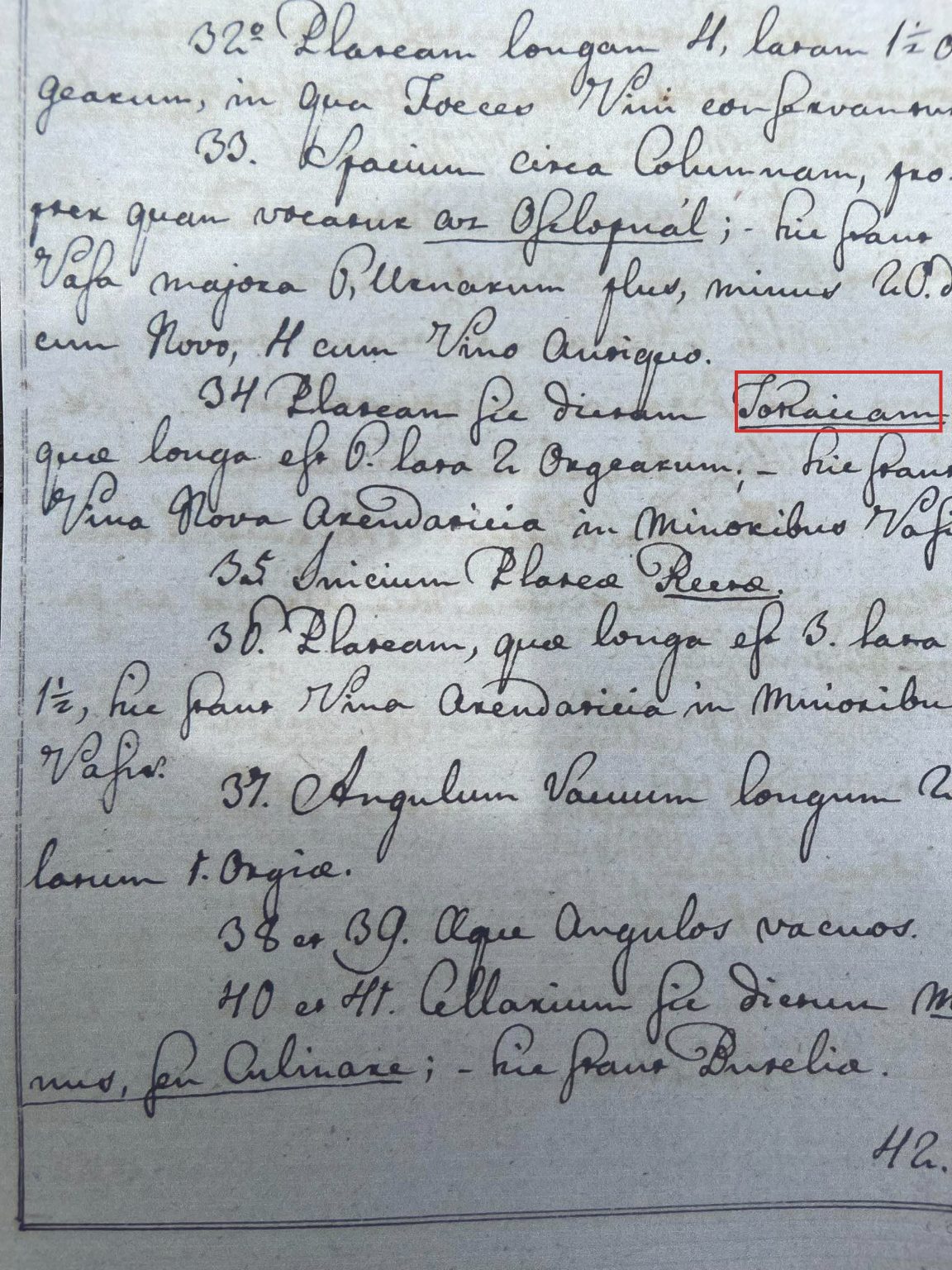
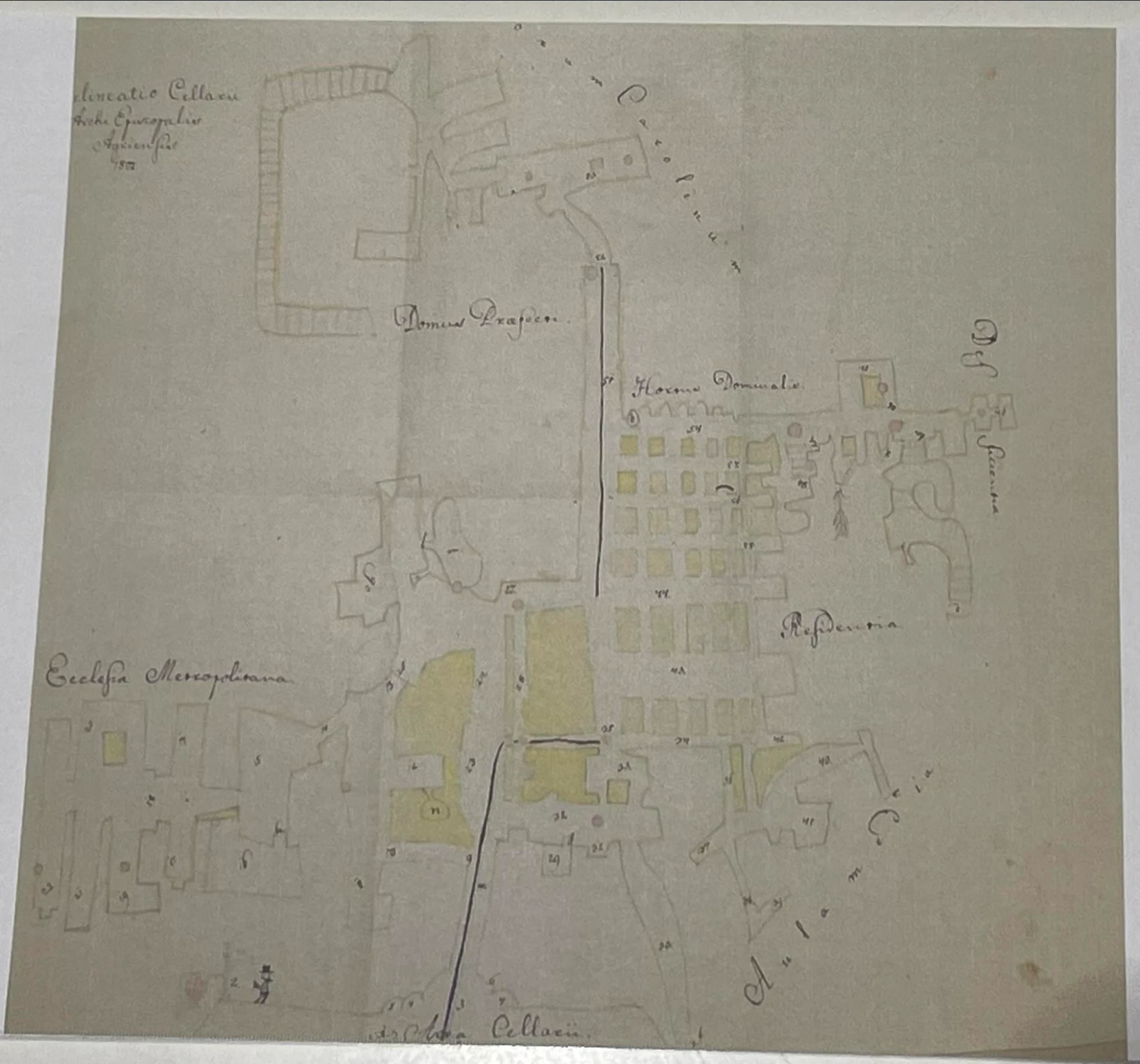
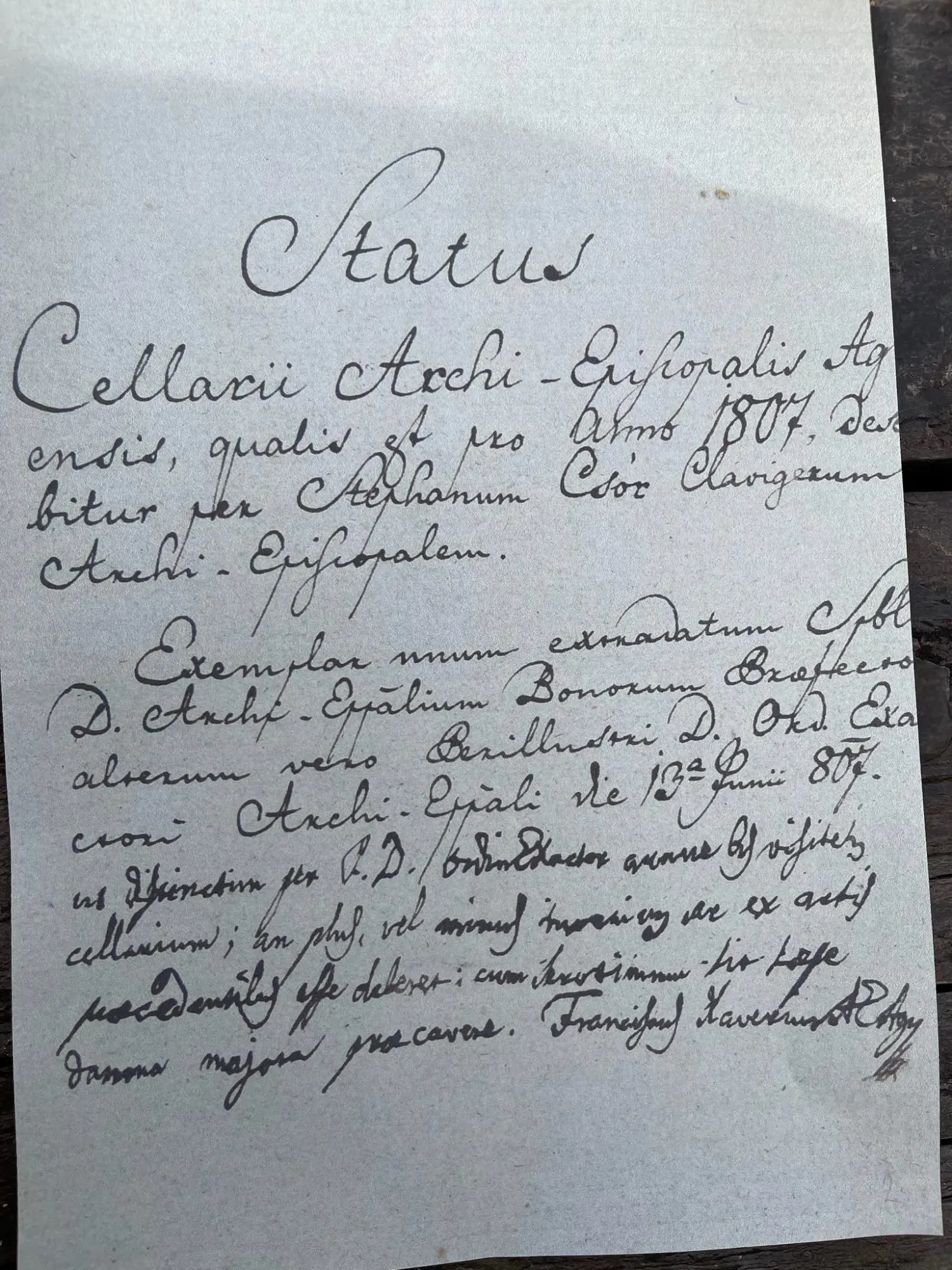
The Status Cellarii Archi-Episcopalis Agriensis for the year 1807, drawn up by the cellar-master (claviger) István Csór and dated Agriae die 5a Junii 1807, with an accompanying coloured plan, the Delineatio Cellarii Archi-Episcopalis Agriensis 1807. It walks the whole underground system in fifty-seven numbered spaces and says what stood in each.
An audit order, two weeks before his death
The cover note is in a second hand, signed Franciscus Xaverius A[rchi]E[piscopus] Agr[iensis] — Ferenc Xavér Fuchs, first Archbishop of Eger. On 13 June 1807 he orders one copy to the Prefect of the archiepiscopal estates and the other to the Ordinary Exactor, who is to visit and check the cellar against the previous accounts, damna majora praecavere — to prevent greater losses. Fuchs died on 27 June 1807, so the order is among his last acts.
The three Tokaji references
No. 16, Cellarium Tokaini, 3 × 3 fathoms (orgiae) — about 5.7 × 5.7 m. A dedicated Tokaji cellar, small, listed straight after no. 15, which held Hejczense, Neszmélyense et alba nova: wines from Hejce, the Eger bishops’ own estate on the northern edge of the Tokaj hills, from Neszmély, and new whites.
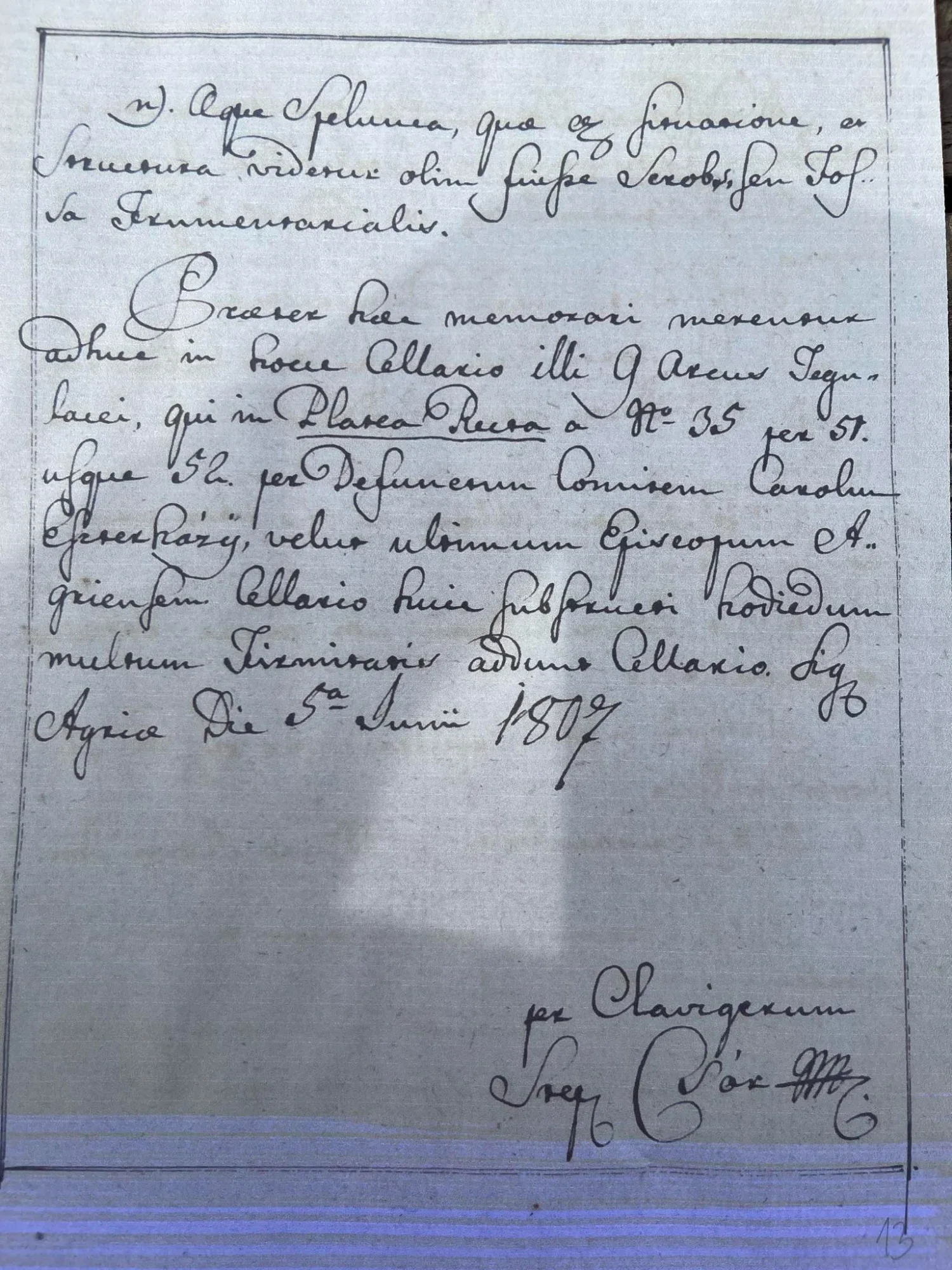
No. 34, Platea sic dicta Tokaica, 6 × 2 fathoms — the “Tokaj alley”. But the text says hic stant Vina Nova Arendaticia in minoribus vasis: in 1807 it held new rent-wines in small casks, not Tokaji and not bottles. The alley kept its old name after its use had changed.
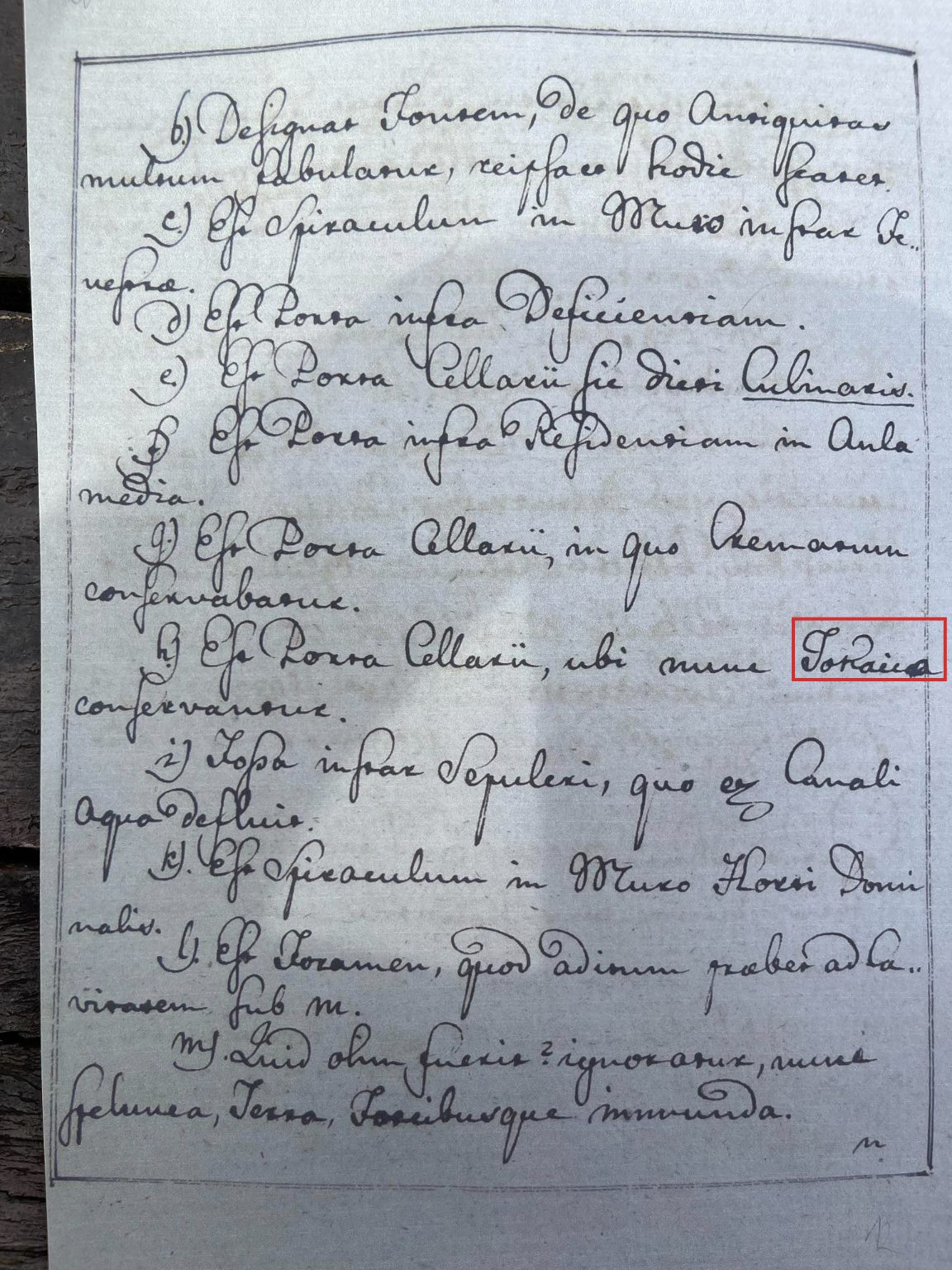
Letter h — Est Porta Cellarii, ubi nunc Tokaica conservantur. The word nunc, “now”, is the key: the Tokaji had been moved, presumably out of the Platea Tokaica and behind this door, which is consistent with no. 16 being the current Tokaji cellar.
Every reference to Tokaji in the document, marked in red: Cellarium Tokaini (no. 16), Platea sic dicta Tokaica (no. 34), and ubi nunc Tokaica conservantur (letter h). Click any image to enlarge.
Bottles, casks and classes of wine
Bottles appear once. Nos. 40–41, the Cellarium Culinare — hic stant Butelia. The kitchen cellar is where the bottled wine stood; everything else is measured in casks, vasa majora of 20 to 79 urnae against the small minora.
Three legal classes.Vina allodialia, the estate’s own production (the 1804 wines in no. 11); vina decimalia, tithe wine (nos. 27, 46, 49, 54); and vina arendaticia, wine received as rent (nos. 28, 34, 36, 42–44, 55–57).
Origins and vintages named. Old Gyöngyös wines (13), Hejce and Neszmély (15), Kerecsend (22), old reds of 1802 and 1804 (19), a 79-urna cask of 1806 (25), a 65-urna cask of new red (31), a lees store (32), a brandy cellar (Cellarium Cremati, 29) and a vinegar kitchen (Tüzellő, 4–7).
Hungarian names underground.az Oszlopnál — at the column (33), Sáros, the muddy alley (42), Tihamér (46), Paradicsfal (a). The old fountain (b) “of which antiquity tells much” still existed, and the Deficientia, the retired priests’ house, had its own door into the cellar.
Eszterházy’s arches. The closing paragraph credits the nine brick arches in the Platea Recta (nos. 35–51–52) to defunctus Comes Carolus Eszterházy, velut ultimus Episcopus Agriensis — Károly Eszterházy, bishop 1762–1799, “the last Bishop of Eger” because the see became an archbishopric in 1804. He had been dead eight years when Csór wrote.
The plan, and its colour code
Csór’s covering letter explains the Delineatio: yellow for walls and the larger spaces cut from the rock, red circles for air-shafts (spiracula) and red steps for stairs, blue for the water conduits, black for underground channels. The surroundings are lettered Ecclesia Metropolitana, Domus Praesid., Hortus Dominalis, Residentia, Aula media, Deficientia.
The plan, the title page with Fuchs’s order, and the closing page signed per Clavigerum Steph. Csór. Click any image to enlarge.
What the inventory shows is Tokaji in 1807 as a distinct, small, separately housed category in an episcopal cellar otherwise dominated by tithe and rent wine from the Eger region — the same pattern of Tokaji as the prestige reserve that runs through the Esterházy and Fukier material.
The same cellar, twenty-two years later: 1829
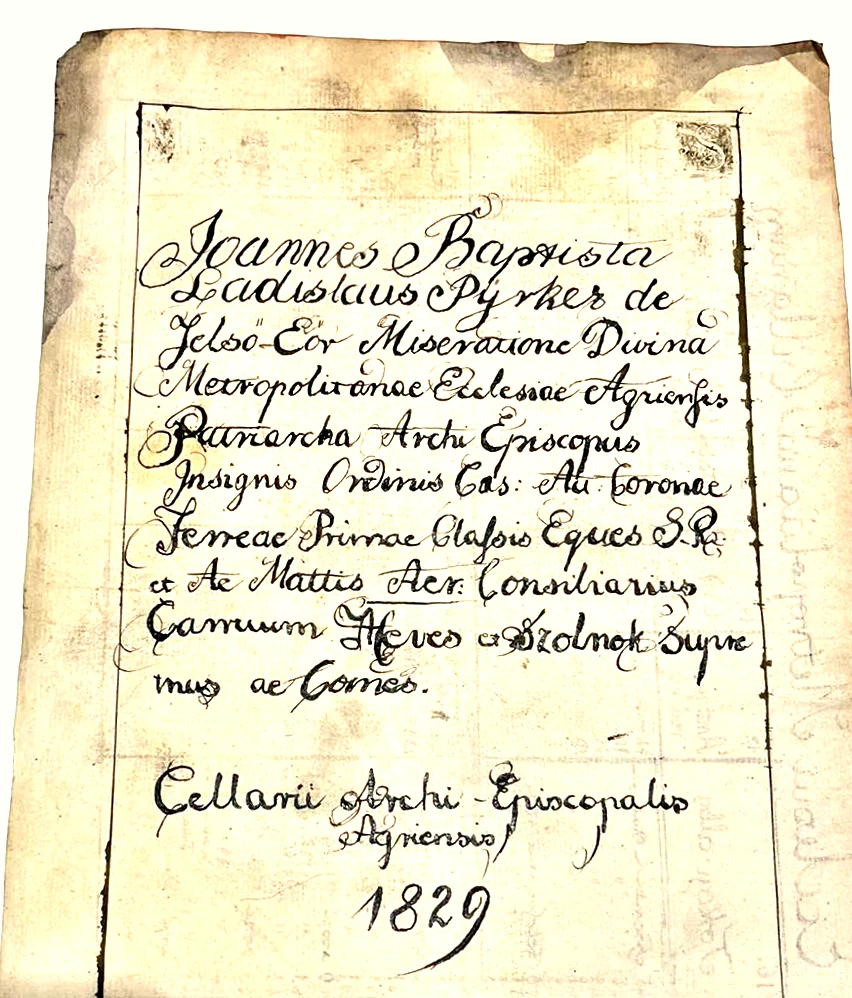
Two sheets of a later cellar book of the same house have come into my hands. The title page is written out for Joannes Baptista Ladislaus Pyrker de Felső-Eőr — János László Pyrker, Patriarch of Venice until 1827 and then Archbishop of Eger, who kept the title of Patriarch personally, which is why the page reads Patriarcha Archi-Episcopus. It gives his knighthood in the first class of the Order of the Iron Crown, his rank as imperial and royal actual councillor, and his standing as supreme count of the counties of Heves and Szolnok; then, beneath, Cellarii Archi-Episcopalis Agriensis and the year 1829.
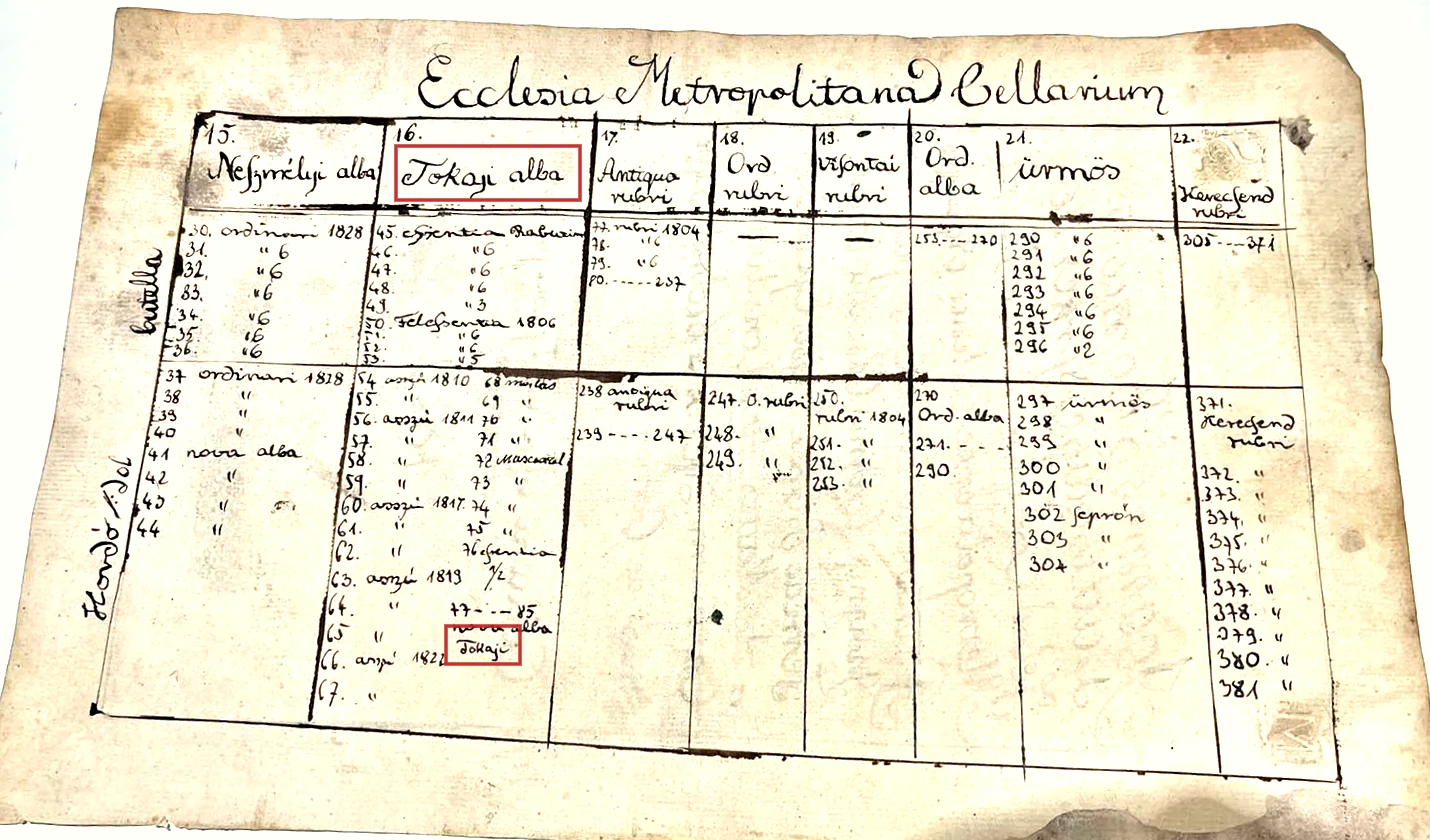
The second sheet is a stock table headed Ecclesia Metropolitana Cellarium, and it is more useful than its size suggests, because its eight columns are numbered 15 to 22 — the same numbers Csór used for the cellar spaces in 1807. Column 15 is Neszmélyi alba, and no. 15 in 1807 held Hejczense, Neszmélyense et alba nova. Column 16 is Tokaji alba, and no. 16 in 1807 was the Cellarium Tokaini. Column 22 is Kerecsend rubri, and no. 22 in 1807 was Kerecsend. The numbering survived two archbishops, which means the 1829 stock can be put back onto the 1807 plan, room by room.
The sheet is in two horizontal blocks, marked in the left margin butella above and hordó below — bottles first, then barrels — with a running lot number down each column. What stood in no. 16 is the part that matters here. The bottled entries run from lot 45 and include a Felső... of 1806; the barrel entries name aszú of 1810, 1811, 1813 and 1817, a lot entered anno 1822 Tokaji, nova alba, and alongside them máslás and a muscatel. So by 1829 the archbishop’s Tokaji holding was not a single undifferentiated stock but a run of named aszú vintages, a decade and a half deep, kept beside the sweet secondary wine.
The 1829 sheets. Straightened and de-shadowed from the original photographs; the two references to Tokaji in column 16 are boxed in red. Author’s collection. Click either image to enlarge.
Readings still open
Several words in column 16 resist the photograph: the entry at lot 45, the place-name before 1806 at lot 50, and the annotation at lot 62. The lot numbers also need collating across all eight columns before the totals can be trusted. Anyone able to read this hand better than I can is welcome to write.
1854
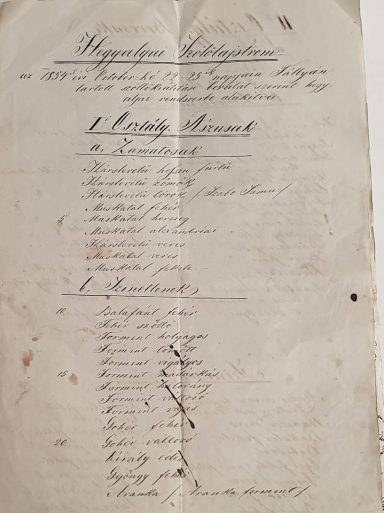
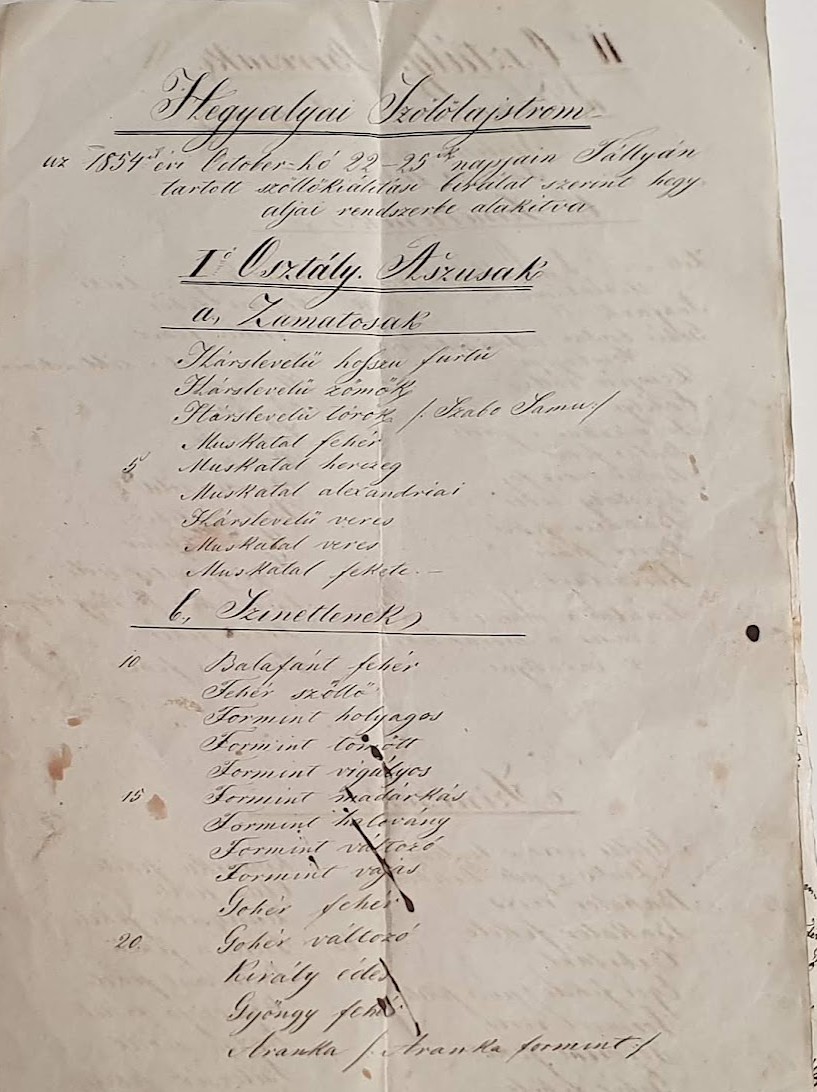
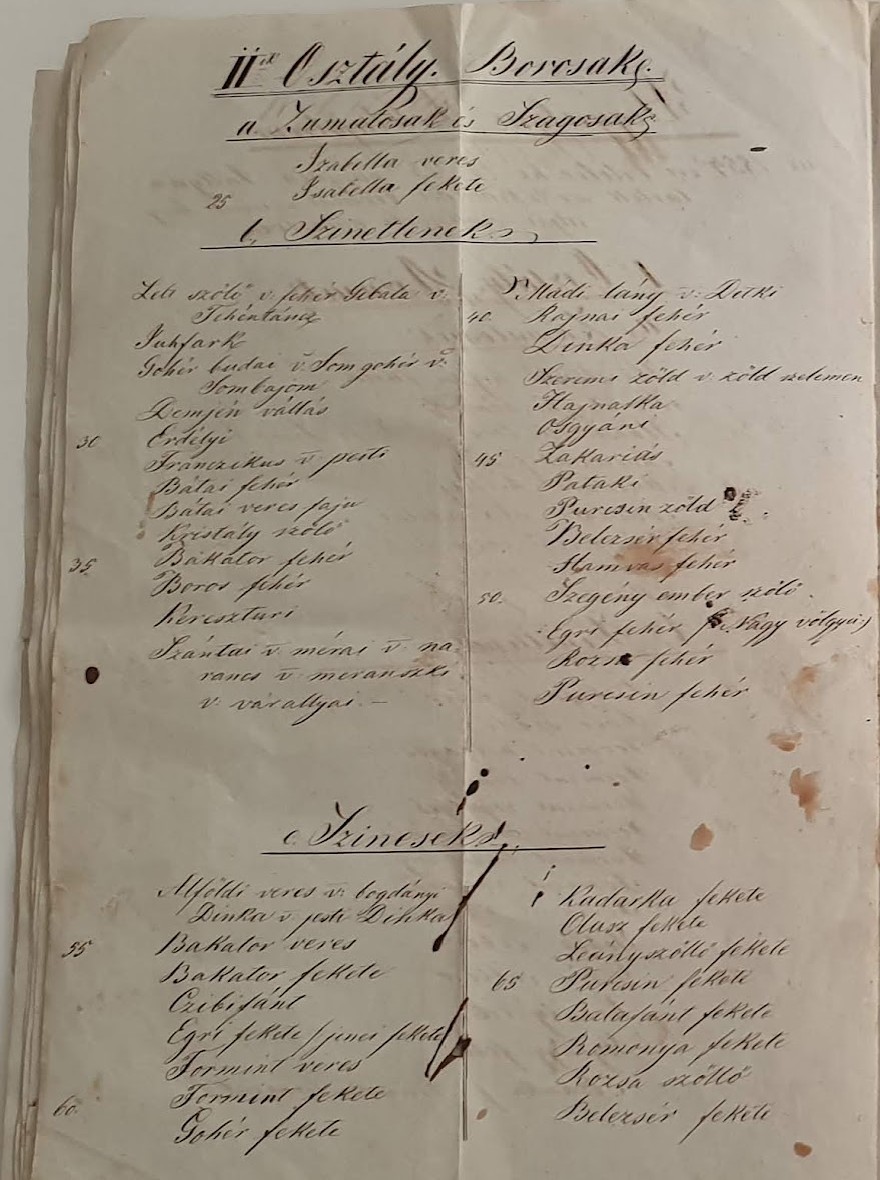
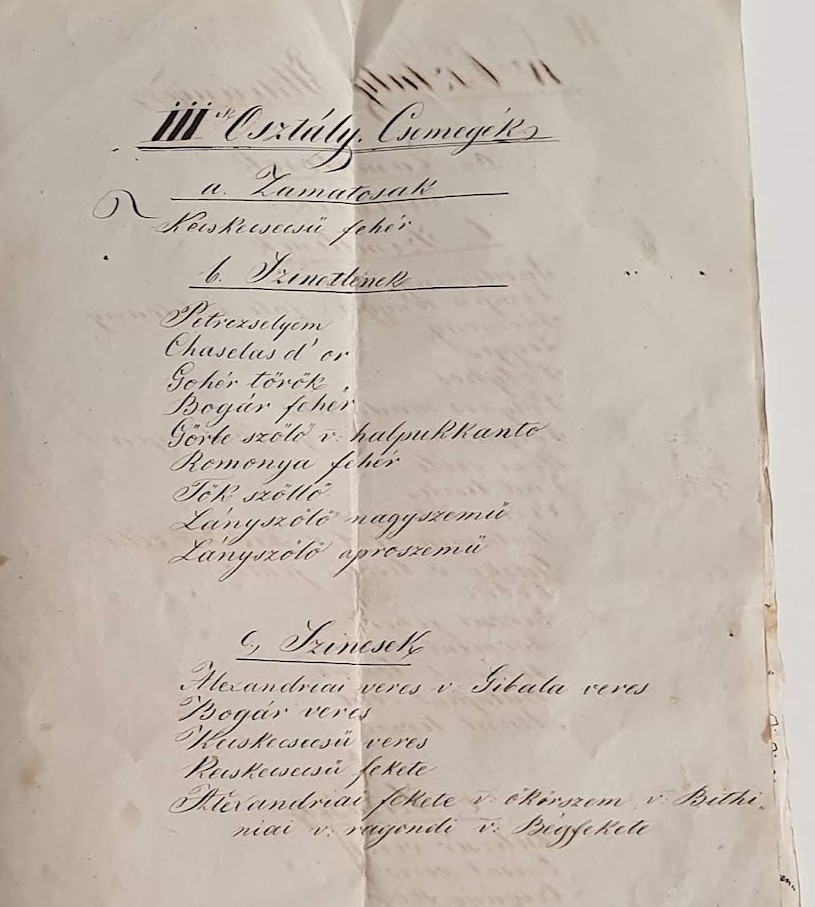
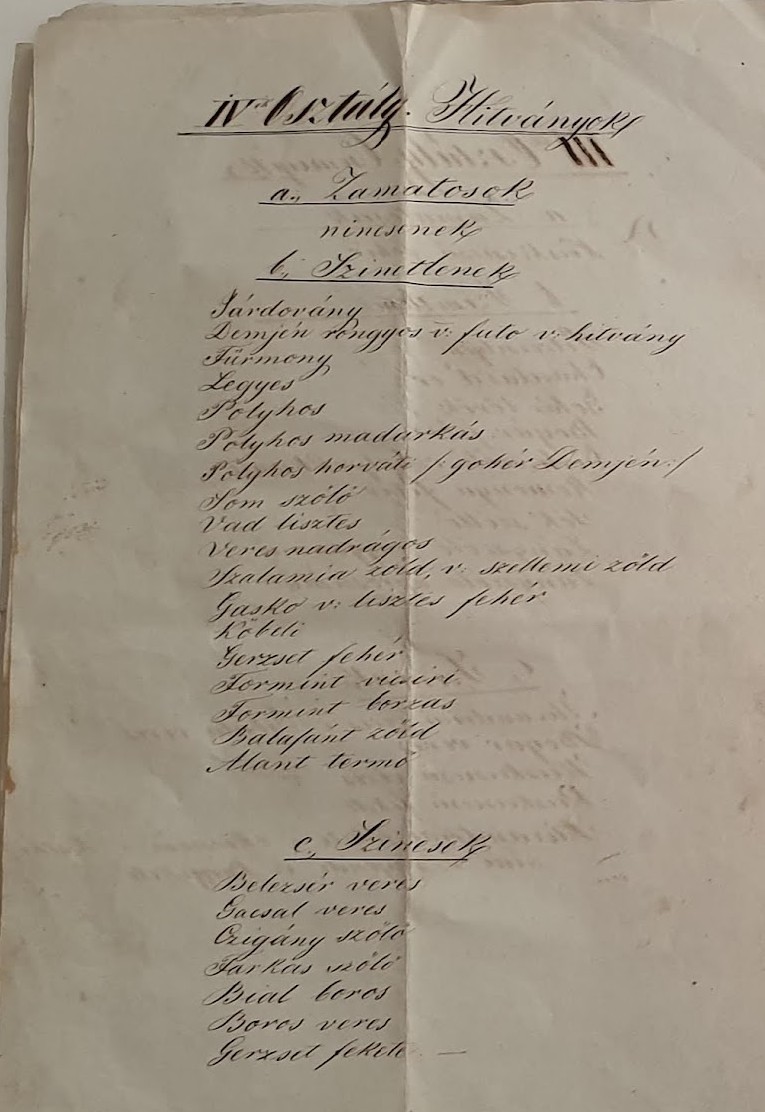
1854 Document listing 109 Grape Varieties in the Tokaj Wine Region
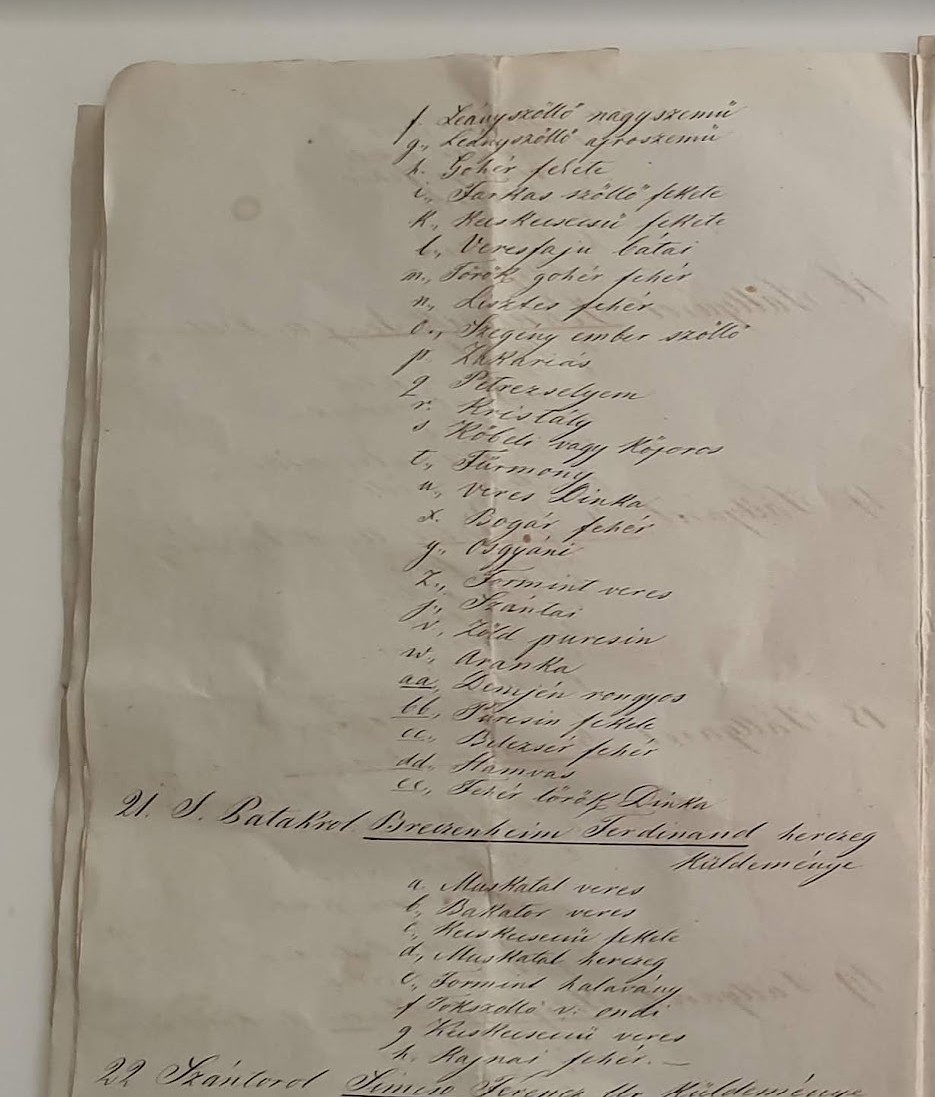
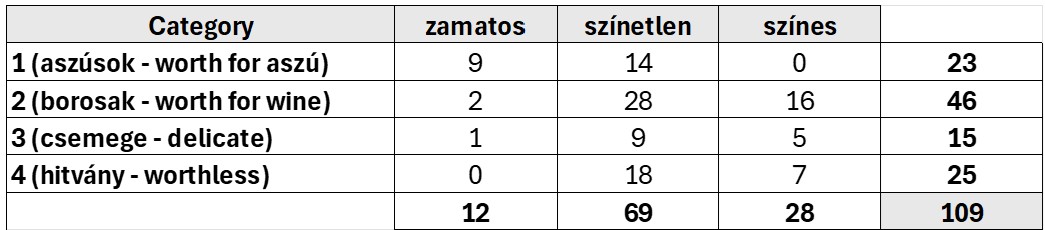
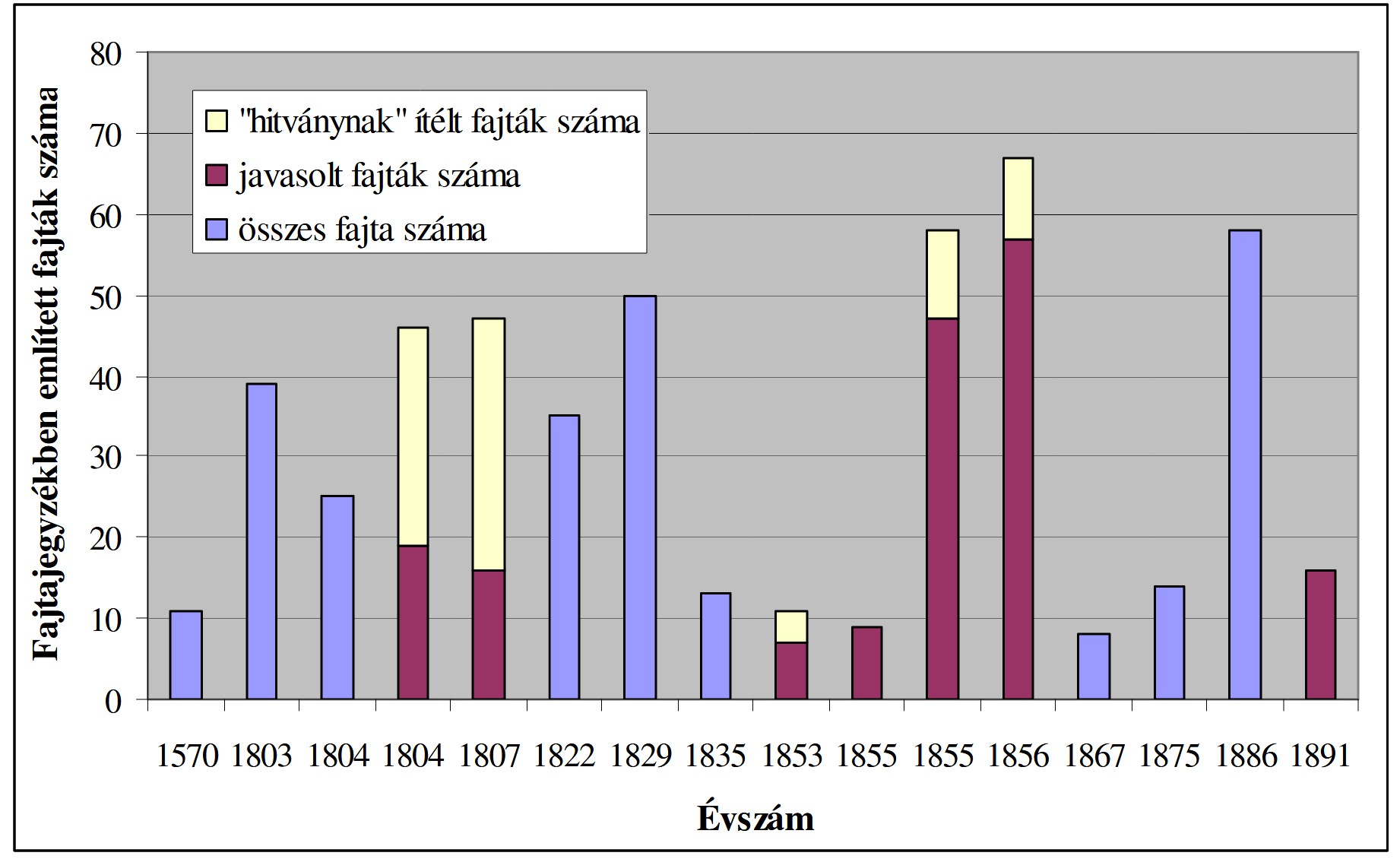
A very interesting find that, to me, shows the amazing breadth of pre-prephyloxera grape varietes in the Tokaj wine region. The document (Hegyaljai szőlőlajstrom) lists a record number of 109 varieties, much more than has been published in the scientific literature (below 70).
The grape varieties are grouped within 4 quality categories, including a number of red grape variants like Furmint veres. Interesting the distinction between “zamatos” (savory, juicy), “színetlen” (colorless) and “szines” (with color).
Even if many of those grape varieties were genetically related, inferior in quality and not commonly used for wine making it is an interesting and important question which grape varieties actually constitute an “original tokaji aszú”. This discussion has been going for several hundred years, and it is still on the table. Even today new grape varieties are occasionally allowed (e.g. Purcsin) and wine categories are changed (e.g. aszú eszencia disappeared).
We can assume that the bandwidth of color, taste and complexity of wines made from so many grape varieties was much higher than today as we find 69 varieties in the two highest categories compared to 6 that are allowed today. Scientific analysis of very old tokaji and its aging process may give us a key to understand how those wines tasted when they were young. There is also rumor that some pre-prephyloxera vines could have survived on isolated places like the island between Bodrog and Theiss, but I am not aware of any effort to locate and genetically analyse those vines that could provide us as window to the past.
The document also mentions grape varieties from Ferdinand Bretzenheim in Sárospatak as well as the curiosity of 1 puttonyos aszú.
The 1811 Essence and the 1701 military order used as its label · click any image to enlarge
1874
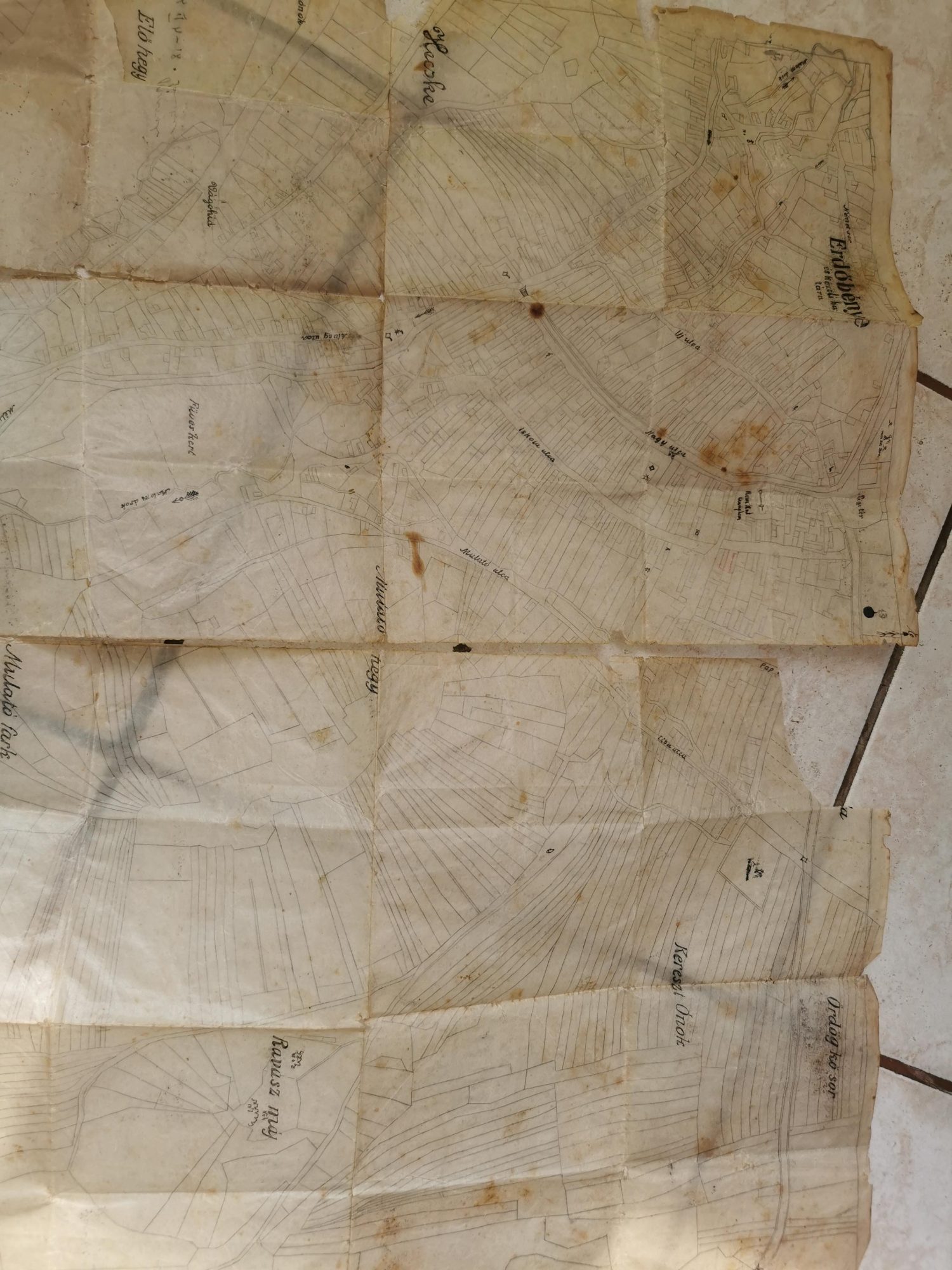
A vineyard map of Erdőbénye
A large hand-drawn plan on tracing paper, titled Erdőbénye és közeli határa — Erdőbénye and its nearby boundary — and dated 1874 on the reverse. It maps the village and the vineyard slopes around it, parcel by parcel, at a date when the region was still working entirely with pre-phylloxera plantings.
The vineyards, by name. Legible on the sheet: Hecske, Elő hegy, Mulató hegy and Mulató park, Ördög kő sor, Kereszt Ónok, Ravasz máj, Füves kert and Vágóhíd. Several are still in use as vineyard names in Erdőbénye today, which makes the sheet directly comparable with the modern dűlő map.
Parcel structure. The slopes are drawn as dense fans of narrow strips running up the hillside — the long, thin family holdings of the Hegyalja, in some places dozens of parcels to a single flank.
The village. Streets are named — Új utca, Nagy utca, Iskola utca, Mulató utca, Tisza utca, Német sor — with Liget tér and the Roman Catholic chapel marked.
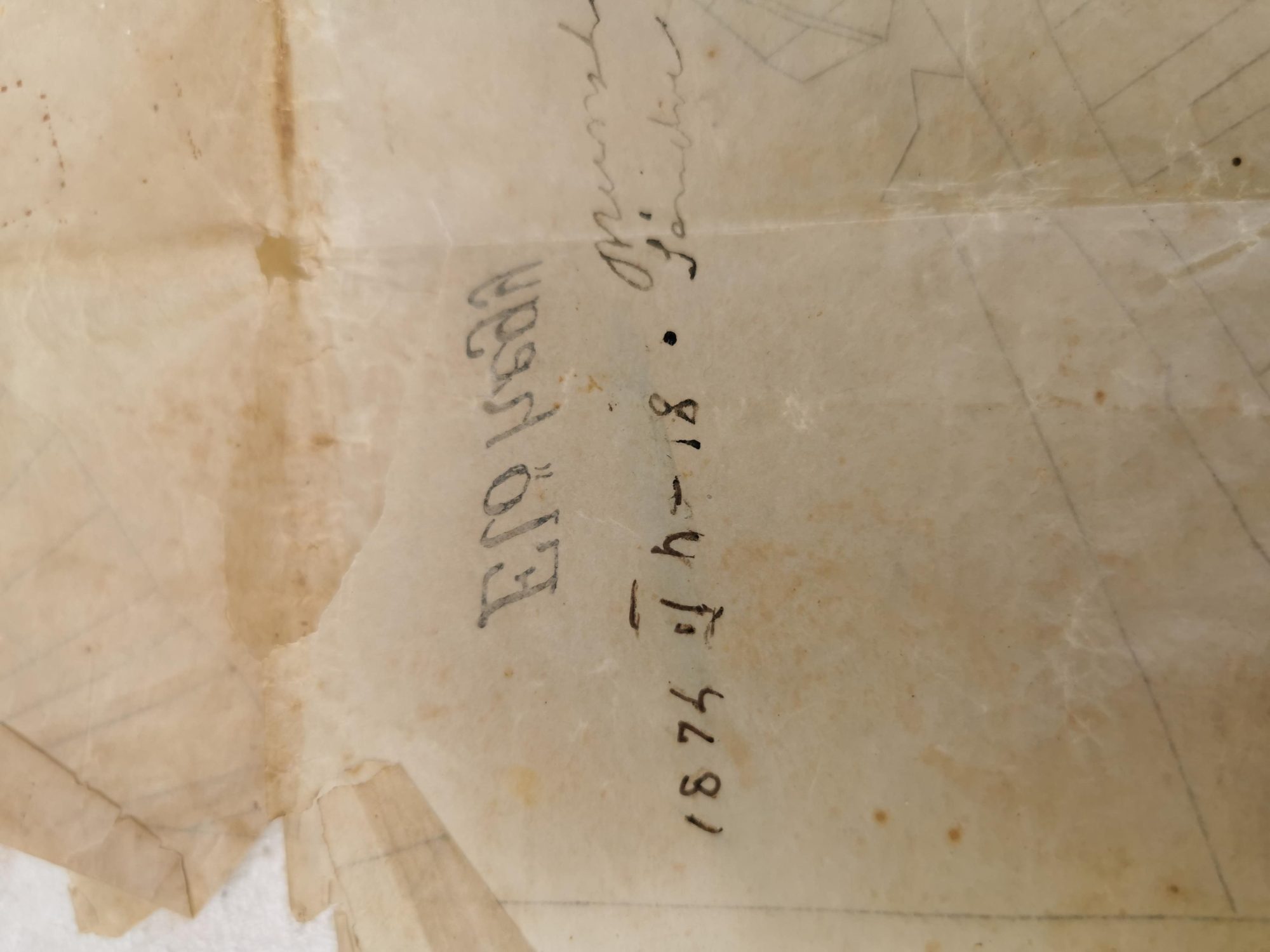
The reverse. A pencil inscription reading 1874 with a section number and a hand-written name; the sheet has been folded into a small packet, and the creases and tears run right through the map.
The sheet photographed unfolded, and the pencil date on its reverse. Click either image to enlarge.
What the map does not carry is an author, a scale bar or an archival stamp, so it is not yet possible to say whether it is an official cadastral tracing or a private working copy. Both would be worth knowing: a dated parcel plan of a single Hegyalja commune, made before phylloxera reached Hungary, is a control document for any claim about which slopes were planted in the nineteenth century.
1882
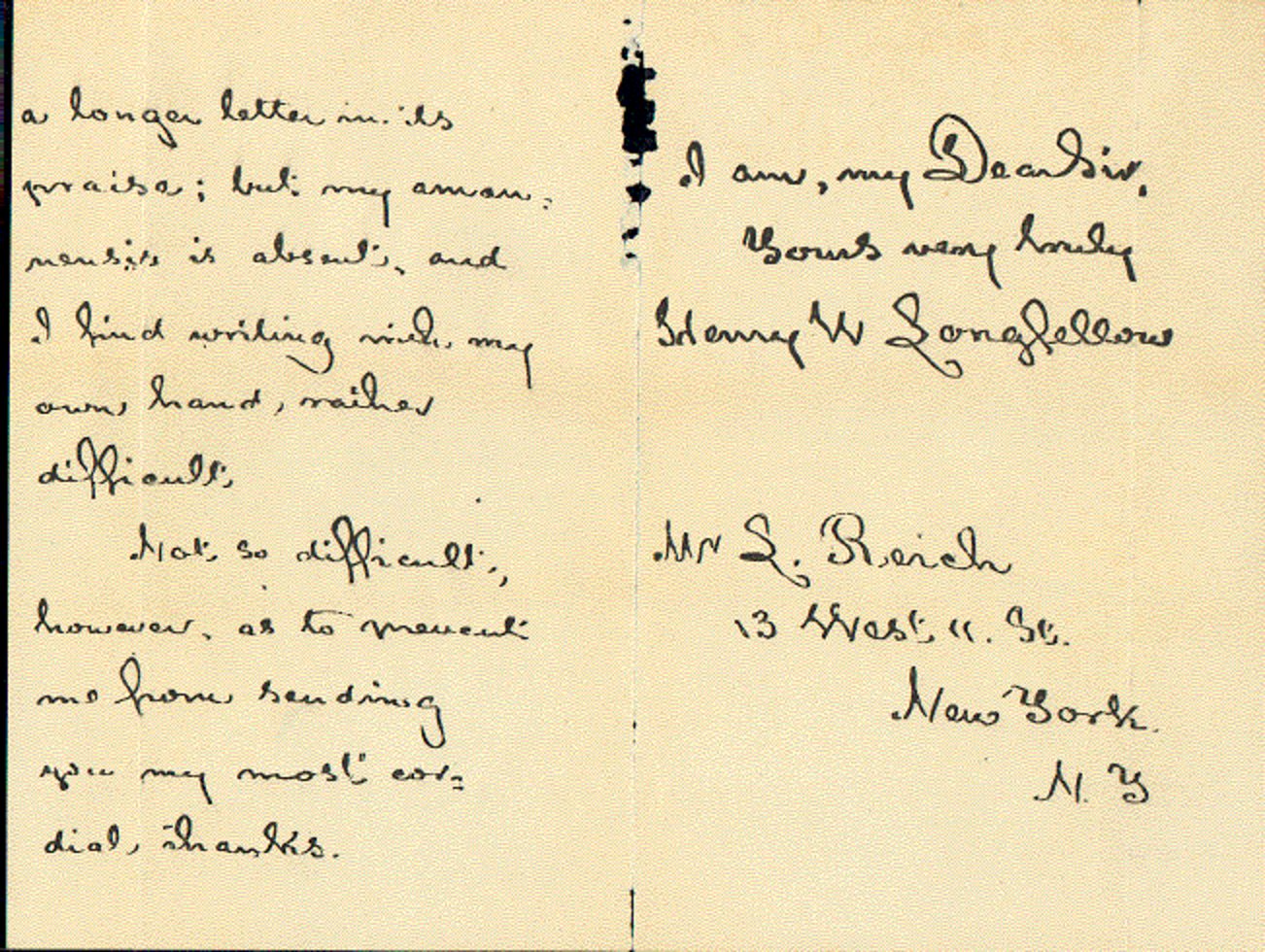
Longfellow’s last letter, on a case of 1868 Ausbruch
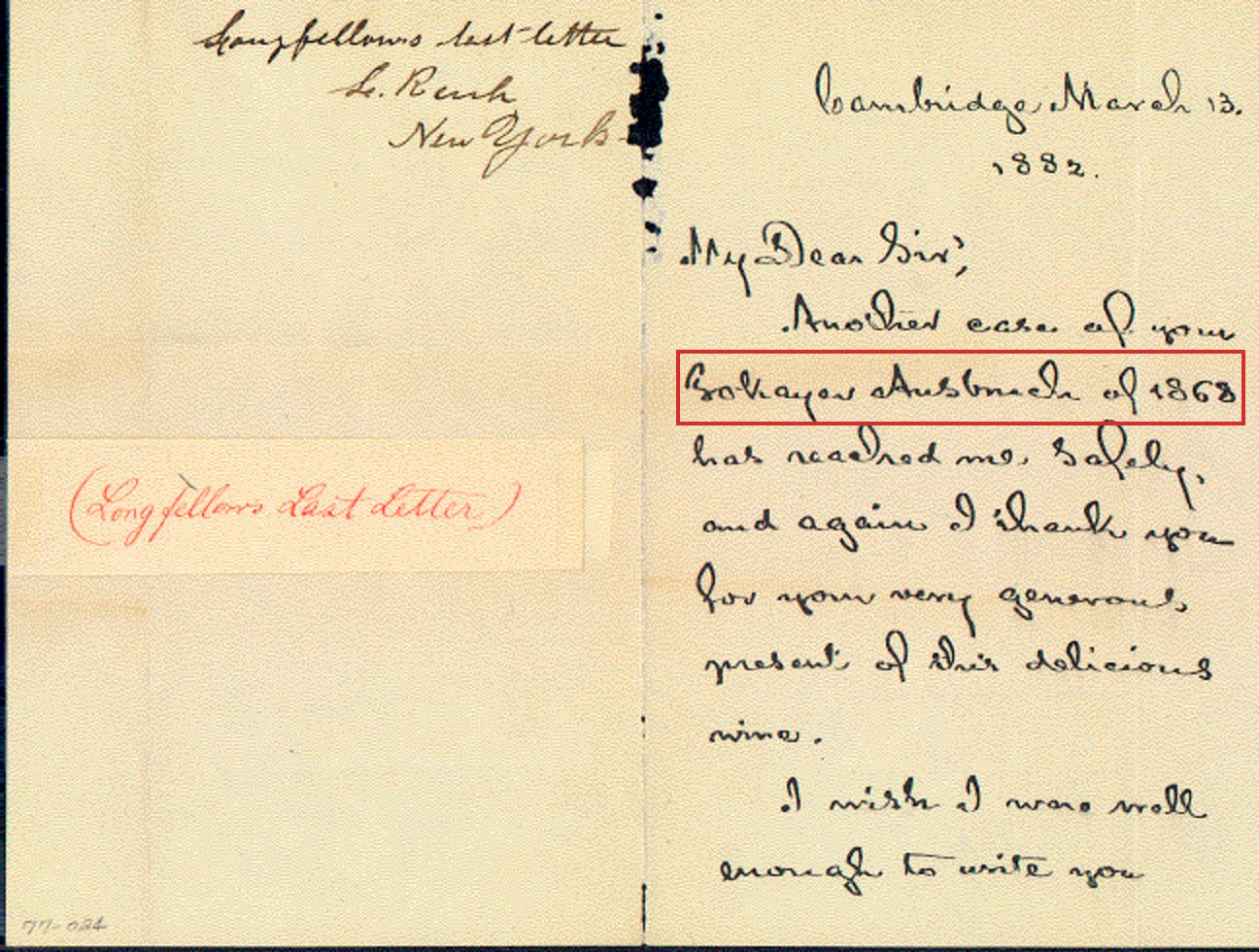
A two-leaf note in Henry Wadsworth Longfellow’s own hand, written from Cambridge on 13 March 1882 to the New York wine importer Lorenz Reich. A collector’s docket at the head reads Longfellow’s last letter / L. Reich / New York, and a red-ink label was added later: (Longfellow’s Last Letter). Item no. 717-024.
The letter
Cambridge, March 13, 1882.
My Dear Sir, Another case of your Tokayer Ausbruch of 1868 has reached me safely, and again I thank you for your very generous present of this delicious wine. I wish I was well enough to write you a longer letter in its praise; but my amanuensis is absent, and I find writing with my own hand rather difficult. Not so difficult, however, as to prevent me from sending you my most cordial thanks. I am, my Dear Sir, Yours very truly Henry W. Longfellow
Mr L. Reich, 13 West 11. St., New York, N.Y.
The two leaves. The phrase Tokayer Ausbruch of 1868 is marked in red. Click either image to enlarge.
What it records
Eleven days before his death. Longfellow died at Craigie House on 24 March 1882, of peritonitis, after a decline that had begun that winter. “I wish I was well enough … I find writing with my own hand rather difficult” is the voice of a man in his final illness, and the collector’s label is close to the truth: this is among the last things he wrote.
The importer. Lorenz (Lawrence) Reich, of 13 West 11th Street, was the Hungarian-born merchant whose firm — L. Reich & Son, later “Lorenz Reich, Importer of Hungarian Wines” — was the leading American house for Tokaji in the 1870s–90s.
A testimonial by design. Reich made a practice of sending cases of his best Tokaji to famous men and publishing their letters of thanks; Longfellow’s is the most celebrated, and was reproduced in Reich’s promotional literature and in later histories of Tokaji in America.
A dated wine, sent by the case. 1868 was a fine Hegyalja vintage, so the wine was fourteen years old when it arrived. “Another case” means Reich had sent at least one before — and a case implies bottles, not cask.
As a document of the American Tokaji trade it carries everything one would want: a named vintage and style, a named importer with an address, a bottled shipment, and a testimonial from one of the most famous men in the country, written in the last fortnight of his life. The Houghton Library’s Longfellow papers (Harvard, MS Am 1340) would be the place to look for Reich’s side of the correspondence and for the earlier thank-you letter implied by again.
1954 · 1962
Churchill: “Wine of this age is a great rarity”
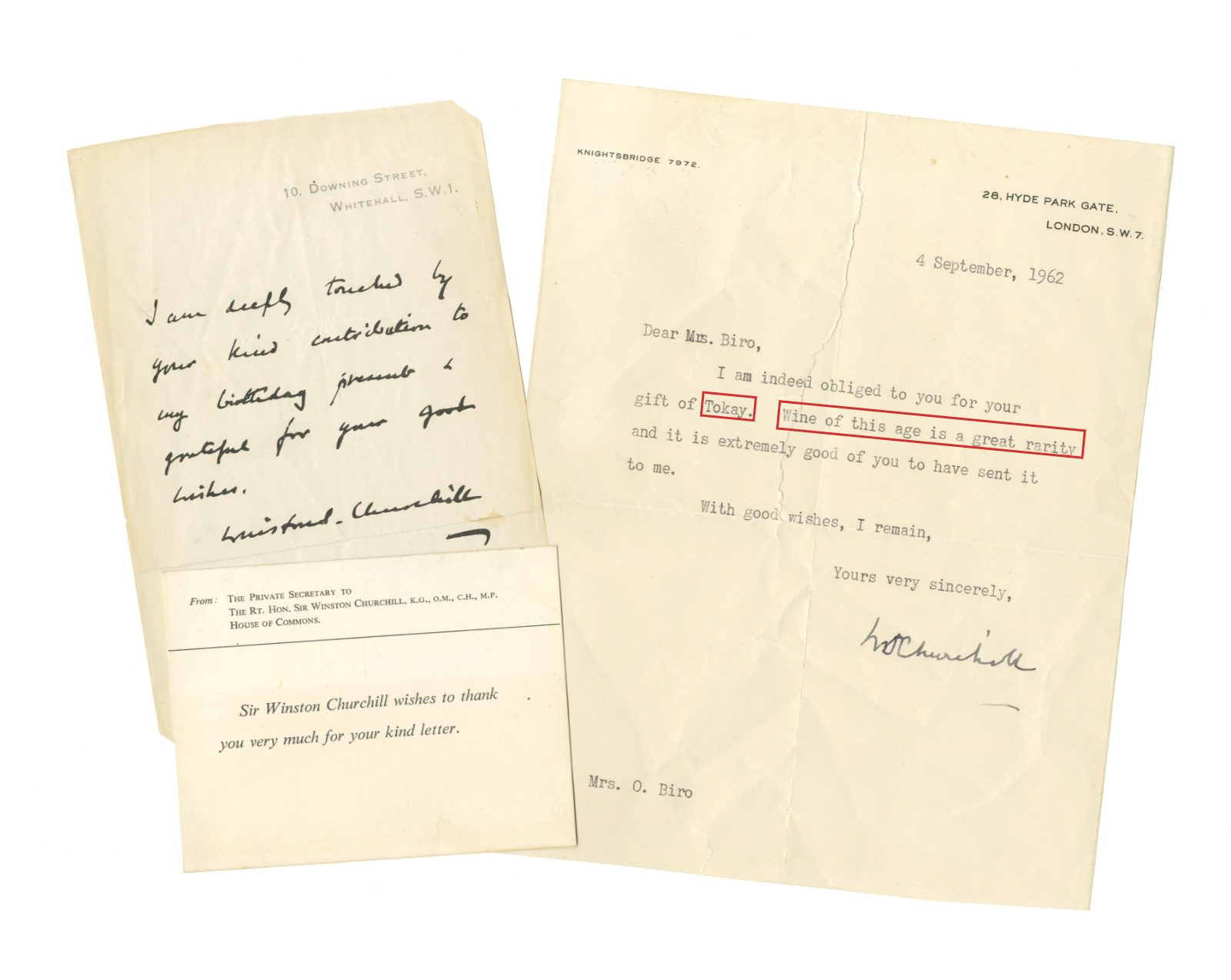
Three pieces of Churchill correspondence addressed to the same recipient, Mrs O. Biro: a handwritten note on 10 Downing Street paper, a typed letter of 4 September 1962 signed in ink, and a printed card from his private secretary.
The letter · 28 Hyde Park Gate, 4 September 1962
Dear Mrs. Biro, I am indeed obliged to you for your gift of Tokay. Wine of this age is a great rarity and it is extremely good of you to have sent it to me. With good wishes, I remain, Yours very sincerely, W. S. Churchill
The handwritten note, on 10, Downing Street, Whitehall, S.W.1 paper and undated, reads: “I am deeply touched by your kind contribution to my birthday present & grateful for your good wishes. — Winston S. Churchill.” The card reads: “Sir Winston Churchill wishes to thank you very much for your kind letter,” from the Private Secretary to The Rt. Hon. Sir Winston Churchill, K.G., O.M., C.H., M.P., House of Commons.
The three items together. Tokay and Wine of this age is a great rarity are marked in red. Click to enlarge.
Dating the note. The Downing Street paper places it in Churchill’s second premiership, October 1951 to April 1955, and the reference to a contribution to a birthday present points to the collective gifts organised for his eightieth birthday on 30 November 1954 — the occasion of the Sutherland portrait and the national presentation. The K.G. on the secretary’s card fits: he was made a Knight of the Garter in 1953.
The letter belongs to the very end. In September 1962 Churchill was 87, convalescing at Hyde Park Gate after breaking his hip in Monte Carlo that June. The unsteady signature is characteristic of these last years, when letters were typed by his secretaries for him to sign.
Who sent it. Mrs O. Biro was evidently a Hungarian émigrée in Britain — Bíró is a common Hungarian surname, and the 1956 exodus brought many to London. Sending an old Tokaji to Churchill, a champagne-and-brandy man who nonetheless received Tokaji as a gift more than once, was the classic gesture of homage.
Why the phrase matters.“Wine of this age is a great rarity” is Churchill acknowledging in his own words that what arrived was an old Tokaji, valued for its age — in 1962, when pre-war and pre-nationalisation bottles were exactly what émigré families still had.
Neither the vintage nor Mrs Biro’s identity is established. The Churchill Archives Centre in Cambridge — CHUR 2, public correspondence, and the 1962 gifts files — may hold her covering letter and would show what she sent.