
Vintage 1606 · Fukier, Warsaw
The oldest bottle of Tokaji in the world
Found in a cellar, still wrapped, still corded, with the house name written on it in red. The wine behind it is the best documented old Tokaji there is.
- Vintage
- 1606Written on the bottle and on its tag
- In the cellar, 1934
- 328Bottles of this vintage counted by Bókay
- Price, 1934
- 450 złEighteen times the house price of Lafite
- House still trading
- 1942Latest Fukier docket held
This bottle was not bought at auction and has no aristocratic inventory behind it. It came out of a cellar, dressed exactly as the Fukier house dressed its own stock, and what supports it is the paper trail the house left behind: a Hungarian journalist who counted the bottles and drank one, the firm’s own advertising, and an invoice from the last years of the shop.
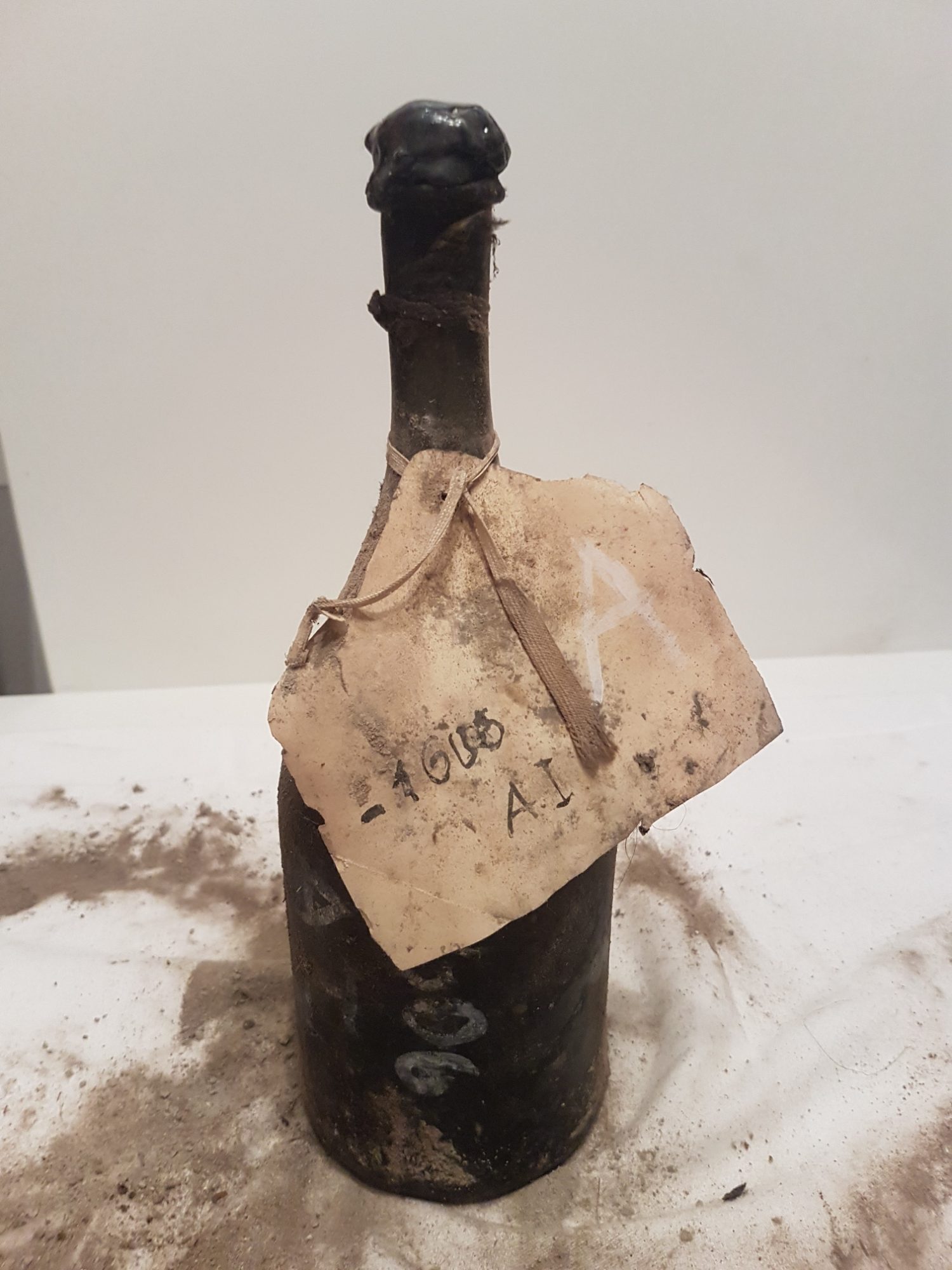
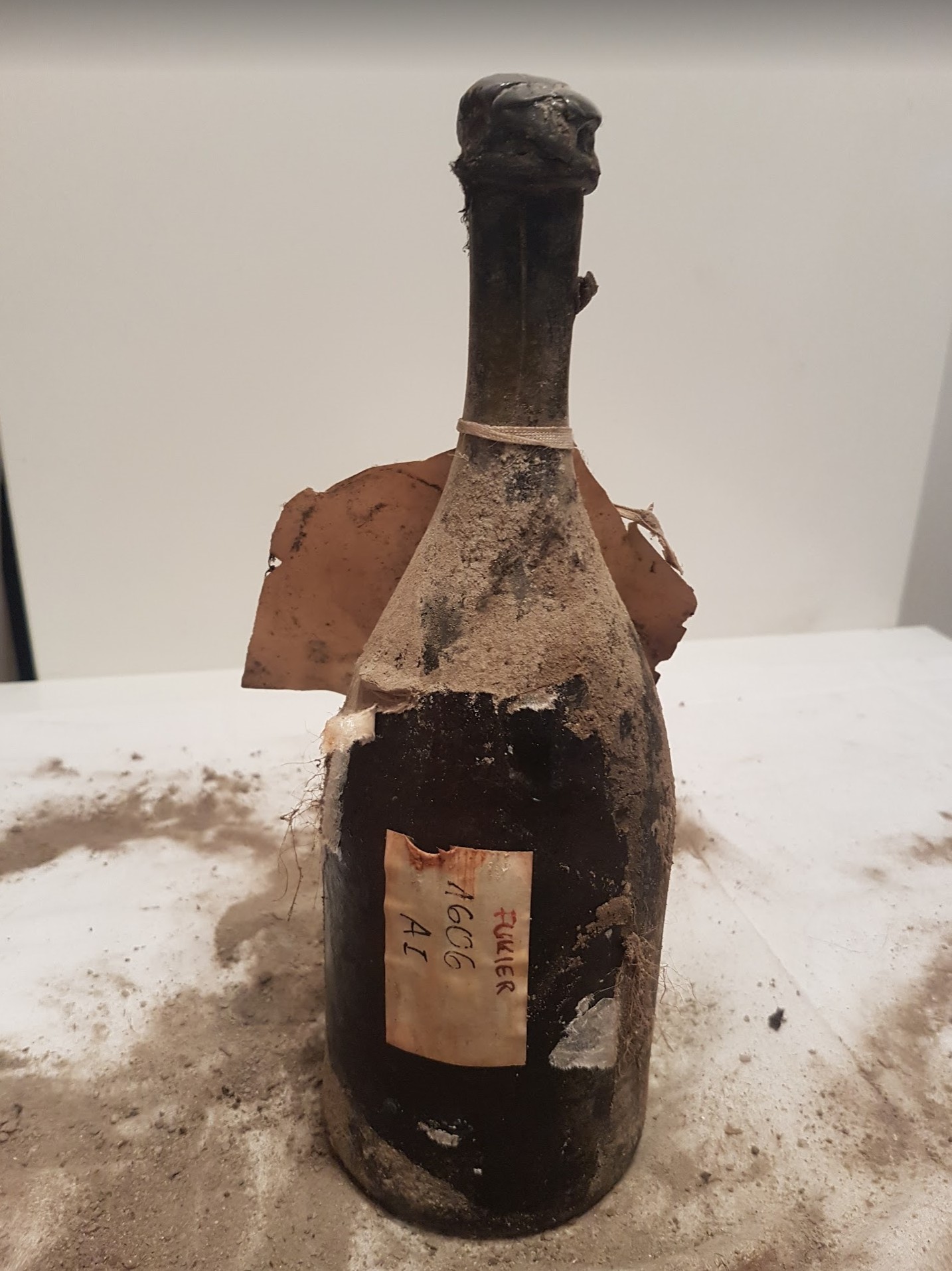
The bottle as found
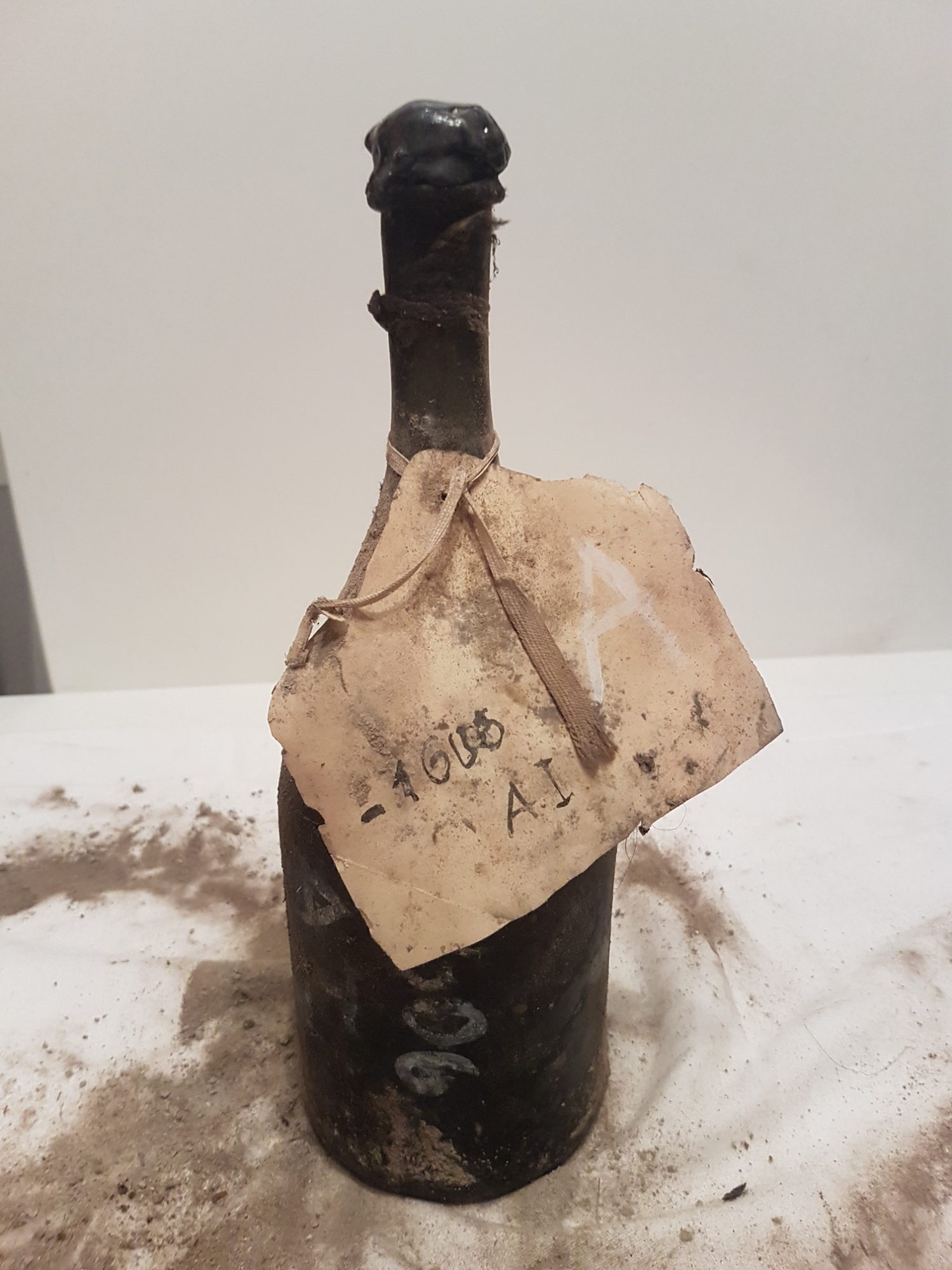
The glass is a squat, wide-shouldered form in near-black glass, the cork capped in dark sealing compound and a cord tied under the collar. A sheet of paper is wrapped over the shoulder and torn where it was handled; a second paper tag hangs from the neck on a cotton loop. Everything is grey with cellar dust.
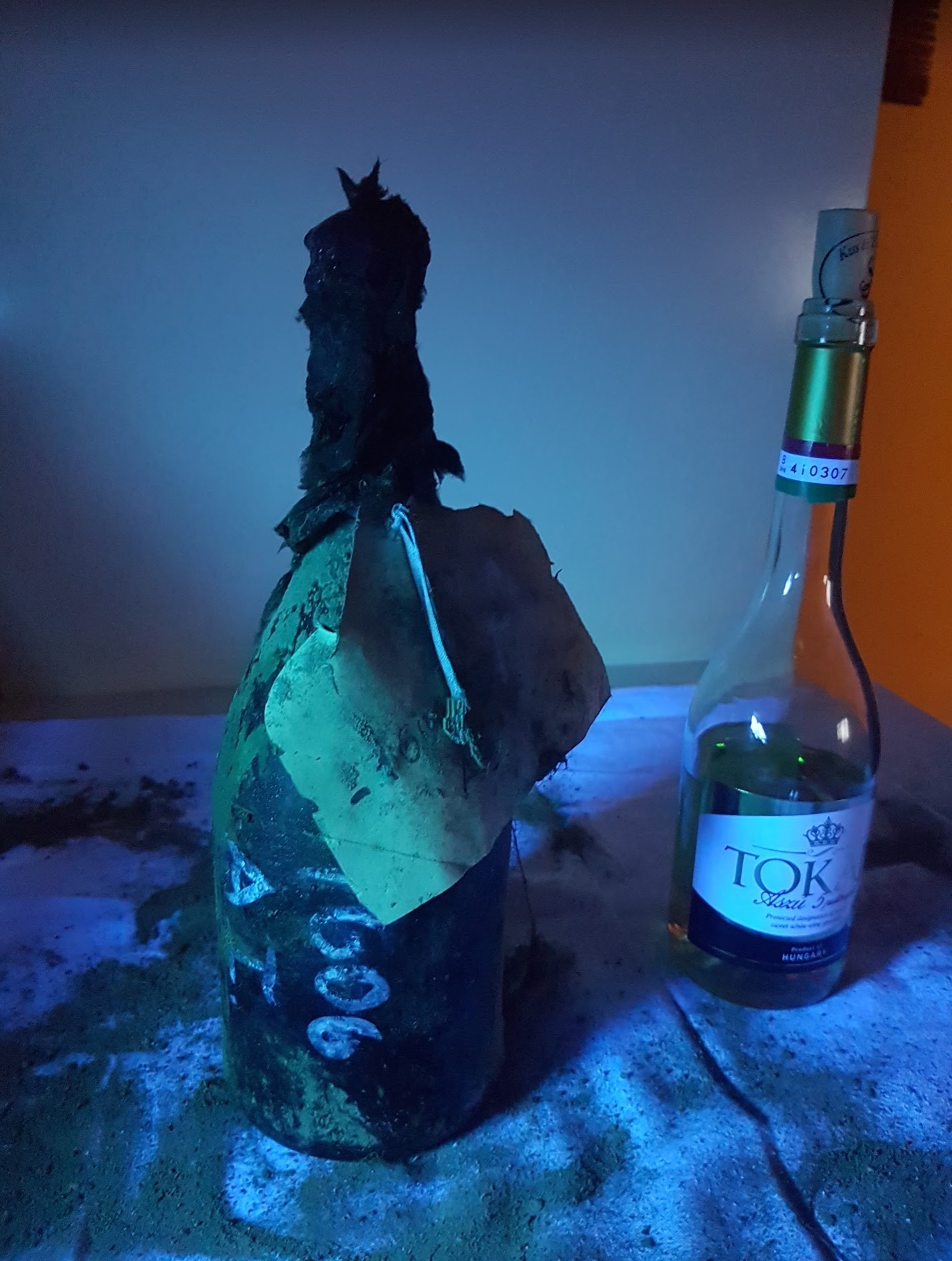
Two marks carry the identification. On the body, a small paper label reads 1606 with FUKIER written across it in red and the cellar reference A I beneath. The neck tag repeats both: 1606, A I, and a large painted A. Under ultraviolet light the painted figures on the glass fluoresce — the same paint, and the same habit of marking inventory number and vintage directly onto the bottle, found on other bottles from this house.
The same tag, in the cellar
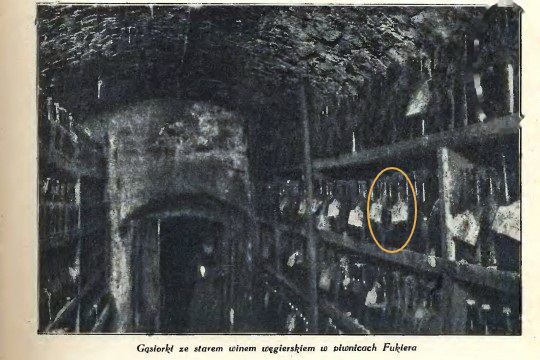
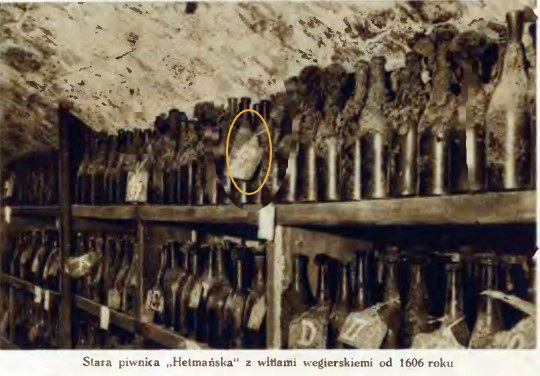
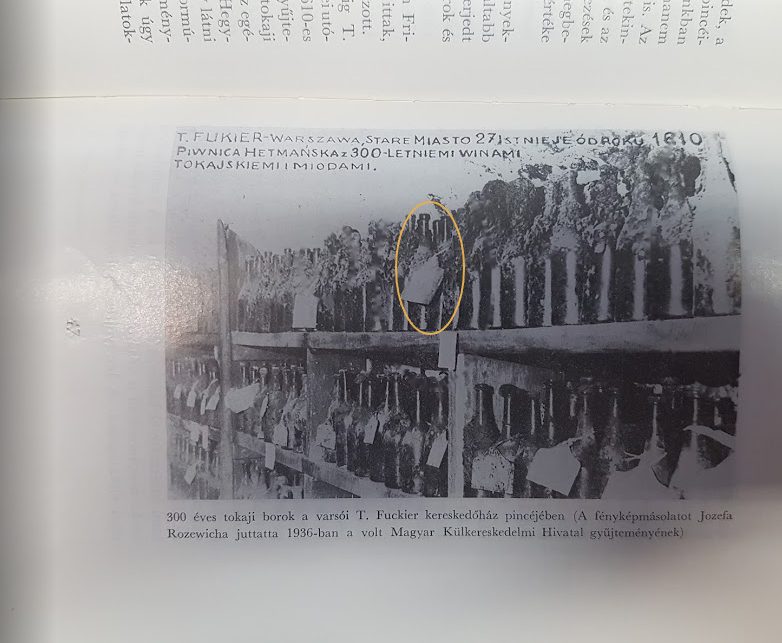
Three photographs of the Fukier cellar survive from before the war, and all of them show how the stock was marked: a paper tag hung from the neck of every bottle on a loop of cord, exactly as on this bottle. Marked in each photograph is one clearly visible example.
The earliest plate is captioned Gąsiorki ze starem winem węgierskiem w piwnicach Fukiera — flagons of old Hungarian wine in the Fukier cellars. The second names the room and the vintage outright: Stara piwnica „Hetmańska” z winami węgierskiemi od 1606 roku — the old Hetman cellar, with Hungarian wines from the year 1606. The later one carries the house’s own caption across the top, naming the Warsaw address at Stare Miasto 27 and the Piwnica Hetmańska with its three-hundred-year-old Tokaji wines and meads; beneath it, the printed caption records that the copy photograph was passed to the Hungarian foreign trade office collection by Jozefa Rozewicha in 1936.
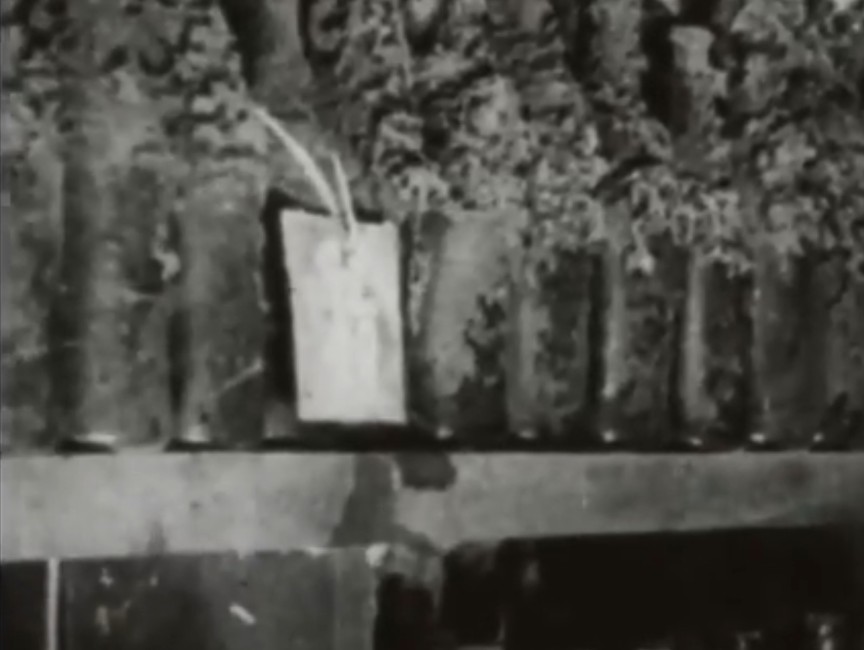
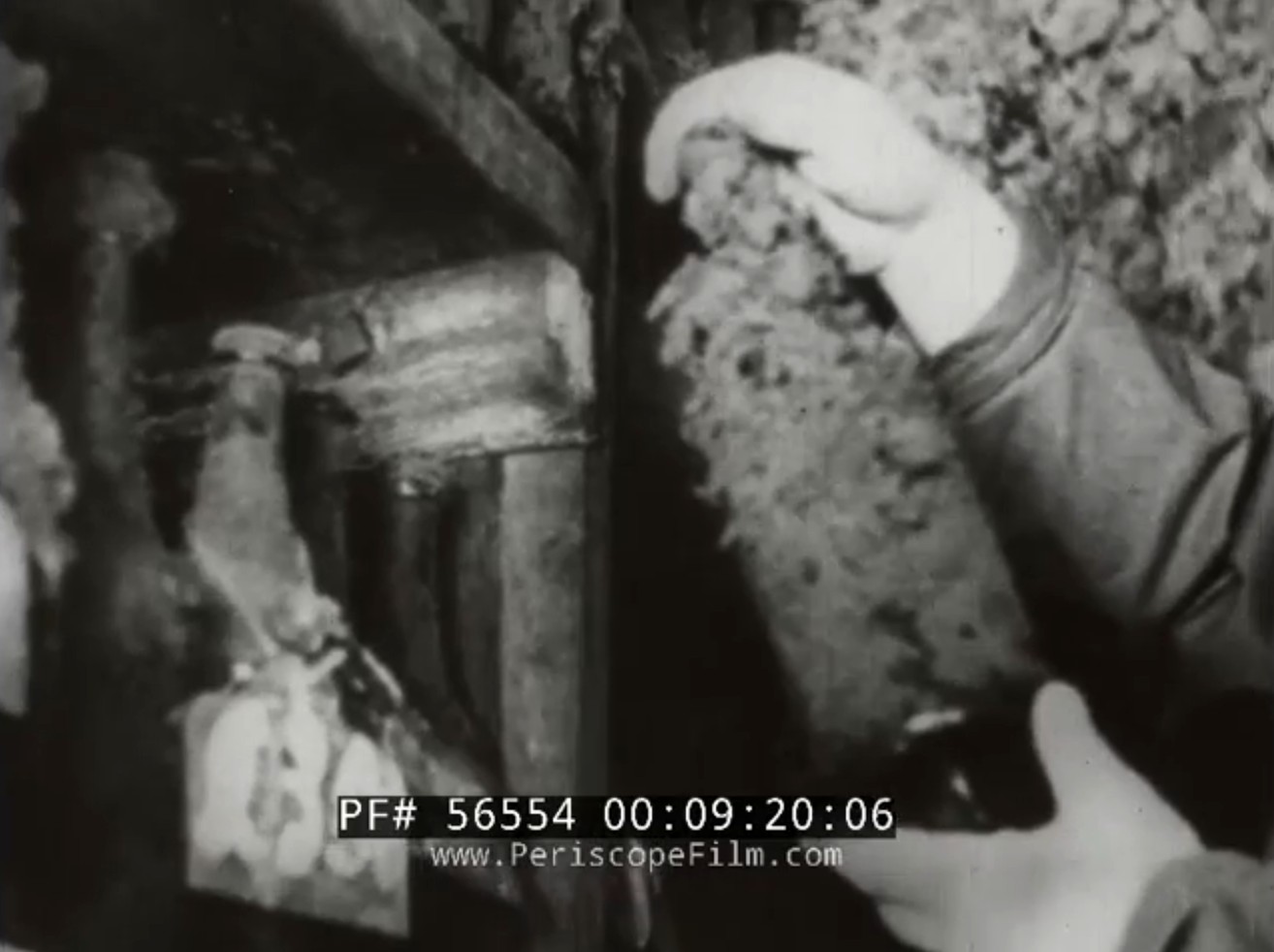
The cellar was also filmed. Two stills from a 1933 film about Poland, shot in the Piwnica Hetmańska (the Fukier sequence begins at 8:43), show the racked bottles under a thick growth of cellar mould with only their paper neck tags kept clear of it — the condition in which this bottle came out, its own tag legible above a crust that covers the glass.
What Bókay counted, and drank
In November 1934 the Hungarian journalist János Bókay visited the Fukier cellar in Warsaw and published what he found in Borászati Lapok. His article is the most useful quantification of the cellar anyone made: roughly 5,500 bottles of Tokaji across some 27 rooms, of which 700 were very old and 328 were of the 1606 vintage. Between 1914 and 1934, twelve bottles of that vintage were sold or given away, and five were drunk.
One of the five was opened for him. His note is the most important tasting note on any Fukier bottle, and the most extravagant:
“The real ambrosia, the drink of the gods, the numbing of tongues, the inspirer of the most wonderful dreams, the king, the prince, the noblest of the nobles: Tokaji. Three hundred and twenty years old. A dark liquid, like the darkest Malaga, but it does not impress with its sweetness, but with the mystical complexity of its flavor.”
Three hundred and twenty years before 1934 is 1614, near enough to 1606 for a journalist rounding a number. What matters is that the vintage he was served was the house’s oldest, and that he wrote it down at a datable moment.
The house advertised it
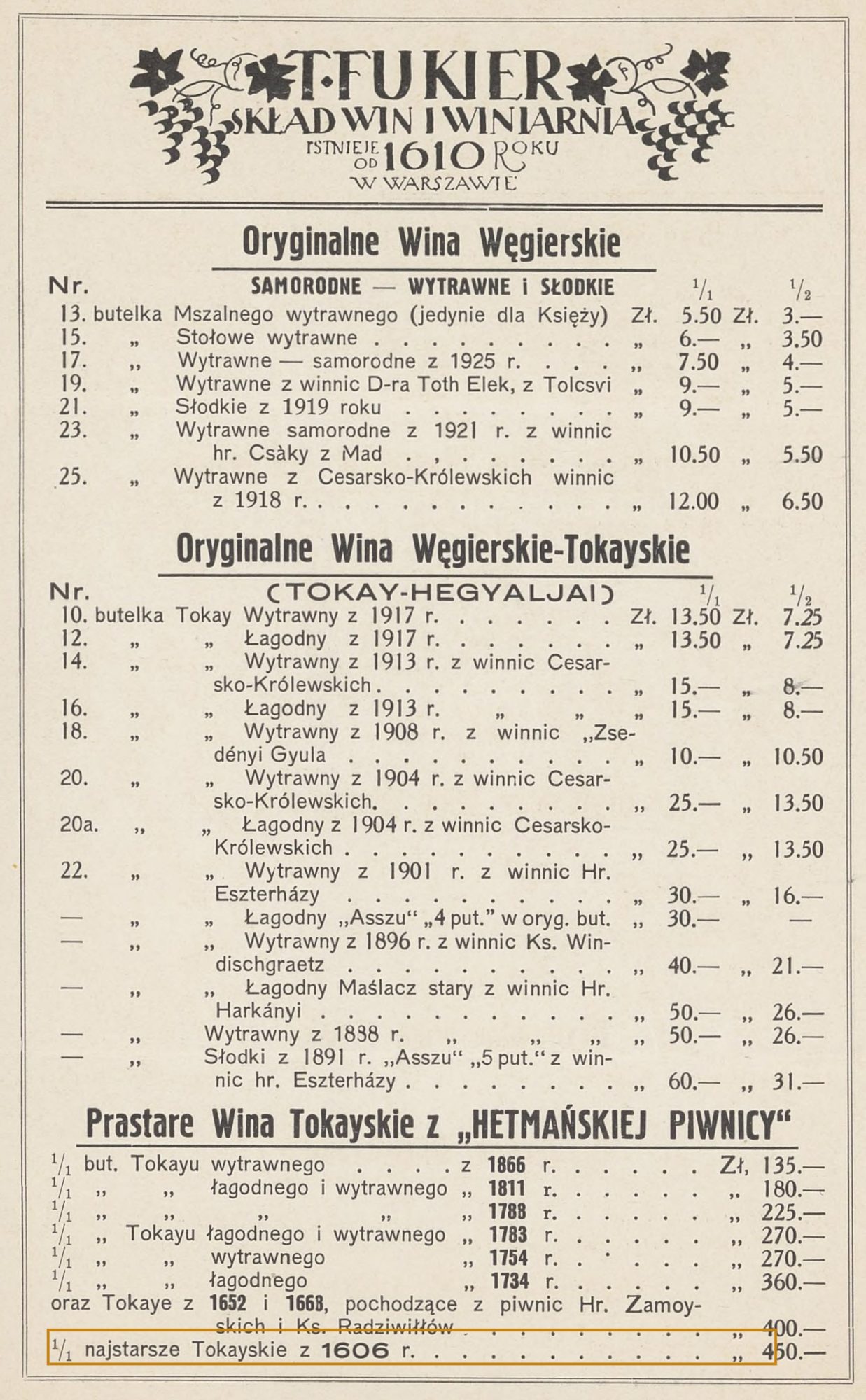
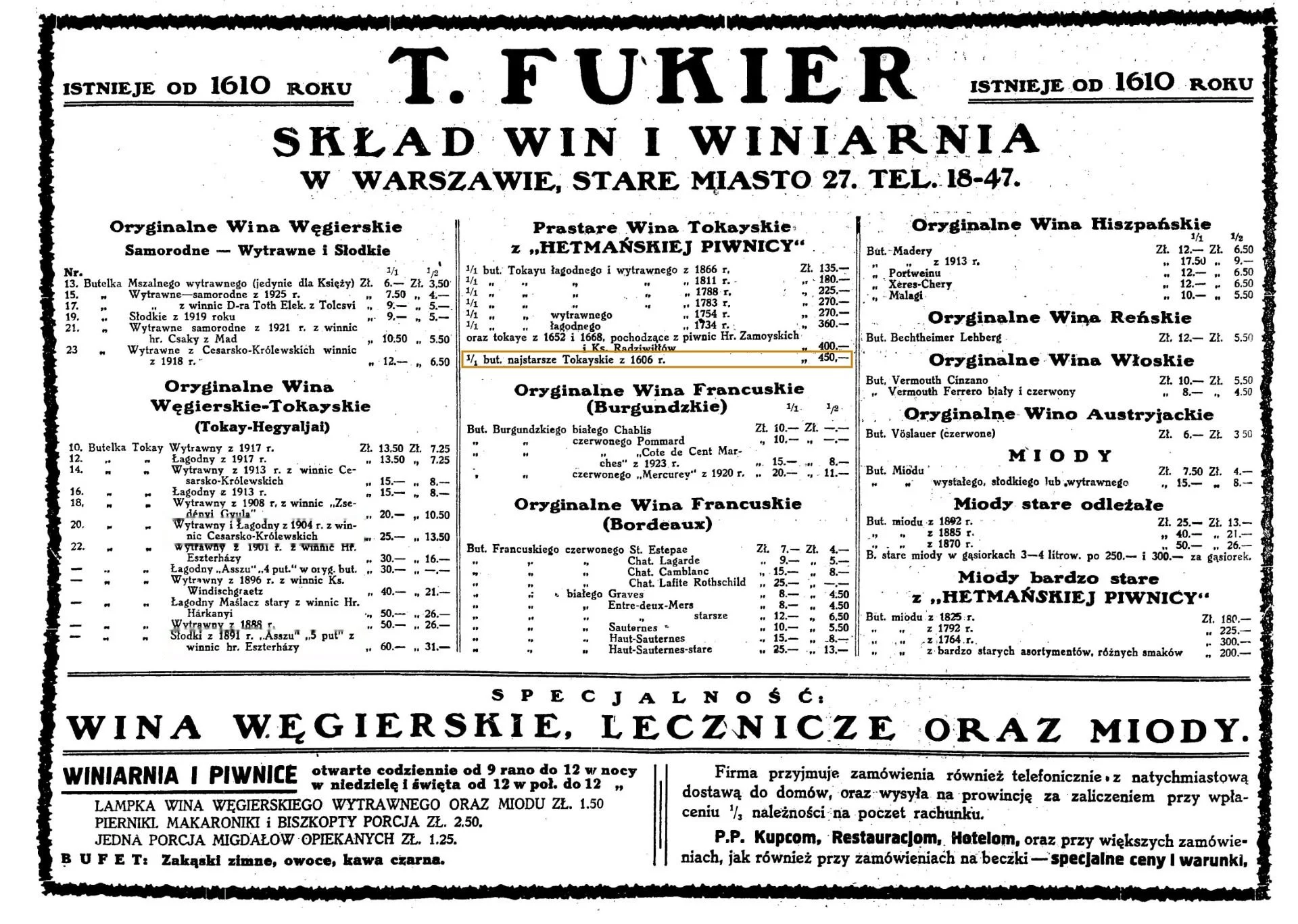
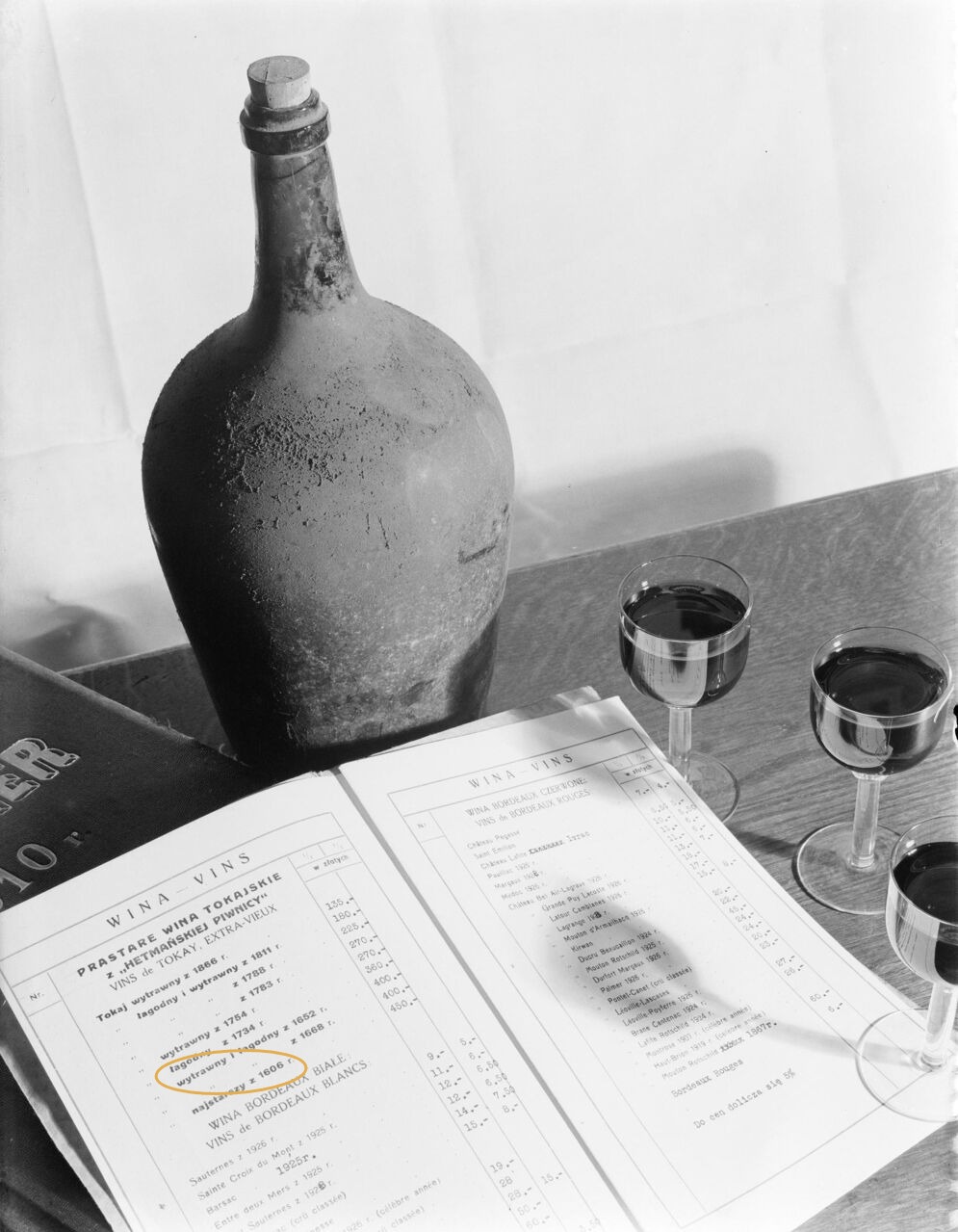
The 1606 was not a story kept for visitors. It headed the firm’s own price lists in the interwar years at 450 zł the bottle, described simply as najstarszy — the oldest — with no style given, where every other vintage on the sheet is marked dry, mild, or both. Below it the sheet runs down the cellar by vintage — 1866 at 135 zł, 1811 at 180, 1788 at 225, 1783 and 1754 at 270, 1734 at 360, and the Zamoyski and Radziwiłł Tokays of 1652 and 1668 at 400.
The comparison on the facing page of the same list is the useful part. The dearest Bordeaux was an 1867 Mouton-Rothschild at 60 zł; a 1924 Lafite-Rothschild went for 26 zł. The 1606 Tokaji stood at eighteen times the house price of Lafite, and some three hundred times a glass at the counter. Whatever the twentieth century did to the reputation of Hungarian wine, in 1934 the market had not forgotten what old Tokaji was. The full documentation of the lists is set out on the Fukier Cellar page.
And sold it
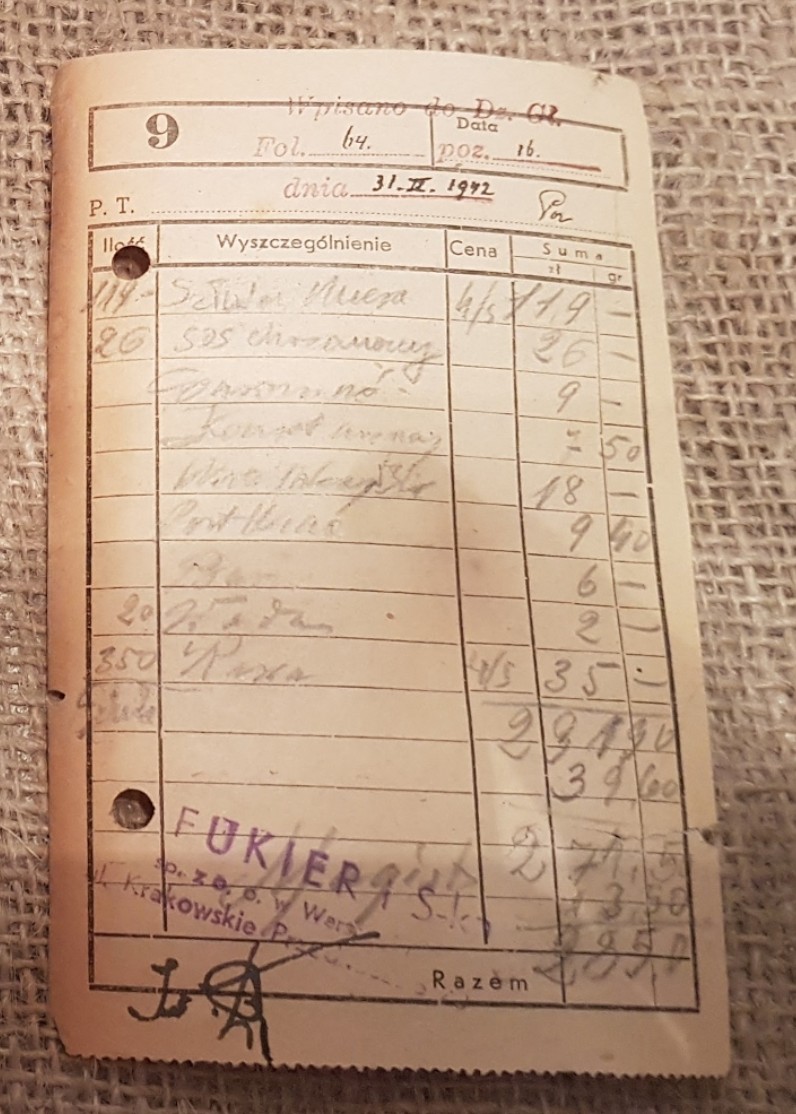
The house also sold wine, and the receipts survive. This one is a Fukier docket of 31 December 1942 — folio 64, position 16 — itemised in a Polish hand, totalled in złoty and groszy, stamped FUKIER sp. z o.o. w Warszawie, Krakowskie Przedmieście and signed. It records ordinary trade, wines among the items, in the middle of the occupation.
That matters for a cellar find. An invoice does not authenticate a particular bottle, but it does establish that this house was still moving stock at that date, from those premises, under that name — which is the commercial context any bottle marked FUKIER has to fit.
What is settled and what is not
The vintage itself has a contested historiography, and it is worth stating plainly. In 1868 Kłosy described the oldest wine in the house as pressed from the berries more than three centuries earlier — that is, before about 1568 — and nobody yet mentioned 1606. The precise date appears only in the interwar years, and an impossible 1610 entered through a news agency in 1927. The dating of the oldest wine therefore moved more than once, and only the middle version has ever been treated as a fact.
What this bottle adds is physical. It carries the house’s own marks, made in the house’s own way, on glass that came out of a cellar rather than a saleroom; the paint fluoresces like the paint on other Fukier bottles; and the documentary record around it — a counted stock of 328, a printed price, a tasting note, a wartime invoice — is denser than for any other Tokaji of the period.
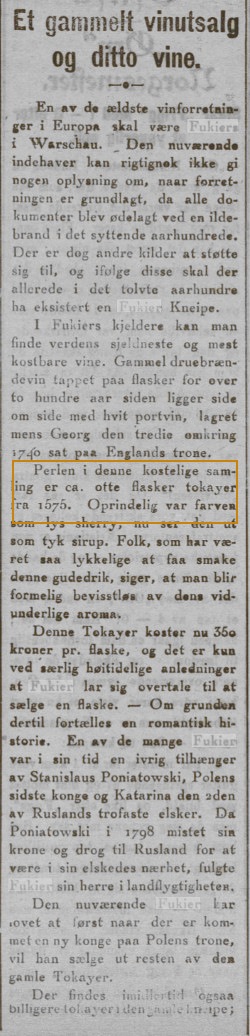
A Norwegian newspaper report pushes the claim back further still. Hortens Avis of 18 October 1920, under the heading Et gammelt vinutsalg og ditto vine, sets it out. Describing the Fukier house as one of the oldest wine merchants in Europe, it says the prize of the collection was some eight bottles of the 1575 vintage, originally the colour of light sherry and by then dark as syrup, sold only on special occasions at 350 kroner the bottle. No 1575 bottle is known to survive, and the report belongs with the other shifting dates rather than beside them as a fact — but it is one more contemporary voice placing the cellar's oldest wine well before 1606.
And the Fukier cellar is not the only place such a bottle could be. Old Tokaji travelled as gift and tribute across half of Europe, and closed collections — noble families, monasteries, court cellars, walled-up rooms not opened since a war — are still being found. An older bottle than this one may well be standing somewhere, unrecorded. The claim made here is only that this is the oldest bottle of Tokaji presently known.