Imperial Habsburg Cellar (K.u.K. Hofkeller), Vienna
For more than 300 years the Imperial Cellar in Vienna was the epicenter of tokaji wine not only with respect to quantity and quality but also prestige.
Chapter one
The Imperial Cellar
1619 — 1967
Under the Hofburg
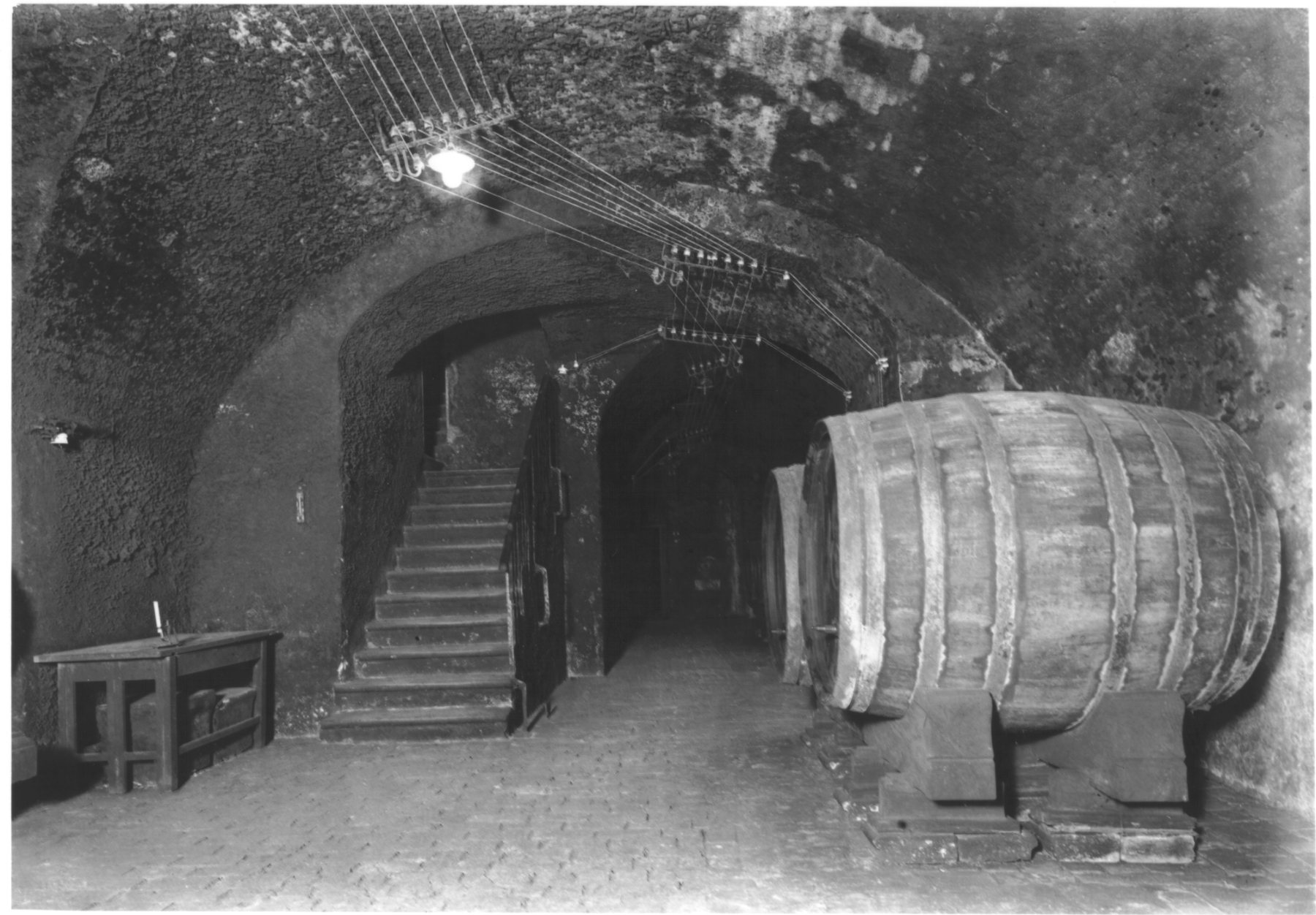
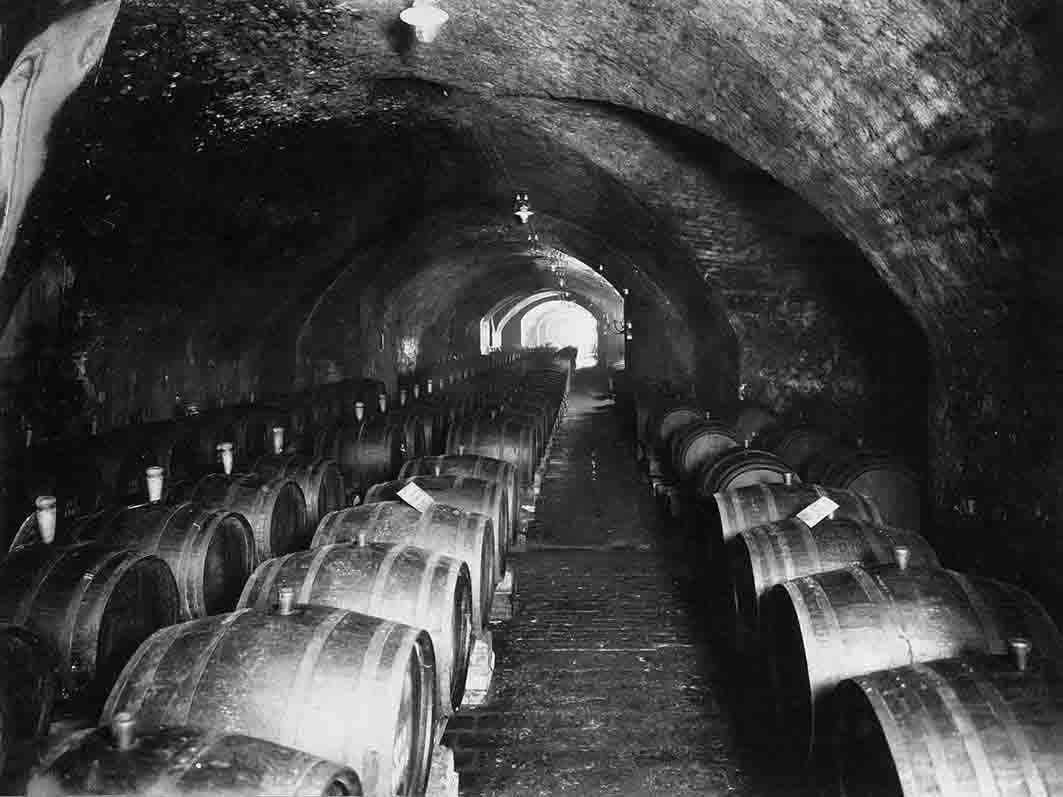
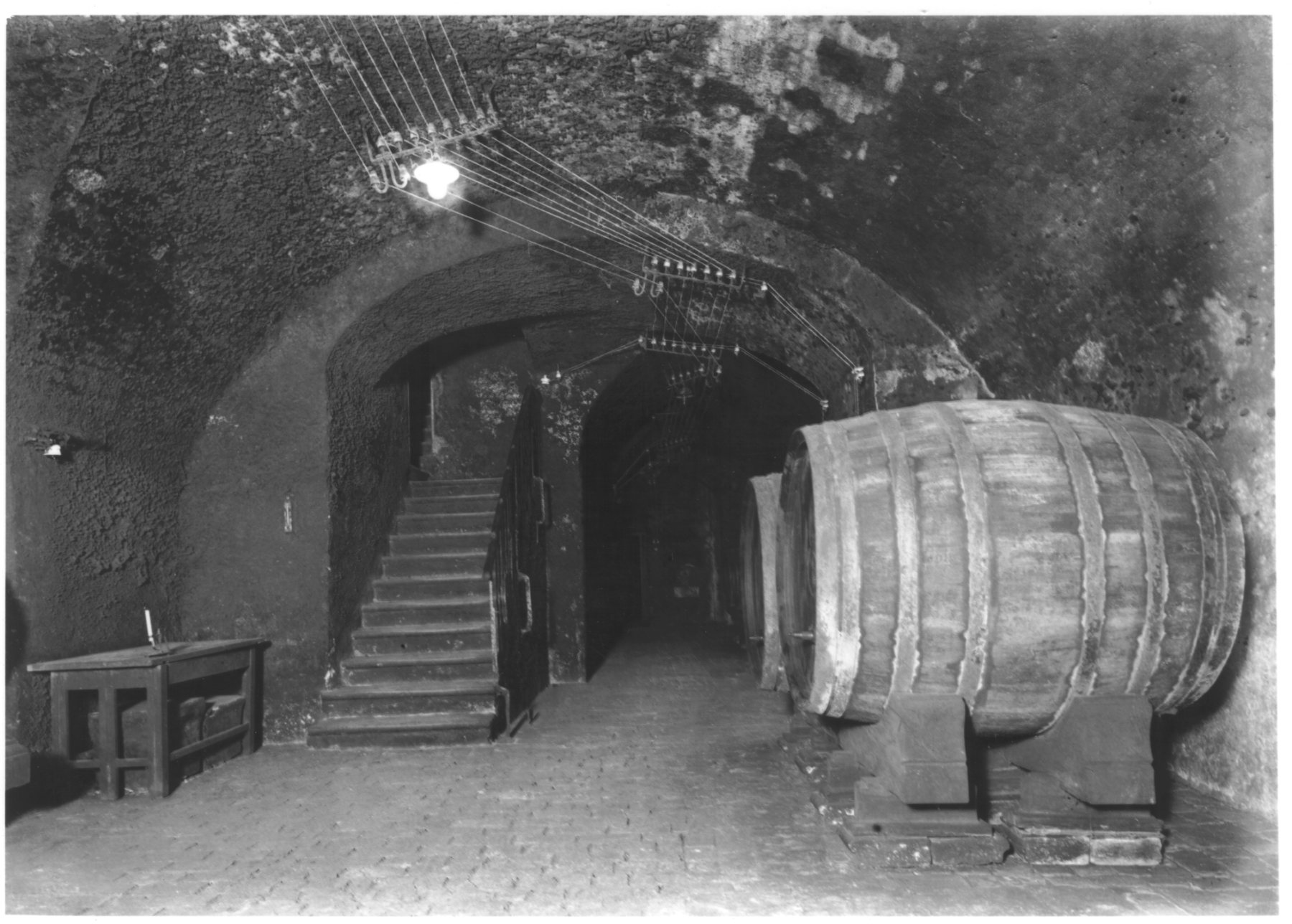
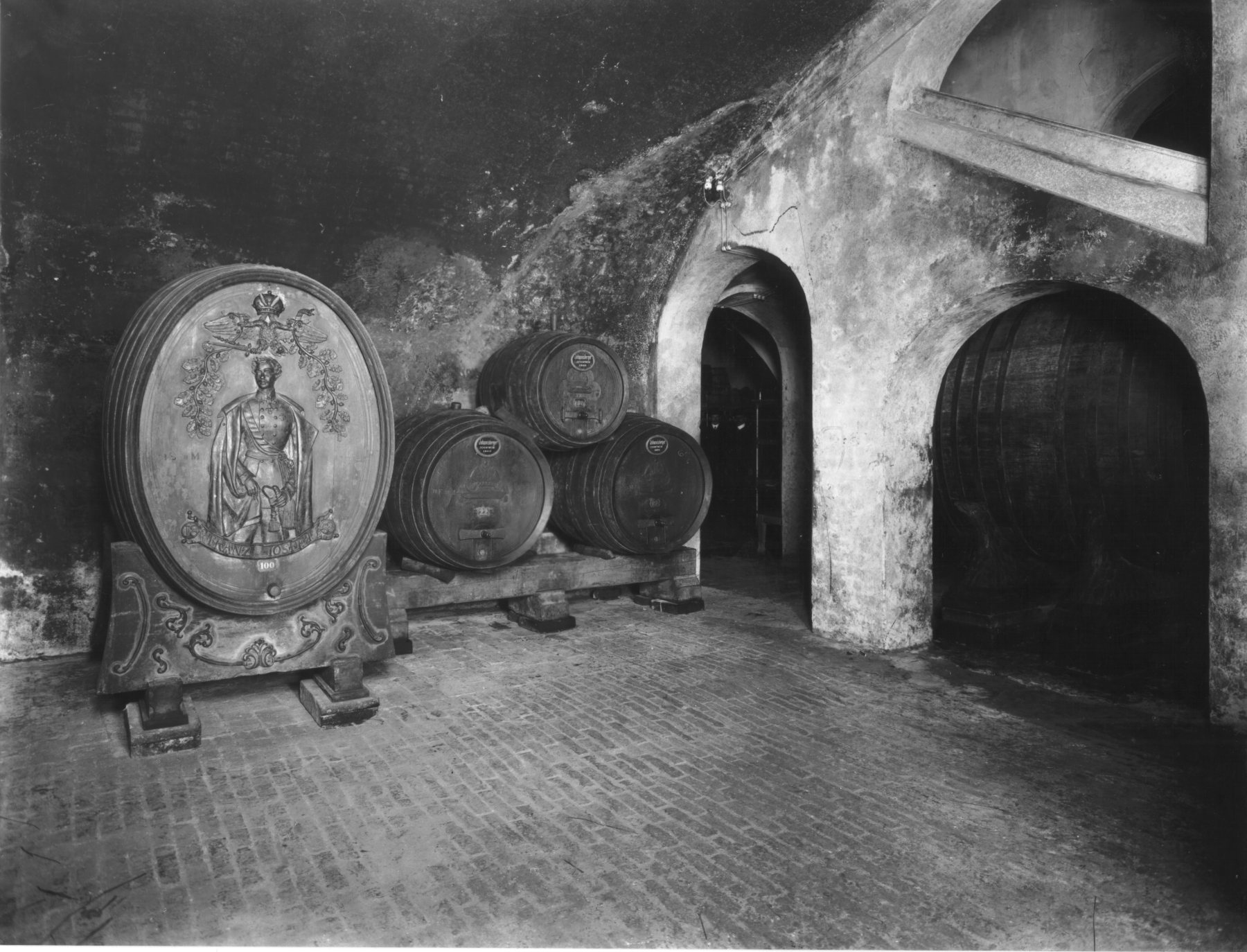
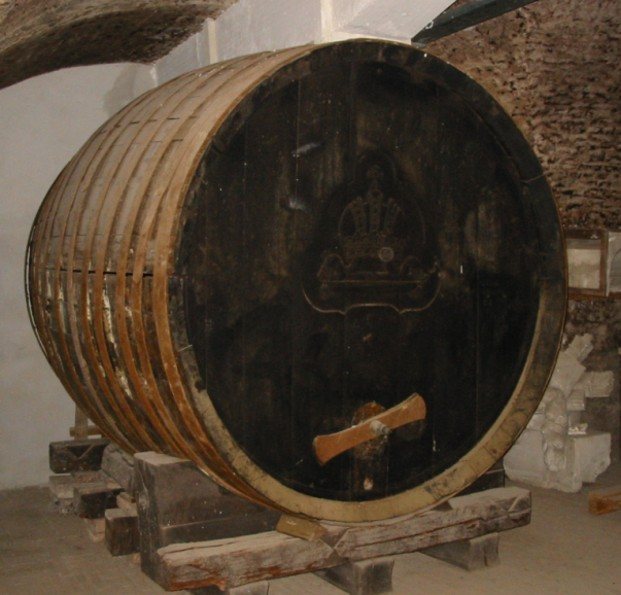
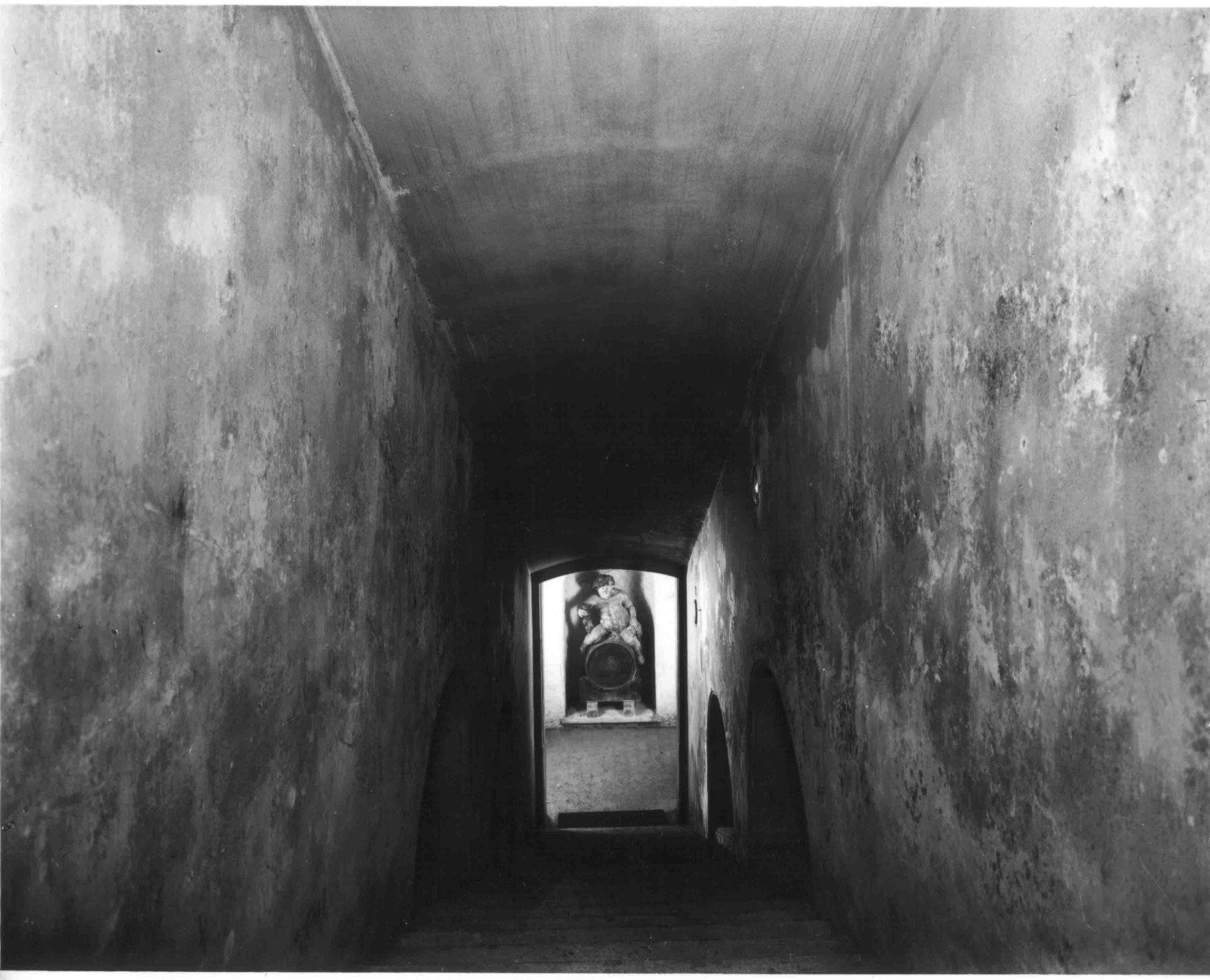
The Imperial Cellar lies beneath the Leopoldine and Amalien wings of the Vienna Hofburg, on three underground storeys. It held up to twenty thousand hectolitres, and a ceramic-concrete cask of 73,100 litres, built in 1878, still stands down there. The first known trace of Tokay in it dates from 1619.
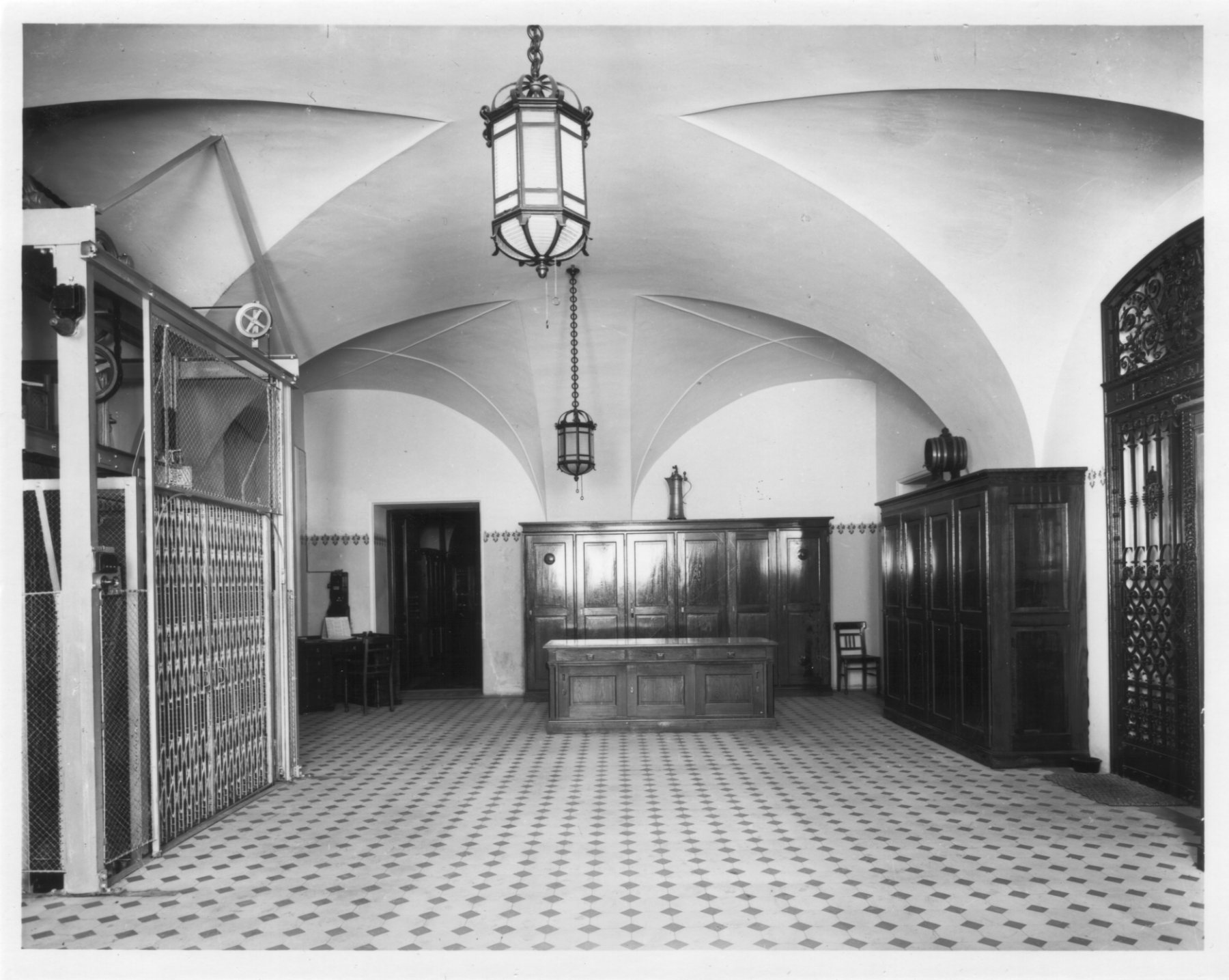
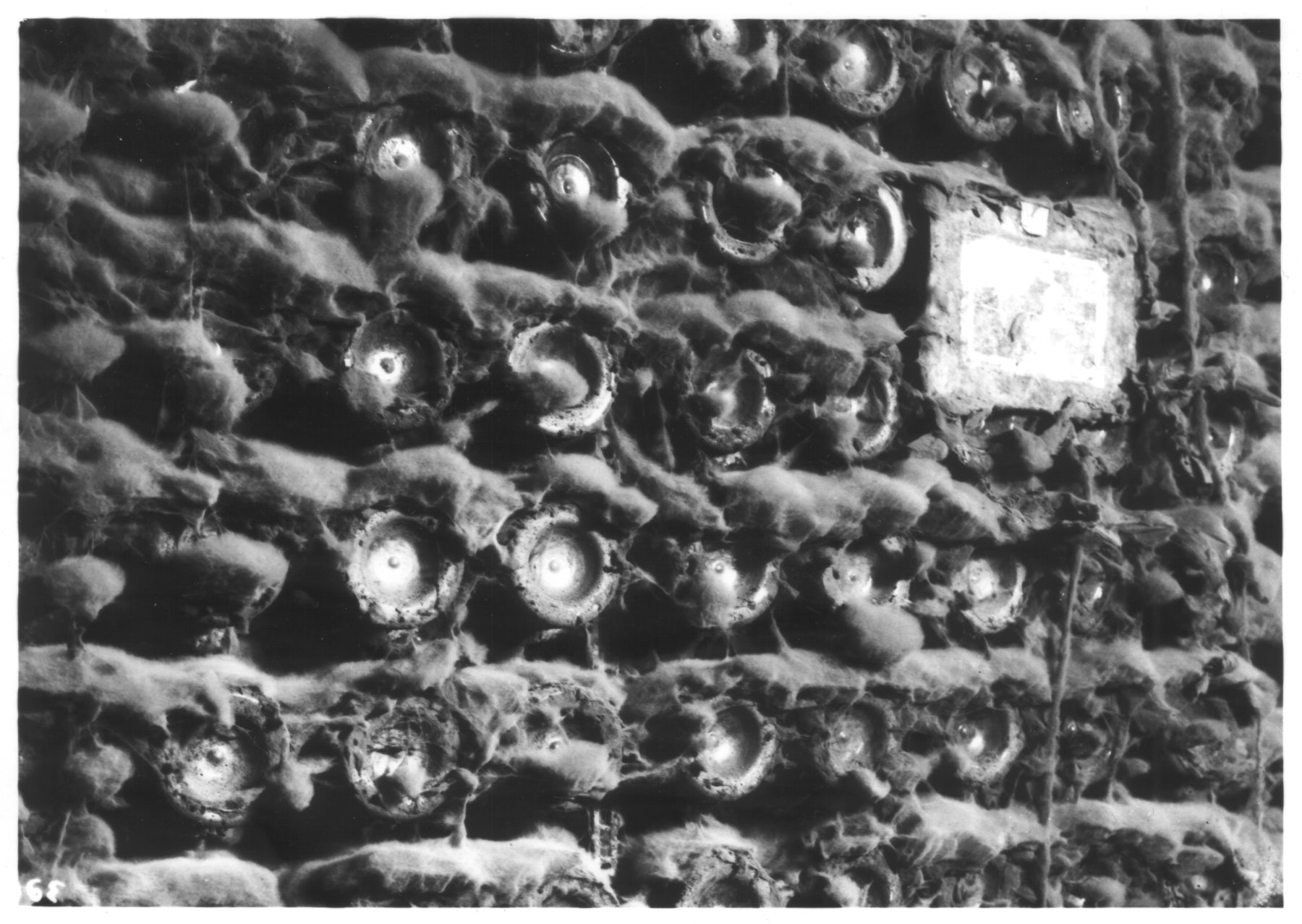
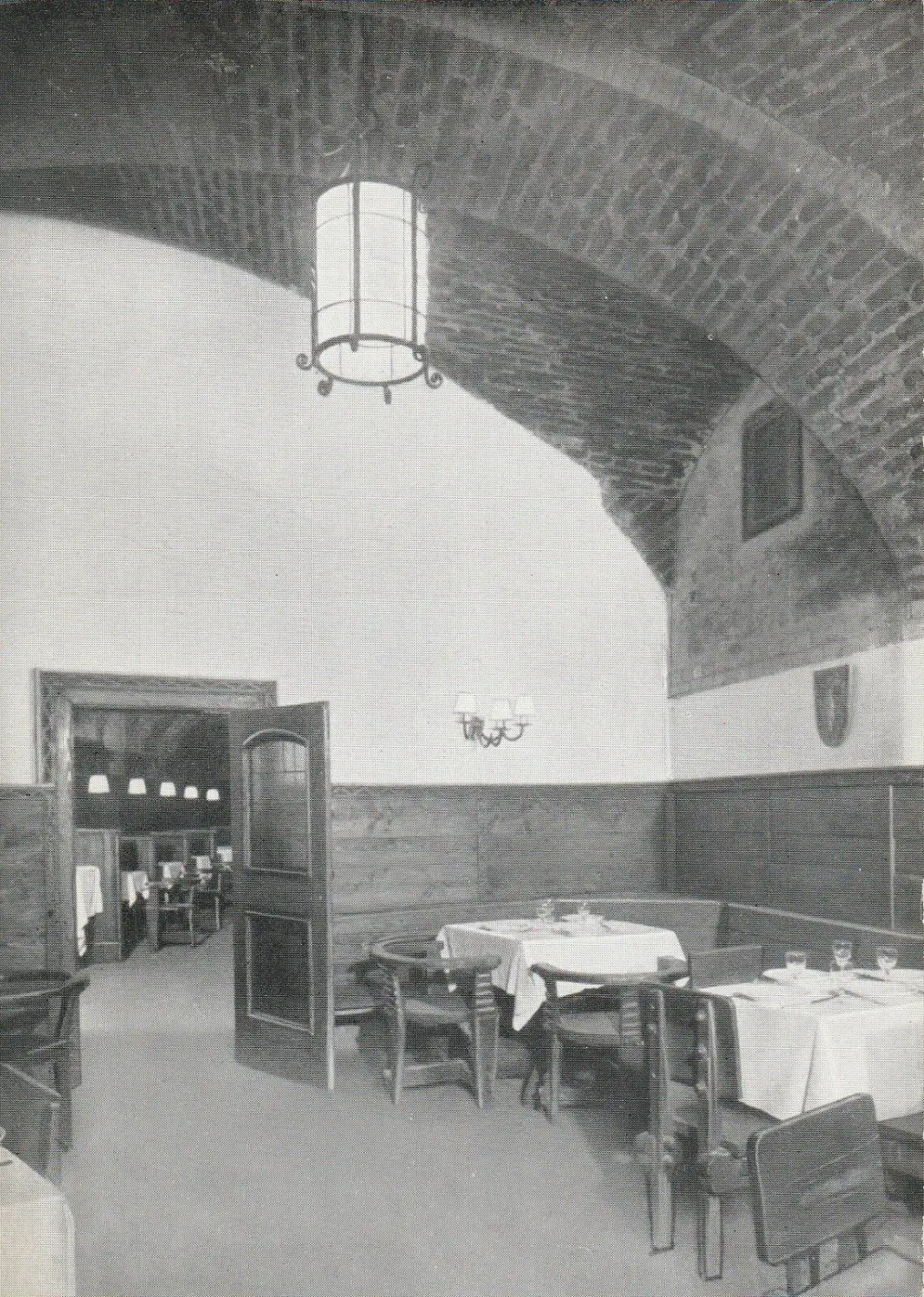
The cellar in working order. The vaulted passage, one of the rooms, the mould-crusted bottle wall, and a cask of the kind the ceramic-concrete giant of 1878 was built to replace.
Two things about the layout matter. The first is that the cellar was deep enough, and compartmented enough, that its lowest two levels could be sealed off from an invading army — which is what happened in 1805 and again in 1809. The second is that a separate room of the former cellar still preserves the empty containers of the Tokay bottles drunk by the imperial couple and their guests. The wine had its own room, and the room outlasted the wine.
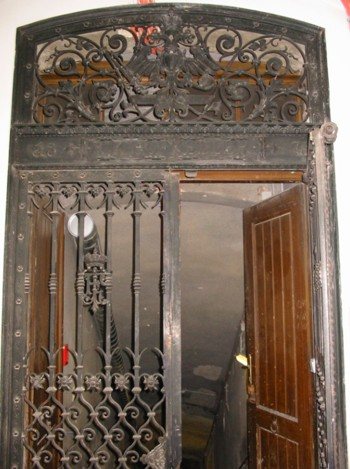
Door, stairs, and the cellar master. The last image shows the Austrian bottle cellar in the Amalientrakt with the Hofkellermeister in it — the only photograph in the set with a man at work.
1619
The first appearance: «Toggaÿer» in the stock list of 1619
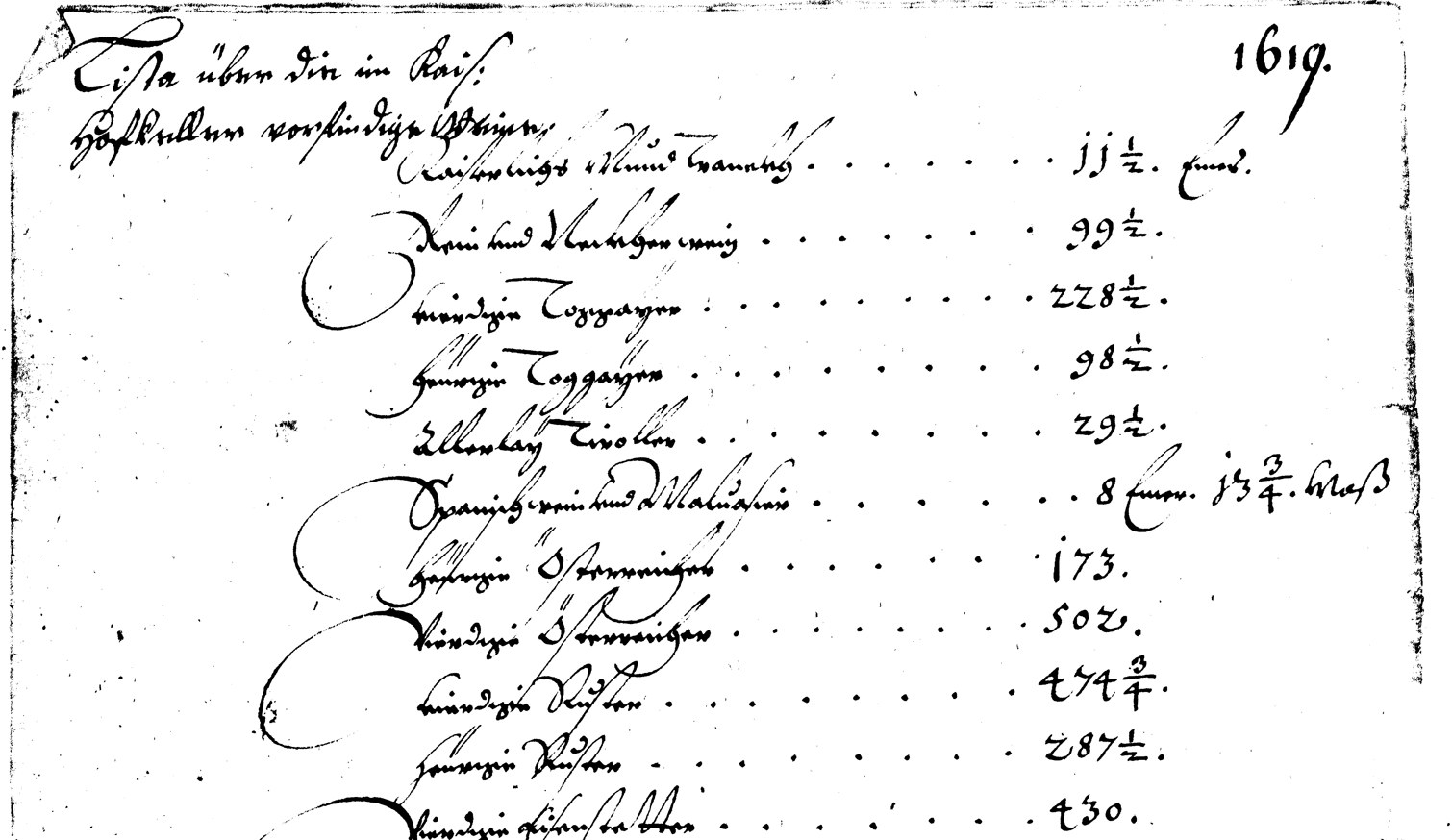
The earliest known trace of Tokaji in the Imperial Cellar is not a purchase order or a letter but a stock-take. A single sheet, headed Lista über die im Kais. Hofkeller vorfindige Weine and dated 1619 in the top right corner, lists everything then lying in the cellar, wine by wine, in Eimer.
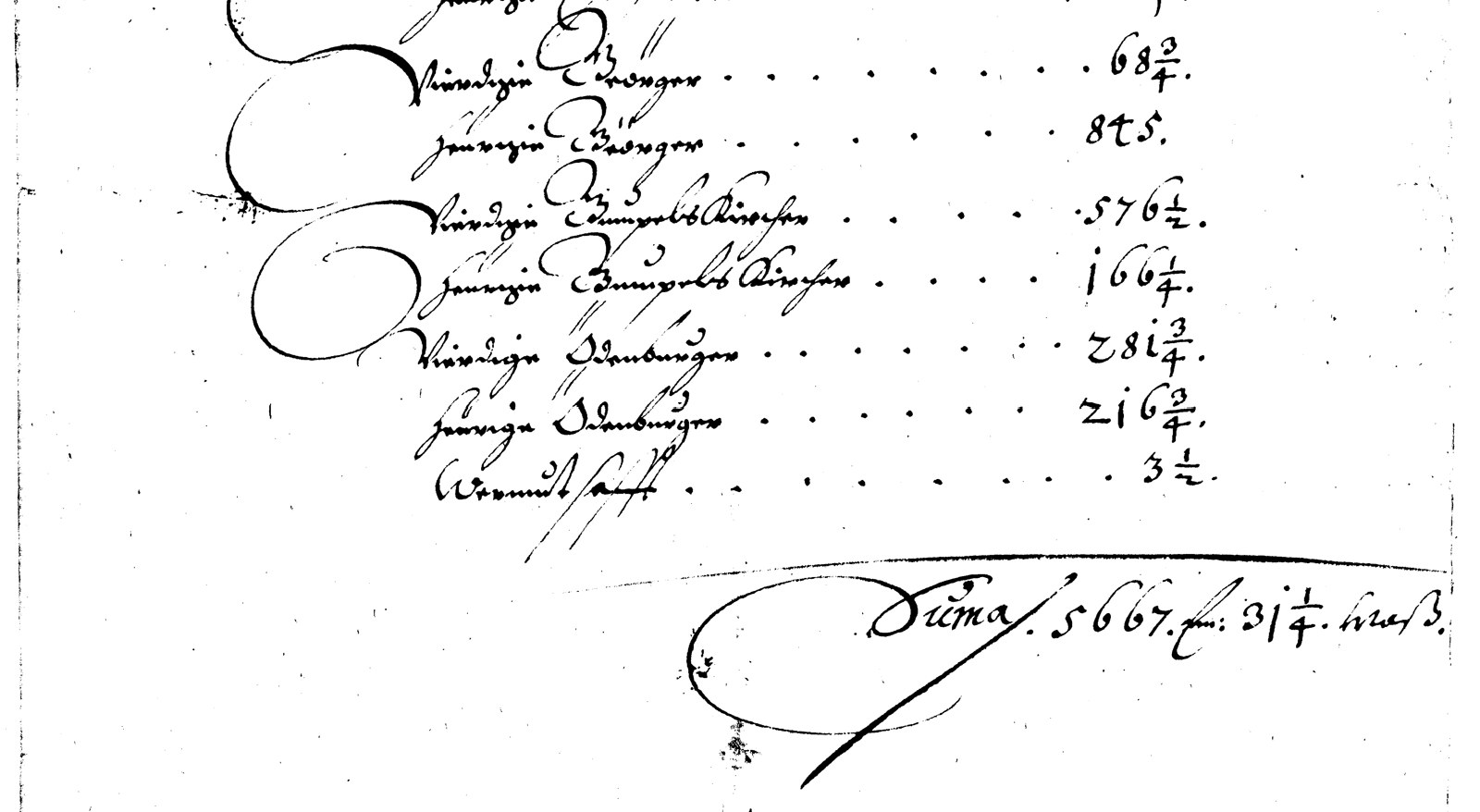
Two of its lines are the reason this page exists. Third and fourth from the top stand firniger Toggaÿer — last year's or older — at 228½ Eimer, and heuriger Toggaÿer, this year's, at 98½. Between them, 327 Eimer of Tokaji, out of a cellar holding 5,667 Eimer in total. Roughly one barrel in seventeen was Tokaji, and it was already being kept in two age classes.
Head and foot of the sheet. Above, the heading, the year, and the two Toggaÿer lines. Below, the closing Suma — 5,667 Eimer 31¼ Maß. Click either scan to read the hand.
The list transcribed
Entry
Eimer
Kaiserlicher Wein und Traminer (both words uncertain)
11½
Rhein- und Neckarwein
99½
firniger Toggaÿer (place unidentified)
228½
heuriger Toggaÿer
98½
Allerlei Tiroler
29½
Spanische Wein und Malvasier
8 Eimer 13¾ Maß
heuriger Österreicher
173
firniger Österreicher
502
firniger Ruster
474¾
heuriger Ruster
287½
firniger Kirchstetter
430
heuriger Kirchstetter
1166¼
firniger E—berger (unread)
68¾
heuriger E—berger
845
firniger Gumpoldskirchner
576½
heuriger Gumpoldskirchner
166¼
firniger Ödenburger
281¾
heuriger Ödenburger
216¾
Wermutsaft
3½
Suma
5667 Eimer 31¼ Maß
Read as a whole, the sheet is a portrait of what the Vienna court actually drank in 1619. The bulk is domestic and near — Kirchstetten, Gumpoldskirchen, Rust, Ödenburg, Austrian wine of both years. The imports are few: Rhine and Neckar, a little Tyrolean, eight Eimer of Spanish and Malmsey. Tokay is the largest single non-Austrian holding on the list, and the only one recorded, like the local wines, by vintage class.
One caution about the word
Toggaÿer is the spelling on the sheet, and the place it names is not written out. The reading as Tokaj rests on the form of the word and on the quantity — 327 Eimer of a named foreign wine held in two age classes is a court staple, not a curiosity. Two lines further down, the same clerk writes Allerlay Tiroller for wine he could not or would not itemise, which suggests he named what he knew. Until the place is confirmed from an accompanying account, the identification should be stated as very probable rather than certain.
1565 — 1571
Before 1619: what the Hungarian scholarship adds
That 1619 date is the earliest trace of Tokay I can show in the cellar's own records. It is probably not the earliest evidence of the Vienna court's interest in the wine, and the Hungarian literature puts the two more than half a century apart.
October 1565. King Maximilian instructed Ferenc Pesthy, his royal commissioner in Zemplén county, to buy one cask each from the wine of twelve vineyard hills. The region, at that date, could not produce enough to satisfy every demand.
1571 — a cellar wing with a name. The Garai property-division contract of that year, found by István Zelenák in the Sátoraljaújhely archive, records 70 casks and 52 átalag of aszú wine and is the earliest known document attesting Tokaji aszú. Its owner, János Garai, was the imperial harmincados at the Tokaj ferry crossing; Zelenák's reading is that he got his aszú into the cellar of the Viennese court, and that one wing of that cellar was in these years called the tokaji pince.
1567 — the fiscal machinery. Lazarus von Schwendi, having taken Tokaj castle on 11 February 1565, proposed the creation of the Szepes Chamber to supply the border fortresses, and worked out a plan to revive the wine trade.
Do not yet move the 1619 date
A named Tokay wing in the 1570s would antedate the cellar's own earliest Tokay entry by some forty-five years. But Zelenák states it in passing and without a citation, and qualifies the delivery itself with alighanem — presumably. Treat the Garai delivery as a hypothesis and the cellar-wing name as an unsourced claim, and leave 1619 standing until the name can be found in a Viennese record.
1918 — 1967
What happened to it
After the collapse of the monarchy the cellar was worked for a while longer. Part of the Tokay on hand — 32,000 bottles and 35 hectolitres in cask — went to the social fund for war invalids. In 1925 a wine tavern was opened at which Hofkeller wines were sold; a postcard of the period advertises the «Alter Hofkeller» in the Schauflergasse and names one of its rooms outright as the former Tokay cellar of the Emperor.
During the Second World War the vaults served as an air-raid shelter and a command centre. Afterwards they filled up with plaster casts. The last official role the cellar ever played was in 1967, as a film set for Mayerling, with Omar Sharif and Catherine Deneuve. Since then it has stood unused and can be entered only by special permission — the offices of the Austrian Federal President are directly above.
«Ehemaliger Tokayerkeller des KAISERS». The 1920s tavern advertisement names one room as the Emperor's former Tokay cellar.
1771 — 1851
The Tokay Wine Inspector, and the men who ran the cellar
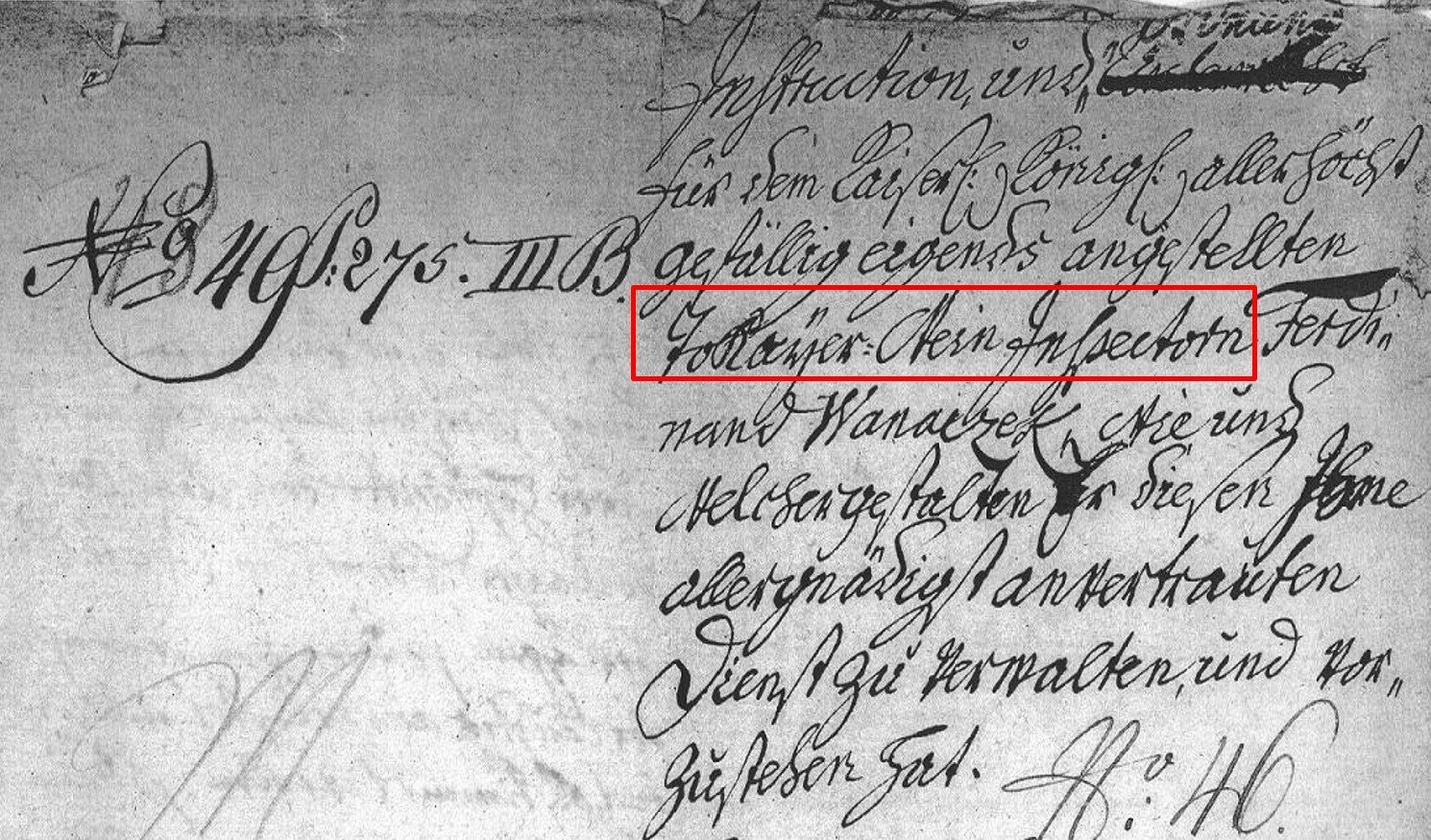
In 1771 Maria Theresa created an office that as far as I know has no parallel at any other European court: a Tokay Wine Inspector, appointed for this one wine. The job description of the first holder survives in Vienna, naming him in full — the imperially and royally appointed Tokayer Wein Inspektor Ferdinand Wanaczek.
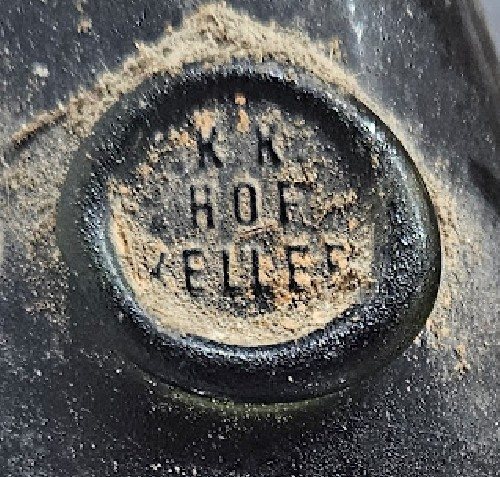
Instruction and job description of the first Tokay Wine Inspector, 1771. Österreichisches Staatsarchiv, Vienna.The cellar's own seal. On a bottle or a document it marks the k. u. k. Hofkeller itself rather than a purveyor.
Later the cellar was directed by a Hofkellermeister running a staff across three levels of management. The best documented of them is Franz Leibenfrost (1790–1851) — wine expert, wine merchant, purveyor to both the Vienna and the Bavarian courts, and a man whose career shows how porous the line between court office and private trade actually was. In 1831 he was in Tokaj as a consultant, assessing the imperial and royal Cameral vineyards in the Hegyalja. He owned the Leibenfrost coffee house in Vienna, and a street in the city still carries his name.
The Leibenfrost firm's own labels are among the most findable physical traces of the imperial supply chain: a 1917 Aszú labelled Medicinischer Tokayer Ausbruch mit südlichen Trockenbeeren over the name Franz Leibenfrost & Co., Munich; and a 1932 Tokayer Ausbruch, 2 buttig, with the firm dated Hannover 1869, Vienna 1773, and the motto Nullum vinum nisi Hungaricum across the vine border.
Chapter two
Tokaji in the Imperial Cellar
1856 — 1918
The court that grew its own: the Hofweinberg-Verwaltung at Tarcal
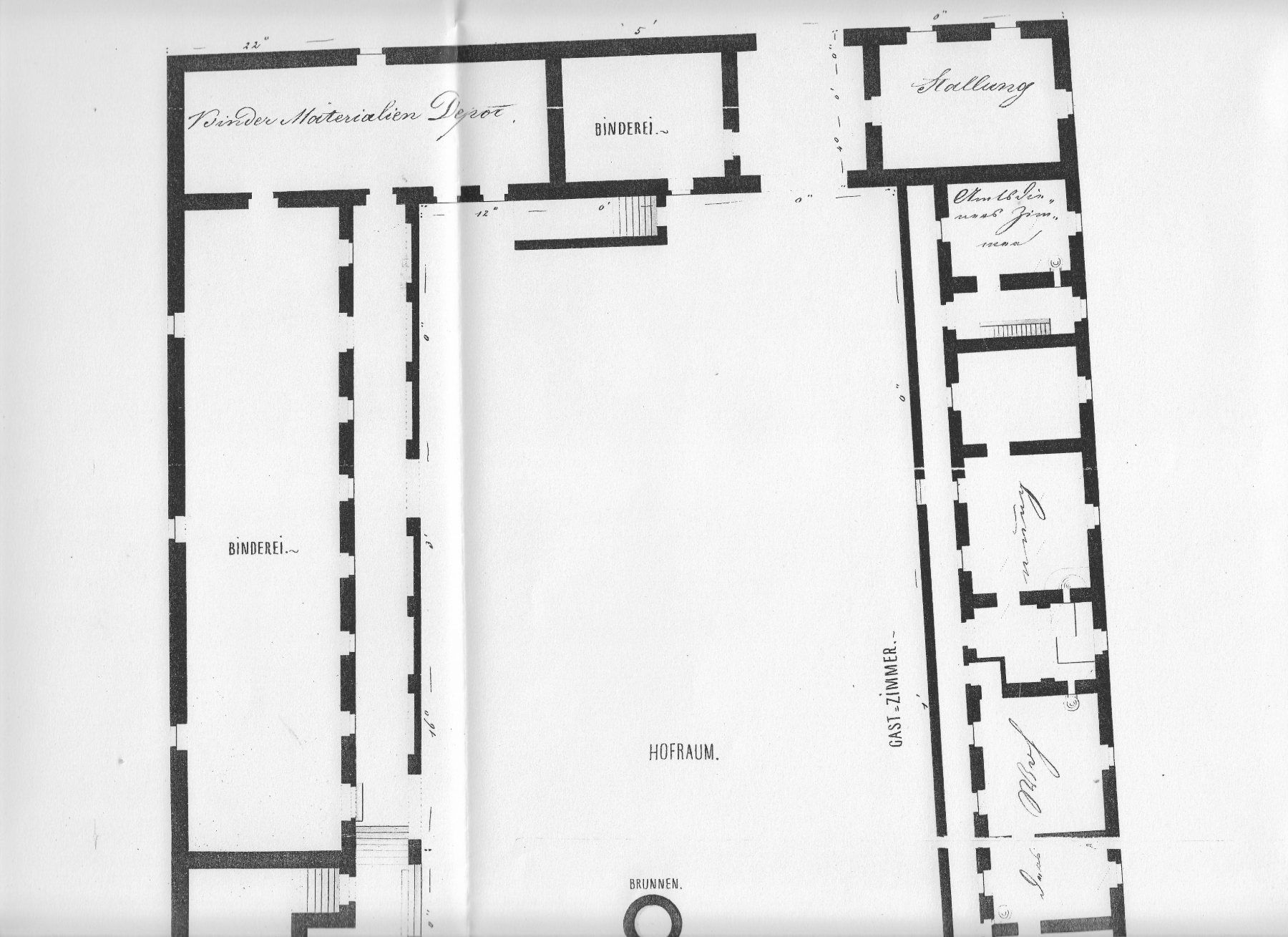
This is what makes Vienna different from Dresden and from Warsaw. The Saxon kings bought their Tokaji; the Fukiers traded in it. The Habsburgs owned the vineyards. And they ran them not through a Hungarian estate office but through the k. und k. Hofweinberg-Verwaltung, sitting under the Obersthofmeisteramt in Vienna and audited by the Hof-Controlaramt and the Hofwirtschaftsamt. The vineyards were part of the household, like the stables and the silver.
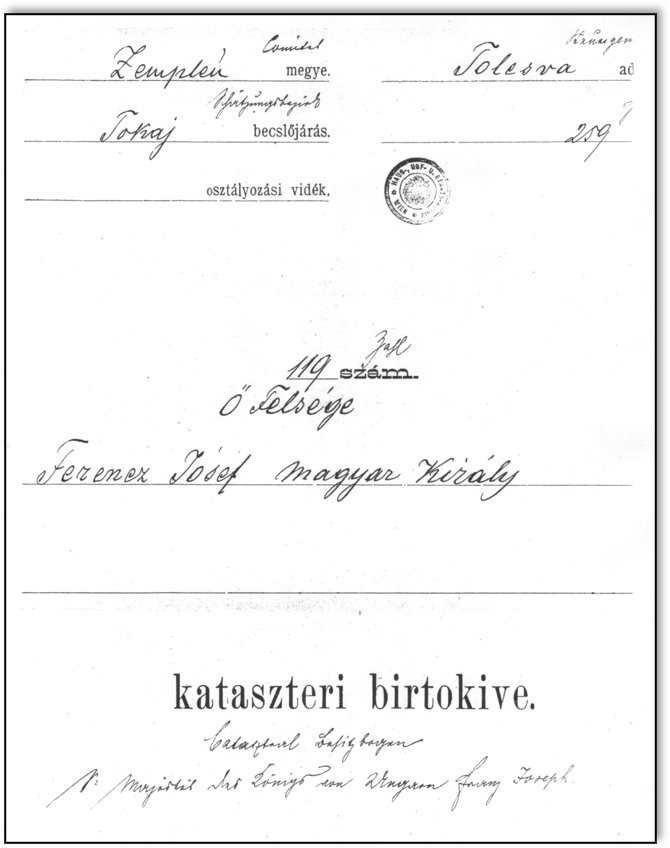
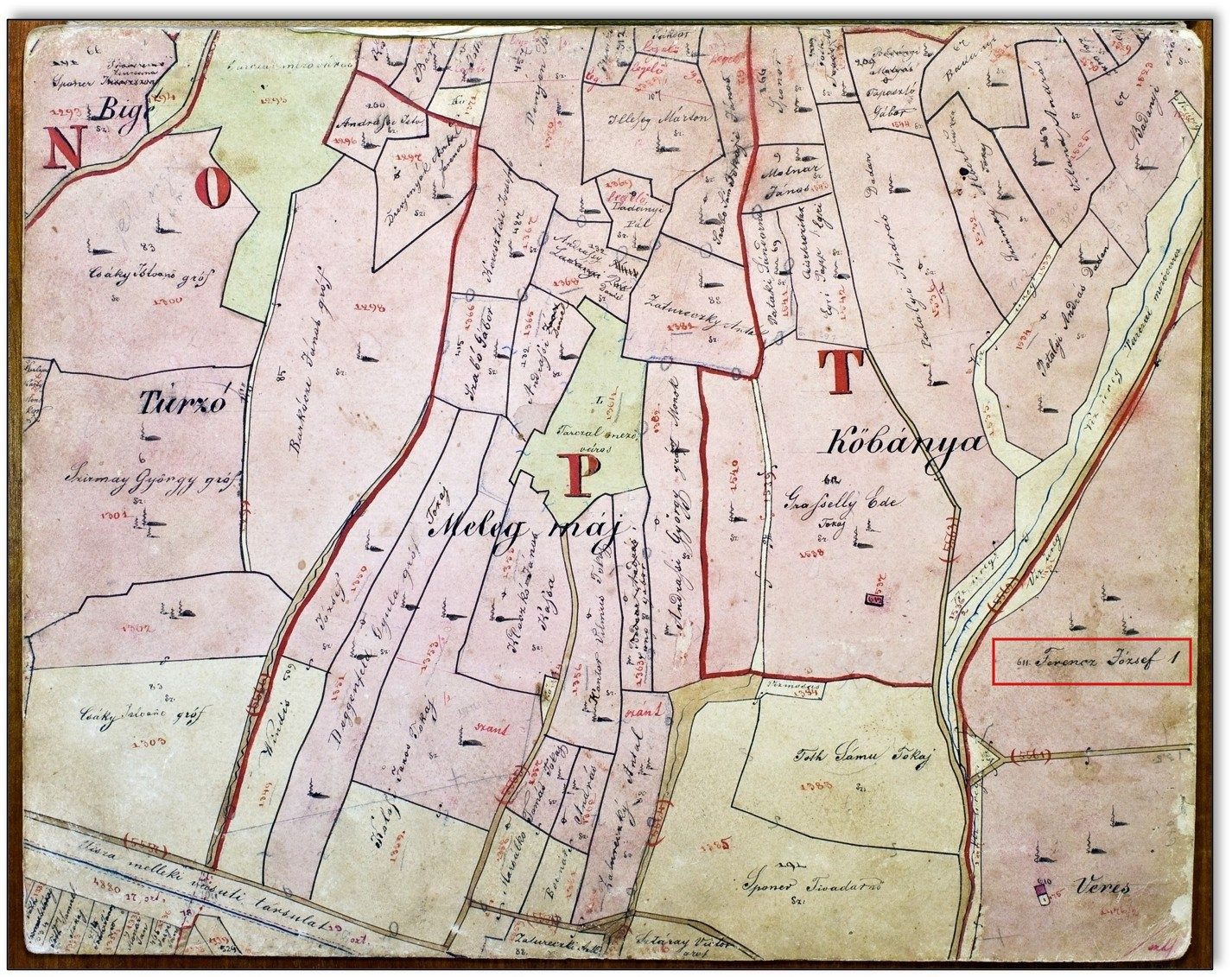
The land was held as personal possession, and only the Hungarian royal title appears in the land register — the cadastral extract runs in the name of Ferencz József magyar király, Francis Joseph, King of Hungary, not Emperor of Austria.
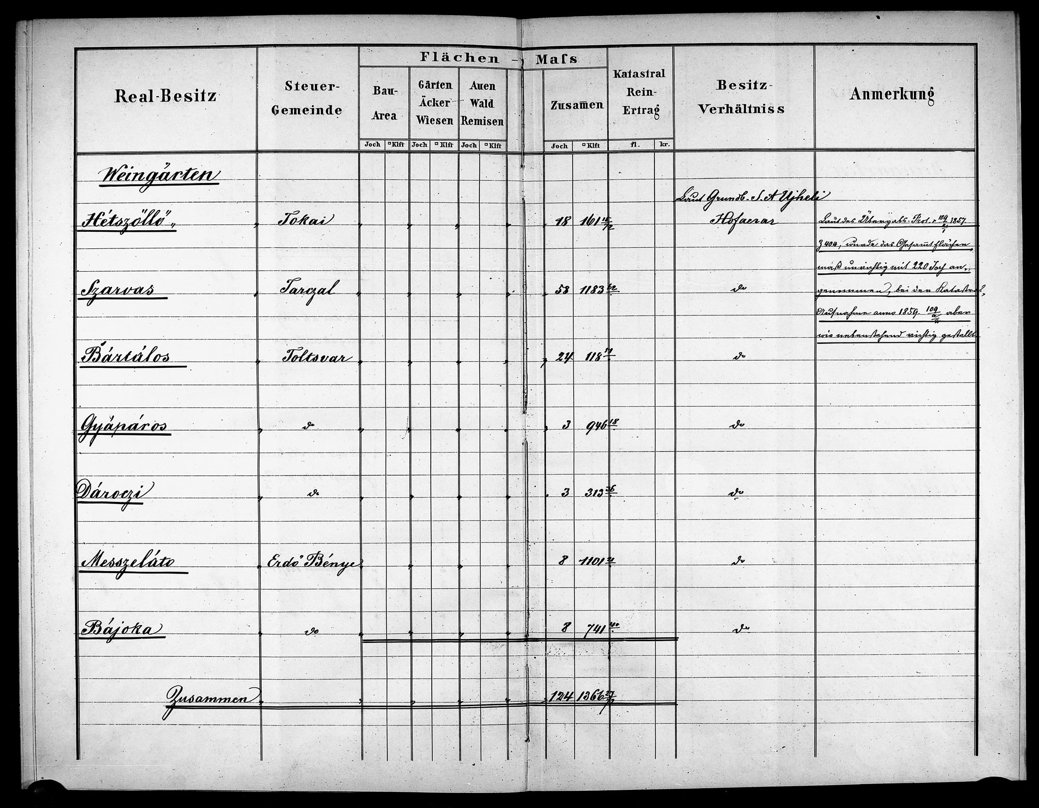
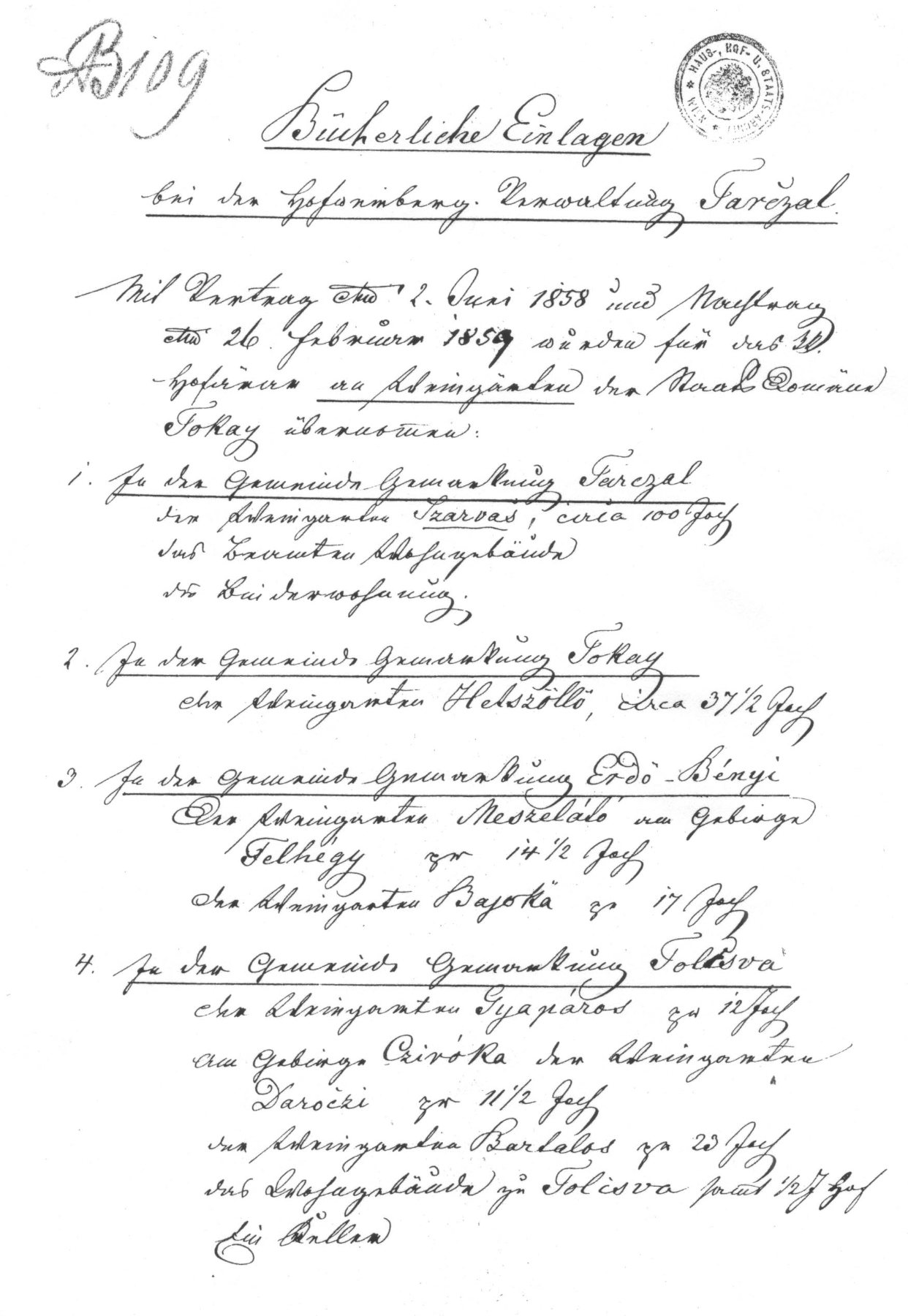
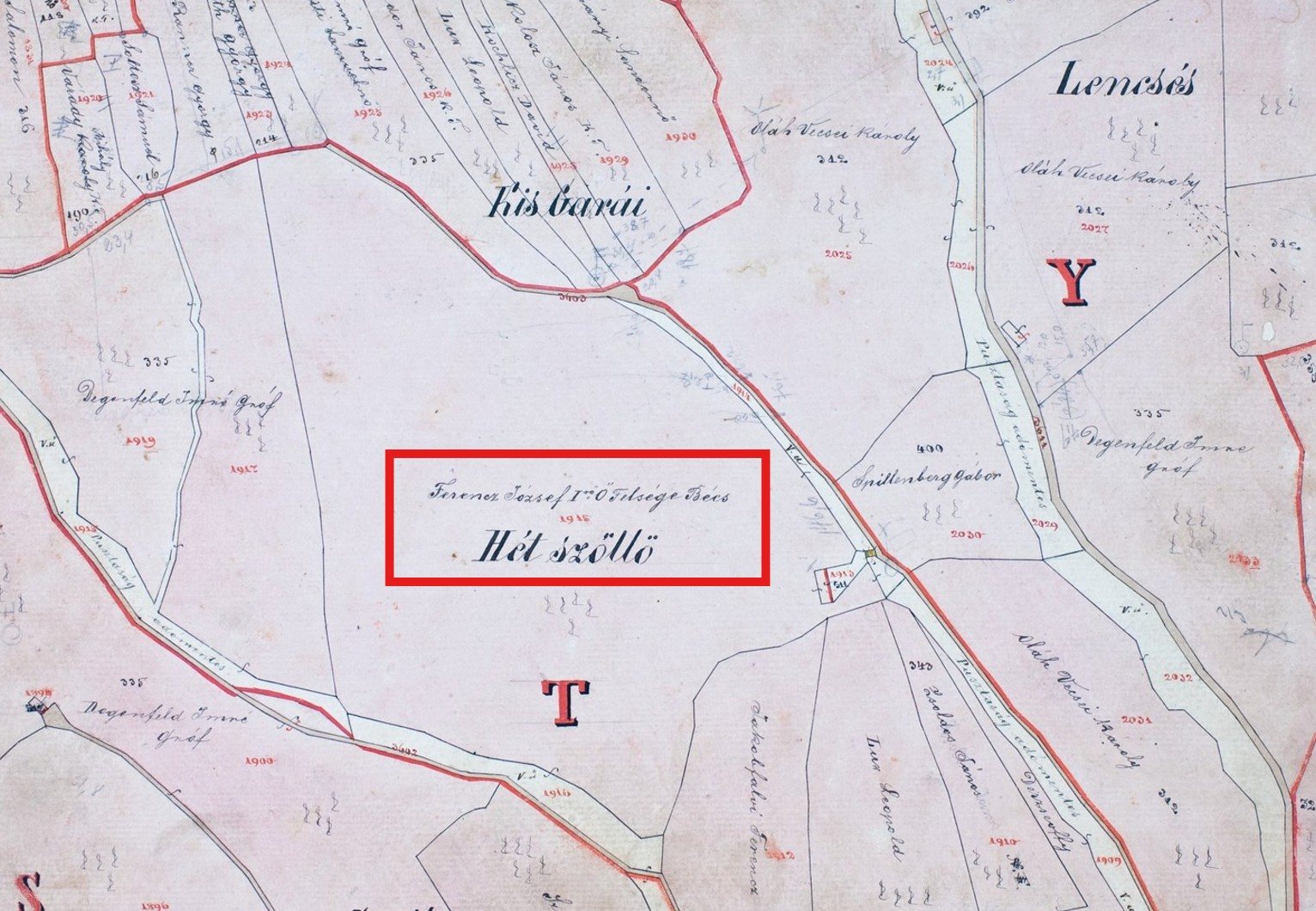
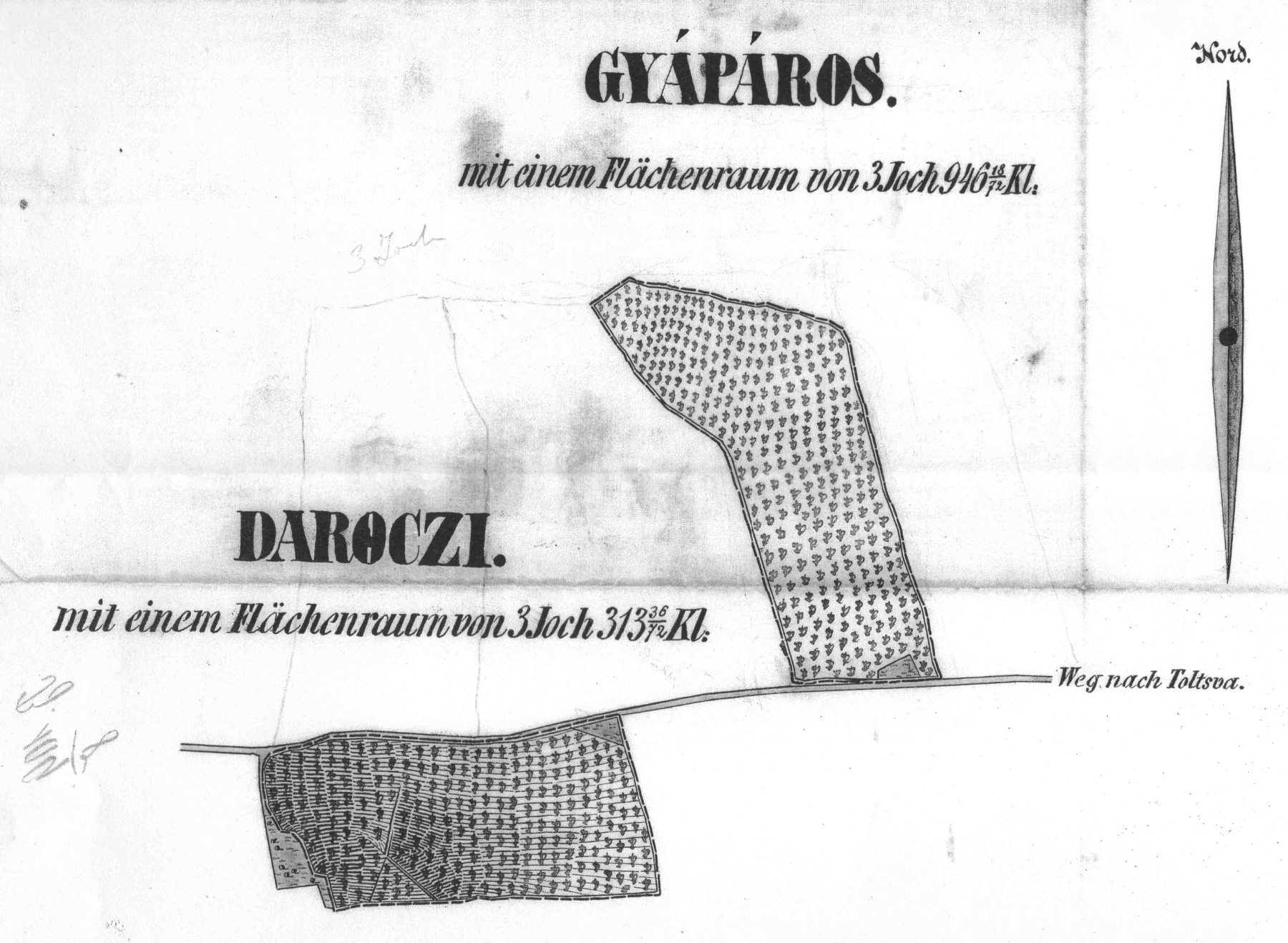
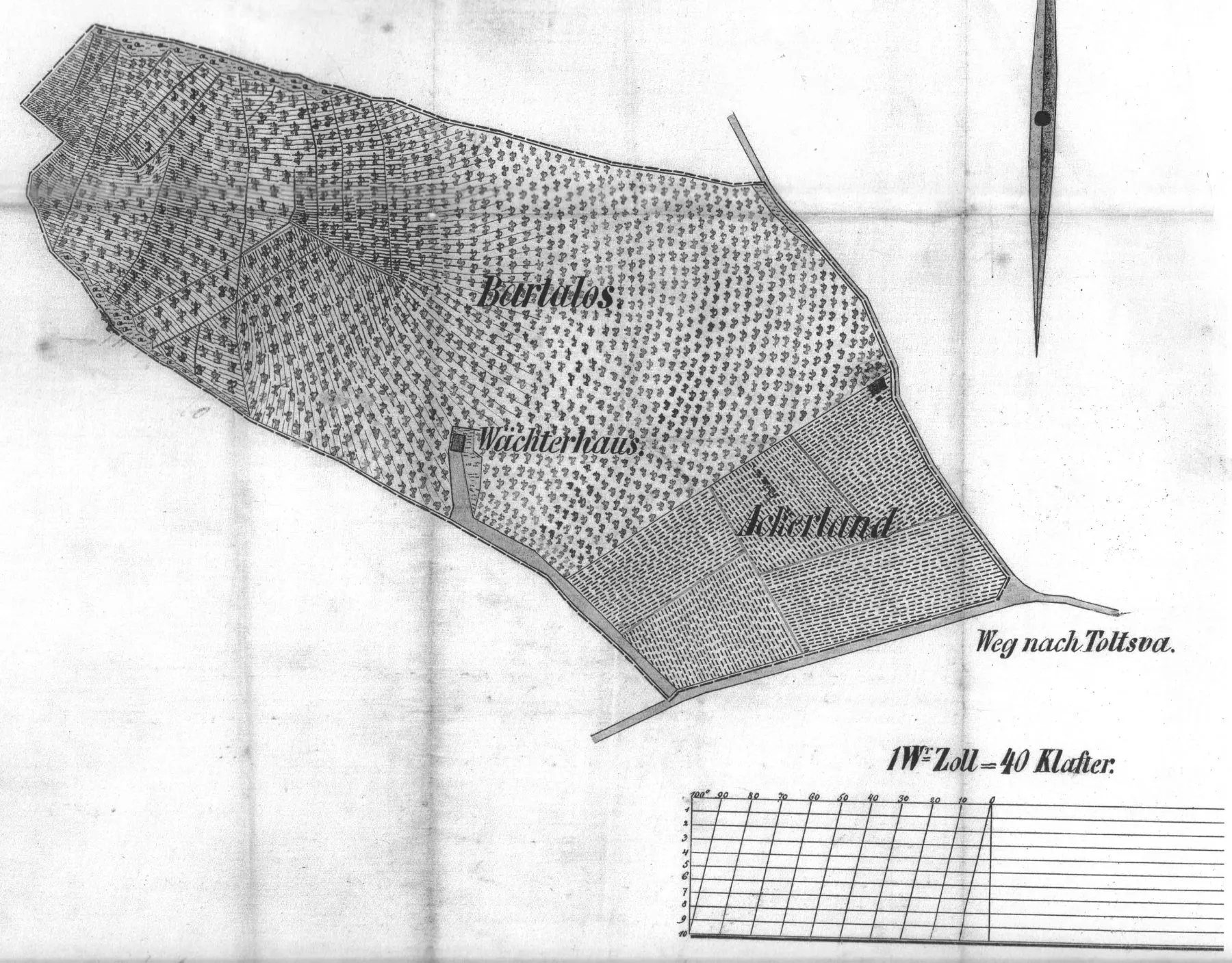
The cadastral extract, first: the title page in the king’s name, and the Real-Besitz table listing the vineyards one by one — Hétszőlő at Tokaj, Szarvas at Tarcal, Bártalos, Gyapáros and Dárocz at Tolcsva, Messzeláto and Bajoka at Erdőbénye, 124 joch in all, each entered as Hofaerar. Then the estate on paper and on the ground. The 1859 vineyard survey, the cadastral extract in the King of Hungary's name, three of the crus — Hétszőlő, Gyapáros, Bartalos — and the Tarcal winery that is today Királyudvar.
The Kron-Weingärten of Tokaj, Tarczal and Tolcsva — from the register
Vineyard
Tax commune
Area (Joch · □Klafter)
Hétszőlő
Tokaj
18 · 1601½
Szarvas
Tarczal
53 · 1183
Bártalos
Toltsvar
24 · 1187
Gyápáros
Toltsvar
3 · 946
Dároczi
Toltsvar
3 · 313
Messzelátó
Erdő Bénye
2 · 1101
Bajóka
Erdő Bénye
2 · 741
Total as registered
124 · 1066
The spellings are the register's own, not the modern forms. And the Joch column as I read it from the reproduction sums to 105, against a printed total of 124 — re-transcribe from the original before publishing the figures.
In modern measure the difference hardly matters. One cadastral joch is 0.58 hectares, so the court's Tokaj vineyards covered roughly 60 to 71 hectares — about 150 to 175 acres. That is a substantial holding by the standards of any fine-wine estate: rather more than the 50.6 hectares of the whole Clos de Vougeot, more than Schloss Johannisberg’s own vineyard, and roughly two to three times the total holdings of the Domaine de la Romanée-Conti. Divided across seven or ten named sites in four communes, it made the court one of the larger proprietors in Hegyalja.
Ten vineyards are named across the estate papers in total — Szarvas, Hétszőlő, Gyapáros, Bakonyi, Bartalos, Messzelátó, Bajóka, Daróczi, Térhegy and Cziróka. The staff was small and specific: three winemakers, two coopers, two butlers and seven lead workers. The general manager's post was substantial enough to be given to Count Vilmos Szirmay at the end of his military career.
Still to write
How the court came to hold these particular crus — the Rákóczi confiscations and what followed them. Send me the passage and I will set it here, at the head of this article.
1915
Tarcal reports to Vienna
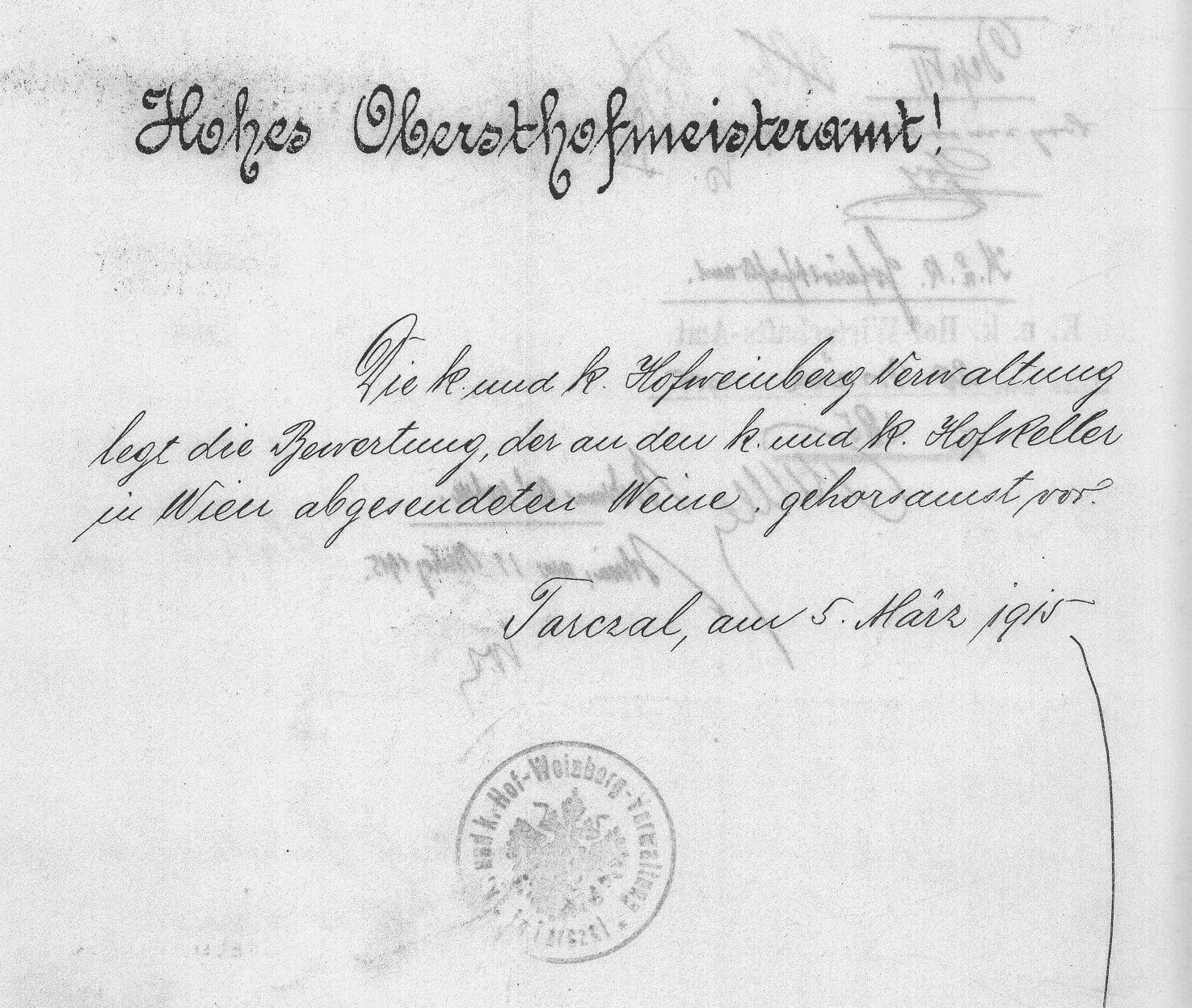
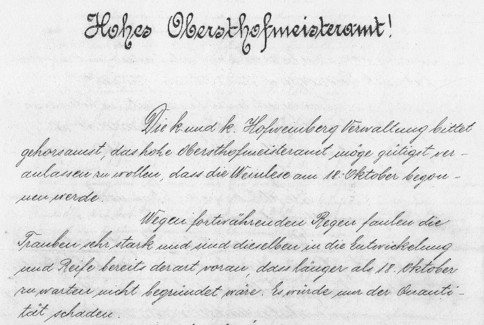
The traffic between the Hegyalja and the Hofburg was constant and minutely bureaucratic: vintage and quality reports, operating plans, contracts, cellar books, fiscal transactions. In the first of these two documents the Hofweinberg-Verwaltung petitions the Obersthofmeisteramt most obediently for permission to begin the harvest on 18 October, on the grounds that continuing rain is rotting the grapes badly. In the second, a telegram from Tarczal reports that the harvest is proceeding without difficulty, two hundred hectolitres of must so far, sugar content 29 degrees Klosterneuburger.
A vineyard in Hungary asking Vienna by letter for permission to pick, and telegraphing the must weight back the same week. That is the whole relationship in two sheets of paper.
Petition and telegram, October 1915.
1736 — 1867
What was kept: Essenz, Ausbruch, Szamorodner, Wermuth
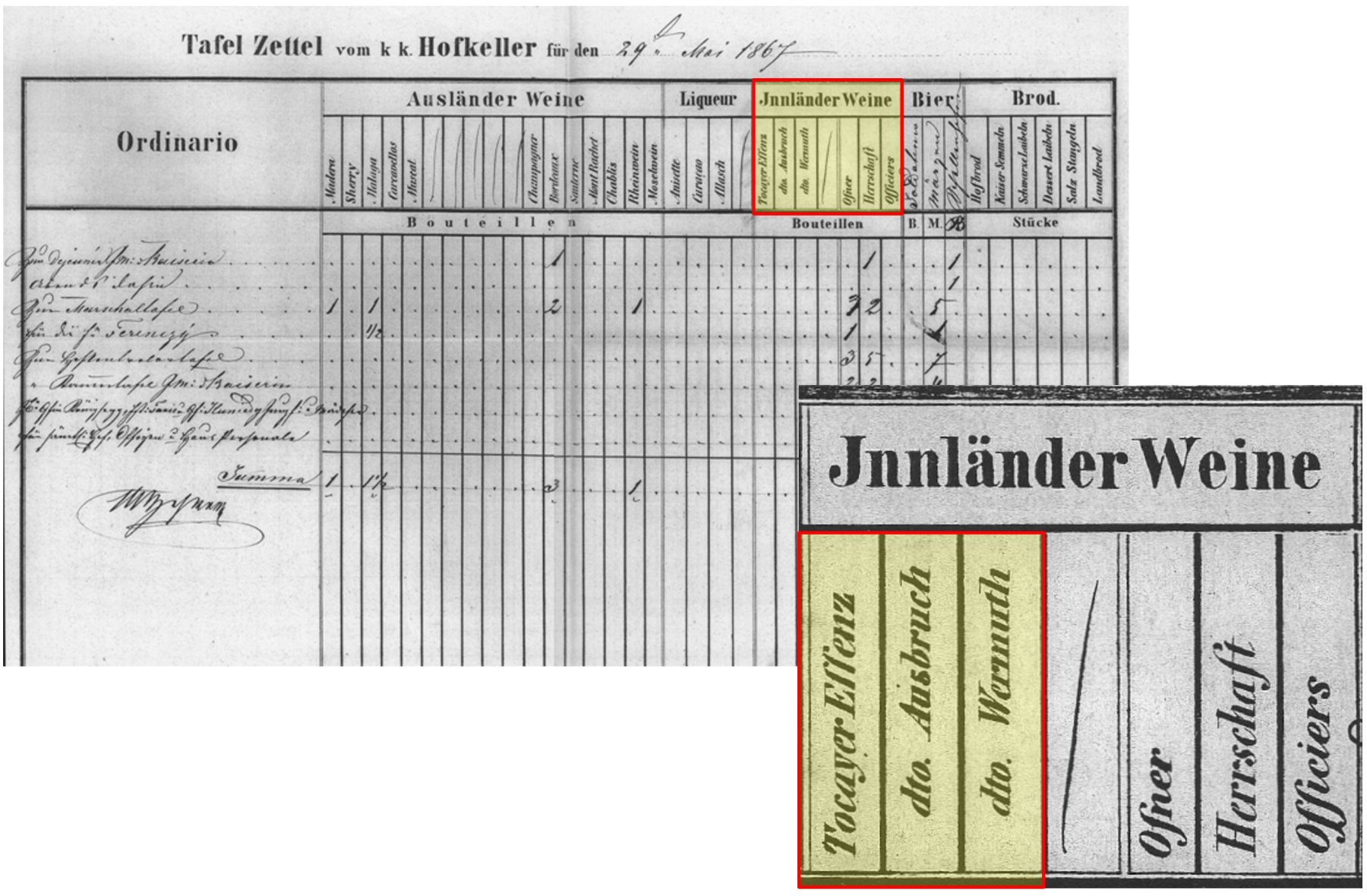
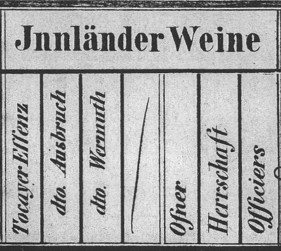
The daily Tafel Zettel of the k. k. Hofkeller has a whole block headed Innländer Weine whose first three columns are Tocayer Essenz, dto. Ausbruch and dto. Wermuth — before Ofner, Herrschaft and Officiers wine. Tokay heads the domestic wines on the court's own issue sheet.
Tafel Zettel, 1867. The issue sheet — the same wine, issued rather than sold.Tokajer Wermuth. The third column of that block, made from the court's own wine.
What an Essenz cost the estate is worth having beside every Essence line on a menu card. Gábor Gyöngyösi, chamber councillor and himself a vineyard owner, argued in 1736 against making much essencia, since thirty casks of aszú come out of the grape quantity needed for a single cask of essencia — and the more essencia is pressed, the poorer the common wine left behind. The court was drinking, at that ratio, the most expensive decision a Hegyalja estate could make.
1797 — 1809
Napoleon, and the two levels that were walled up
On 28 July 1797 Bonaparte wrote from Milan to the Directoire exécutif that once he had four half-brigades and three thousand hussars he would be in Vienna at vintage time, and would have the Hungarian peasants drink Tokay.
He arrived in November 1805. And here is the detail that matters most on this page for anyone hunting bottles: the French could not get at most of the Tokay, because the lowest two levels of the cellar had been walled up beforehand. The same thing was done in 1809, when they came again. Napoleon had the part that could be confiscated sent to Paris.
That is the earliest documented instance I know of the technique this entire project depends on — a court sealing its oldest wine behind masonry when an army approaches. Where it worked, the wine survives.
One story from the same occupation belongs in a different register: an Austrian anecdote has the French general Vandamme taking a daily bath in Tokay. Reception, not record — but it tells you what the Viennese believed the French were capable of.
1918
The sale: the cellar pays the payroll
At the end of the First World War the Vienna Hofzahlamt was so short of money that the court could no longer pay its employees. In cooperation with the wine merchant Lajos Fuchs of Tolcsva, the court sold 6,000 hectolitres of Tokay for 15 million crowns to the Reichsdeutsche Weinzentrale. Fuchs was given the title of Royal Hungarian Consultant on 15 October 1918, and Joseph Franz Renglovics, director of the Imperial Cellar, received Hungarian nobility for the deal.
Two weeks later there was no monarchy. The honours for selling the cellar were awarded on 15 October; the Republic was proclaimed on 12 November. Six thousand hectolitres is a great deal of Tokay — and it means that a substantial share of whatever imperial wine circulates today entered the trade through one transaction, in Germany, in the autumn of 1918.
1811 — 1906
Vienna Hofkeller Bottles
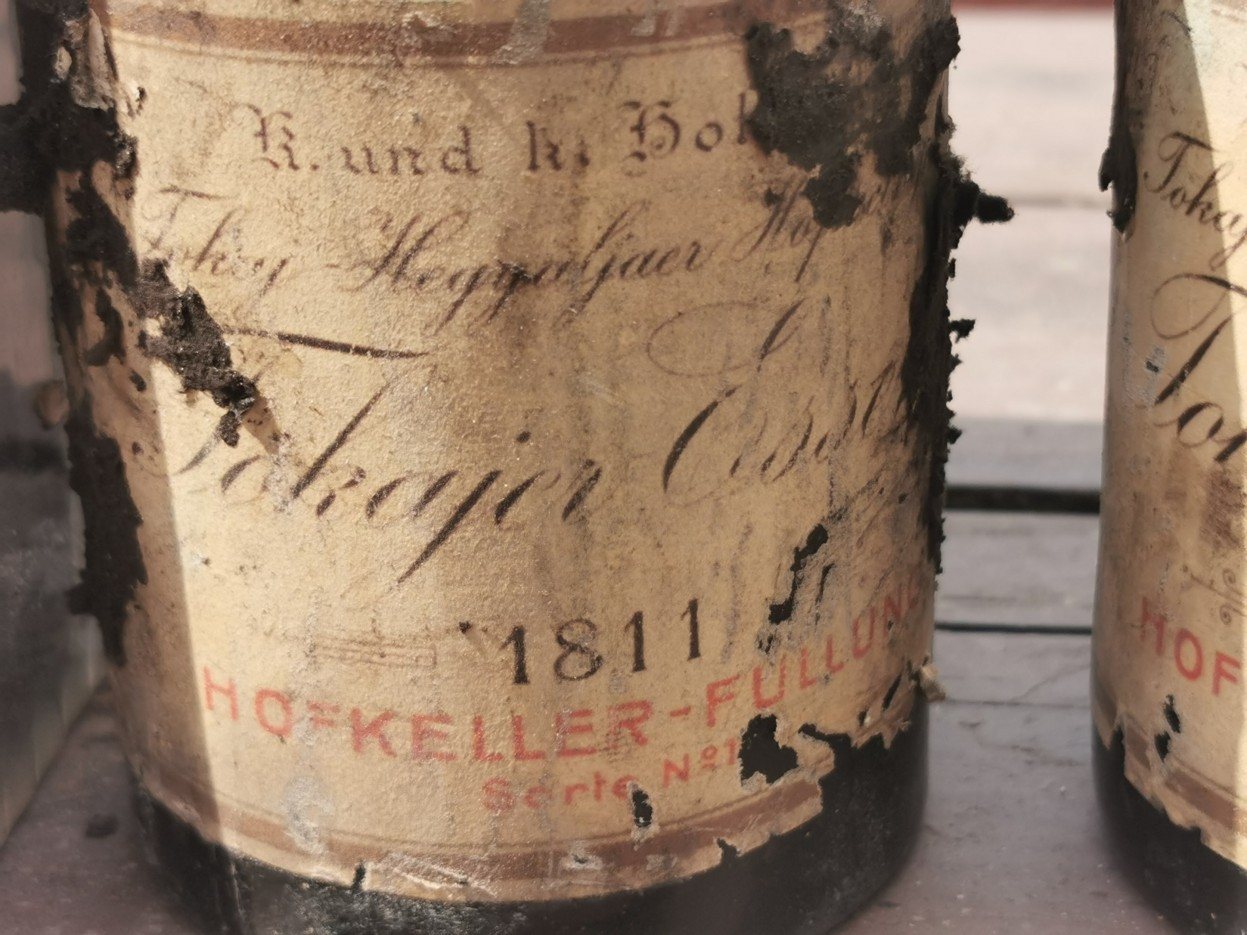
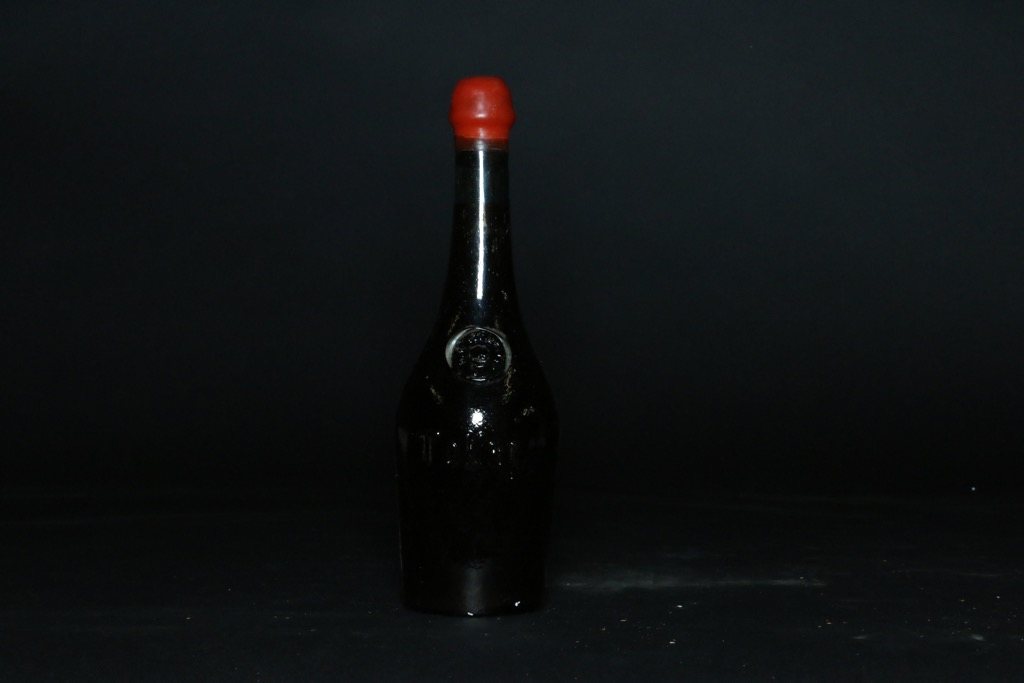
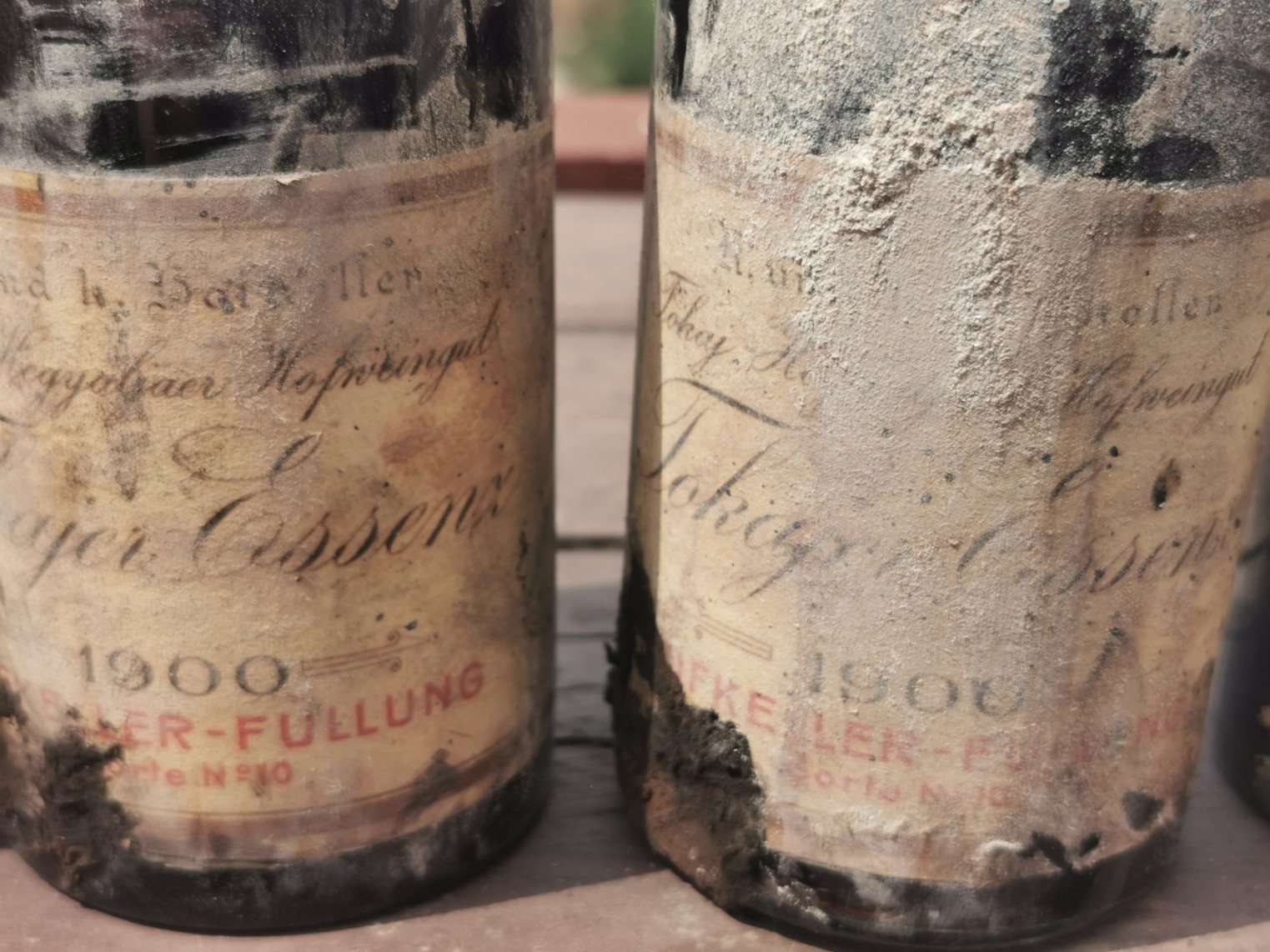
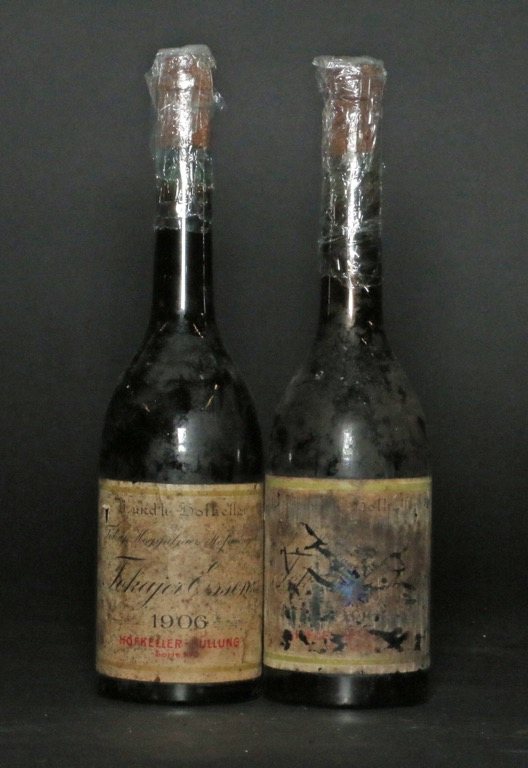
Four surviving bottles carry the cellar's own marks. Read the capsule as carefully as the label: on these bottles the crown is often the only legible mark left, and the capsule colour and its embossing are what separate a court bottling from a purveyor's.
Hofkeller bottles, 1811 to 1906. The 1811 Eszencia, the 1877 Tockaier Ausbruch marked k. u. k. Hofkeller Vienna, the 1900 Essenz and the 1906 Essencia.
1912 — 1939
Hofkeller bottles sold
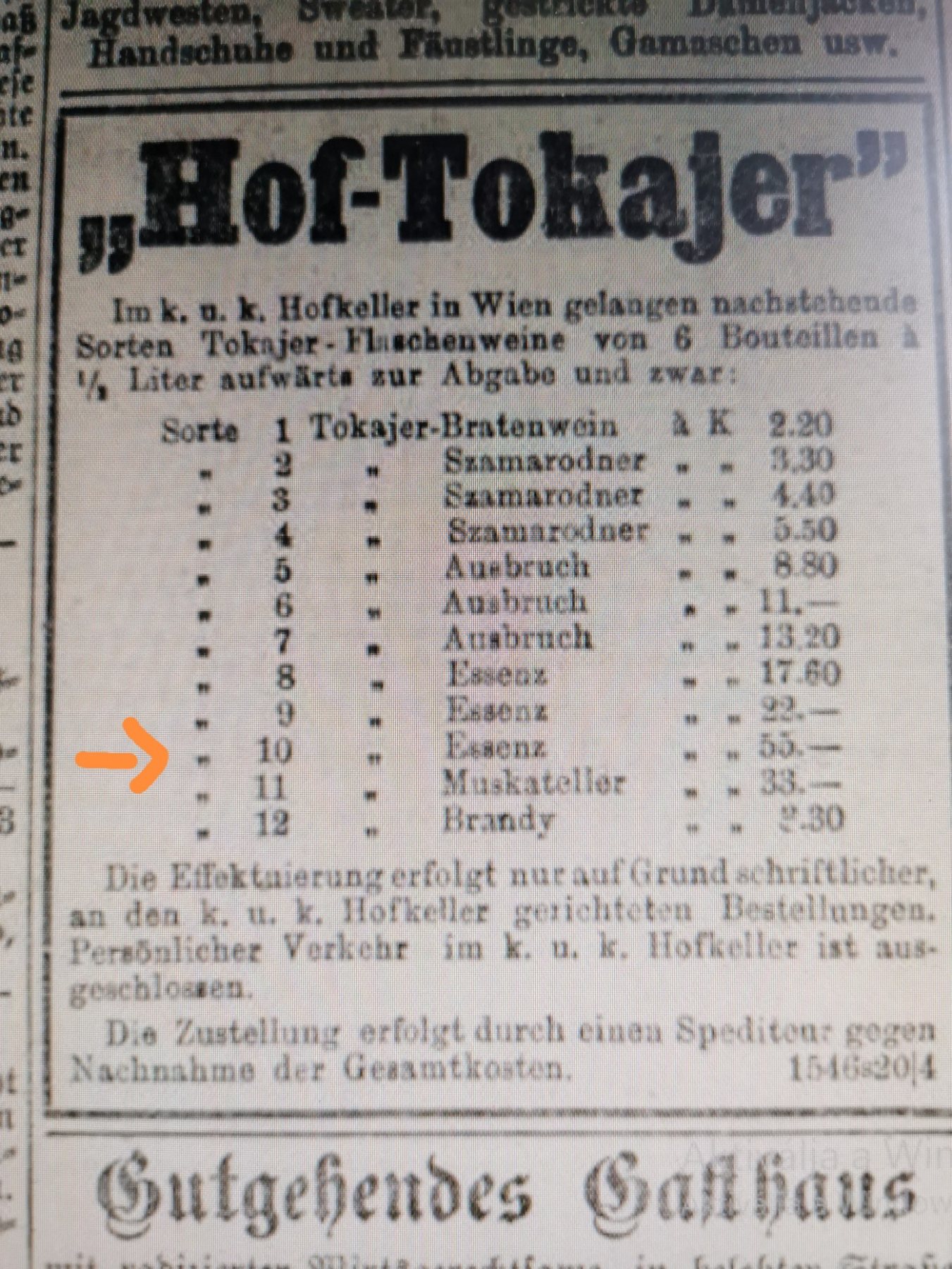
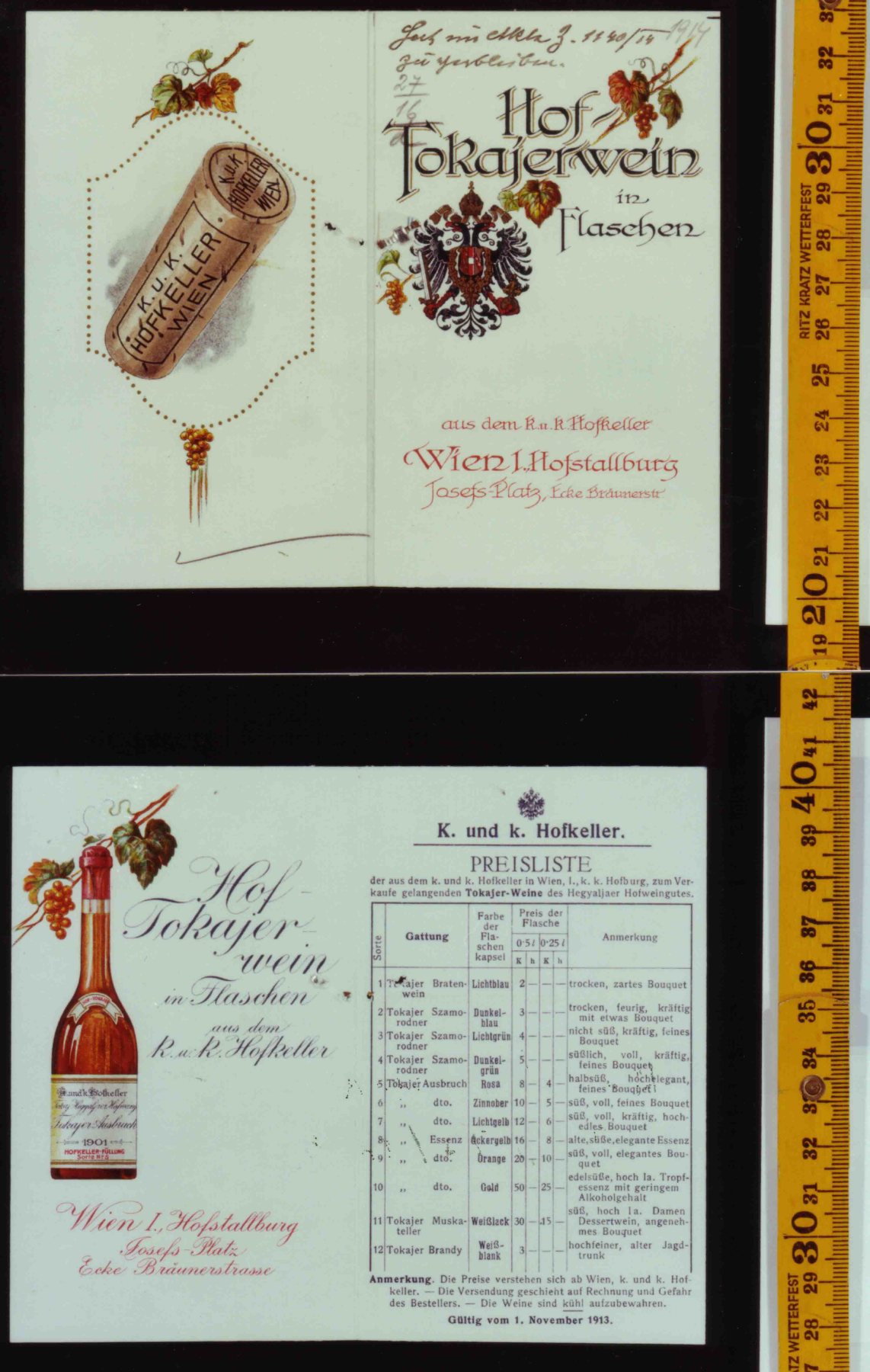
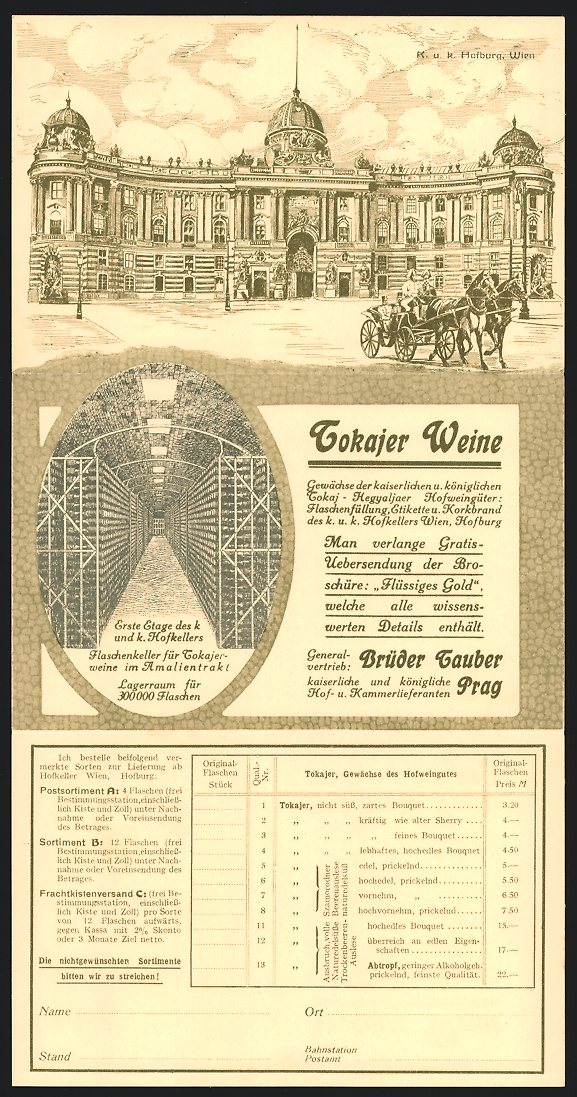
This is the finding that surprised me most in the Vienna material. A printed price list — Hof-Tokajerwein in Flaschen, from the k. u. k. Hofkeller at the Hofstallburg, Josefsplatz — is marked valid from 1 November 1913. The imperial court was selling its Tokaji commercially, bottle by bottle, by graded sort, a year before the war and five years before the empire ended.
Selling under the double eagle. The court's own lists of 1913 and 1914, and the Gebr. Tauber list of 1912 — the trade selling imperial pedigree alongside it.
Set beside the Saxon story that is a striking contrast. Dresden did not certify its royal Tokaji for sale until 1927, nine years after the abdication, and needed a family association and a wax-sealed parchment to do it. Vienna was simply over the counter, under the double eagle, in 1913.
Berlin, autumn 1913: the imperial cellar in a merchant’s catalogue
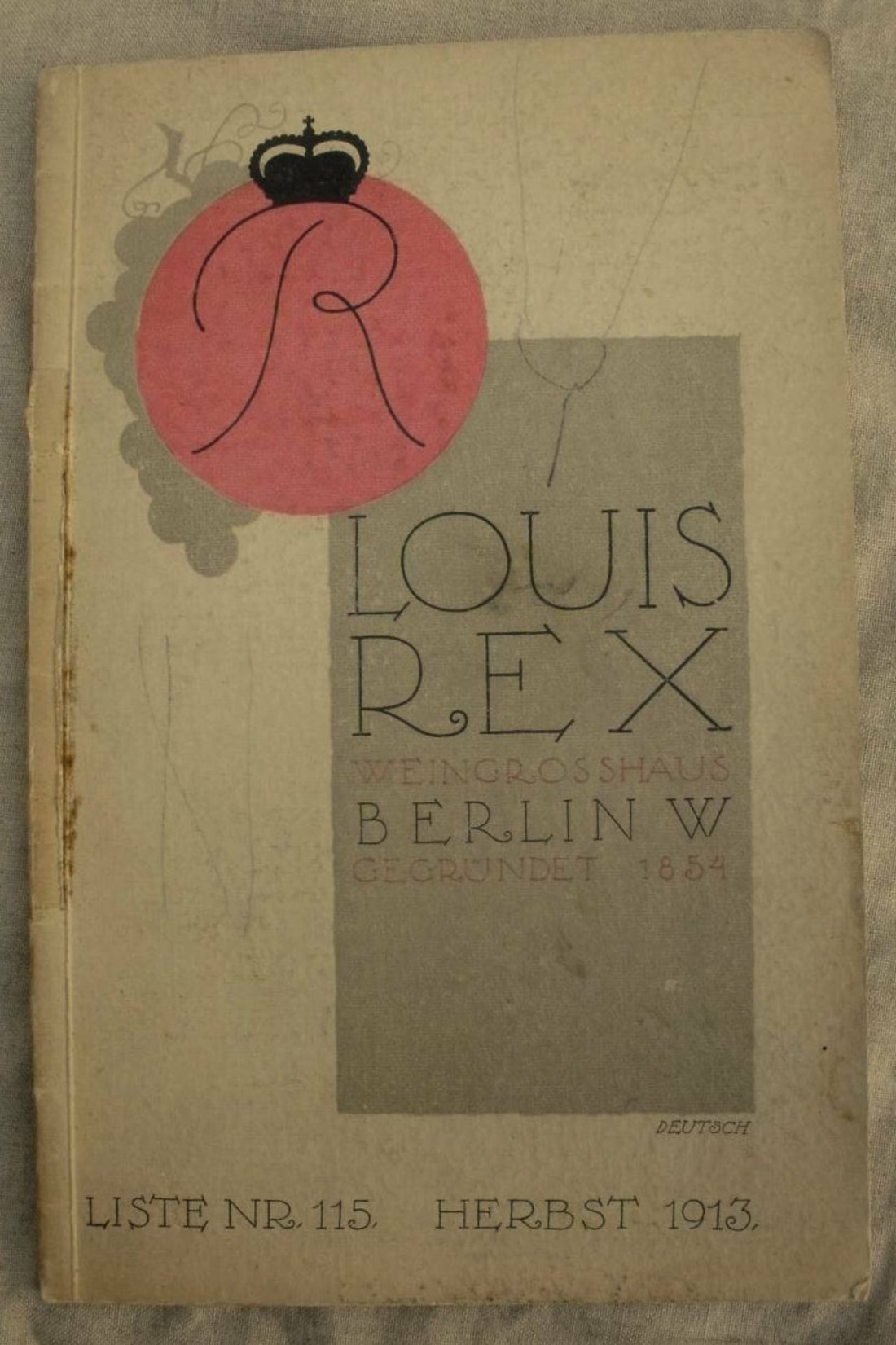
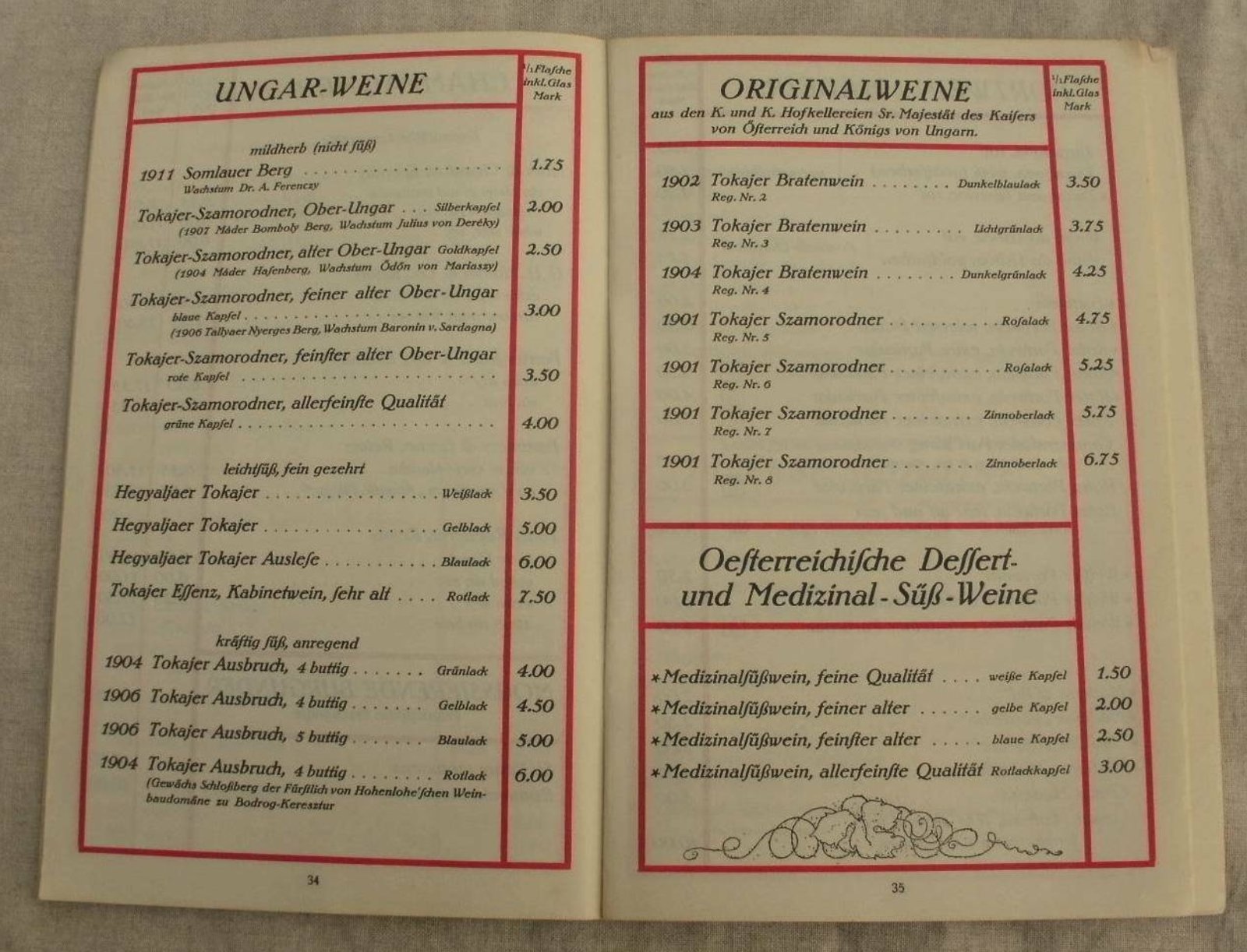
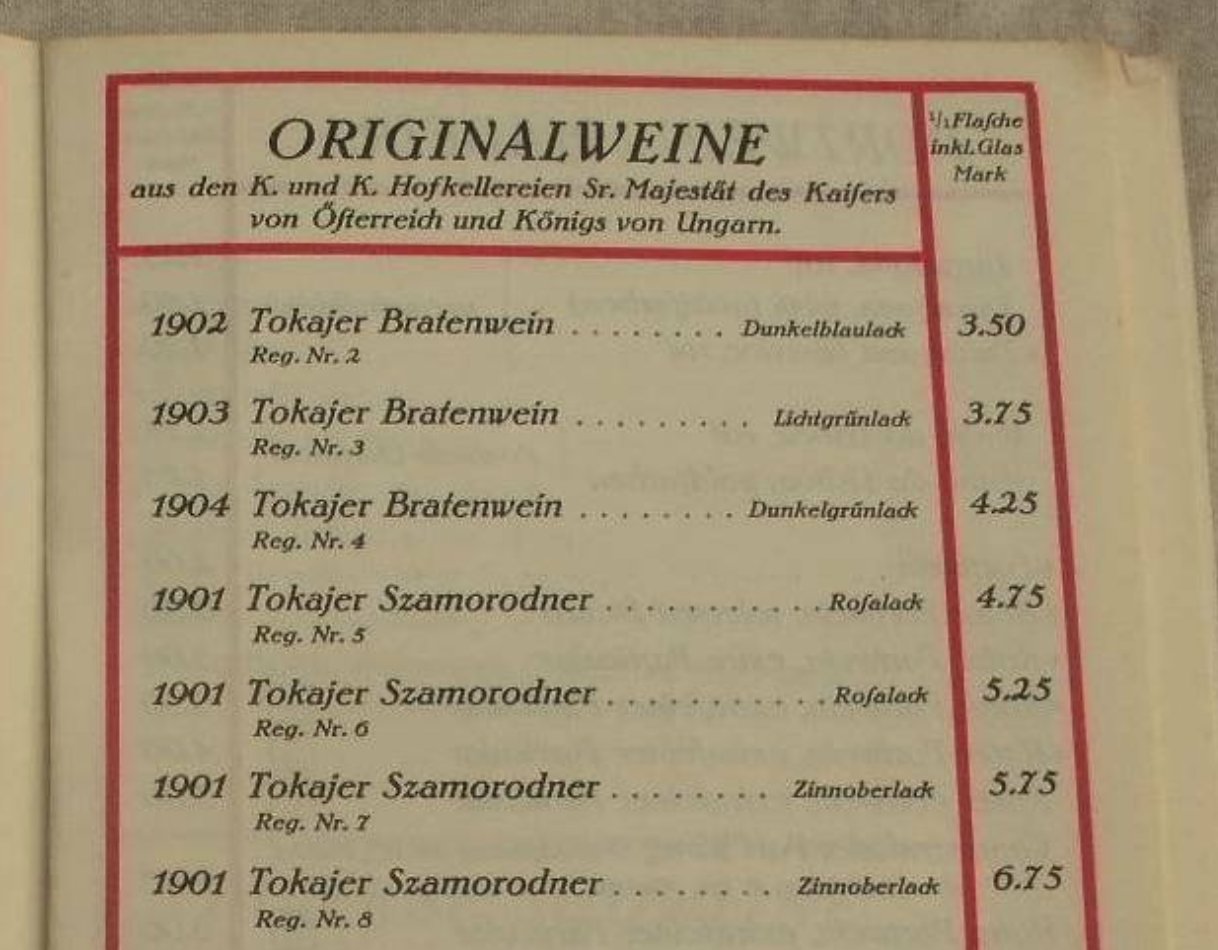
The Berlin wine house Louis Rex, founded 1854, issued its Liste Nr. 115 for autumn 1913. Its Hungarian pages carry an ordinary trade selection — Szamorodner and Ausbruch from named growers, Máder, Tállya, the Hohenlohe domain at Bodrogkeresztúr — and beside it, in its own frame, a section of a different kind: Originalweine aus den K. und K. Hofkellereien Sr. Majestät des Kaisers von Österreich und Königs von Ungarn. Seven bottlings, 1901 to 1904, each with its register number, from 3.50 to 6.75 Mark. A Berlin merchant was retailing the Vienna court cellar’s own registered wines in the same season the court’s own list was valid.
Louis Rex, Berlin, Liste Nr. 115, autumn 1913. The cover; the spread, pages 34–35, with the trade’s Ungar-Weine on the left and the imperial Originalweine on the right; and that section enlarged — 1902 to 1904 Bratenwein and 1901 Szamorodner, Reg. Nr. 2 to Reg. Nr. 8, each identified by the colour of its capsule lacquer. Click any image to enlarge.
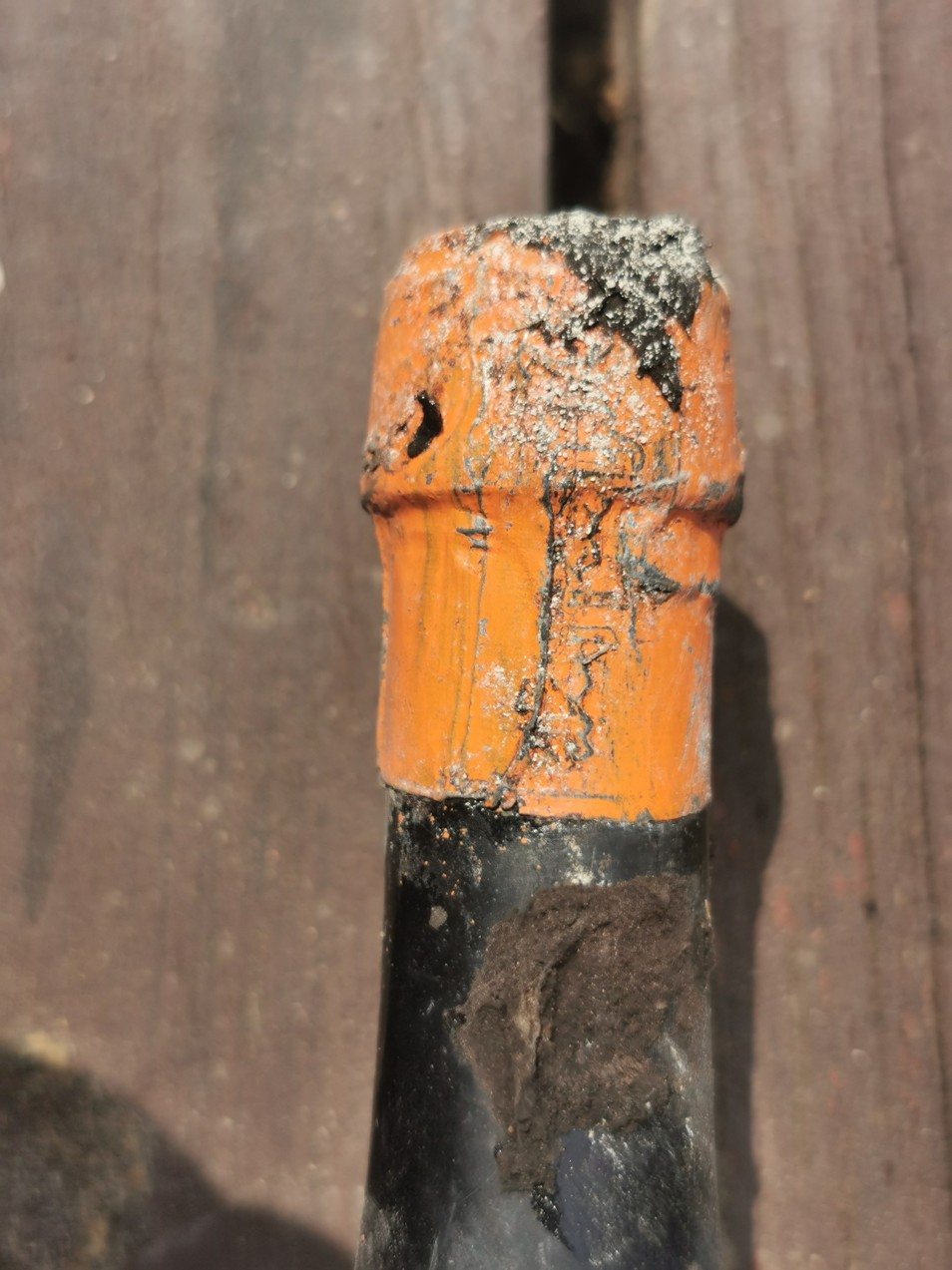
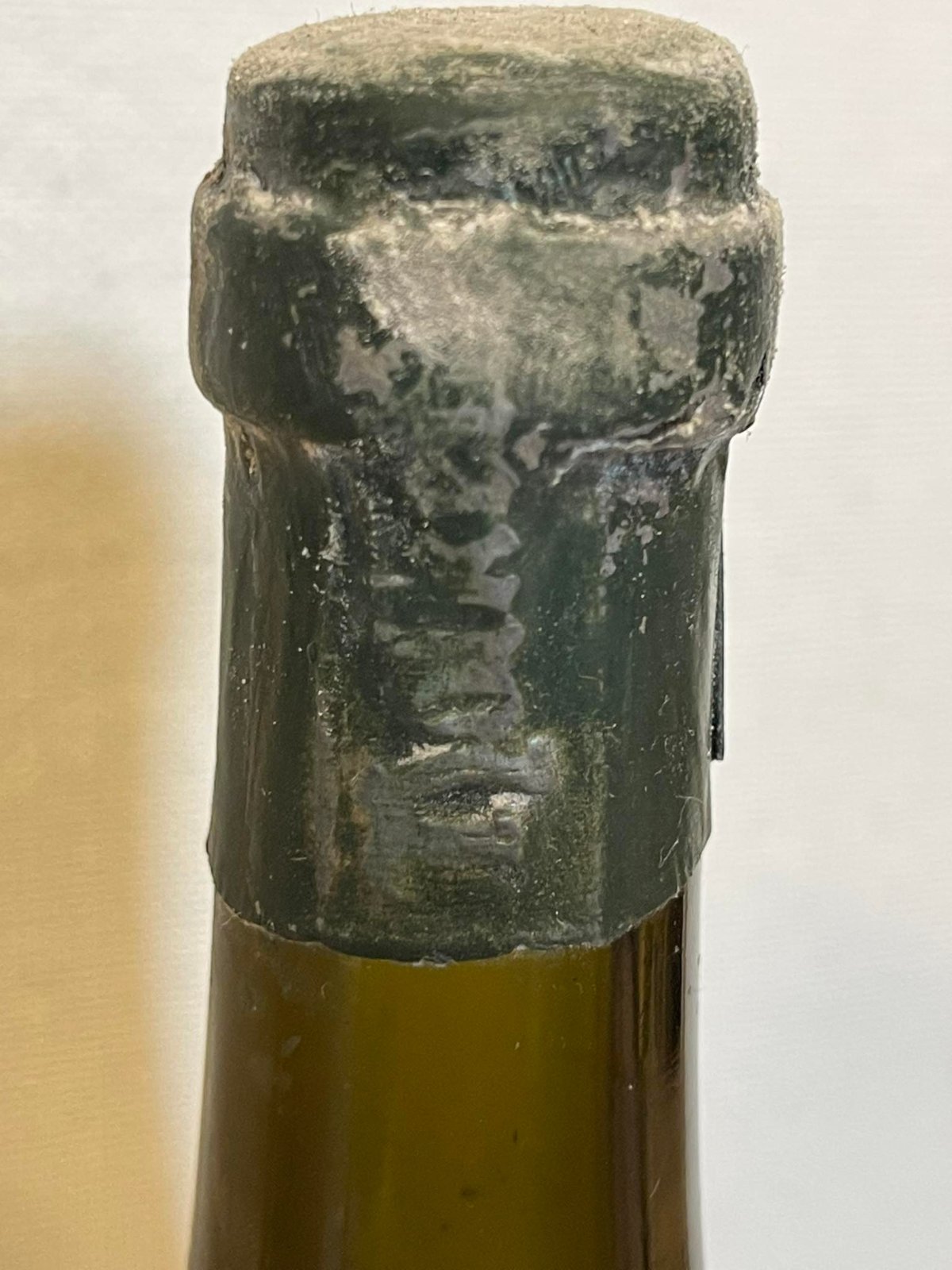
What identifies each wine is not a vineyard but a colour. Dunkelblaulack, Lichtgrünlack, Dunkelgrünlack, Rosalack, Zinnoberlack — dark blue, light green, dark green, pink, vermilion — and on the trade page opposite the same system in plainer words: silver, gold, blue, red and green capsules, white and yellow lacquer. Two 1901 Szamorodner both sealed Rosalack differ only by register number and by a fifty-pfennig step in price.
Colour coded capsules
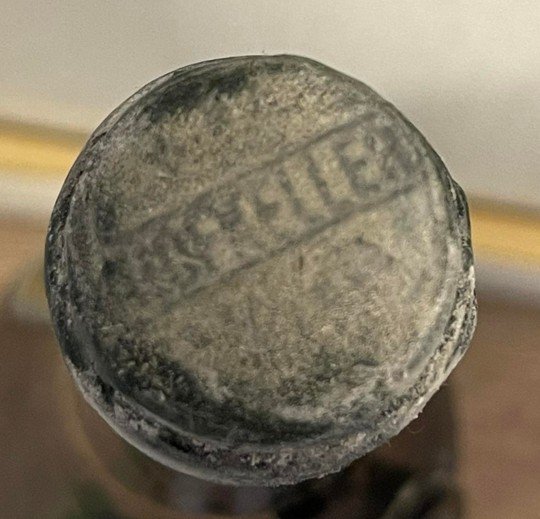
Sealing a bottle with coloured lacquer to mark its quality was never a Tokaj practice. In Hegyalja the wine was identified by village, vineyard, grower and the number of puttonyos; the bottles that survive from the region’s own cellars carry paper labels and plain wax. A graded ladder of capsule colours, in which the colour is the quality statement, belongs to a different tradition — and the court that used it had one supplier who had been doing exactly that for a century.
The lacquer on the bottles. An orange capsule and a dark green one, both embossed, a capsule seen from above with its embossed lettering still legible, and a pair of necks whose wax has worn back to bare glass. Read against the price card the colour is the sort — but only where enough lacquer survives to be read at all.
Schloss Johannisberg, in the prestigious Rheingau wine region on the Rhine, was given to Prince Metternich by Emperor Francis I in 1816, in recognition of his part in the Congress of Vienna, and the gift was made subject to a tithe: a tenth of the vintage is due to the Habsburg family. That tithe is the reason Johannisberg has been sending wine to the imperial house from 1816 to the present day — the obligation outlived the empire and is still honoured by the Metternich family. Johannisberg is also where the colour code comes from. On my question about its origin the estate’s management answered that the exact date of introduction is not known, but that it was Prince Metternich who introduced it — at first with three colours — and that an invoice of 1829 already describes the lacquer colours, which makes it the oldest documentation. The system was therefore in use at Johannisberg by 1829 at the latest.
Introduced by the man whose estate owed a tenth of every vintage to the Emperor, it grew there from three colours into the familiar ladder. The Vienna cellar received that wine, sealed that way, year after year. When the Hofkeller came to grade its own Tokaji by capsule colour, it was applying a Rheingau convention to a Hungarian wine. I cannot prove the borrowing — no document in the Vienna material states it — but the sequence, the shared household and the absence of any Tokaj precedent make it the most economical explanation.
Two German lists show the imperial pedigree still being sold two decades later. Munich, autumn 1937: a 1931 Tokajer Ausbruch, 5 buttig, sold on the strength of the individual cask — «Aus dem Kaiserin Elisabethfaß, 1242 Liter». Berlin, winter 1938/39: a 1928er Orig. Süßer Tokayer at 3.10 RM, attributed «Gewächs Königl. Ungar. Staatskellerei, ehem. Kais. Weingärten Tokay» — the vineyards of the article above, ten years after nationalisation, still trading on the Emperor's name.
1690 — today
“Imperial Tokay”: what the term actually means
There is no precise definition, and there never was. Two readings are obvious and both are plausible: Imperial Tokay means either the best Tokay from the Imperial Cellar, or the best Tokay from the imperial vineyards. Everything above says that the court had both, and used the words loosely.
That matters commercially as well as historically, because the term is the single most valuable phrase in the trade's vocabulary and it is still in use. Anyone selling or buying under it should know that it is a reputation, not a designation.
The term was used outside the court, and never by the court itself
This is the part of the story the labels do not tell you. Not a single Austrian source uses the term — so far no archive document, no article, no menu card and no price list from the imperial side calls anything Imperial Tokay. The court's own vocabulary is the plain one seen throughout this page: Tokayer Essenz, Ausbruch, Szamorodner, Hofweingut.
Every attestation gathered here comes from outside Vienna — a French account memorandum, English and Hungarian novels, German and Polish merchants, London salerooms, and the labels below. Imperial Tokay is what other people called the Emperor's wine.
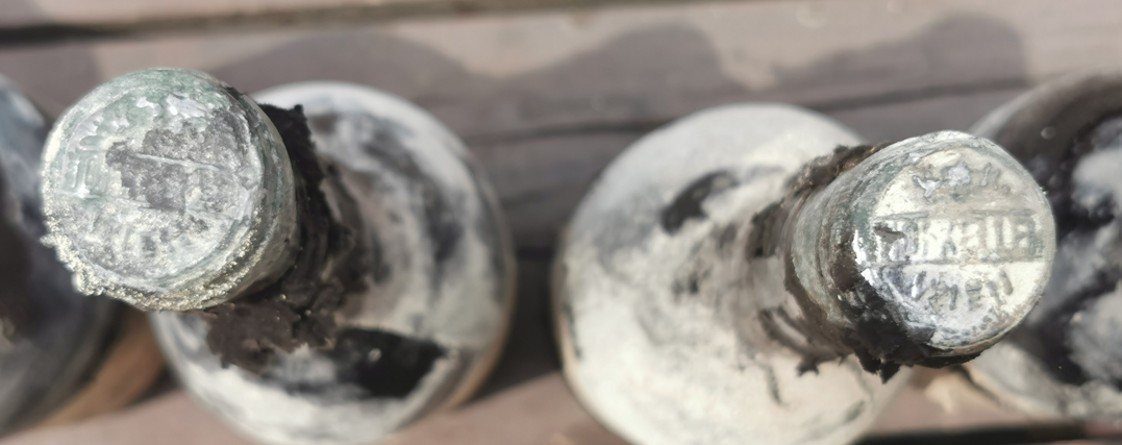
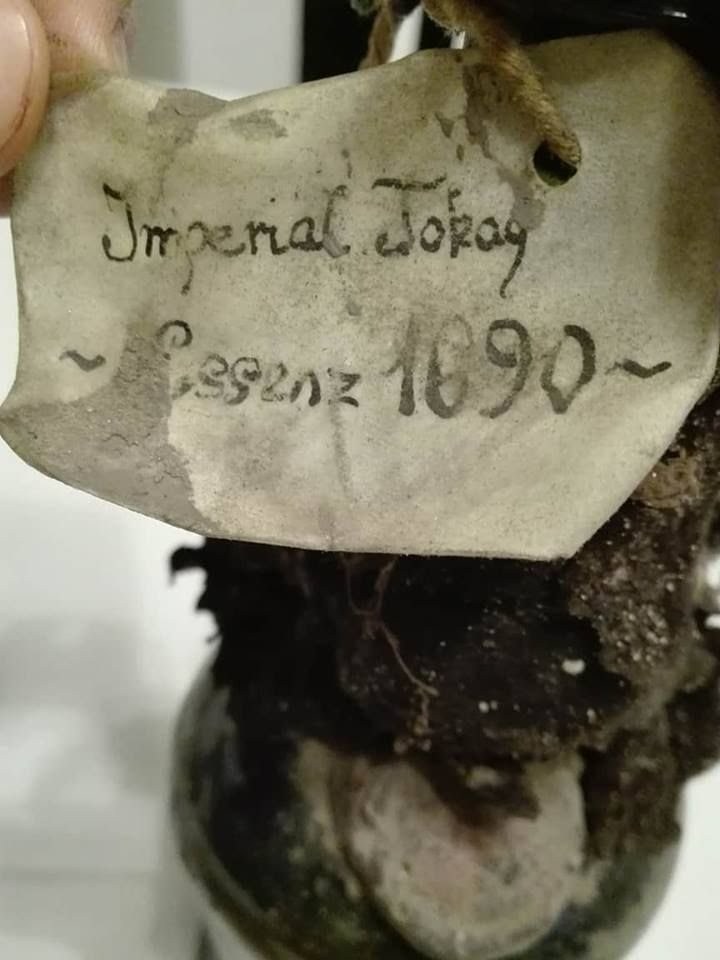
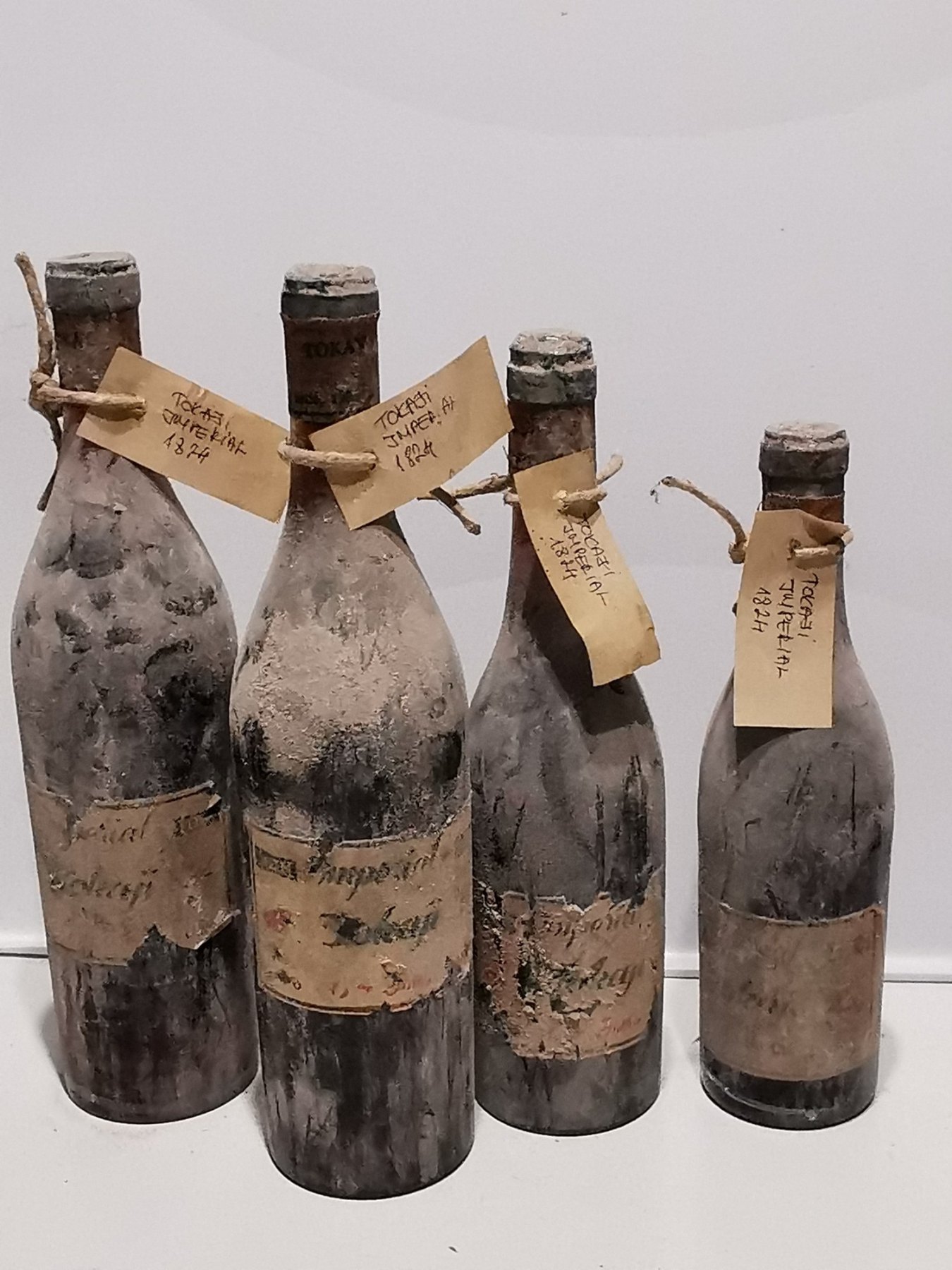
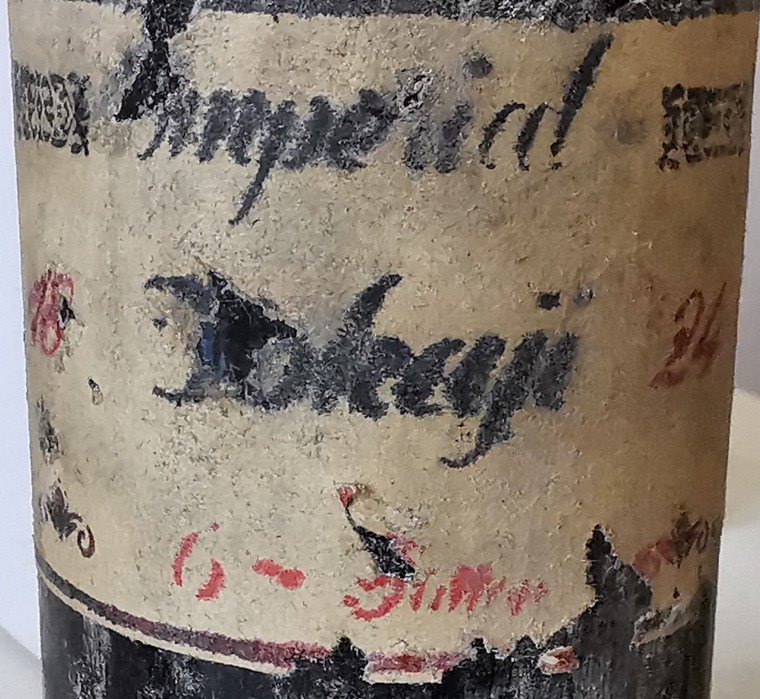
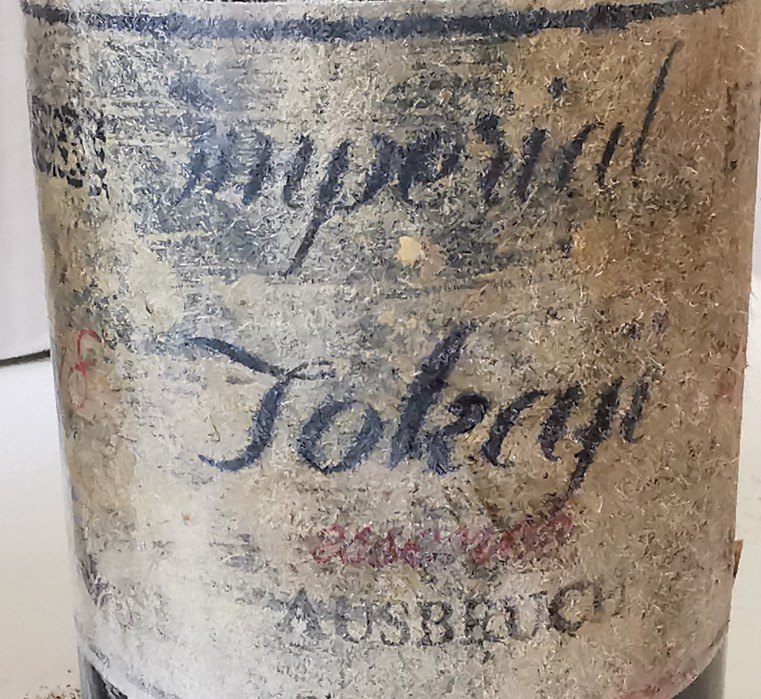
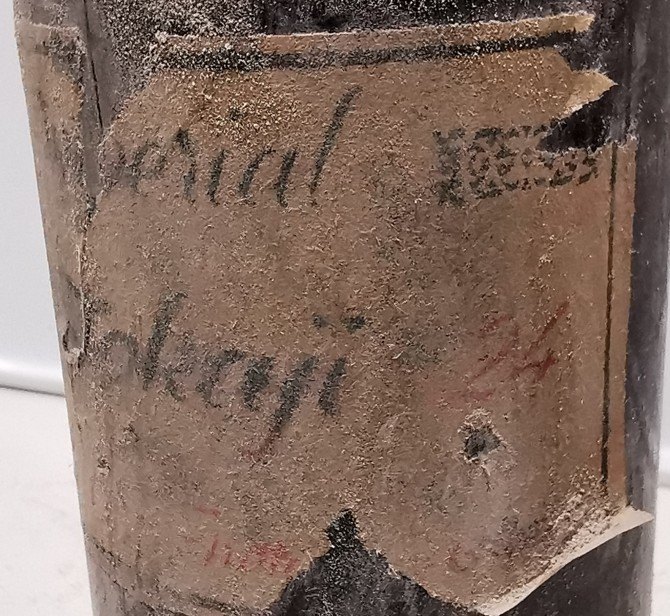
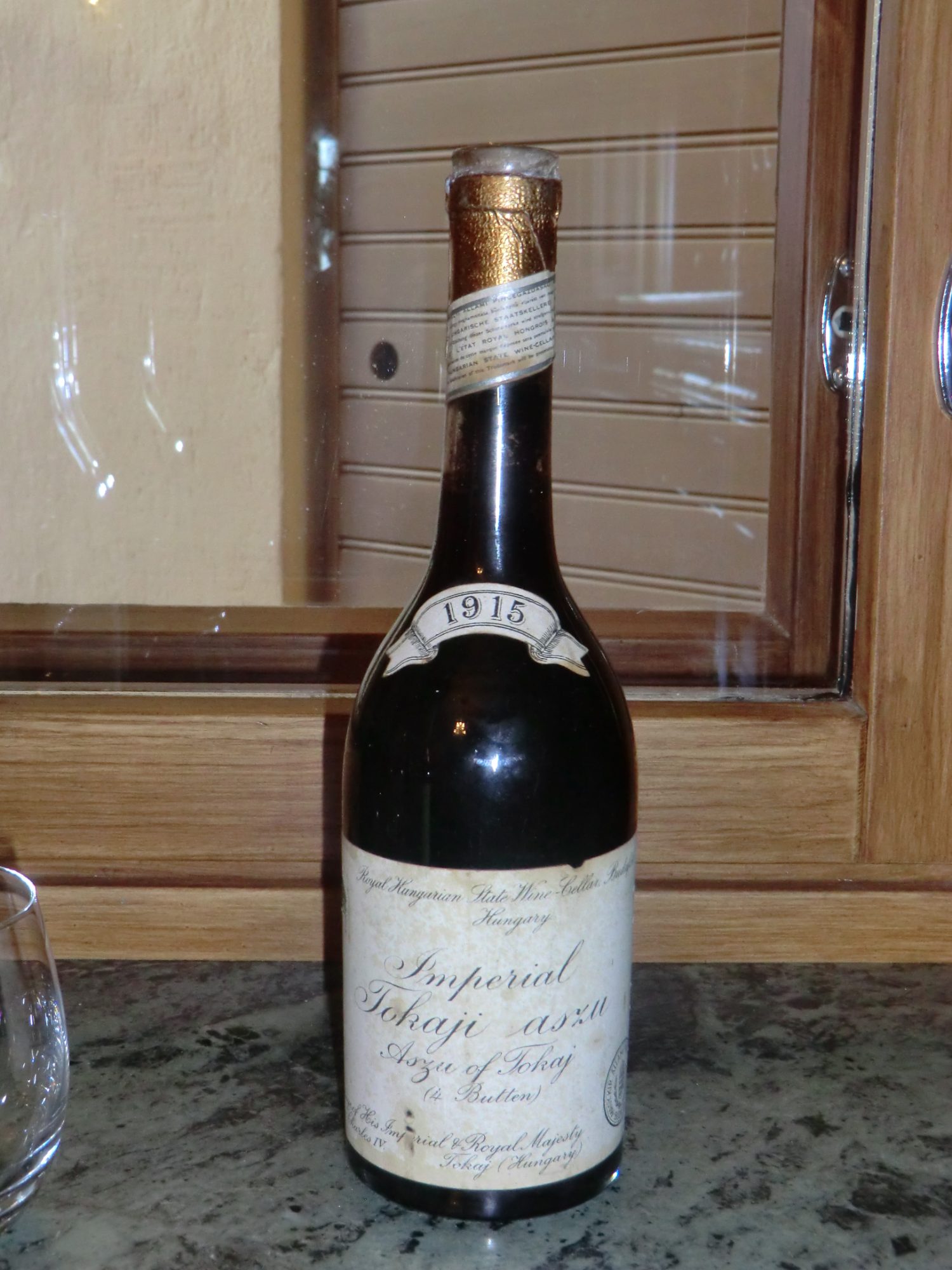
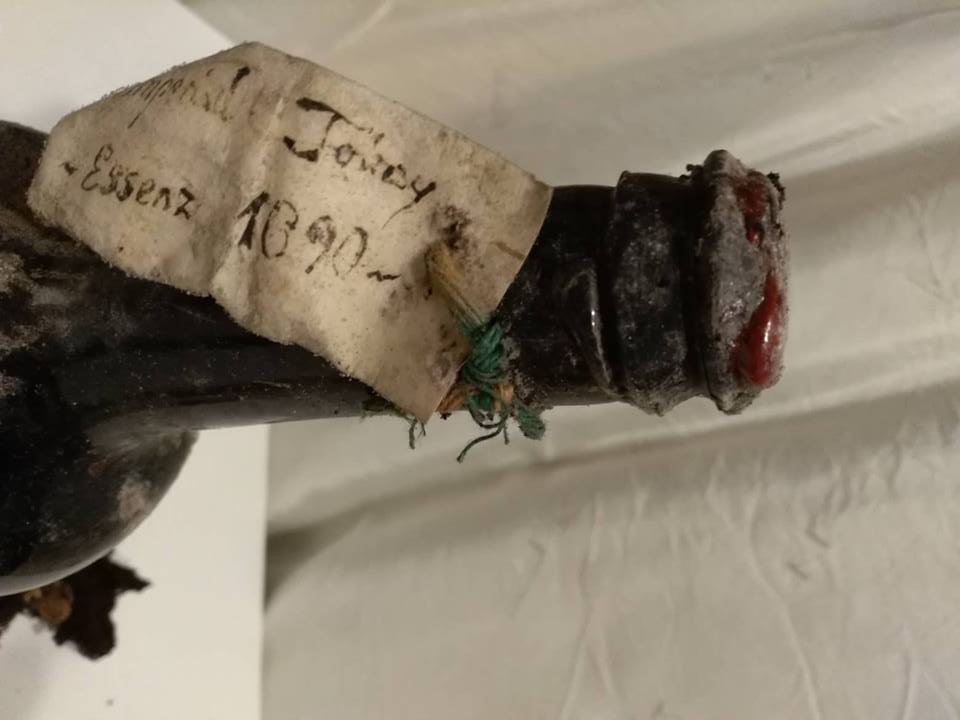
The term on a neck tag. A parchment tag tied to the neck of a heavily encrusted bottle, hand-lettered Imperial Tokay above Essenz 1690. German Essenz beside English Imperial Tokay — the mixture of languages is itself part of the question of where the term came from.Four bottles carrying the term on the label. Hand-lettered Imperial Tokay labels under heavy cellar deposit; the modern cellar tags read Tokaji Imperial 1824. One neck capsule is embossed TOKAY.
The term on the glass. Two hands and two spellings — Imperial Tokay above Ausbruch in one case, Imperial Tokaji with a red annotation in another — and a tied neck tag reading Imperial Tokay Essenz 1690, still under its sealed and wired capsule. Click any image to read the script.
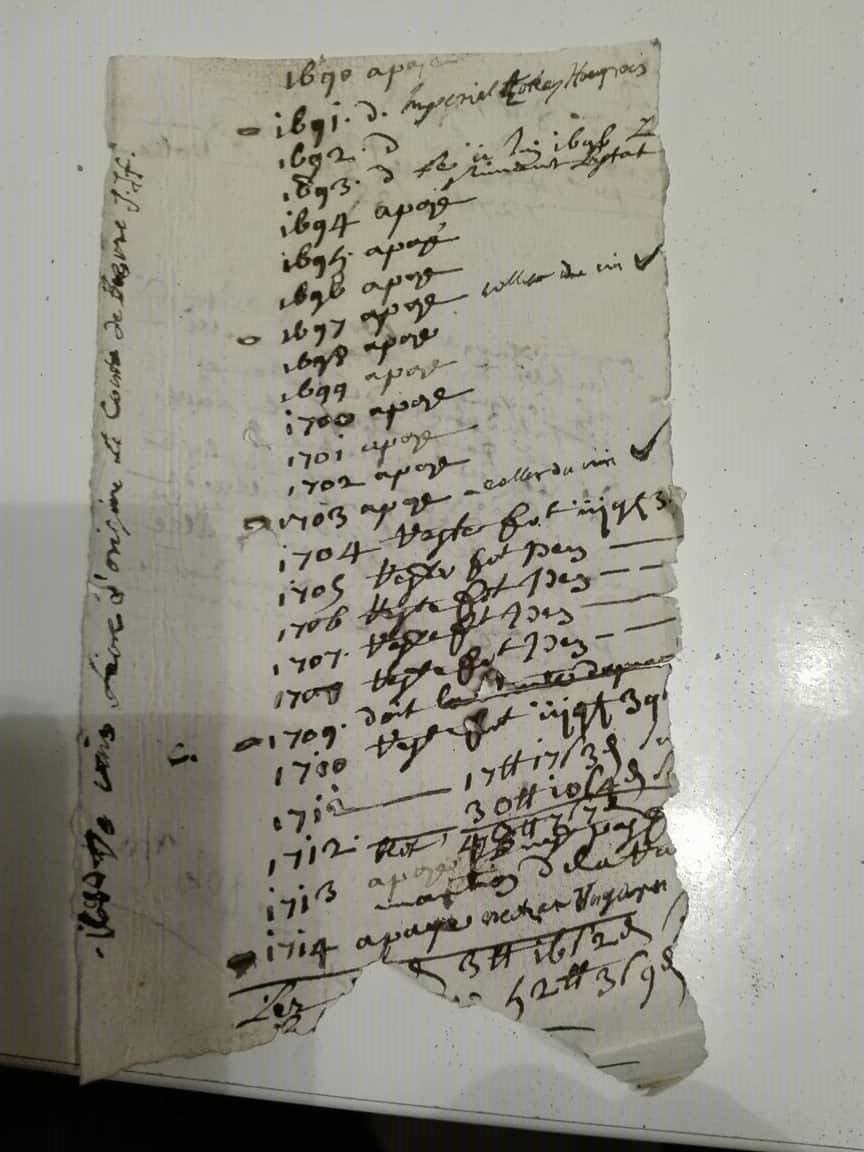
The oldest one on paper. A torn French account memorandum runs year by year from 1690 to 1714 under the heading Imperial Tokay Hongrois, recording annual payments and cellar-service notes for a Comte de B. The payment record breaks down precisely across the Rákóczi rising and the War of the Spanish Succession, and recovers after 1713. It is reproduced below.
The most famous bottle. The Guinness Book of Records for 1998 gives the oldest wine ever auctioned as a 1646 Imperial Tokay, sold at Sotheby's in Geneva on 16 November 1984 for 1,250 Swiss francs. The American owner does not permit a photograph to be published.
The paper fragment, 1690–1714. Second line at the head: Imperial Tokay Hongrois. Down the left edge, the note of origin naming the Comte; then a year-by-year column from 1690 to 1714 with payments, and the gap that opens after 1703. The oldest use of the term known to this project — and it is French.
1904 — 1938
Cognac, punch and Tokay bonbons
The Imperial Cellar was not only a store. It was a small manufactory. Tokay cognac production began there in 1904, with oak barrels bought specially for it; the spirit ran at 50 % by volume and was assessed as of ganz hervorragender Qualität.
The punch recipe of Friedrich Hampel, chef of the k. u. k. Hofmundküche: 800 grams of sugar beaten with four yolks, brought to the boil with half a litre of white wine, the juice of four lemons added, strained and chilled; then half a litre of Tokay, the mass frozen, and at the end a quarter litre of whipped cream and two small glasses of cognac.
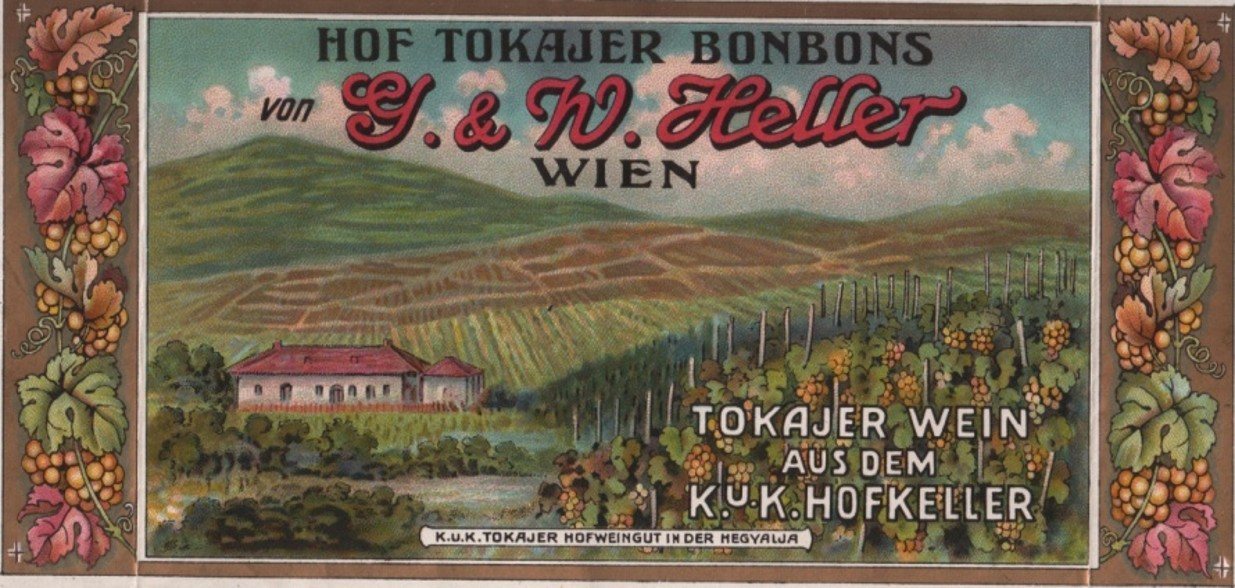
And sweets: Hof Tokajer Bonbons from G. & W. Heller, Vienna, on a lithographed box lid showing the Hegyalja, captioned Tokajer Wein aus dem k. u. k. Hofkeller and, in small type, k. u. k. Tokajer Hofweingut in der Hegyalja.
Hof Tokajer Bonbons, G. & W. Heller, Vienna. Both the cellar and the court's wine estate are named on the lid.
Chapter three
Tokaji at the Royal Court
1770 — 1873
The glasses
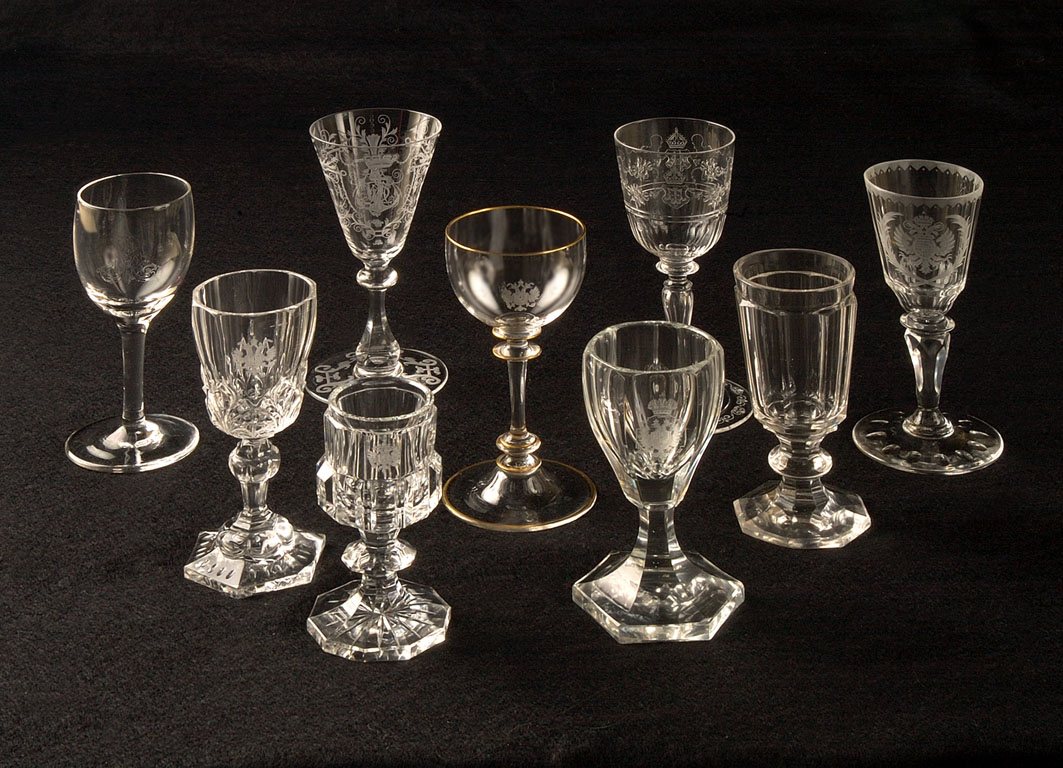
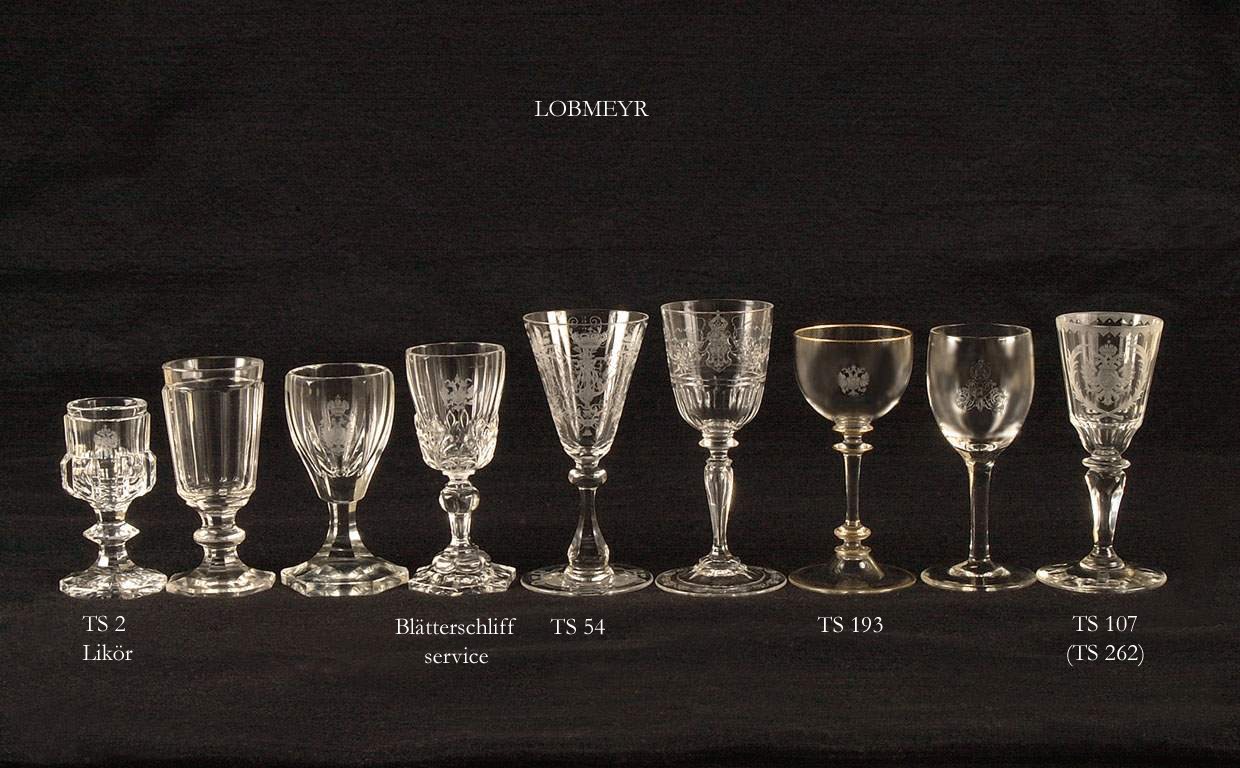
A wine that gets its own inspector also gets its own glass. The Silberkammer collection of the Vienna Hofburg lists nine different types of Tokay glass, and the historical inventories record a full table service with several Tokay forms among them. That service has not survived.
One purchase gives the scale of the thing: the court bought 200 Tokay glasses for the celebrations at the Belvedere that preceded the wedding of Marie Antoinette. The most prestigious of the survivors belongs to the Kaiserservice, which Lobmeyr designed for the 1873 World Exposition in Vienna. After the Expo the service was installed in a sideboard in Franz Joseph's audience room — and never used. The Tokay glass from it has been produced and sold by Lobmeyr ever since, with and without the imperial eagle.
Nine forms, and the one still in production. Note the size: these are small glasses, made for a wine served in spoonfuls rather than measures.
1867 — 1997
Tokay on the menu cards
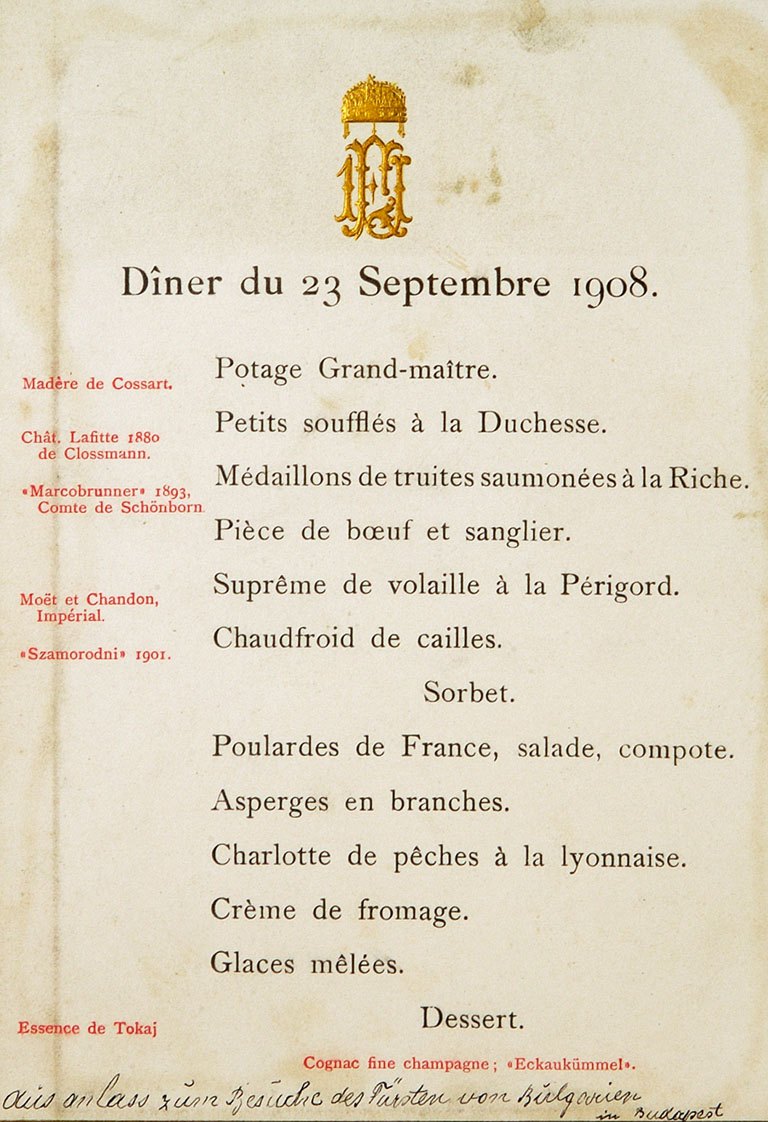
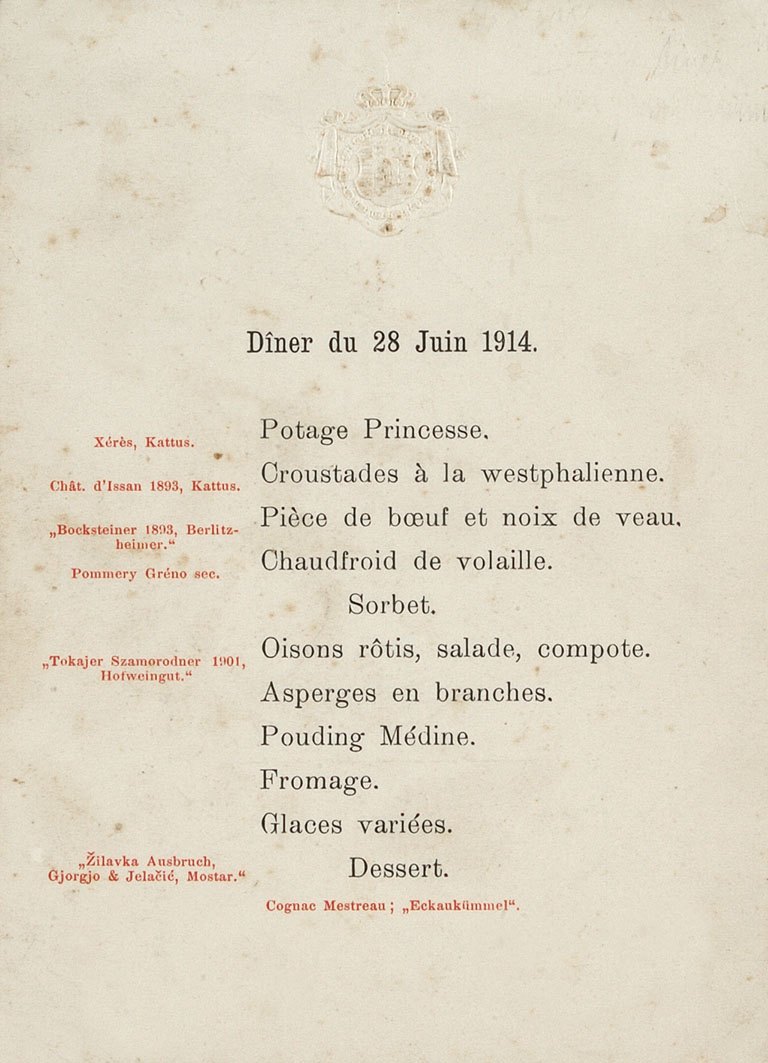
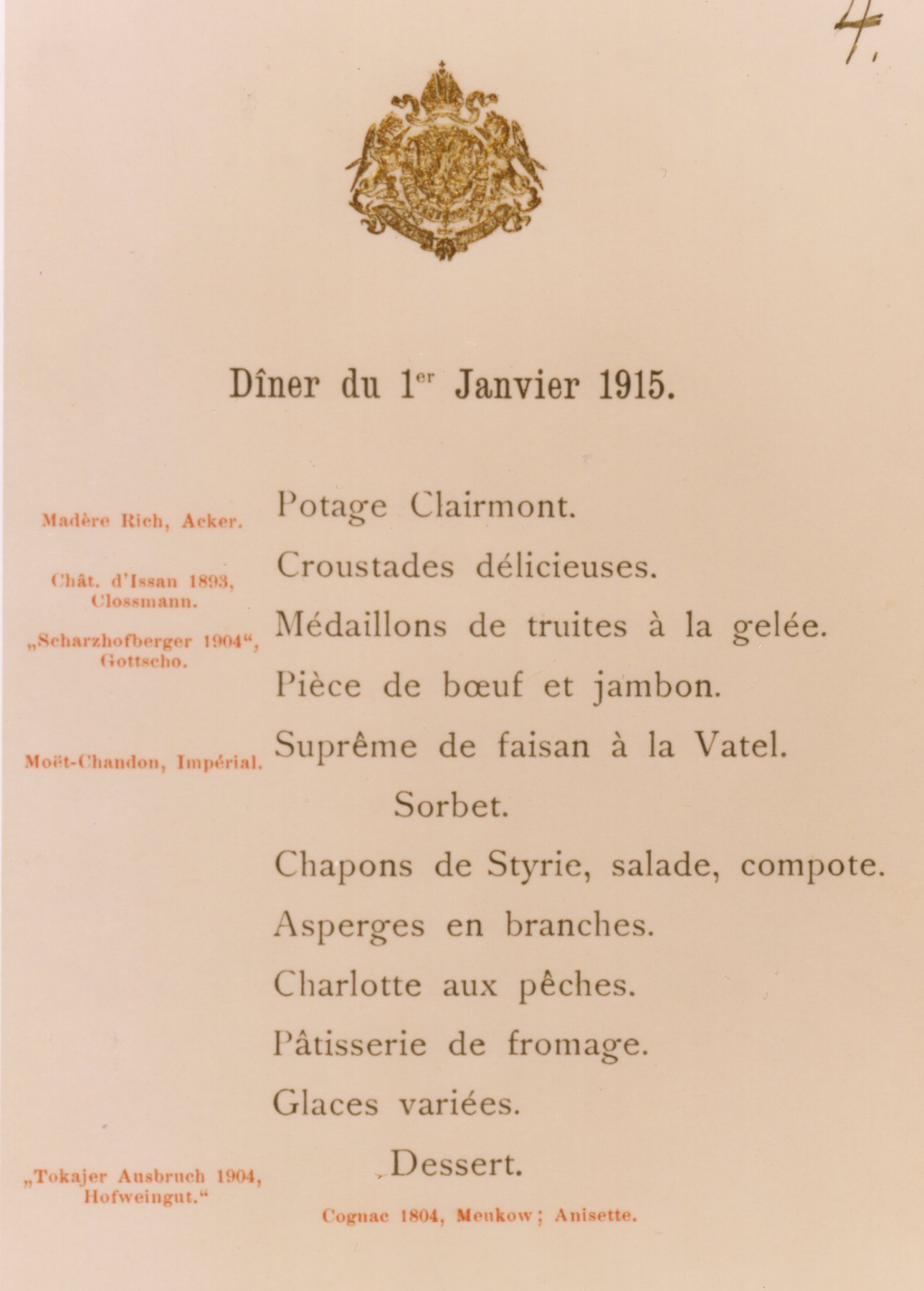
The menu cards are almost monotonous in what they prove: Tokay was present at essentially every important occasion at the imperial court, and above all when foreign royalty was being received. It sits in the wine column at the left, usually twice — once as Szamorodner with the roast, once as Essence with the dessert.
Four state dinners, and what stood in the wine column
Date
Occasion
The Tokay lines
23 Sept 1908
Visit of the Duke of Bulgaria
«Szamorodni» 1901 · Essence de Tokaj — Hungarian royal arms
2 Oct 1908
Visit of the Spanish royals
«Szamorodni» 1901 · Essence de Tokaj 1901 — Hungarian royal arms
Dinner planned for the day of the Sarajevo assassination
«Tokajer Szamorodner 1901, Hofweingut» — the dinner never took place
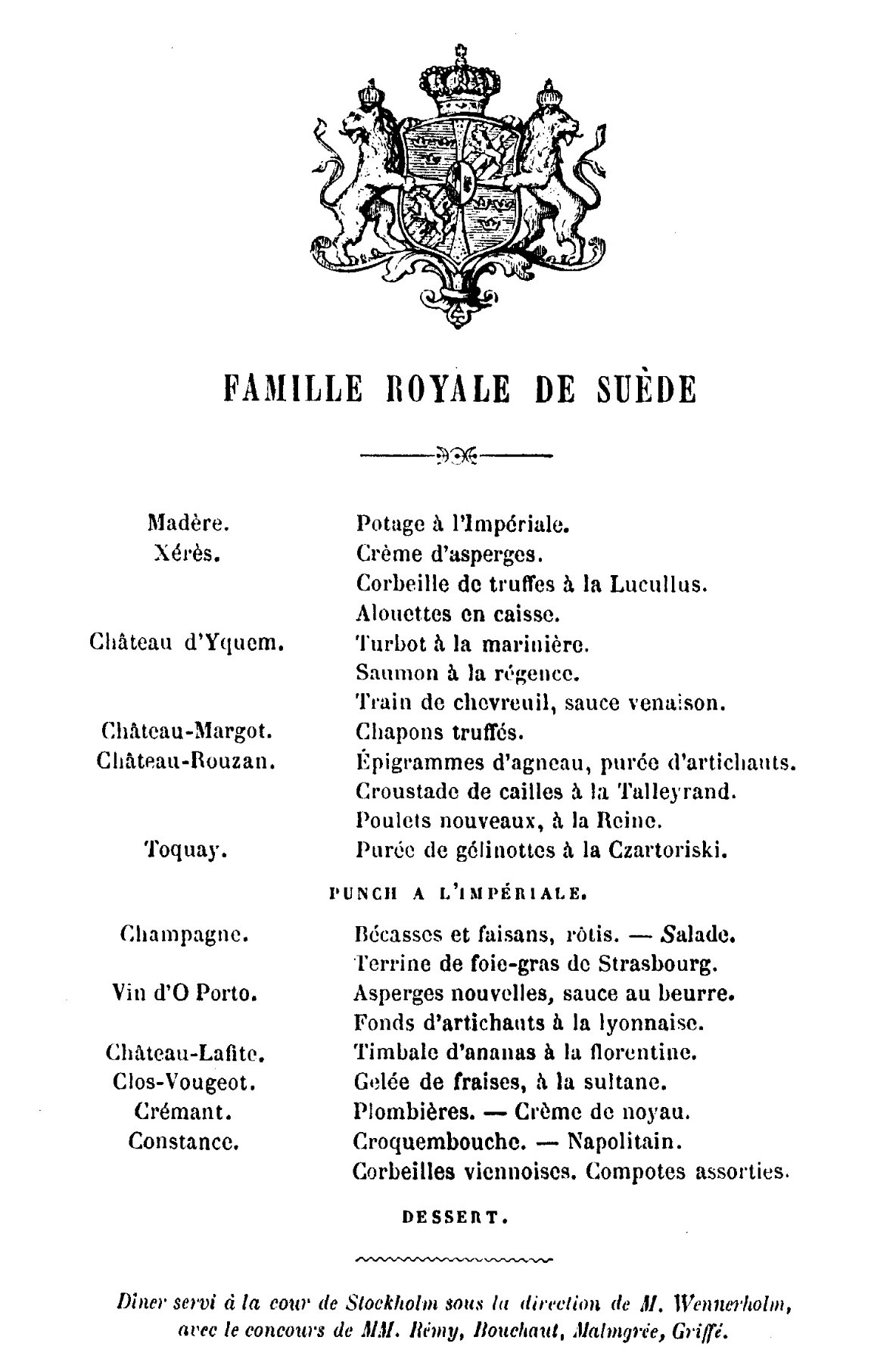
Four cards of the Vienna court. The 1908 card with the Hungarian royal arms; the 5 December 1908 dinner for the Swedish royal couple, with a handwritten note at the foot recording the occasion; the card for 28 June 1914, the one nobody used; and the Wiener Hof card of 1 January 1915. Click any card to read the wine column.
Read the third column again. On the Swedish and Sarajevo cards the entry is not simply Tokajer but Hofweingut — from the court's own wine estate. The Emperor was serving his guests wine he had grown himself, and the menu card says so.
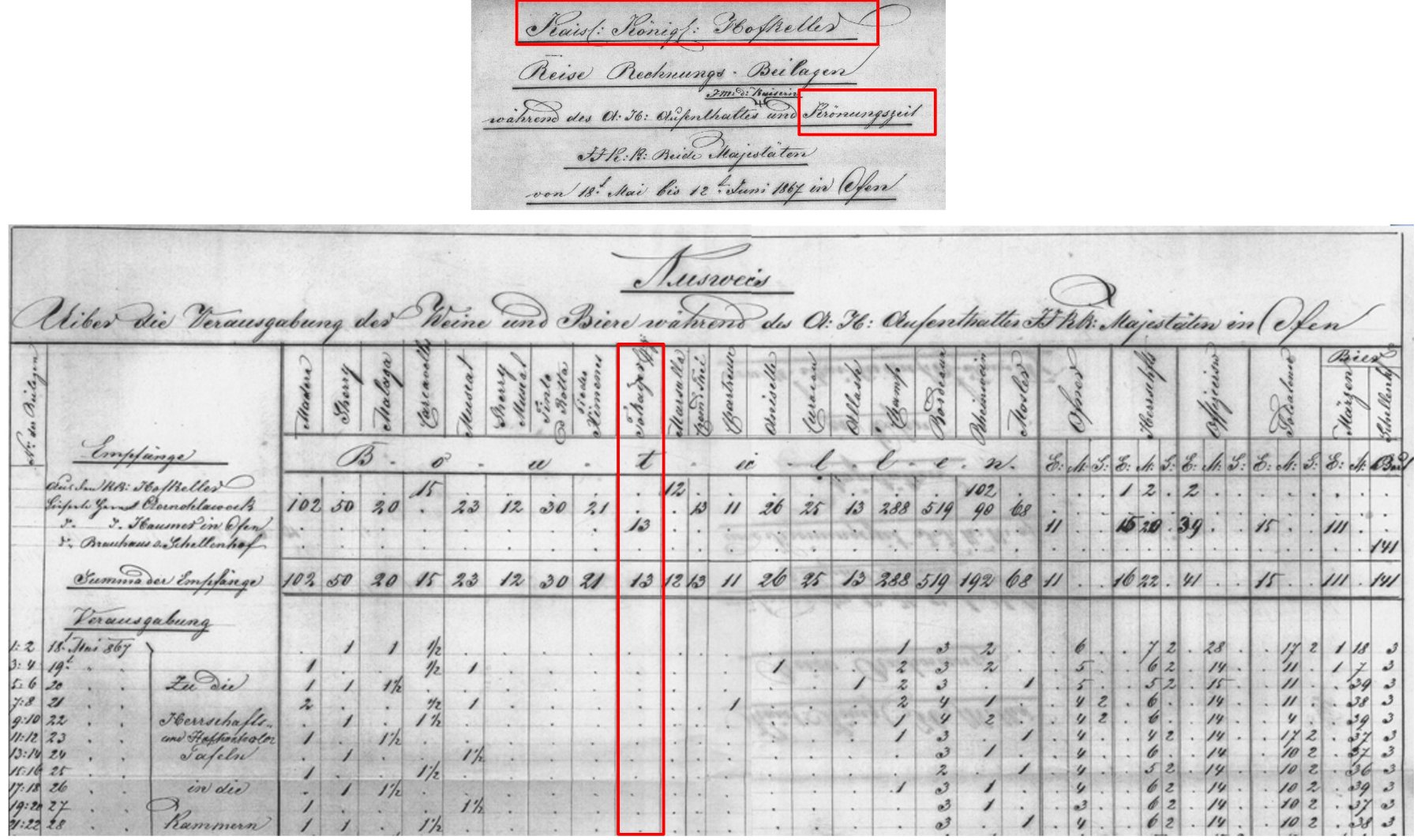
Buda, 1867. The travel-expense annexes of the k. k. Hofkeller for the imperial couple's stay include an Ausweis of all wine issued: among thirty columns of Madeira, sherry, Bordeaux and champagne, one narrow column headed Tokayer, running to thirteen bottles.
Two of the guests at that coronation matter elsewhere on this site. Teofil Fukier sent bottles of two-hundred-year-old Tokay from Warsaw. And in 1916, at the coronation of Karl I in Budapest, Henryk Fukier sent three bottles of the 1606, then the oldest Tokay in the world. The coronation menu that day included Tokajer Obstaspik — the wine in the aspic.
In 1881 the court went looking for the best possible Tokay for the planned wedding of Crown Prince Rudolf, and Baron Miklós Vay sent 200 bottles of the 1701 vintage from his own cellars, remarking that the Habsburgs are very wealthy but even they cannot pay what this wine is worth. A hundred and eighty years old at the time, and given away. And the tradition outlived the monarchy: the menu for the 1997 wedding dinner of Prince George Habsburg at the Budapest Gundel carries a Tokaji Aszú 6 puttonyos 1991 with the dessert.
1695 — 1825
Diplomacy: the gift channel, the tariff war, and Tokay as currency
The Habsburgs sent Tokay to European monarchs as a matter of routine. The oldest document in that series is a ruling of Leopold I in 1695, directing that the King of England receive «zwey Väßel Toggeyer des Bösten und ein Väßel des mittleren» — two casks of the best Tokay and one of the middle quality. Even a diplomatic present was sorted by tier.
Under Maria Theresa the wine presents were regulated and recorded: precisely what went to whom, and precisely what came back — champagne from France, Cape wine from Holland. She sent Tokay to her daughter Marie Antoinette as a wedding present, and the Austrian ambassador reported back that she liked it.
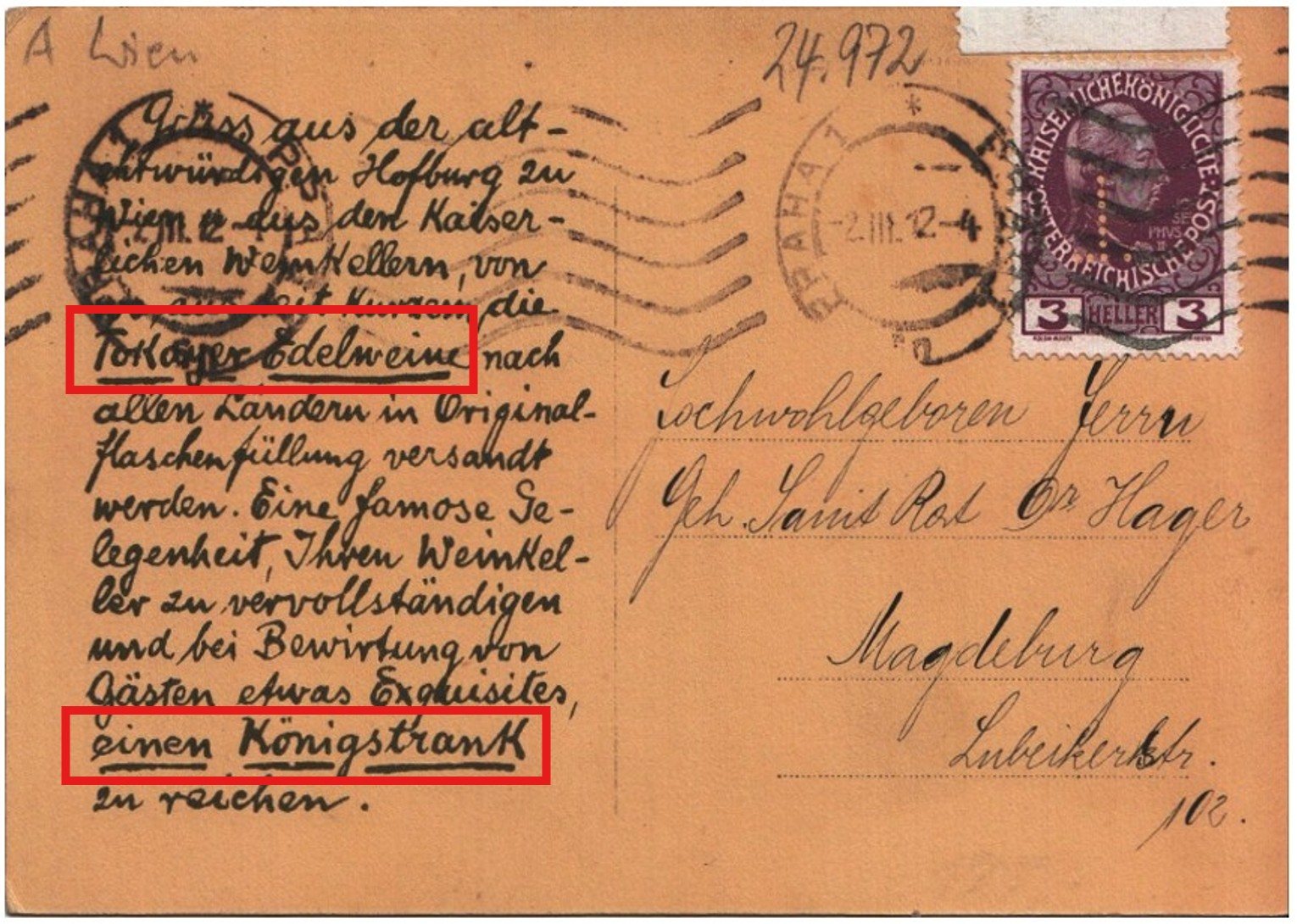
«Königstrank». The drink of kings as a popular image — the reputation the gift channel had built, sold back on a postcard.
An imperial pass for twenty Eimer of Ausbruch, 1721
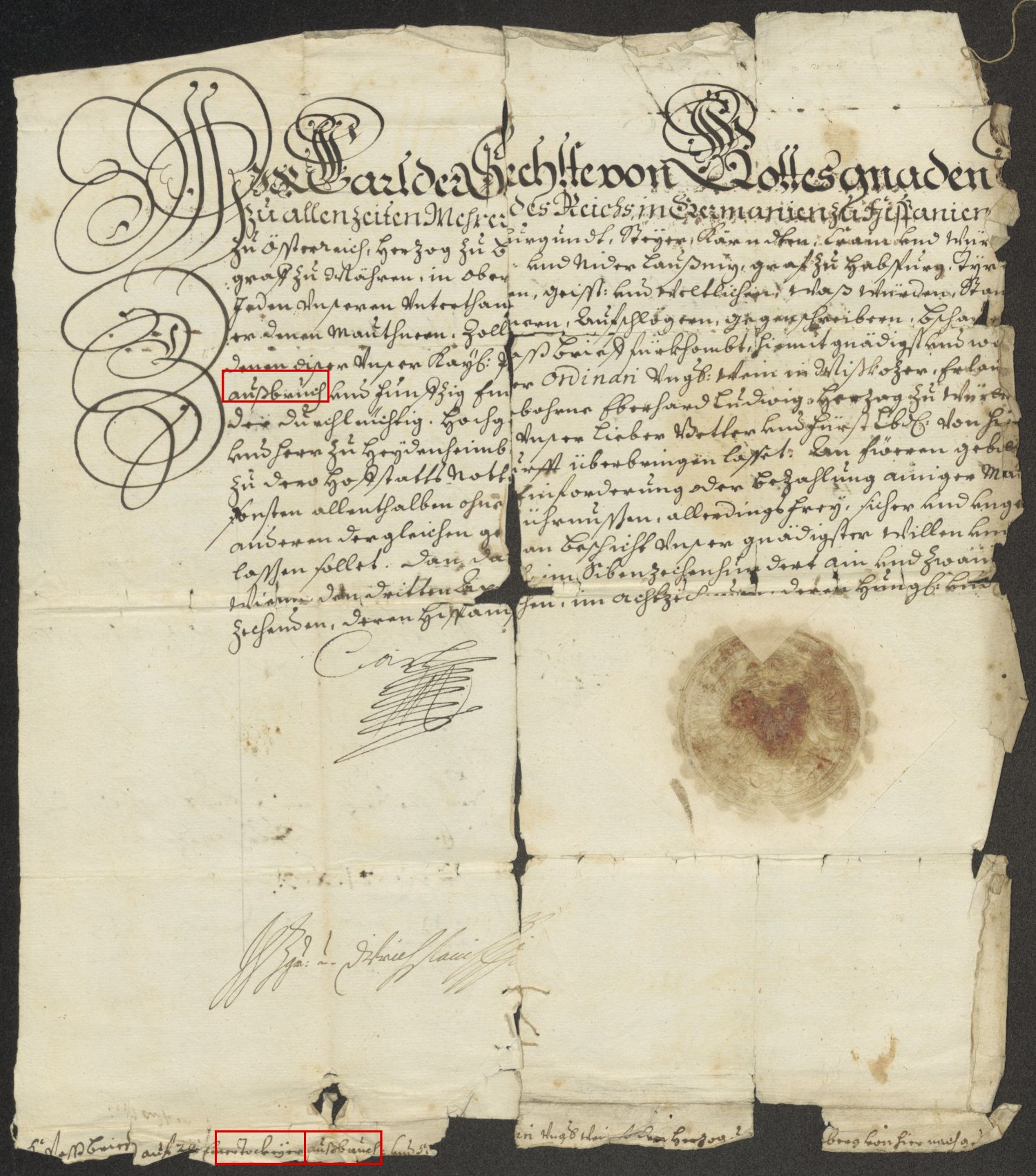
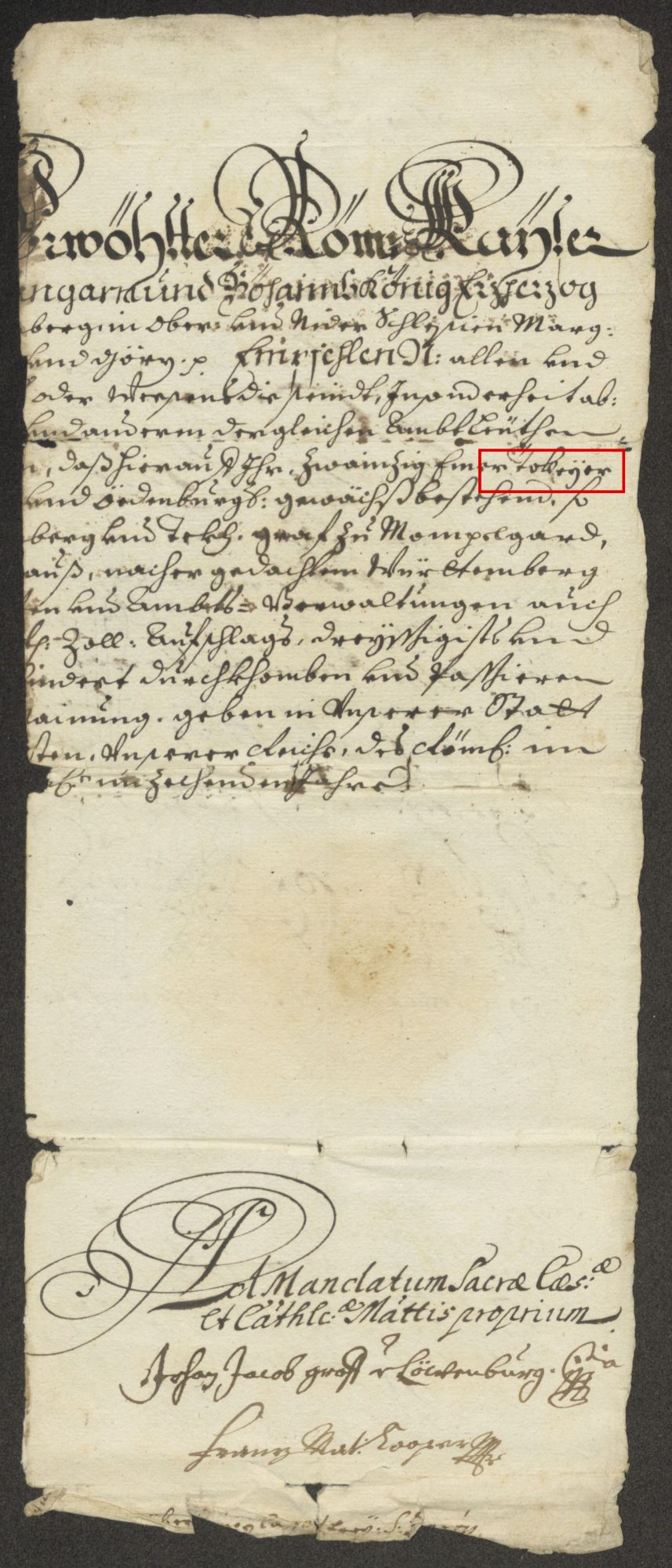
The gift channel had a freight problem, and the Emperor himself was the remedy. On 3 May 1721 the Vienna Hofkammer issued a Paßbrief in the name of Holy Roman Emperor Charles VI — signed Carl in his own hand, under the imperial paper seal with the double eagle — ordering every toll-keeper, customs officer and inspector to let «zwainzig Emer Tockheyer Ausbruch und fünfzig Emer ordinari Ungar. Wein» pass free of any duty. The wine, twenty Eimer of Tokaji Ausbruch and fifty of ordinary Hungarian, about forty hectolitres, was being brought from Vienna to the court of Duke Eberhard Ludwig of Württemberg.
The pass itself, Vienna, 3 May 1721. The Emperor’s titles fill the head of the sheet; below stand his own Carl with paraph, the imperial paper seal with the double eagle, and the counter-signature of a Hofkammer official. The sheet is rubbed through at the fold crossings, which is where the words zwainzig Emer Tockheyer are lost — only Ausbruch survives in the body, framed in red, while the dorsal note at the foot repeats Tockheyer Ausbruch in full. Click to enlarge.
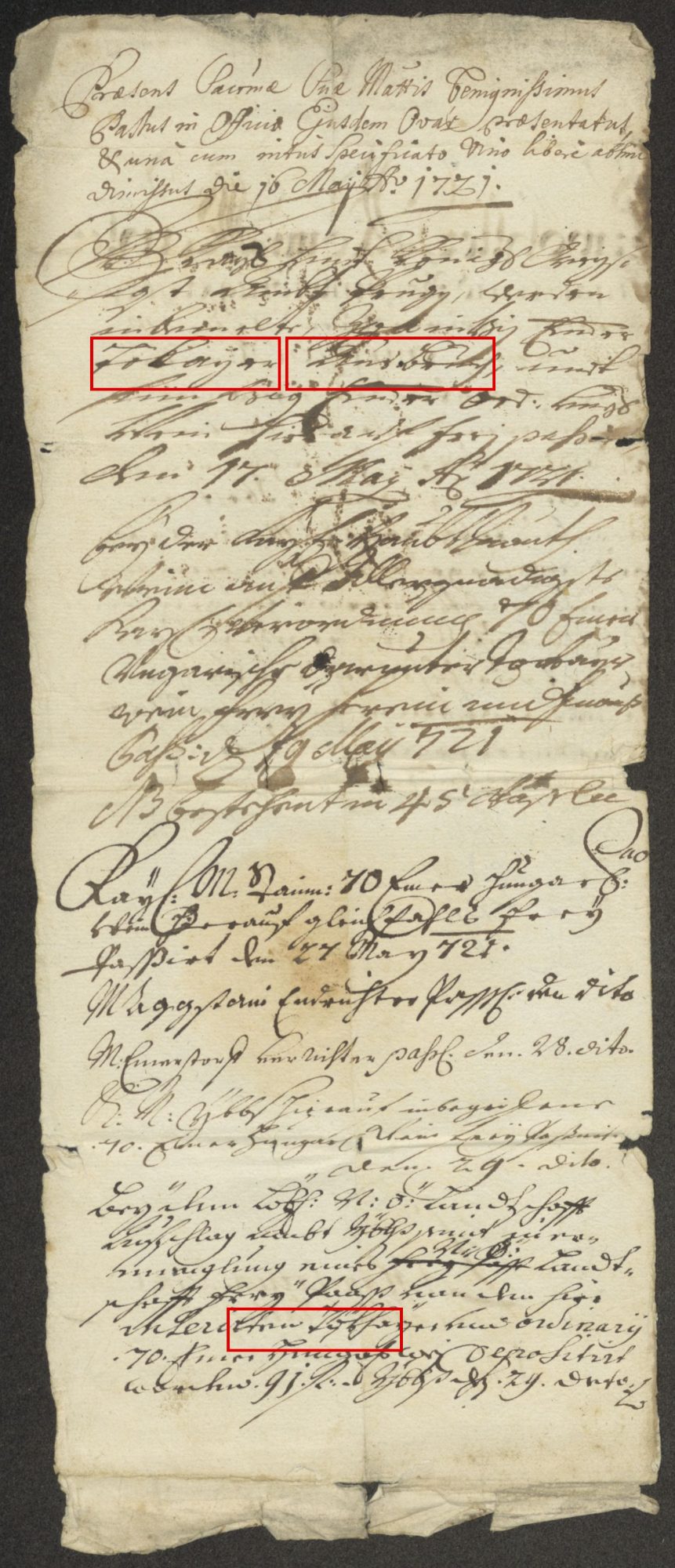
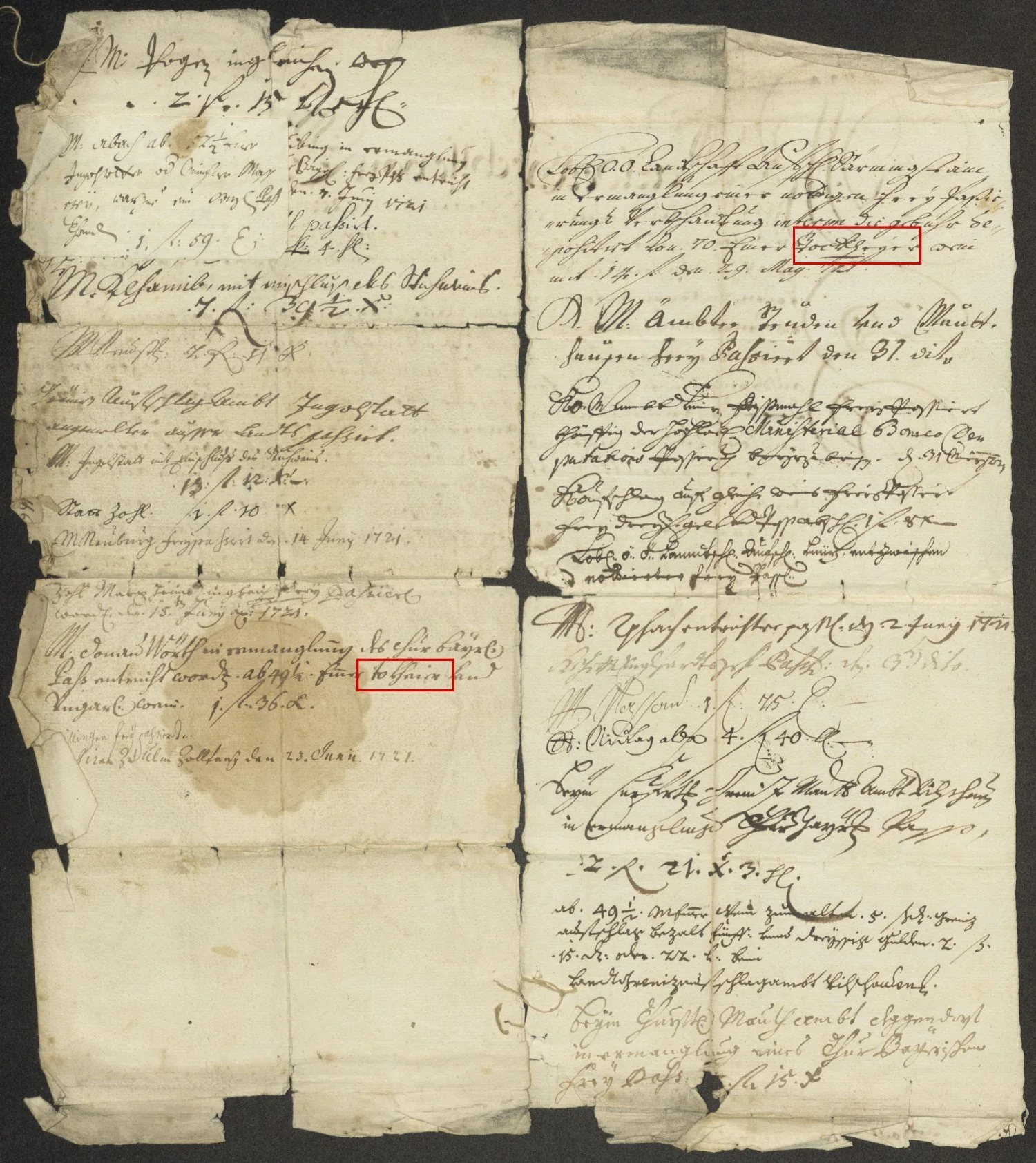
The back of the sheet records what the order was actually worth. The Hungarian and Lower Austrian imperial tolls pass the wine frey; but the provincial excise offices make the carrier deposit the duty anyway — 91 florins in Lower Austria, 14 at Sarmingstein — in Ermanglung einer Frey-Passirungs-Verschreibung, for want of the right piece of paper. From Passau on, in the prince-bishopric and in Bavaria, the transport pays at every single station, expressly in Ermanglung eines Chur-Bayrischen Paß. The Emperor could command his own toll-keepers, not the estates and not the Elector of Bavaria: the Württemberg court would have needed three passes.
Left, the slip carrying the Hungarian and Lower Austrian visas — Magyaróvár on 16 May, then Tokayer Ausbruch passed free on 17 May, Nußdorf on 27 May, and the Lower Austrian excise office taking 91 fl. on deposit. Centre, the verso with the Bavarian stations and the final entry Visirt zu Ulm Zollhauß den 23. Junii 1721. Right, the fragment of a second pass, for twenty Eimer of Tokheyer and Ödenburg growth. Click any image to enlarge.
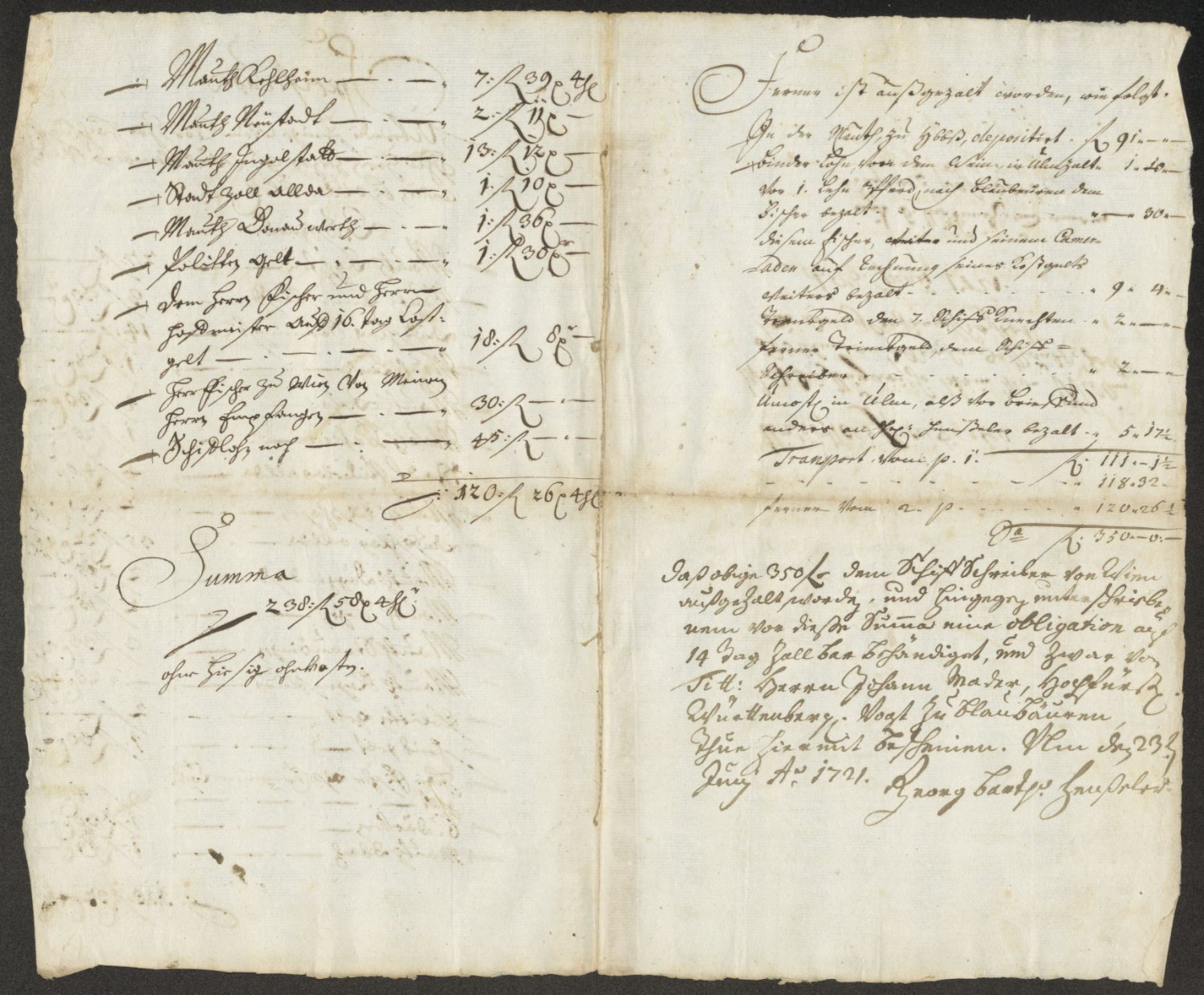
The visa entries trace the journey up the Danube — Magyaróvár on 16 May, Nußdorf on 27 May, Ybbs and Sarmingstein on 29 May, Passau on 3 June, Straubing on 7 June, Neuburg on 14 June, and finally «Visirt zu Ulm Zollhauß den 23. Junii 1721»: five weeks and some nine hundred river kilometres, then by waggon from Ulm to Ludwigsburg. A separate cost sheet in the same file totals 238 fl. 58 x in tolls, and 350 fl. with the boatmen, board and tips, against 2,925 fl. for the wine itself — twelve per cent of the value spent on getting it there. For twenty Eimer of Ausbruch a German court troubled the Emperor personally.
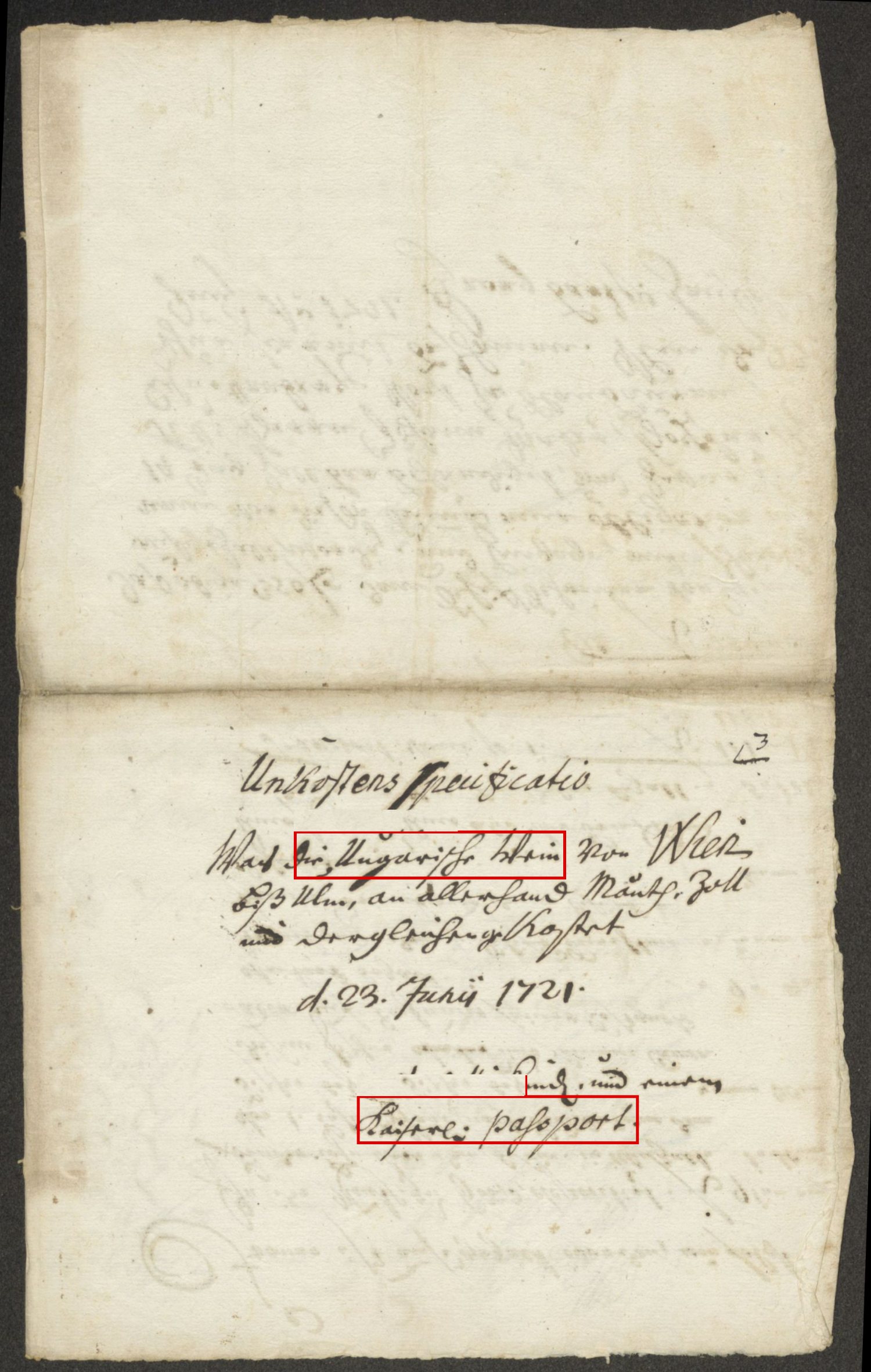
Left, the toll list — Kelheim, Neustadt, Ingolstadt, Donauwörth, the boatmen’s wages — Summa 238 fl. 58 x 4 h, and beside it the Ulm settlement of 350 fl. against a fourteen-day bill. Right, the file title: what the Hungarian wine cost from Vienna to Ulm, 23 June 1721, with five vouchers und einem Kayserl. Passport. Click either image to enlarge.
Source: Hauptstaatsarchiv Stuttgart, A 21 Bü 474 — original on paper, folded, rubbed through at the fold crossings with some loss of text, with the imperial seal, the Emperor’s signature and the counter-signature of a Hofkammer official. The word Aszú does not occur in the 1721 papers; the German sources say Ausbruch.
In 1825 the French press reported an «prix extraordinaire des vins de Tokai» when the Austrian Emperor purchased 2,000 bottles of old Tokay in Kraków at seven ducats a bottle — for onward shipment to Louis Bonaparte, Napoleon's brother and former King of Holland. Old Tokay bought at auction in Poland and sent to a Bonaparte by a Habsburg: the wine crossed political lines more easily than anyone in it did.
Tokay was also exposed to politics, and sometimes it was the weapon. Maria Theresa's economic council tried to prop up Austrian growers with a decree permitting the export of Hungarian wine only if an equal quantity of Austrian wine was exported with it. When Austria imposed heavy duties on Silesian goods, Frederick the Great — himself a serious Tokaji drinker — raised his own tariffs on Hungarian wine in reply. And as obstruction of the Russian wine-purchasing company in Tokaj increased, Tsar Paul I closed it in 1798 — though the Emperor did permit the Russians to buy vines and plant them at home, which is how Hegyalja stock reached Massandra in the Crimea.
Twice in the record Tokay stops being a luxury and becomes money. On the day the general Andreas Hadik raided Berlin in October 1757, a Prussian minister sent him Tokay from his own cellar with a letter asking that his property be spared — the letter is on the Documents page. The second time is 1918, and it is in the chapter above.
1740 — 1980s
Medicine, for people and animals
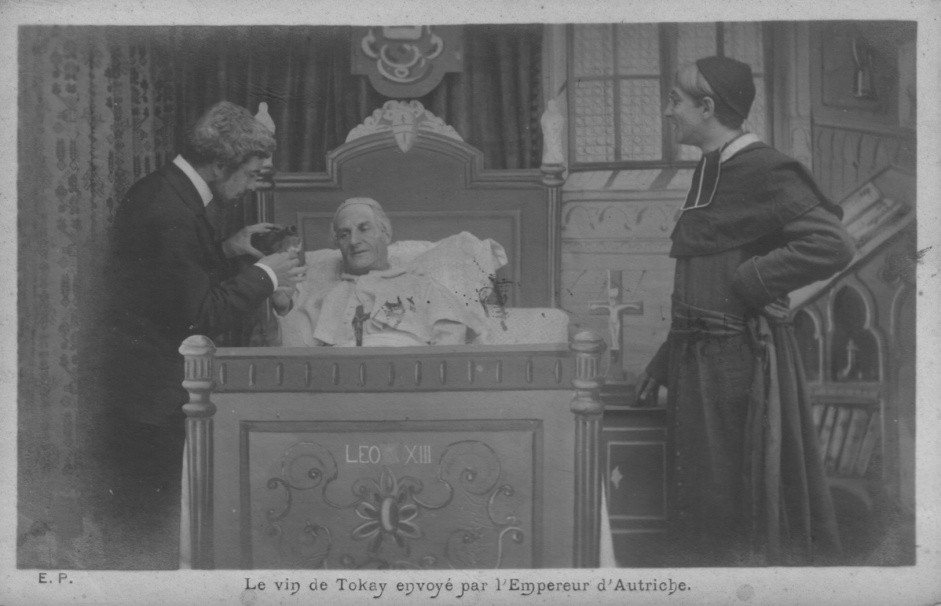
Leo XIII on his sickbed. The contemporary print is captioned as the Tokay wine sent by the Emperor of Austria.
Imperial Tokay was not only a luxury. In Vienna it was, formally and for a very long time, a medicine — and to my mind the paperwork shows it more convincingly than the anecdotes do. Tokay was sent to sick kings, emperors and popes; in 1912 Franz Joseph sent twelve bottles of Aszú to the ailing Meiji Tenno of Japan. Maria Theresa's physician Gerard van Swieten advised her to drink Tokay daily. In the cellar accounts of her father Charles VI there were two barrels of Tokaji a year for the court’s parrots. And the practice long outlived the empire: the old Court Pharmacy in Vienna, now gone, was still offering medicinal Tokay in the 1980s.
The Austrian Military Pharmacopoeia (Vienna, 1861) states the case in the flat prose of an official manual: the most celebrated among the Hungarian wines is the Tokayer; it approaches Canary sect in taste, is white, very spirituous, keeps well, and is for the most part prepared as Ausbruch.
Two barrels a year, for soaking the parrots’ bread
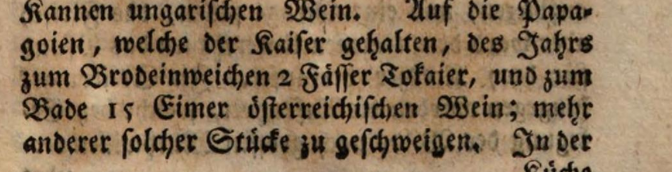
The parrots are not an anecdote; they are an audit finding. When Maria Theresa came to the throne she had the existing accounts examined, and a history of her reign published at Frankfurt and Leipzig in 1759 sets out, under the heading Oekonomie, what the cellar accounts had been carrying: a lady of the court, six Kannen of wine a day; five chamberlains, when they had been out hunting with the Emperor, one Eimer of Austrian wine between them; the widowed Empress Amalia Wilhelmina, twelve Kannen of Hungarian wine every evening as a sleeping draught. Then the birds. For the parrots the Emperor kept, two casks of Tokaji a year to soak their bread in, and fifteen Eimer of Austrian wine for their baths — and the writer adds that other items of the same kind are passed over in silence.
The sentence itself.«Auf die Papagoien, welche der Kaiser gehalten, des Jahrs zum Brodeinweichen 2 Fässer Tokaier, und zum Bade 15 Eimer österreichischen Wein; mehr anderer solcher Stücke zu geschweigen.» From Triumph der Tugend auf dem Thron in der Geschichte der Allerdurchlauchtigsten Maria Theresia, Frankfurt and Leipzig 1759, § 9 Oekonomie, p. 47. Public domain.
How the medicinal trade actually worked — a letter of 30 June 1889
On printed stationery reading «ERN. STEIN, WINE GROWER IN ERDÖ-BÉNYE NEAR TOKAY (HUNGARY)», a Hegyalja producer writes from his newly opened New York branch to a Philadelphia wholesaler, underlining his own product category — Dessert & Medicinal Tokay-Wines:
“I should be very glad to place at your disposition sample bottles in sufficient quantity for the distribution among the principal physicians of your city, as their recommendation is of importance in regard to the medical use of our wines.”
Ern. Stein of Erdőbénye to T. W. Derousse, Philadelphia — New York, 30 June 1889
Medicinal Tokaji was not a folk survival that happened to get printed on a label. It was a distribution strategy, executed through physicians — which is why the pharmacopoeia wording appears on the labels at all.
1672 — 1750
Artefacts: the gold legend in the treasuries
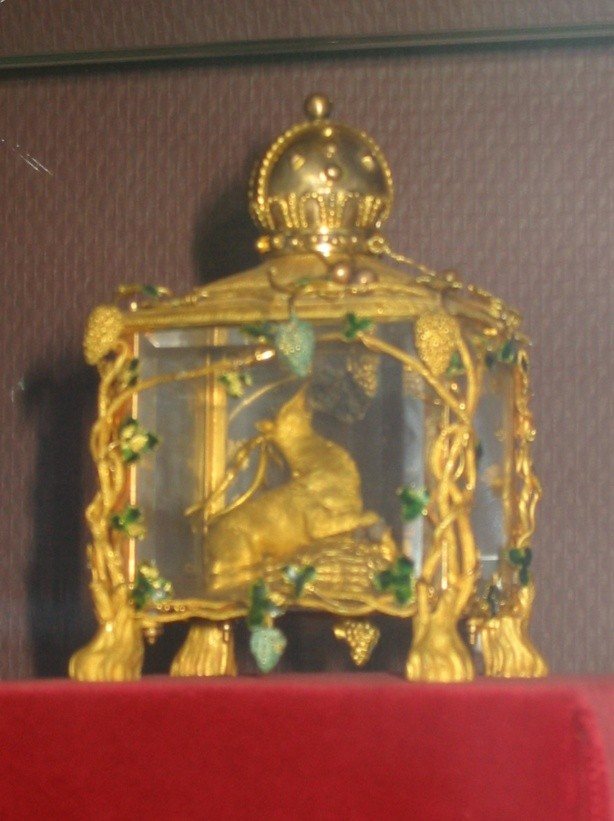
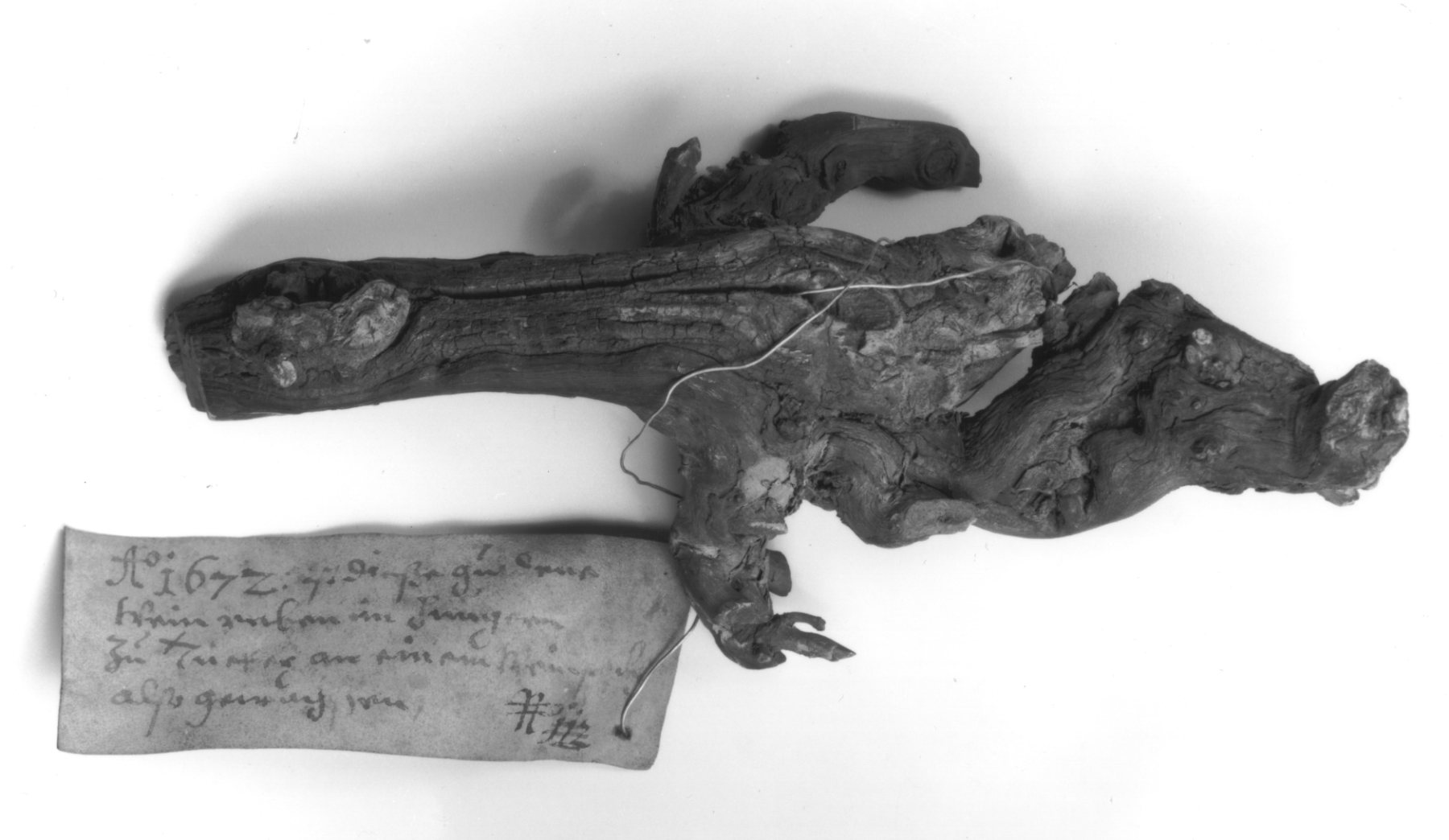
Tokaj has a persistent legend that gold grows in its vineyards — gold wire on the vine stock, gold grains among the roots of the Szarvas. Most legends of this kind leave no trace. This one is in the Habsburg treasury inventories, twice, and one of the objects still exists.
The belief is older than most of the bottles on this site. Vine shoots and roots said to carry threads of gold were collected, drawn, sent to princely courts and discussed in print from the sixteenth into the eighteenth century.
It is also the reason Paracelsus is placed in the wine region in the 1520s, shown a split vine shoot with golden threads in it by his host at Tállya. That attribution does not survive scrutiny: the passage comes from an anonymous hermetic tract of 1771 and was assigned to Paracelsus only in 1928 (see Medicinal Wine). The belief in the golden vines needs no Paracelsus. It ran its course on its own, and ended in a laboratory: in 1779 Maria Theresa had a supposed golden grape cluster from the hills of Mád examined at the university of Vienna.
The golden deer, Hungarian National Museum. A cut-glass box with gold columns, enamelled grapes and the Hungarian crown on the lid; inside, a golden deer holding an aszú berry and gold grains said to be from the Szarvas vineyard. Maria Theresa handed it to the Treasure Chamber on 6 February 1749.The vine stock, Kunsthistorisches Museum, Vienna. A 1750 Treasure Chamber inventory lists a golden wire found on a vine in Tokaj weighing eleven ducats, and a piece of the stock from which such wire grows, found in 1672 according to the handwritten tag.
Chapter four
The Imperial Tokaji in Literature & Arts
Everything in this chapter has a direct link to the Vienna cellar. Works that merely name Tokaji, or use the phrase Imperial Tokay without reference to the imperial cellars, belong elsewhere on this site.
1747 — 1910
A literary topos: the Emperor's cellar as the ultimate source
The cellars of the Austrian emperors as the ultimate source of the best Tokaji were legendary — and the legend is older and more widely shared than any single work. It is what the writers below are all borrowing.
Its earliest statement is not fiction at all but a reference work. Johann Heinrich Zedler's Universal-Lexikon of 1747, explaining why Tokay is so hard to obtain, notes that the tables of all the neighbouring potentates and above all the Polish magnates want to be abundantly supplied with it — and then adds the decisive clause: the imperial court cellar takes the best Tokay for itself first. The topos was in an encyclopaedia before it was in a novel.
Gottfried August Bürger builds the central episode of his Münchhausen on it — see the article below.
Alexandre Dumas, Joseph Balsamo — Louis XV is genuinely indignant that anyone other than himself should possess Tokaji from the Habsburg cellars. The wine's scarcity is used to characterise a king's vanity.
Karl May invokes the same cellars, and Arthur Conan Doyle praised Tokaji repeatedly in his work — plausibly connected to his schooldays at the Jesuit college Stella Matutina at Feldkirch in Austria.
Josef Lippert, delicatessen and wine merchant in Prague, ran a full-page newspaper advertisement in 1910 offering «Tokayer aus dem k. u. k. Hofkeller». By then the topos had become a selling line — and, as chapter two shows, a truthful one.
Read together, these are not four literary curiosities. They are evidence that for a century and a half the phrase from the Emperor's cellar functioned across Europe as the highest available claim about a wine, in fiction, in reference books and in trade advertising alike.
1786 — 2005
Münchhausen: a bottle fetched from the imperial cellar in one hour
The most consequential appearance of the Vienna cellar in world literature, and the one place where it is not scenery but plot. In Bürger's Münchhausen the Sultan produces his last flask of Tokay in a private cabinet; Münchhausen tastes it, allows that it is decent, and remarks that he drank far better in Vienna under the late Emperor Charles VI. The Sultan refuses to believe any Tokay could be better. Münchhausen wagers that he will have a bottle brought straight from the imperial cellar in Vienna within the hour — and his running footman does it.
Two details are worth holding on to. The wager only works as a story because the audience already accepted that the imperial cellar held the best Tokay in existence — so the tale is itself evidence of the reputation documented in chapters one and two. And the wine is named to an emperor: not Vienna in general but the cellar of Charles VI, in whose cellar books, as chapter three notes, two barrels stood reserved for the court's parrots.
The motif survived every retelling, because the cellar is the one thing in it that cannot be substituted.
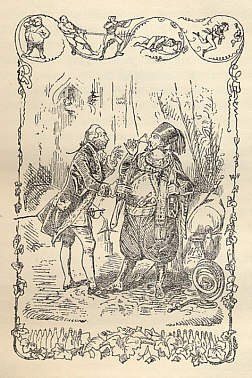
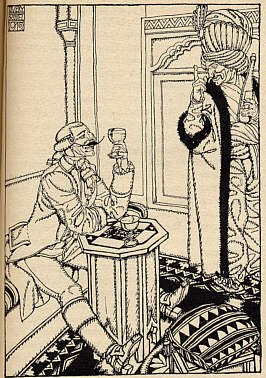
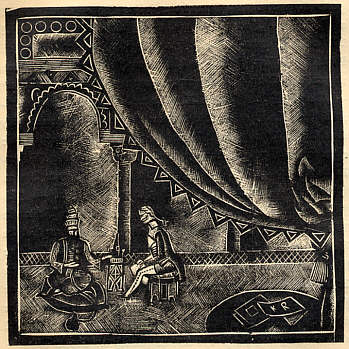
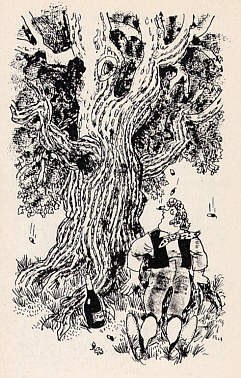
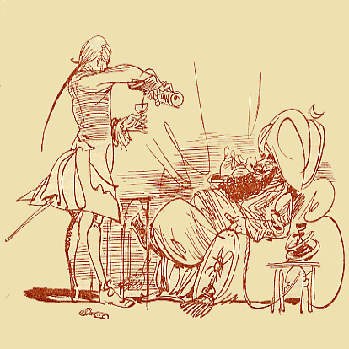
Book illustrations across a century of editions put a bottle labelled Tok… in the Baron's hand — flying on a cannonball with it, or presenting it to the Sultan.
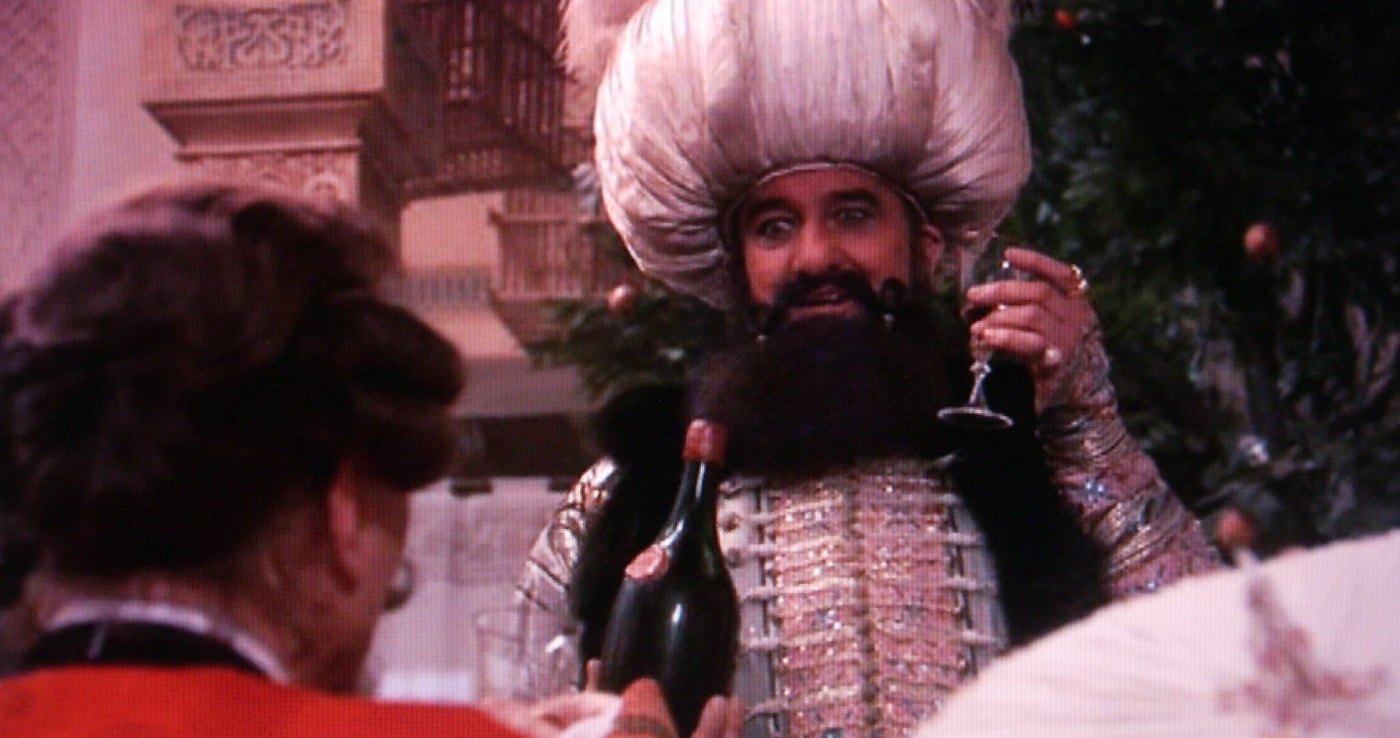
The UFA film, Germany 1943, directed by Josef von Báky, with Hans Albers as Münchhausen and Leo Slezak as the Sultan. The screenplay is by Erich Kästner, who — banned from publishing — could only be credited under the pseudonym Berthold Bürger. His version keeps the hour, the courier and the cellar, and ends with the Sultan conceding the bet.
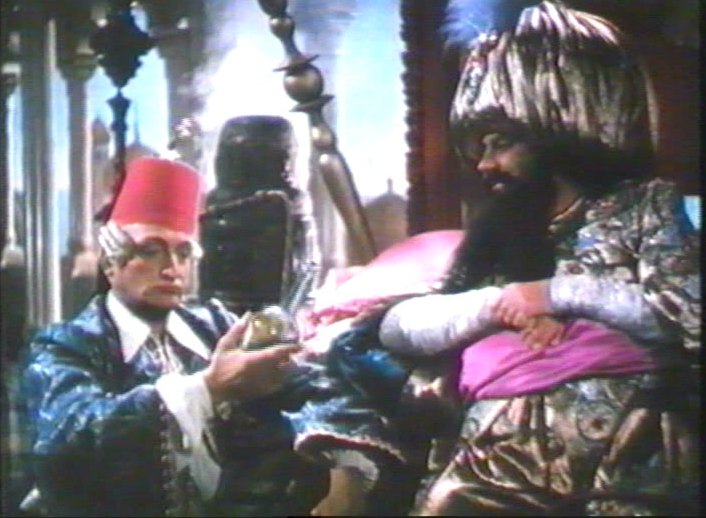
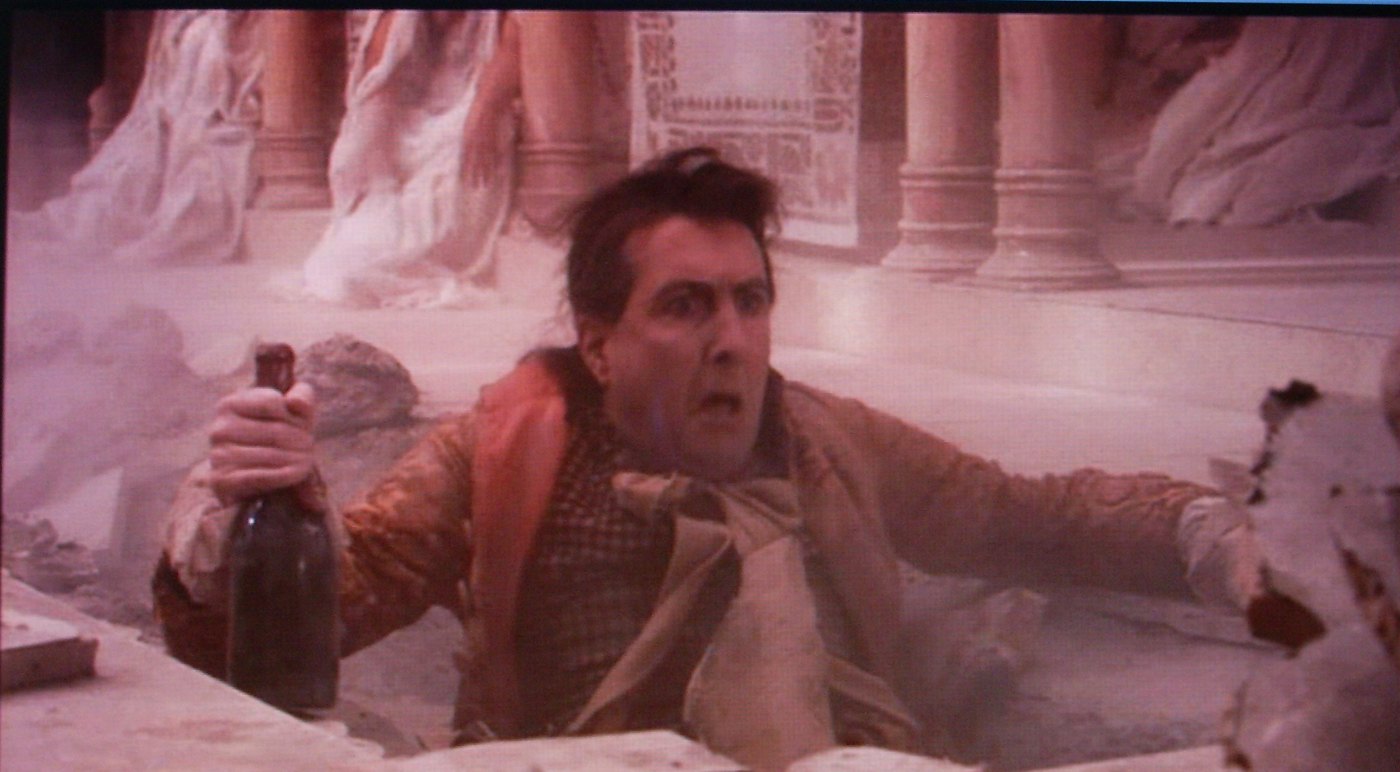
Terry Gilliam's The Adventures of Baron Munchausen (1988), with John Neville and Peter Jeffrey.
A comic opera, Münchhausen – Herr der Lügen, music by Dan Dediu, libretto by Holger Siemann. The Baron spits out what he is offered and objects that at the court in Vienna they drink the better sorts; then he sends a messenger to the Emperor, promising the wine within the hour. The oldest form of the joke, still turning on the same cellar.
One episode, five hands. Illustrators return to the same four beats: the wager in the cabinet, the Sultan tasting, the runner asleep under the oak with the bottle at his side, and the shot that wakes him in time. The bottle is drawn as a bottle in every version — the cellar it came from is the only thing that has to be imagined.
The wager on film, 1943 and 1988. Hans Albers and Leo Slezak in Josef von Báky's UFA production; then Gilliam's Sultan with glass and bottle, and John Neville's Baron still holding the bottle. Frame captures from DVD.
To settle before publication
Each illustration needs its edition, illustrator and year in the caption, and the twentieth-century ones need a rights check. The two film stills are frame captures and need clearance as well.
1936 — 2008
Lord Dunsany: a wine uncorked only by imperial command
In My Talks with Dean Spanley a whole plot rests on the cellar's reputation. The narrator has borrowed half a dozen bottles of a wine which, he explains, until recently was uncorked only at the command of the Emperors of Austria — and he uses it quite deliberately to carry the Dean past his usual limit, since his enquiries would have been impossible without it.
The device only works because the reader grants that such a wine both exists and cannot be bought. Filmed in 2008 with Peter O'Toole; the first edition carries an illustration of the scene.
1957 — 1970
Film: Sissi, Maria Theresa's coronation wine, and the cellar as a set
«Er ist zu feurig!» — «Ganz alter Jahrgang.»
Sissi — Schicksalsjahre einer Kaiserin, 1957
Sissi — Schicksalsjahre einer Kaiserin (1957). Romy Schneider, as Queen of Hungary, tells Count Andrássy that perhaps it was his Tokay that went to her head, and objects that it is too fiery. Andrássy's answer is the whole subject of this website in three words: a very old vintage. The exchange goes on to trade the wine for a confession — the Tokay is what licenses the Count to say more than protocol permits.
Frau Wirtin treibt es jetzt noch toller (1970, dir. Franz Antel) — Maria Theresa's coronation Tokay of 1740, in painted casks, tapped and then carried off on horseback. A specific imperial vintage used as a plot object.
Mayerling (1967), with Omar Sharif and Catherine Deneuve — filmed, as chapter one records, in the Imperial Cellar itself. The cellar's last official role was to play a cellar.
1920 — 1925
The Vienna stage, and one manuscript that was never played
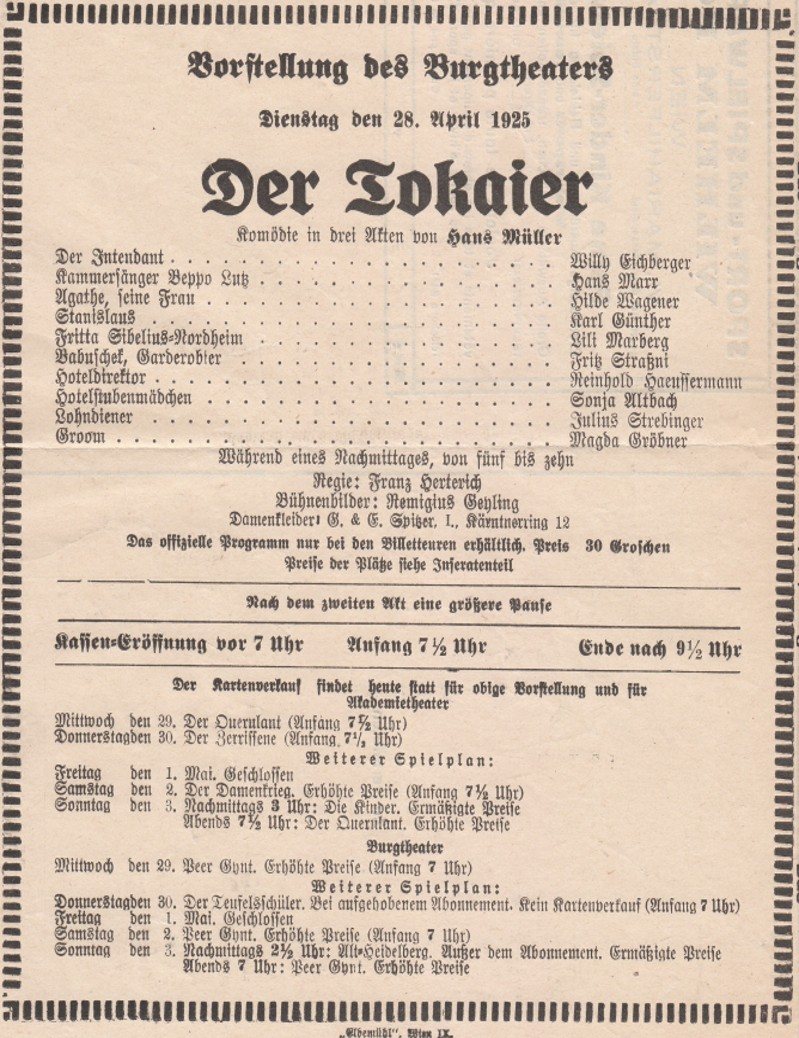
A comedy in three acts by Hans Müller, Der Tokaier, was played at the Vienna Burgtheater on Tuesday 28 April 1925, directed by Franz Herterich. The playbill survives, cast and all. The house matters here: until 1918 it was the k. k. Hofburgtheater, the court theatre — the wine of the Hofkeller named in the title of a play on the imperial stage, seven years after the court had gone.
Beside it sits something rarer: a musical manuscript by G. Robecker and Carl Treumann, Ein Gläschen Tokayer, from around 1920, held in the Wienbibliothek and never performed, its title page stamped as the property of the director Carl Blasel. Inside, in Kurrentschrift, a widow's verse about a bottle kept for decades against a golden wedding that will now not happen, and a toast drunk instead to the years to come. It is the only item in this corpus where very old Tokaji is the subject rather than the ornament.
Burgtheater, 28 April 1925. The playbill for Der Tokaier.