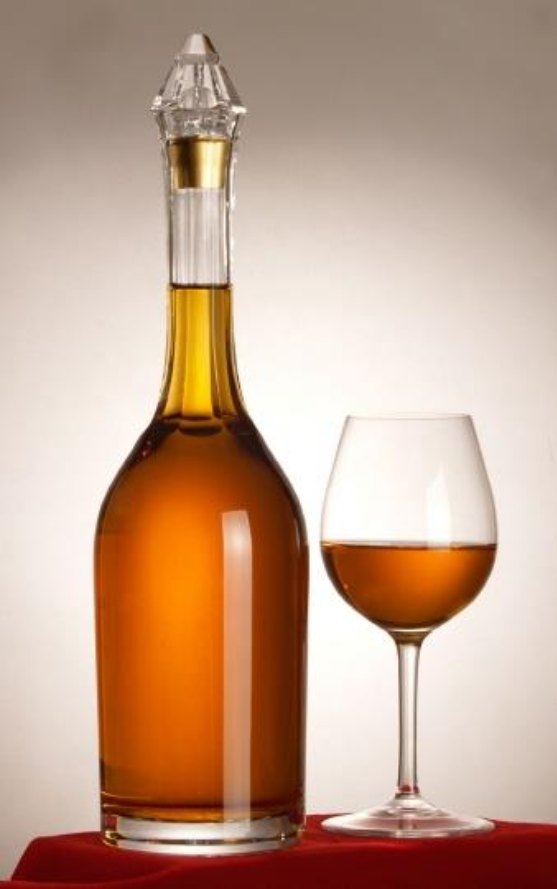
Occasionally old Tokaji bottles are opened and tasted, and a surprisingly high number of the wines is not only drinkable and enjoyable but of excellent quality. This page gathers what is known about why — the observations, the cellar practices behind them, and the published research.
Start
Why old tokaji wine is still alive after three centuriesThe aging of Tokaji
What keeps very old Tokaji drinkable, what the cellars did right, and what the research so far can and cannot explain.
In preparation
The unexplained mystery
Why is old Tokaji drinkable after three hundred years, when almost all other wines fail to be so after thirty?
There are certainly other wines that age in grace. Tokaji is the most striking example of exceptional longevity, not the only one — but to me the gap between it and the rest looks large enough to need explaining rather than admiring.
The usual answer, and why it is incomplete
Most scholars and experts would attribute the longevity to high sugar content, to high acidity, to high alcohol, or to some combination of the three. As far as I can see, the alcohol argument does not survive contact with the wine. Natural alcohol in Tokaji rarely exceeds 14%, the range of a typical white wine, and Eszencia — the category most famous for longevity — typically sits below 6%. Cases of added alcohol have been known, but most old bottles tasted by professionals showed no unusual alcohol level. Fortifying Tokaji with alcohol has never been a common practice in the wine region.
That leaves sugar and acidity. Sugar seems to me a reasonable candidate. Honey is microbiologically very stable at high sugar concentration, and to a layman it seems likely that the same principle applies here. But I do not think it finishes the argument: why are other, similarly sweet wines not equally known for holding quality over centuries? My own guess is that sugar may be necessary without being sufficient.
Which is why acidity is, in my humble opinion, the strongest of the three. Sweet Tokaji can reach up to four times the acidity level of other white wines — an order of difference that neither sugar nor alcohol shows — and it is the one factor that plausibly separates Tokaji from other sweet wines rather than grouping it with them. If I had to bet on where the answer lies, I would bet there, in combination with sugar. That is a collector’s hunch, not a finding, and it is where the question begins.
The house view
The Fukier recipe
How did the ultimate masters of Tokaji ageing — the Fukier house in Warsaw — answer the question themselves?
In his publications and interviews Henryk Fukier never gives a chemical or technical explanation. He explains it entirely in terms of vintage and care, which is how the old trade thought about it.
That holds for what he published in his lifetime. His memoir Wspomnienia staromiejskie, printed in 1973, fourteen years after his death, is a different matter. It is still silent on chemistry, but it is exact about practice — and on one point, the corking, it describes a mechanism plainly enough that it can be argued with. Everything in the next two sections comes from it.
The great year
Two things he says bear on it. The first is the vintage: “centuries of experience tell us that the best vintages arise when the vine flowers during rain and ripens in sunny weather”, and it was precisely those exceptionally successful years — 1606, 1764, 1811, 1848, 1866 — that, in his words, “improved greatly in quality through lying”. So longevity, as I read him, is not a property of Tokaji as such but of particular harvests: only the great years have the constitution to keep improving, and those are the ones that survived in the Hetman’s cellar.
The cellarman’s hand
The second is the raising. The whole argument turns on the old Polish formula he quotes, that the wine was “born in Hungary and raised in Poland” — na Węgrzech urodzone, a w Polsce wychowane. In the trade’s Latin, „Hungariae natum, Polonia educatum“. The credit for the age goes to the centuries of cellar tending on the Warsaw side — the same claim the 1954 anonymous tasting was staged to vindicate for the state cellars.
On the lees, in cask
The only hard evidence about method comes from the purchase ledger (APW, Zbiór Fukierów, sygn. 7), published in Kurczewski’s Teofil Fukier i jego winiarnia. Hungarian wines from Jan Lacko of Gniazda (1837–1864) and Emanuel Teitelbaum of Abaújszántó (from 1864) were graded by number, 1 to 5. The cheaper no. 2 casks were often marked bez lagru, while the dearer, older, higher-numbered casks contained lagier, “whose presence Polish wine merchants regarded as favourable to the ageing of Hungarian wines” (którego obecność polscy winiarze uważali za sprzyjającą starzeniu win węgierskich, p. 139). That is, as far as I can see, the closest thing to a stated theory of ageing in the whole paper: keep the wine on its lees, in cask, in the cellar.
The two terms are worth unpacking, because the whole method turns on them. Lagier (from German Lager, a bed or store) is the post-fermentation deposit — the sediment of dead yeast, precipitated tartrates and grape solids that settles at the bottom of a cask once fermentation has finished; in English cellar language, the lees. Bez lagru is simply “without lagier”: wine that had been racked clear of its deposit before sale. A cask sold z lagrem, with the deposit, travelled with its lees still in it.
The commercial logic seems to me the reverse of what a modern buyer might expect. Clear wine is easier to move, to draw and to sell at once, so bez lagru was the cheap option — the no. 2 casks. Wine on its lees is cloudy, heavier to handle and needs time before it can be touched, which is exactly why the Warsaw trade paid more for it: the lees were understood to carry the wine forward. Modern oenology gives that intuition a mechanism — yeast lees consume dissolved oxygen, release mannoproteins and glutathione, and buffer a wine against oxidation — but no such explanation appears in the ledger. What appears is a price difference, which strikes me as the firmest kind of evidence available about what the trade believed.
A second Kurczewski paper, on Florian’s winiarnia, names the operation itself. Florian’s purchase book records Hungarian wines marked naprawne. The word is the plural adjective from Polish naprawa, repair — literally “repaired” or “mended” wines, in the trade sense of a cask that has been put right rather than one that was good to begin with. Kurczewski glosses the entries as “probably improved by racking onto the deposit, the so-called lagier, left by a better wine” (n. 30, p. 18). Two things are worth keeping in view. It is a ledger term, written by the buyer to describe what had been done to a cask before he bought it, not a legal category or a style; and it is not a euphemism for adulteration — the operation it names is the one the same book prices at a premium, since the dearer casks were the ones carrying lees. That, as far as the documents allow me to judge, is the Polish method behind Poloniae educatum: a lesser cask racked onto the lees of a superior one. Tokaj used the same principle under another name — maszlasz was made by re-soaking pressed aszú pomace with wine, and the word was also applied to wine improved by ageing on the deposit left by aszú wine (n. 27). So the lees vocabulary does not look to me like a later refinement: it is there in the 1800s and 1830s, and the firm was buying wine already treated that way.
The same book settles where the ageing happened. Florian bought young wine — one or two years old, twice from the harvest just finished — and almost never anything over ten years; the oldest cask he ever bought was an 1788 at 21 years. The famous old wines were raised in the Warsaw cellars from young stock, which I take to be the documentary substance behind the motto, and firmer than anything Henryk Fukier ever said about it. The purchase entries are set out on the Fukier cellar page.
The second technique comes from a visitor rather than the firm: refreshing. Julian Wieniawski’s account of a visit in 1874 (published 1918, reproduced on blog.czajkus.com) records that the oldest wines could hardly be drunk on their own any more, “but one improves less old wines with them” (poprawia się nimi wina mniej stare). So the historic bottles seem to have functioned partly as a blending reserve: which would mean the great age was maintained by moving between vintages rather than by leaving bottles untouched for two centuries. That fits the 1954 admission in Świat that the aged Tokaj “received its careful upbringing in Poland” — pielęgnacja meant active cellar work rather than passive storage — the word is explained under „Poloniae educatum“ tested.
The corking rule
This is the most technically useful paragraph Fukier ever wrote, and it is the opposite of a secret. Tokaji laid down for long ageing was not sealed. It was half-corked with a tapered cork, for years, and waxed only at the very end.
„Toteż przeznaczone na odstarzenie tokaje przez długie lata przykorkowane są jedynie do połowy spiczastym korkiem, aby nabierały bukietu. Lakuje się je dopiero w ostatniej fazie dojrzałej starości, pamiętając przy tym, że płyn ma sięgać zawsze do połowy szyjki w butelce.”
“Tokajis destined for long ageing are therefore, for many years, only half-corked with a tapered cork, so that they take on bouquet. They are waxed only in the final phase of ripe old age, remembering that the liquid must always reach halfway up the neck of the bottle.”
Wspomnienia staromiejskie, p. 81
His reason is given in one clause: the wines “still do not lose contact with the air, they still want to breathe”. Elsewhere the bottles on the shelves are described simply as lekko zakorkowane, lightly corked (p. 87). So the deliberate policy for the oldest stock was slow, controlled air ingress through a cork that was never fully seated, with the fill level in the neck as the gauge, and an airtight wax seal applied only once the wine was judged finished. That is a mechanism, it is stated flatly, and it explains the upright storage far better than the secret fluid does: a bottle half-corked and standing up has its air pocket where the cork is, and no wine against the cork to rot it.
Two further practices belong with it. The finest Tokajis were held in cask six to eight years before bottling, “so as to take on bouquet, body, szkło, and then to age for decades in lightly corked bottles” (p. 87) — so the bottle was the second stage of maturation, not the first. And ancient bottles were re-corked after inspection: each of the 1606 bottles sent to Budapest in 1916 was na nowo przekorkowanej po sprawdzeniu, re-corked afresh after checking (p. 96).
He also gives the attrition rate, which no other source does. To find three bottles of the 1606 still faultless and nie zamarłe — not dead — for that despatch, he had to open seven (p. 96). Better than half the oldest wine in the cellar was gone by 1916, in a cellar that was being actively worked. Any estimate of how much drinkable seventeenth-century Tokaji existed at any date has to be discounted accordingly.
Three words from the trade
Myszka — the popular Polish name for the bouquet of an old wine (p. 81).
Szkło, “glass” — the smoothness, clarity and harmonising of the shades of taste that a wine acquires with age (p. 81). It is what the six to eight years in cask were for.
Obrączka — the ring of wine-stone deposited inside the neck, read against the light together with the sediment to judge a bottle’s age. In Tokaji the ring takes decades to form; in red wines stone and sediment appear far sooner (pp. 83, 92).
“The bigger the cask, the worse the wine kept in it”
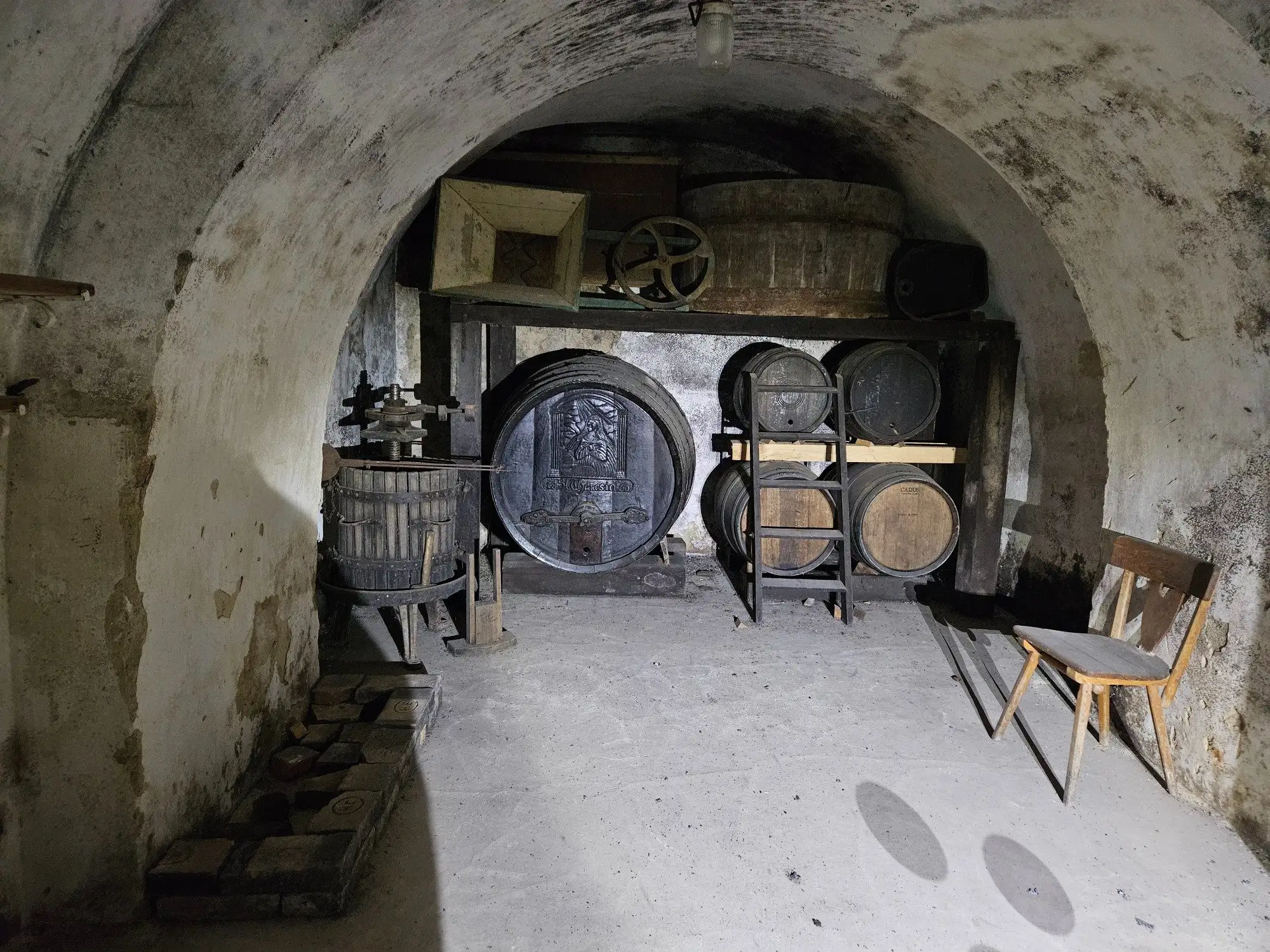
Stated as a flat rule (p. 80). A cask breathes and gives much from its own wood, creating its own atmosphere, so the same wine from the same vineyard takes a different taste in different barrels — which is what the trade meant by a “good cask”. Oak is the best wood, for the tannin it gives; where good oak was scarce, chips were added to obtain a dębak, the oak character (p. 79). Small casks were stacked one on another. He was an avowed opponent of the modern cistern, which he granted was practical and gave purity, but which “gives nothing to the wine”.
| Vessel | Capacity | Use |
|---|---|---|
| Tokajka | 180–360 l | All Hegyalja wines were matured in these |
| Okseft (oxhoft) | 220 l | The standard cask for better French wines; about 314 bottles of 0.7 l |
| Pippa | c. 300 l | Spanish wines |
Upright bottles and the secret fluid, 1934
The most detailed account of how the cellar was actually managed does not come from the Fukiers at all. It was published in November 1934 in Borászati Lapok (LXVI/47, pp. 395–396) by János Bókay jr., reprinted from Budapesti Hírlap, after an evening spent in the cellar with engineer Krzemiński, who had bought the cellar, the building and the restaurant at auction from the ruined Fukier family some six years earlier. Everything below is Krzemiński speaking, not the house — which matters, because it is precisely the kind of technical explanation Henryk Fukier never gave.
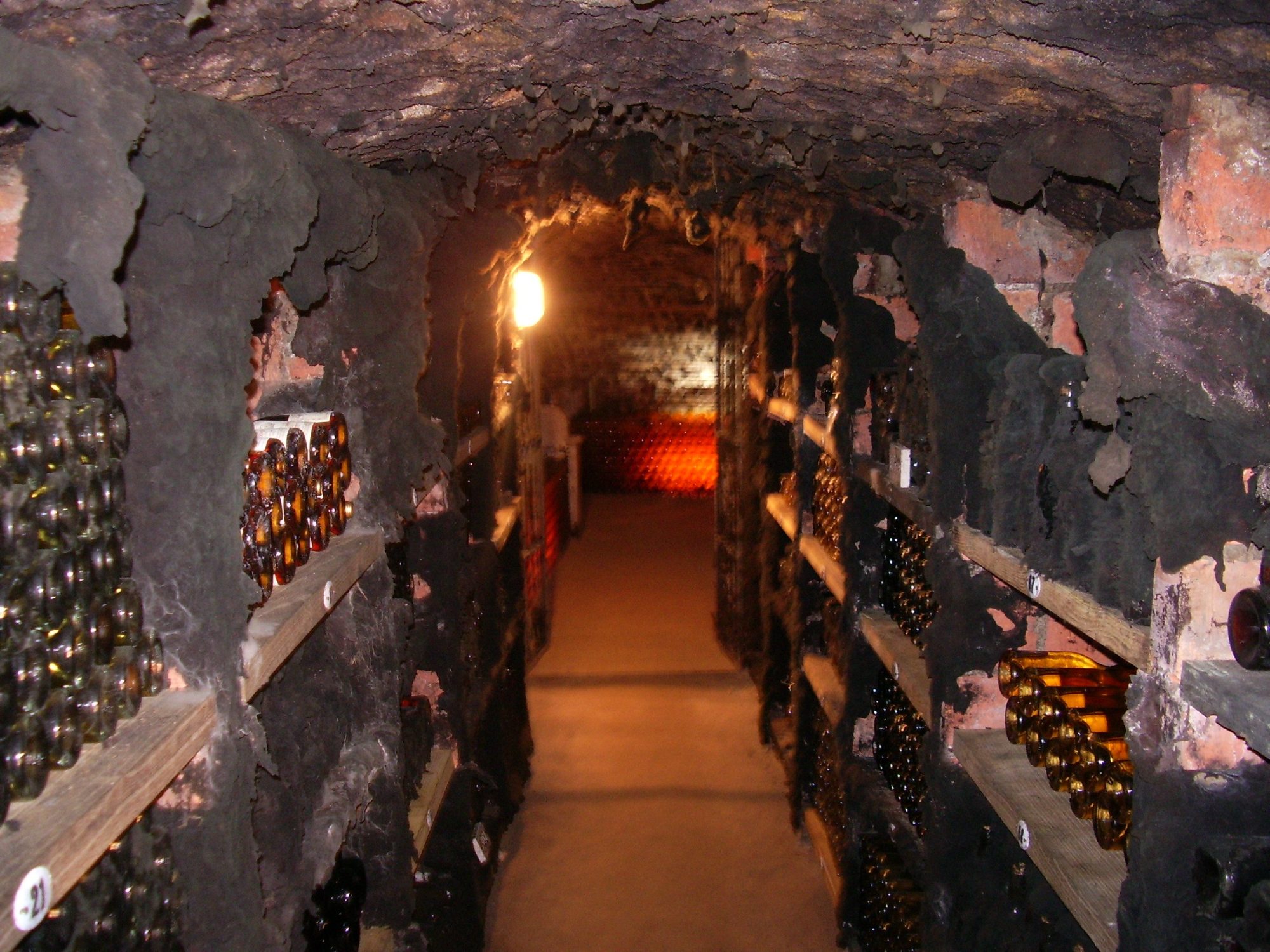
Bókay’s first surprise on the cellar stairs was that the bottles stood upright on the shelves rather than lying down, caked with tartar and cellar dirt up to the neck. Krzemiński read the thought and answered it: “Tokaji defies time only standing up — your wines do not survive because you lay them down. The rotting of the cork inevitably ruins the wine. And that little bit of air pressed in between the wine and the cork is needed for the wine to ennoble itself.” Then he quoted the motto, Nullum vinum nisi hungaricum, Hungariae natum, Poloniae educatum.
The second claim is the six-year recorking: “Every six years we change the corks, and we do it by dipping the new cork in a fluid of particular chemical composition and stoppering the wine with that. The composition of the fluid is unknown in the world, it is the jealously guarded secret of the Fukier family; it passes from father to son on the deathbed. Only a cork prepared this way protects the wine — that is the explanation of why only we have three-hundred-year-old Tokaji.” The operation was carried out by the head of the firm in person; the last round, he said, he had done himself. Even so, “one or two bottles always die every six years”, so every cork change doubled as an inspection — the smell, he told Bókay, shows in the first moment whether the wine is alive or dead. He added that a four-hundred-year-old family law excommunicated anyone who falsified wine.
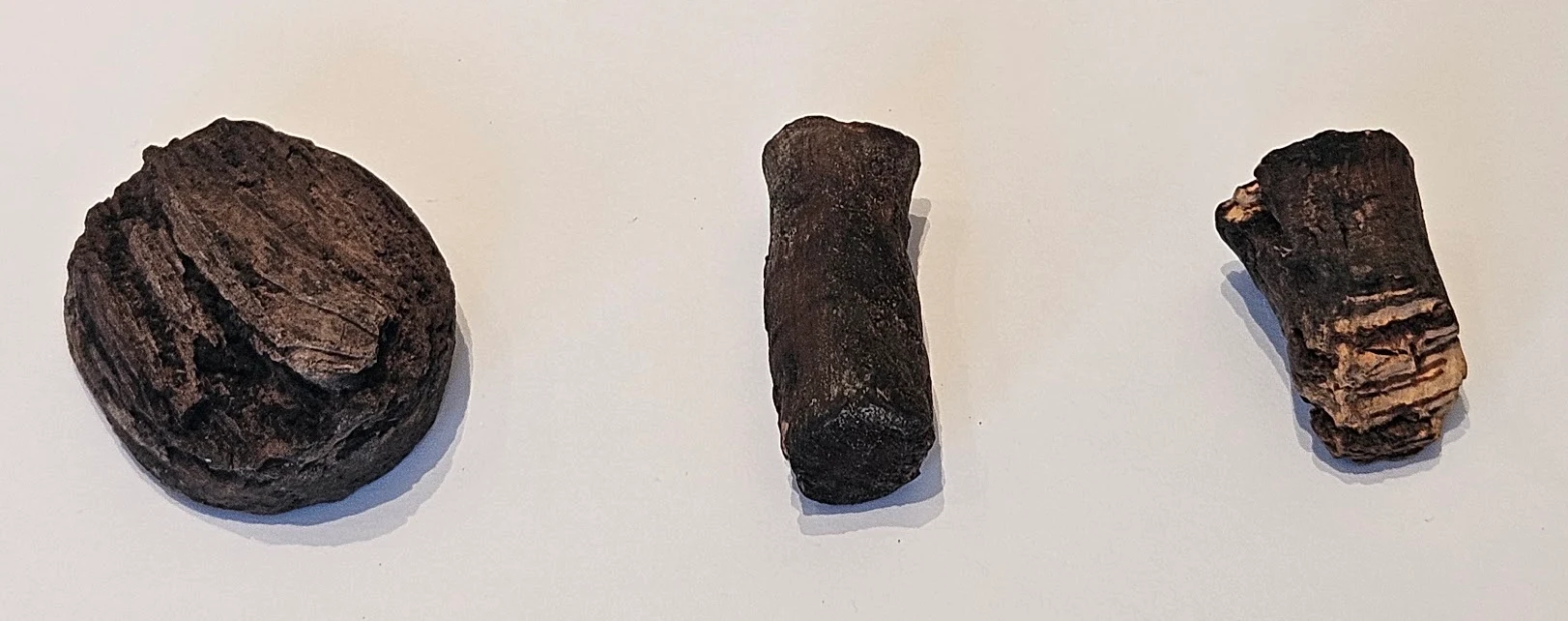
There is a physical trace of this practice in my own hands. I own three corks from broken Fukier bottles. They have not yet been tested, and I would be glad to have them examined by any serious and promising method of scientific analysis — if the dipping fluid was real, a residue of it should in principle still be in the cork.
My own view is that this has to be read for what it is: a cellar owner explaining his stock to a visiting journalist, in a genre — the enthusiastic feuilleton — that rewards a secret. The upright storage is at least a directly observed fact, and it is an unusual one, since the dogma everywhere else is that bottles must lie down. The secret fluid is unverifiable by definition, and no such recipe appears in any Fukier publication or in the surviving company papers as far as I know. What I take from it is that the cellar was worked on a six-year cycle — bottles opened, judged, and re-sealed by hand — which fits everything else on this page about pielęgnacja as active intervention.
The memoir sharpens that. Fukier describes the same cycle — bottles opened, judged, re-corked — and describes it as routine, with no fluid, no recipe and no deathbed transmission. What Krzemiński presented to a journalist as a chemical secret looks, set beside the family’s own account, like the ordinary management of a half-corked bottle, dressed for the occasion. The one thing the two accounts agree on exactly is the mortality: Krzemiński’s “one or two bottles always die every six years”, Fukier’s seven opened to yield three.
Buying age, not only making it
A large part of the “ageing” was buying wine that was already old. Kurczewski’s ledger analysis shows Teofil normally bought wines of one to four years, but repeatedly acquired old stock from third parties: a cask of 1827 from Rosenthal of Podgórze in 1842; 1823, 1827 and 1834 casks from Wolff of Kraków in 1850; 145 bottles of 1830 and 1834 from Weiss of Kraków in 1860; 327 bottles and 25 half-bottles of old Hungarian wine from Seidman of Dubno in 1887; and a cask of 1822 maślacz from Teitelbaum in 1879 (p. 140).
And the Hetman cellar itself originated, on Kurczewski’s reading, in the 1853 auction of Count Franciszek Potocki’s effects — up to 700 “arch-old” bottles, the press said 1624–1794, catalogued in French as Tokaj wines “many of which date from 150 and even 200 years” (pp. 141–142). Later the firm re-attributed the wines to the Zamoyski, Radziwiłł and Lubomirski cellars and to Franciszek Poletyłło; only in his 1959 memoir did H. M. Fukier add “own pielęgnacja” as a source and speculate that the oldest vintage had been in the family since Michał Fukier (d. 1625). The date 1606 first appears in 1870 — and even then as “wines that were already old in 1606” — and Kurczewski notes that nobody knows on what basis it became the vintage year (pp. 143–144).
What he leaves unexplained
What he does not explain, and explicitly says is unexplained, is the wine’s apparent memory of its origin: Hungarian wine in cask begins to stir and ferment at almost exactly the same date as the vines flower in the vineyard it came from, and “the mystery of this wine nostalgia has not been explained”. That is, in my reading, as close as he comes to a theory of why the wine stays alive — and he offers it as a mystery rather than a mechanism.
The memoir shows he did more than assert it. He tested it, and the test is worth having in full. He laid three-year-old casks from Erdőbénye in a separate cellar and told his cellarman — without saying why — to check them every morning from June and report any sign of fermentation at once. Several days later it began. He re-checked every cask that evening and, by prior arrangement with a Poznań-born friend named Marian who worked for a large exporter at Abaújszántó, wired Hungary.
„Dziś erdöbénye zaczęło robić — Henryk.” — Today erdőbénye has started to work.
Two days of silence. On the third morning the reply came:
„Dziś erdöbénye zakwitło — Marian.” — Today erdőbénye has flowered.
Wspomnienia staromiejskie, p. 78
The two telegrams had been sent the same day and crossed in transit. He says he verified the phenomenon several more times in the years that followed (p. 79). I have no explanation to offer and I am not going to invent one; a cellar and a vineyard eight hundred kilometres apart sharing a calendar is the sort of claim that needs a controlled repetition, not a better story. But it is worth being precise about what the source is. This is not folklore reported at second hand: it is a designed test, with a blind observer at one end, a named correspondent at the other, and a dated pair of telegrams as the record.
His own essay “Nullum vinum nisi hungaricum” (Naokoło Świata 1925, no. 12, reprinted 1928) is the fullest statement by a Fukier, and it reads to me as entirely historical and commercial. Its explanatory core is one sentence: “Only in Poland did Hungarian wines find their proper appreciation and only in Poland, strangely, did people learn to raise them” (tylko w Polsce, rzecz dziwna, nauczono się je hodować), followed by Hungariae natum – Poloniae educatum. No cellars, no temperatures, no lees, nothing about what Hungarians did differently. The 1954 Świat interview is the same move a generation later: the good vintages — flowering in rain, ripening in sun — plus Polish upbringing, plus the “wine nostalgia” that he himself calls an unexplained mystery.
So: no aszú sugar, no botrytis, no acidity, no volcanic soil in his account. Longevity, for him, is the great year plus the cellarman’s hand, with a touch of the uncanny.
And then, in 1954, a laboratory
The surprise is what the same 1954 report says the trade intended to do next. The Central Cellars of Imported Wines — with Henryk Fukier as their wine expert, the man whose whole account of ageing is vintage and care — were fitting out an in-house laboratory. The equipment was still standing in crates, waiting for a hundred square metres of floor near the cellars so that production could be monitored as it went; once unpacked, the article says, various trials on improving the quality of the wines would be undertaken, and research was not ruled out into accelerating the maturation of wine by subjecting it to infra-red rays and ultra-short sound waves (badań nad przyśpieszeniem dojrzewania wina przez poddawanie go działalności promieni podczerwonych i ultrakrótkich fal dźwiękowych).
The piece knows it is being provocative: it closes on the old joke about a fly climbing out of a century-old bottle, and remarks that tomorrow that ancient joke may look less nonsensical. So the last Fukier, who explained three-hundred-year-old Tokaji by the great year and the cellarman’s hand, was in 1954 the resident expert of an enterprise proposing to manufacture age by irradiation and ultrasound. Whether any of it was carried out cannot be told from this source: the research is announced as intended, not reported as done.
Source: Lucjan Wolanowski, „Wychowane w Warszawie“, Świat — tygodnik ilustrowany, 5 September 1954, no. 36.
Two things he refused to believe
Both circulate in the Tokaji literature to this day, and the last man to keep three-hundred-year-old Tokaji professionally dismissed both. People boasted to him of wine so old it had gelled and could no longer be poured, and of ancient thick wine eaten with a spoon straight from a cask buried in the ground for hundreds of years.
His verdict is that these rest on overgrown fantasy: “I hardly need explain what a cask of liquid buried in the ground for a long time would look like. What would save it from rotting?” (pp. 119–120).
Source for this section: Henryk M. Fukier, Wspomnienia staromiejskie (Instytut Wydawniczy PAX, Warszawa 1973), Part Three, pp. 77–158; page references as given.
In preparation
„Poloniae educatum“ tested
Of the whole Fukier account, only one part was ever put to a test: the second half of the motto — that the wine owes its age to its Polish upbringing.
The claim is not a small one, and it is worth stating in its strong form. If Poloniae educatum is right, then the longevity of old Tokaji is a cellar skill rather than a property of the wine: the same cask sent to two cellars would end differently, and the three-hundred-year bottles of Warsaw would be a Warsaw achievement rather than a Hungarian one. Put that way the claim is at least in principle testable: take the same wine of the same vintage, raise one lot in Hungary and the other in Warsaw, and compare them. In 1954 something close to that experiment was staged — by the organisation whose own competence was the thing in question.
The word: pielęgnacja
The Polish word standing behind “raised” is pielęgnacja — literally the tending or nursing of something living. It is what one does for a child, a patient or a garden, and the trade used it for wine in exactly that sense. The verb pielęgnować is the same word as wychowywać, to bring up, in the motto: a cask was not stored, it was brought up.
It is a term of work, not of atmosphere. The 1954 report is unusually concrete about its content: pielęgnacja, it says, “covers numerous and often complicated technological operations”, and to show what it meant the writer lists the subjects taught on the autumn training course for cellarmen — wine hygiene, wine diseases and how to fight them, and the conservation of wine. The examples he gives are all interventions: knowing what to do when a wine begins to turn to vinegar, how to recognise a disease in it, how to fight it, and how to save thousands of litres from ruin.
So the English “raised in Poland” is weaker than the Polish. Pielęgnacja names racking, topping up, resealing, re-corking, blending a tired cask with a better one, watching for disease and acting on it — the practices documented across this page. Whether it explains the longevity is the open question; what it is not is a sentimental word for leaving bottles alone.
The experiment, 1954
That claim was put to a test — of a kind. A blind comparative tasting was staged by the Central Cellars of Imported Wines, and Lucjan Wolanowski describes it as a set-piece: a “mysterious” ceremony, in his quotation marks, known as the anonimowa degustacja, the anonymous tasting.
The setup, as described: a dozen or so specialists were invited and served the same kinds and the same vintages of wine, but, as he puts it, “in two editions” — one bottled in Hungary, the other imported young, matured and bottled in Poland. The tasters were not told beforehand which kinds or which vintages they were drinking, so the anonymity was of the samples rather than of the tasters. They tasted and scored, and Wolanowski enjoys the scene: they “tried, tasted, smacked their lips, narrowed their eyes and gave the wines marks, just as at school”.
The result, as reported, was that of all the pairs only one Hungarian-bottled wine — the red — scored better than its Polish-raised counterpart. Everything else came out in favour of the wine matured in the Warsaw cellars. That seems to me the point of the whole article, and the reason the tasting is in it at all: the state monopoly had taken over the work of 120 pre-war private importers and needed to show that Polish cellar work was as good as the pre-war trade’s. The clincher Wolanowski offers is that Polish embassies abroad are supplied with home-matured wine, so that at the embassy in Budapest itself the Tokaj poured at the 22 July reception was born near Tokaj but was Polish-matured, in his phrase, “received its careful upbringing in Poland”.
Worth keeping in mind what the account does not give you. There is no date, no venue, no list of the wines or vintages, no scoring scale, no names of the tasters beyond the presence of Fukier and the other experts elsewhere in the piece, and no indication of who organised the pairs or whether the servers were blind too. It is a journalist’s summary of an in-house event run by the enterprise whose product was being judged, published in an illustrated weekly to promote that enterprise. As evidence for the quality of Polish pielęgnacja I would not give it much weight; as evidence for what the trade was doing and claiming in 1954, and for Fukier’s continuing role as the expert whose authority underwrote it, it seems to me quite good.
What the test settles
In my view very little about the wine, and a good deal about the belief. I do not think the tasting can establish Poloniae educatum as a fact: it was designed and reported by an interested party, and none of the conditions that would make it evidence were recorded. What it does seem to me to establish is that in 1954 the formula was still the working doctrine of the Polish wine trade — enough of one that a state enterprise thought it worth staging a ceremony to confirm, and worth invoking at an embassy reception in Hungary itself.
So the second half of the motto seems to me to remain untested rather than disproved. Testing it properly would, I imagine, mean the physical side the Fukier account leaves out: glass, cork, wax, cellar depth and humidity, bottles standing or laid down, compared across the cellars where very old Tokaji has in fact survived.
Source
Lucjan Wolanowski, „Wychowane w Warszawie“, Świat — tygodnik ilustrowany, 5 September 1954, no. 36 — the account of the anonimowa degustacja and of the “born in Hungary, raised in Poland” formula.
In preparation
Secrets of aging success
Warsaw was not the only cellar that kept Tokaji for centuries. This article will set the practices of the other great cellars beside each other.
Each of them solved the same problem differently, and each left a different kind of record. The Vienna Hofkeller grew its own fruit and ran the wine as a household department, with register numbers and capsule colours in place of vineyard names. The royal Saxon cellar in Dresden bought by the cask over generations and identified its bottles from its own written registers. The Prussian cellars, the Hungarian state cellar at Tolcsva and Budafok, and the Russian, French and Esterházy cellars complete the comparison.
Württemberg, 1721–1757: rest, lees and ullage
The earliest cellar practice I have been able to document in detail is not Polish but German. The Württemberg court bought Tokaji through Vienna and Hungary for four decades, and the correspondence in the Hauptstaatsarchiv Stuttgart (A 21 Oberhofmarschallamt, Bü 418 and Bü 474) carries the advice its agents gave. Six passages seem to me to carry all of it, consistent across thirty years: let the wine settle, bottle it in one operation, keep air out of the cask. Transcriptions are best-effort readings of the Kurrent; the relevant passage is framed in red on each page.
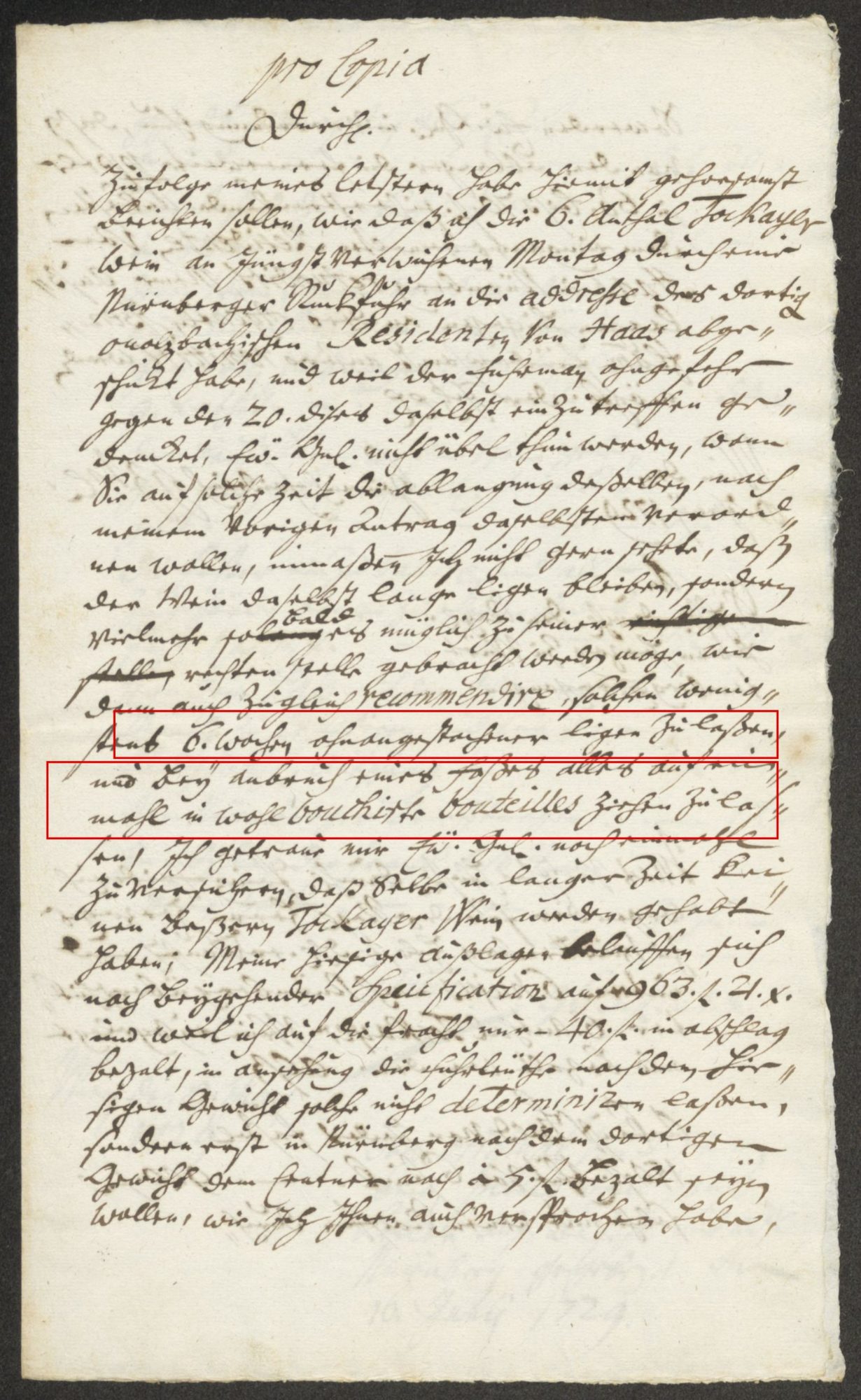
1729 — rest six weeks, then bottle the whole cask at once
The covering letter to the Vienna account for six Antal bought for Prince Heinrich Friedrich, dated Vienna, 8 June 1729, naming the outlay of 963 fl. 21 x.
“…recommendire, solche wenig=stens 6. Wochen ohnangestochen liegen zu lassen … und hernach würd Faßes alles auf ein=mahl in wohl bouchirte bouteilles ziehen zu las[sen]”
“…I recommend that they be left lying at least six weeks without being broached … and that afterwards the whole cask be drawn off at one go into well-corked bottles”
The earliest explicit handling instruction I found in the file, and as I read it there are two rules: rest the cask, then bottle it in a single operation rather than broaching it repeatedly. Bü 474, p. 177.
1755 — fourteen days to settle, or “turbid to the very last drop”
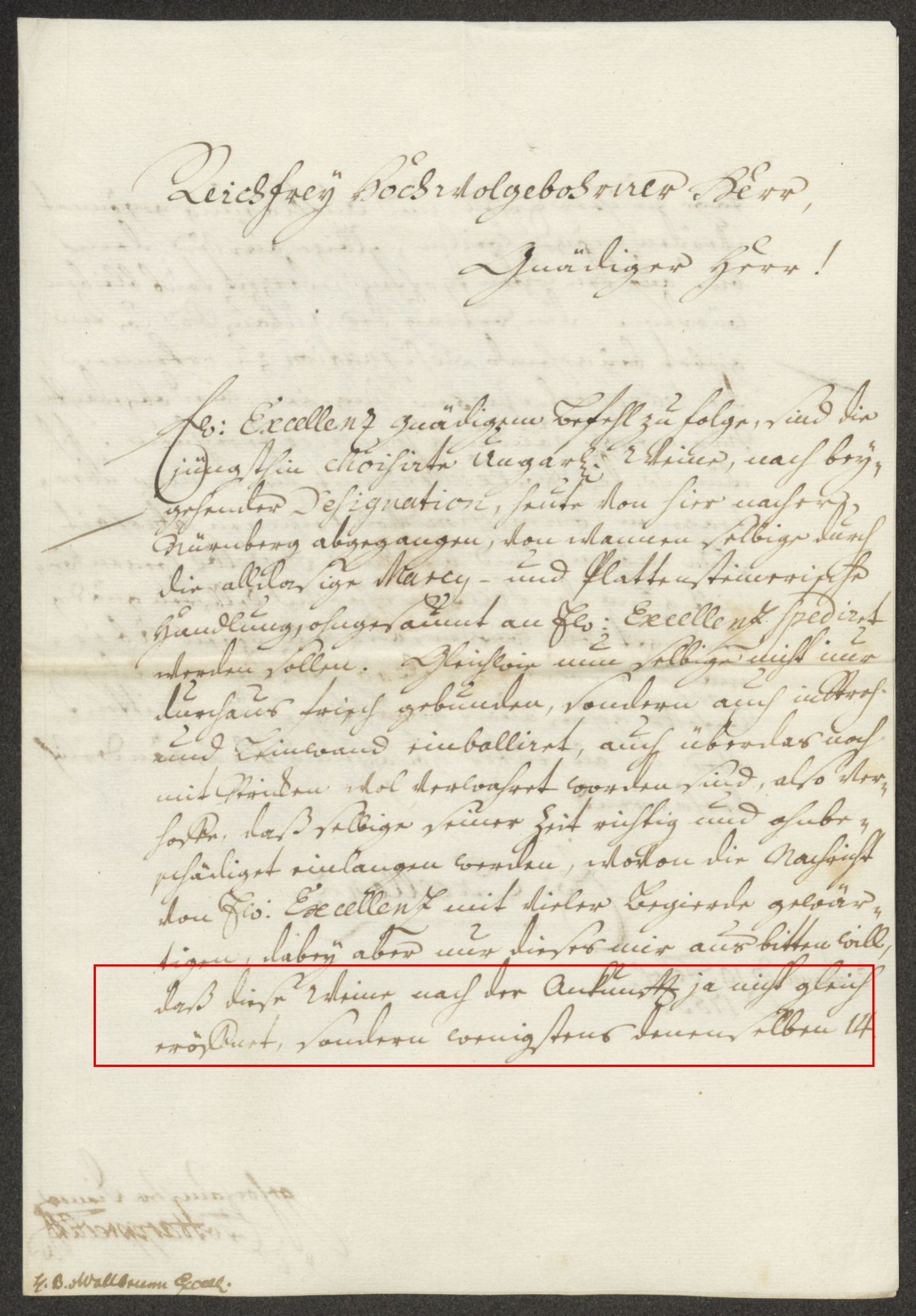
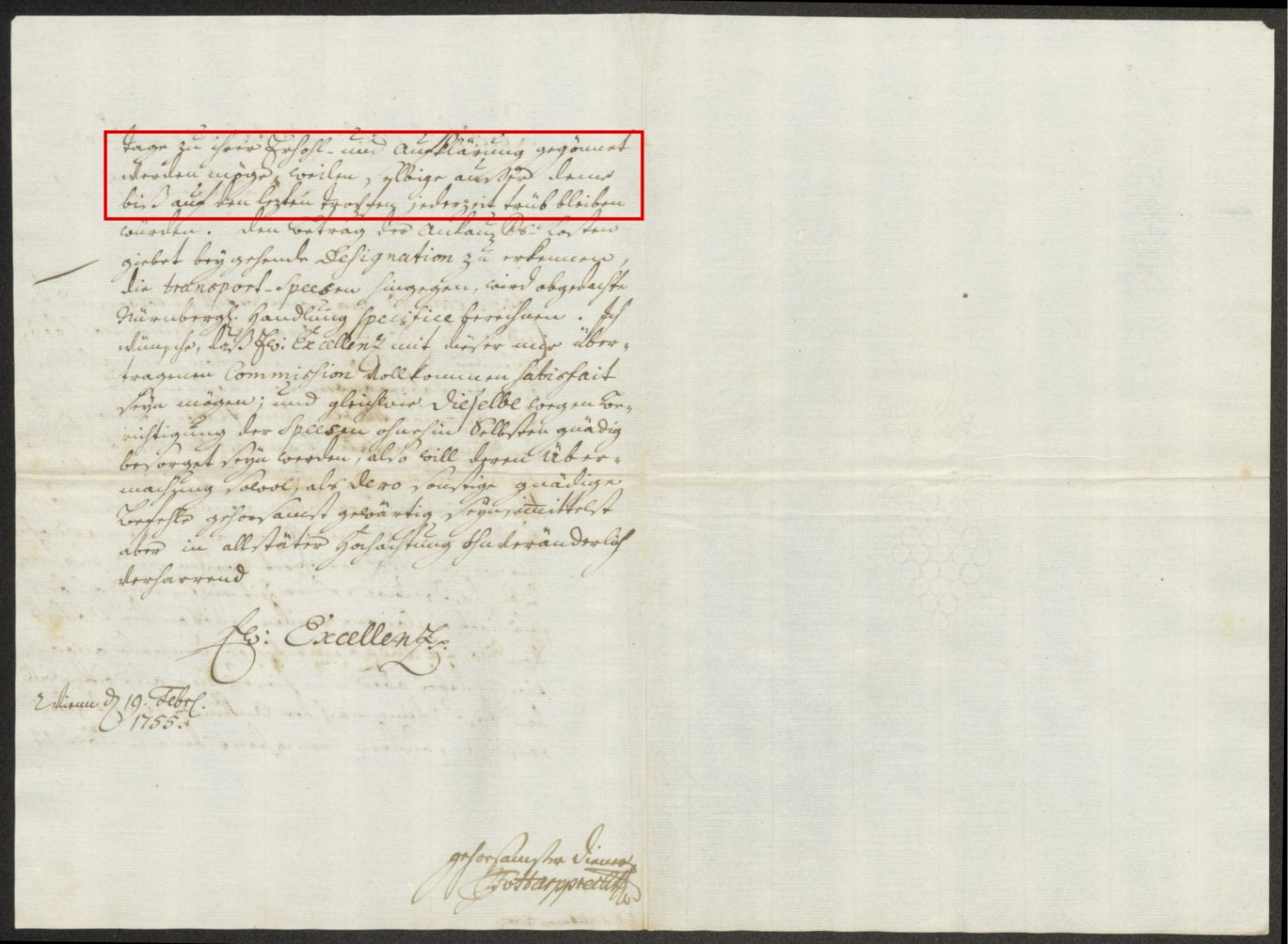
Harpprecht to Wallbrunn, Vienna, February 1755, accompanying seven casks sent by the Nuremberg carrier. The sentence runs across two leaves.
“daß diese Weine nach der Ankunfft ja nicht gleich eröffnet, sondern wenigstens innen selben 14. Tage zu ihrer Setz= und Ausklärung gegönnet werden mögen, weilen selbige außer dem [dann] biß auf den letzten Tropfen jederzeit trüb bleiben [könnten]”
“that these wines, after their arrival, are on no account to be opened at once, but that at least 14 days be granted them for their settling and clearing, since otherwise they would remain turbid to the very last drop”
Note the two technical nouns: Setzung, the settling of the suspended lees, and Ausklärung, the clearing of the wine. The rest is prescribed, as I understand it, as a condition of quality rather than of convenience. Bü 474, pp. 45–46.
1753 — transported on the lees, three months to settle
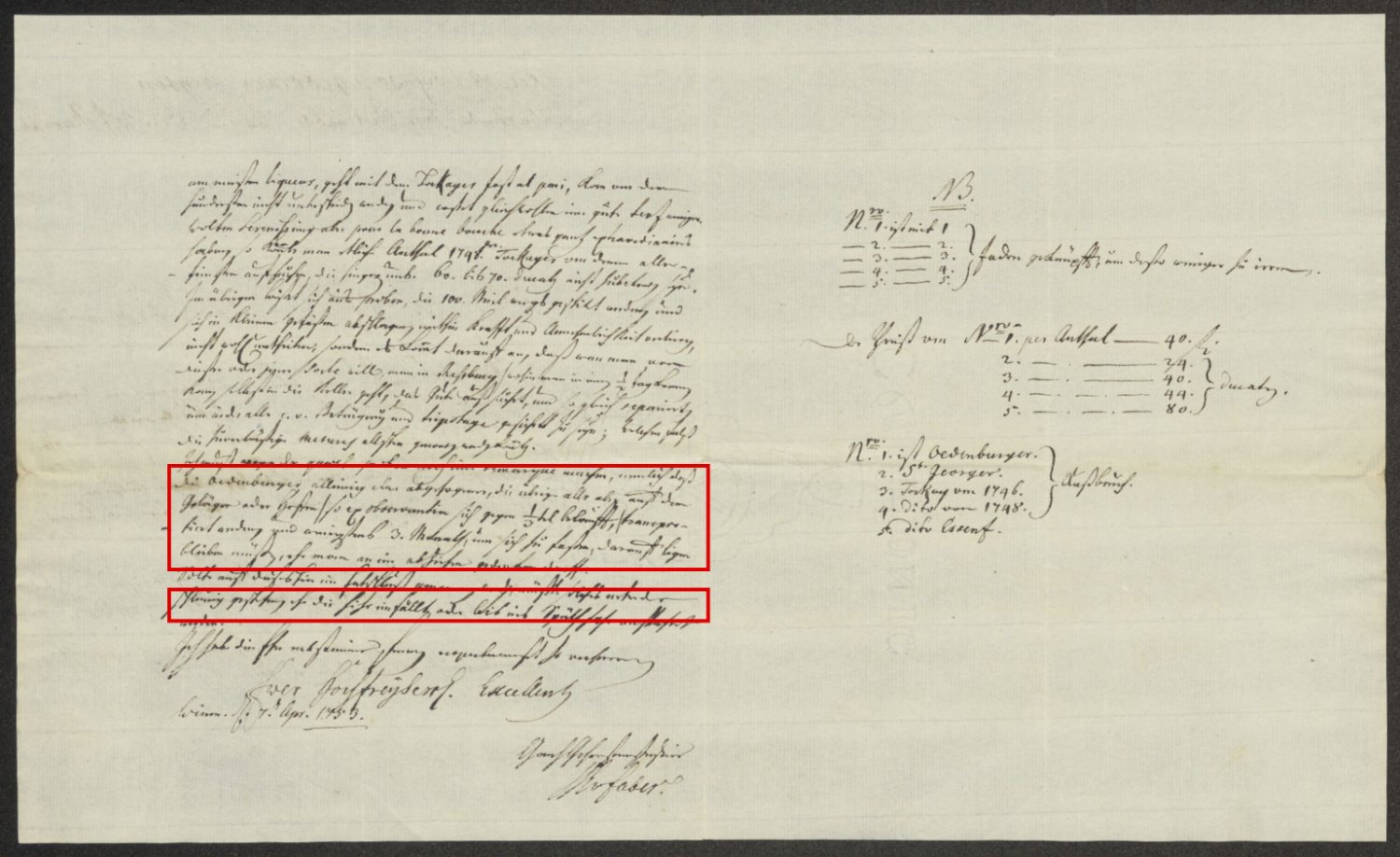
Faber to the Württemberg court, Vienna, 7 April 1753, accompanying five numbered samples — No. 1 Oedenburger, 2 St Georger, 3 Tockay of 1746, 4 the same of 1748, 5 the same Essenz, at 40, 24, 40, 44 and 80 ducats the Antal, listed on the right of the sheet.
“die Oedenburger alleinig das abgezogene, die übrige alle aber auf dem Geläger oder Hefen, so ex observantia sich gegen ⅓ th[ei]l beläufft, transpor=tiert werden und wenigstens 3. Monath, um sich zu setzen, darauf ligen bleiben müssen, ehe man an ein abziehen gedenken darff.”
“the Ödenburg wine alone is the racked-off wine, but all the others are transported on the lees or yeast — which by experience amounts to about a third — and must lie on it at least three months in order to settle, before one may think of racking it off.”
This seems to me the technical core. Hungarian wine travelled on its lees, the lees made up about a third of the cask, and the wine had to lie on them three months at the destination before it could be racked. To me this suggests that the practice made the receiving cellars — Stuttgart, Warsaw, Dresden — part of the wine’s making rather than merely its storage. A second framed clause fixes the season: “schleunig geschehen, ehe die hitze einfällt, oder biß ins Frühjahr anstehen” — quickly, before the heat sets in, or else wait until the spring. Bü 474, p. 74.
1746 — sealed at the customs house against adulteration
Pilgramm from Vienna, 1746, on eight Antal sent by the Nuremberg carrier.
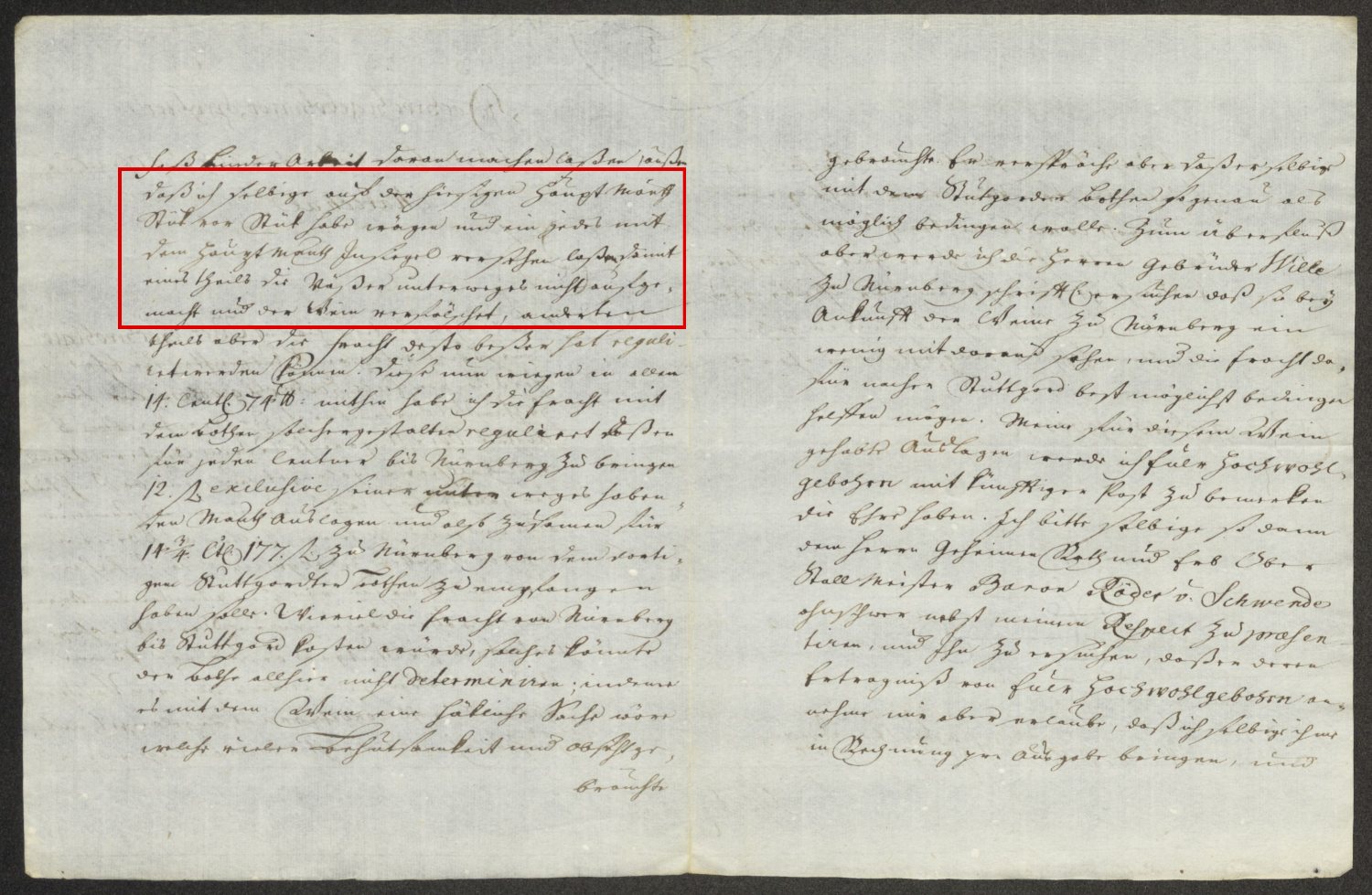
“daß ich selbige auf der hiesigen Haupt Mauth Stük vor Stük habe wägen und ein jedes mit dem Haupt Mauth Insiegel versehen laßen, damit eines Theils die Fäßer unterwegs nicht aufge=macht und der Wein verfälschet [werde], anderen theils aber die fracht desto beßer hat reguli=ret werden können.”
“that I had them weighed piece by piece at the Head Customs House here, and each one provided with the Head Customs seal, so that on the one hand the casks are not opened en route and the wine adulterated, and on the other hand the freight can be the better regulated.”
The seal looks to me like a quality-assurance device as much as a fiscal one: the buyer’s protection against a carrier broaching the cask and making up the loss with something else. Bü 474, p. 137.
1721 and 1757 — two answers to ullage
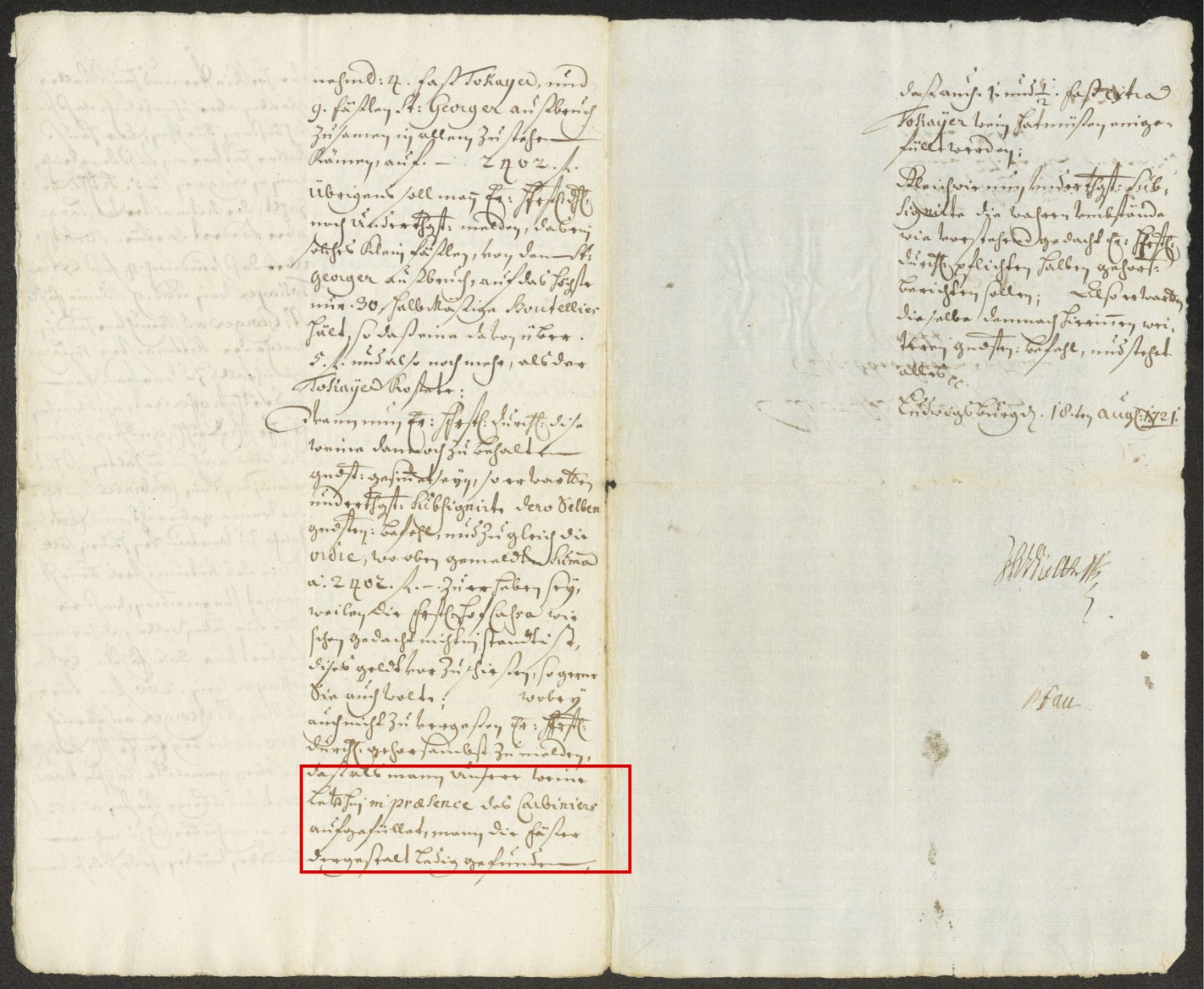
Ullage was recognised as the enemy, and the file records two accepted remedies. In 1721 the Oberhofmarschallamt report on the Lange consignment has the casks topped up with wine, before a witness:
“daß alß mann unßere weine letzthin in praesence des Carbiniers aufgefüllet, wann die Fäßer dergestalt ledig gefunden”
“that our wines were lately topped up in the presence of the carabinier, when the casks were found so far empty”
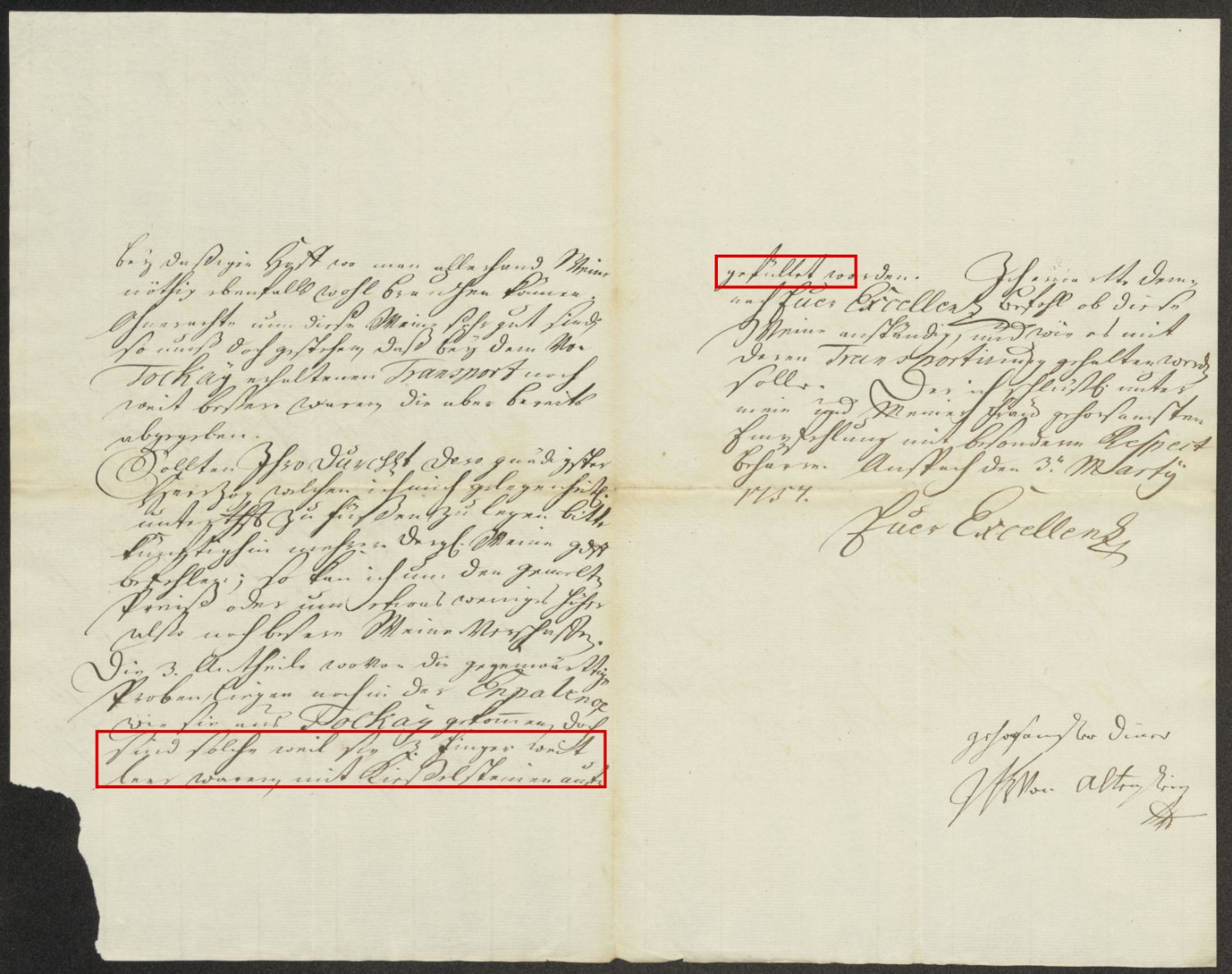
The same report notes on p. 212 that of ten small casks of St Georger Ausbruch the tenth was used up topping up the other nine — the shortfall made good with wine of the same kind, and the operation witnessed. Thirty-six years later von Altenstein writes from Ansbach, 3 March 1757, on samples sent from Tokaj, and the remedy is different:
“Die 3. Aprilis wollen die gegenwärtige Proben liegen noch in der Enpalenoe(?) wie sie aus Tockay gekommen, doch sind solche weil sie 3. Finger leer waren mit Kieselsteinen auf=gefüllet worden.”
“The present samples still lie [in their packing] as they came from Tokaj, but since they were three fingers short they were topped up with pebbles.”
The point of the pebbles, as I understand it, is to raise the liquid back to the bung and exclude the air without adding anything that would alter the wine — the opposite decision from 1721, where the shortfall was made up with wine. Bü 474, p. 223; Bü 418, p. 12.
What the file does not contain
Beyond these six passages the file yields only packing and condition formulas: casks freshly hooped, packed in straw and linen and strapped (p. 45); “wohl conditionirt” on arrival (pp. 119, 132, 136, 138); the cooper’s wage at Ulm (p. 232); delivery into the Long Cellar at Stuttgart (p. 154). Pages 20–60, 64–110, 114–160 and 183–235 of Bü 474 and all twelve pages of Bü 418 were read through; no further passage on resting, racking, bottling or lees was found.
Two things stand out to me. The advice is about settling — six weeks, fourteen days, three months on the lees — which looks to me like the same instinct as the Polish lagier practice, arrived at independently and a century earlier. The other thread is air: pebbles rather than wine, the whole cask bottled at once, the bottles well corked, the bung sealed against the carrier. Nobody here could have called it oxidation, but to me the practice seems to anticipate the explanation.
A report of 1742 looks to me like the control case. Five years after the 1737 inventory, 18 of the remaining 20 ordinary Antal were fit only for vinegar while the Ausbruch survived — same cellar, same handling. Whatever the cellars did right, it seems not to have rescued a wine that lacked the constitution to begin with. Bü 474, p. 23, against the inventory at pp. 24–27.
Dresden, 1719–1802: bottling, lying down, and a condition table
The Saxon court records add, I think, the other half of the picture: what happened to the wine once it was in the cellar. Four practices are documented, and one of them strikes me as a piece of evidence about ageing itself.
Bottled cask by cask, under certificate. On 2 and 27 December 1726 the cellar-master Johann Conrad Schachtmann certified the drawing-off of individual Tokaji átálags into half-Maß bottles — 120 from the Warsaw cask of 30 March, 121 from that of 7 September, and 112 from Flemming’s cask of 3 March 1723, that is after nearly four years in wood. Burgundy, by contrast, went into full-Maß bottles. A cask yielding 112–121 half-Maß bottles implies roughly 56–60 litres net and a bottle of about 0.45–0.47 litres. This looks like the same whole-cask-at-once practice the Württemberg agents recommended, here executed and signed for.
Stored lying, to keep the corks wet. The Oberhofmarschallamt camp files for Hubertusburg, 1736–1755, record that Tokaji, Burgundy and Champagne were bottled on arrival and stored lying so that the corks stayed wet — which is the earliest explicit statement of the practice I have found in this material, and the opposite of the standing storage the Warsaw expert prescribed in 1948. The finest Tokaji was Mundwein, kept in a locked inner cellar to which only the Kellermeister had access.
Resealed between servings. The Nota appended to the 1802 Cabinet table regulates the treasure: one sealed bottle accompanies the electoral evening table, and if it is not finished it is resealed and returned to table until it is — which reads to me as a deliberate answer to the problem of a part-empty bottle, two centuries before the word oxidation.
And a century-long condition assessment. The table of 1802 runs through 79 Cabinet sorts wine by wine: No. 1, 75 bottles of hundertjähriger, already called hundred-year-old in August III’s day and “still very good despite its great age”; No. 27 Czartoryski, “at least 140 years old, of good but dry taste”; No. 38 Bacchus, “sehr gut mit Liqueur”. The general verdict is “sehr gut, aber trocken” — very good, but dry. That vocabulary is, to my mind, the finding: by 1802 the cellar was systematically distinguishing old Tokaji still mit Liqueur from Tokaji gone ganz trocken. Sweet wine kept a century in these conditions survived, but it seems to ferment out — which would mean the sugar that is supposed to preserve it is itself consumed by time. The 1931 Bremen list seems to me to make the same point commercially — the eighteenth-century lots fetched 24–40 RM while two 1874s, still carrying their liqueur, fetched 60.
One footnote on improving wine, for the Polish parallel. Countess Cosel’s cellar, inspected in 1719, had bottles topped up with Pillnitz wine on her own orders, and she kept a notebook titled „Allerhand schlechte Weine zu verbessern“ — all manner of poor wines to improve. The same instinct, as far as I can see, as the Warsaw naprawne, in a private Saxon cellar a century earlier.
Sources: SächsHStA Dresden, 10024 Geheimer Rat, Loc. 8692 series (bottling certificates, 1726); SächsStA-D, 10006 OHMA (Hubertusburg camp files, 1736–1755); SLUB Dresden, Mscr.Dresd.App.306, with the 1802 Cabinet condition table and its Nota; Weber 1871 on Cosel.
Berlin, 1718–1841: kept as relic, not as stock
The Prussian record adds a third pattern, and to me it seems to be about intent rather than technique. The Hohenzollern cellar papers in the Geheimes Staatsarchiv show almost nothing on handling — no resting instructions, no racking, no lees — but they show with unusual clarity what a court cellar decided about old wine, which I take to be the other half of why any of it survived.
Bottled early. By 1718 Tokaji stands at the head of the King’s central Hoff-Wein-Keller ledger and is kept in bottles, like the French grands crus around it — some 94 bottles on hand, a dozen a week to the royal table, restocked in the same breath as Burgundy, Hermitage and Pontac. Around 1680 Hungarian wine had been the last line in the cellar at about 6½ Ohm a year, with one inventory showing none at all. The move from bulk curiosity to bottled house wine of the monarchy seems to have taken one generation.
And it did spoil. A cabinet order of 11 April 1763 directs that spoiled Hungarian wine be distributed among the German and French poor-relief foundations for vinegar production. It looks to me like the Prussian counterpart of the Württemberg vinegar report of 1742, and to carry the same implication: the court was holding Hungarian wine long enough, and in enough bulk, for a part of it to turn — and had an administrative routine for the failures rather than simply discarding them.
Then the deliberate decision to keep. The Oberhofmarschallamt cellar revisions of 1838–1841 inventory old Tokaji as dynastic relic: Hungarian and Tokaji wines attributed to the era of Frederick the Great, alongside Essenz 1788, Ausbruch 1804 and Tokajer of 1811 and 1822, carried through successive revisions — while in the same file commercial stock was actively turned over, 1811 and 1822 Rhine wine sold by lot to the Berlin merchants Gebrüder Habel against young Bordeaux and Sauternes. Old Tokaji was counted, attributed and not sold. That is a curatorial choice, and in my view the reason bottles of this age exist at all.
The Berlin stock count of July 1839 shows the shape of it — the eighteenth-century items tiny and one attributed to a person, the nineteenth-century lots in the hundreds:
| Bottles | As listed | Vintage | Note |
|---|---|---|---|
| 14 | Alter Ungar v. Friedrich II. | — | attributed to the King by name |
| 2 | Ungar | 1788 | the relic datum |
| 50 | Tokajer | 1779 | pre-1786 vintage |
| 127 | Ungar. Ausbruch | 1804 | |
| 59 | Ungar. Essenz | 1811 | |
| 355 | Ungar. Ausbruch | 1822 | largest single lot |
| 168 | Tokajer | 1822 | |
| 100 | Ober Ungar | 1822 | |
| 181 | Tokajer | — | no vintage given |
| 1,056 | Total Hungarian wine, Berlin cellar | July 1839 |
Two readings suggest themselves to me. Fourteen bottles of “Alter Ungar v. Friedrich II.” and fifty of 1779 mean that pre-1786 Hungarian wine was still in the Berlin cellar half a century later, drinkable enough to be inventoried rather than written off. And the single-digit or double-digit counts for the old wines against 355 bottles of the 1822 Ausbruch seem to me to describe exactly the two regimes: the old wine as relic, the recent wine as stock.
A negative finding worth recording. The seventeen surviving Prussian Hofkellerei wine-rack labels in the SPSG collection were checked object by object: all are Rheingau Rieslings of the 1880s and 1890s, and no Tokaji label survives among them. Physical label evidence for the relic stock will have to be sought elsewhere, if it exists at all.
Sources: GStA PK, I. HA Rep. 36 Nr. 1065 (Hofkellerei ledgers, Cölln/Berlin and Schönhausen) and Nr. 1160 (the 1763 vinegar order); BPH Rep. 113 Nr. 2211, fol. 29 (cellar revisions of 1839/1840); SPSG Varia, wine-rack labels; with Lutz H. Prüfer, Potsdam und der Wein (Wiesbaden 2006), who prints the 1839 Hungarian lines.
2003 — 2025
The science of tokaji aging
Other wines survive a very long time — the 1653 Rüdesheimer in the Bremen Ratskeller is still in its cask, and old Madeira and Port can be magnificent at a century and more. What sets Tokaji apart is not that it can last, but that with Tokaji the exceptional longevity is not the exception but the rule: no other wine has so rich, so consistent and so well recorded a history of ageing well, across centuries, cellars and countries. A phenomenon of that standing would, I should have thought, have prompted serious research long ago. It came as a complete surprise to me that to this day nobody has seriously tried to understand and explain it. I am no microbiologist, and nothing below is the judgement of one — it is a collector reading the papers he could get hold of. On my reading, this article would be more honestly titled the missing science of Tokaji ageing. As far as I have been able to establish, there is no study anywhere that analyses the same Tokaji at two points in time, none that compares young and old bottles of the same wine, and none that measures the rate of any process the received explanation is supposed to prevent.
The explanation everyone repeats — sugar as a natural preservative, Furmint acidity, the compounds botrytis leaves behind — appears, as far as I can see, as a premise in the introductions of papers about something else. To me it seems plausible, and probably right in outline. But I have not found where it was tested. For a wine whose whole reputation rests on longevity, that strikes me as a remarkable gap.
Of the factors usually named, acidity seems to me the one most worth testing. Sweet Tokaji can carry up to four times the acidity of other white wines, and a difference of that size is the kind of thing that could plausibly account for the longevity where sugar and alcohol do not.
What has been studied is worth knowing, and some of it seems to me excellent. As I read it, the work falls into four kinds: two nuclear methods that can date or screen a bottle; one compositional series across twenty-one consecutive vintages; four papers on botrytis chemistry and polyphenols; and one measured survival of a single molecule over eighty years in bottle. Read together, they give us — so far as a layman can judge — two firm dating tools, a readable environmental record in the wine itself, a well-established chemistry of noble rot, and a mechanism which seems to me to suggest, against everything the trade believes, that aszú ought to be more fragile than an ordinary white wine rather than less. That contradiction is, in my view, where the interesting questions start.
Dating a bottle: the two nuclear methods
Radiocarbon — ten microlitres, two to three years
Varga et al. 2023 dated twenty bottles of aszú, one per vintage 1999–2018, all from Tokaj-Hétszőlő — a single estate, so soil, climate and method are held constant and the only variable is the year. Wine was separated by distillation into ethanol, water and residue; about 2 mg of each was combusted with manganese dioxide at 550 °C, graphitised, and measured on the MICADAS accelerator at Debrecen against the post-bomb atmospheric curve. Whole undistilled wine was handled the same way but dispensed in melting-point capillaries, so that under 10 µL sufficed.
All three fractions agreed (R² = 0.98 against expected Δ¹⁴C), and the cheap near-non-destructive whole-wine route proved as good as the laborious one. Calibrated intervals were 2.1–2.5 years wide, and the difference from the known vintage was under a year. For a collector like me the practical consequence seems to be that a harvest year can be verified from a drop, and that the commonest fraud — young wine sold as old — shows up, because atmospheric ¹⁴C has been falling since the 1963 peak. The authors are equally explicit about the limit: after 1999, at present precision, the honest accuracy is two to three years, not one.
Three caveats travel with it. The global calibration curve is not locally exact — regional fossil-fuel dilution and nuclear-facility emissions shift results, which is how the anomalous 2002 and 2011 values are explained, and local curves are recommended. The seasonal swing in atmospheric ¹⁴C over Hungary is about 26 ‰ across a year, larger than the measurement error. And every measured value crosses the curve at more than one point; only the most probable date is quoted. One detail bears directly on very old cask-aged wine: the whole-wine fraction ran slightly high, and the authors suggest it “may contain materials from the soil, probably from the wooden cask” — long cask ageing can put foreign carbon into the wine.
Caesium-137 — the bottle is never opened
Thanasi et al. 2025 is about Portuguese wine, and it is here for one reason: the method does not open the bottle. Fifty-one verified single-vintage bottles of 1947–1971 were laid horizontally in a high-purity germanium detector inside a lead shield and counted for sixty hours or more — up to 190 where the signal was faint — for the 661.7 keV gamma of caesium-137 decay. Calibration was against a spiked model wine; empty period bottles gave no signal, and neither glass colour nor wine composition measurably attenuated the line.
Everything before 1959 fell below detection. Activity appears with atmospheric testing, peaks around the 1963 fallout maximum, and disappears after 1965 — so the method separates “inside the fallout window” from “outside it”, and no more. It is, on their own account, a screening and consistency marker, and the authors call it exactly that: a supplementary marker for wines of roughly 1955–1975. A national curve is invalid: fortification lowers the signal, skin contact raises it, and soil and rainfall dominate the rest, so each region and style needs its own verified reference set. Two warnings apply to Hungary in particular. Chernobyl complicates it badly in eastern Europe, where post-1986 wines can approach mid-1960s levels. And the paper’s own Tokaj figures — 1.01 Bq/L for 1963, 0.87 for 1964, detectable 1958–1965 — are cited to Varga et al. 2023, which contains no caesium data at all; the real source is almost certainly Povinec et al. 2020, and I would check them there before using them.
For a valuable historic bottle
If it were my bottle I would go gamma first, because it costs the owner nothing, and radiocarbon second, if the question remained open. Neither method can date a pre-twentieth-century wine — both depend on twentieth-century atmospheric contamination. For a genuinely old bottle their evidential value seems to me negative: the absence of a bomb-era signal is consistent with, but not proof of, pre-1950s origin.
Twenty-one vintages, measured
Ragyák et al. 2025 profiled twenty-one bottles of five-puttonyos aszú, one per vintage 1999–2019, from the same Hétszőlő series — vintages independently confirmed by the radiocarbon work. Analysis was by ICP-OES after nitric-acid digestion, plus FTIR-ATR on neat wine. Three elements moved significantly across the series: potassium fell from about 1150 to about 500 mg/L, chromium from about 0.09 to 0.015 mg/L, and calcium rose slightly. Weather left clear traces — zinc with annual rainfall, barium with the previous year’s, calcium with rainfall two years earlier, and phosphorus, chromium, strontium and zinc all negatively with sunshine hours.
On its own terms — aszú as an archive of historical environmental data — the paper delivers. As evidence about ageing it seems to me to need care on four counts, and the authors say much the same themselves. The x-axis is year of origin, so “negative correlation with age” means the element is lower in the more recent vintages; whether it declines in bottle or the vineyard and cellar changed over twenty years is not tested. The authors’ own explanations are vintage-side and production-side: potassium from fertilisation regimes, chromium from stainless steel and glass pigments — proposed, in fact, as a proxy for manufacturing examination. Temperature and chromium are collinear across the series and are not disentangled. And there was one bottle per vintage: the published version states that the spectral replicates are not independent observations, calls the PCA exploratory, and reports no classification accuracy anywhere.
Two further limits worth stating. The study measured metals, phosphorus and sulphur, plus a mid-infrared fingerprint. It did not measure sugar, acid, alcohol, glycerol, sotolon, polyphenols or any aroma compound — so I do not think anything about how Tokaji tastes can be sourced from it. And on my own reading the paper seems to carry several internal inconsistencies: sixteen elements claimed against seventeen wavelengths tabulated, barium plotted at two scales fifty-fold apart, zinc at implausible concentrations, and absolute values never tabulated, only plotted. I would quote any figure taken from it as approximate and read off a graph.
Noble rot, and a mechanism that cuts the other way
The chemistry of botrytis looks to me like the best-established thing in this literature. Bene 2024 gives the fullest account: sugar concentrated to 300–350 g/L in must; glycerol above 5 g/L under noble rot, commonly above 20 and up to 30 in aszú; tartaric acid down by about 55 per cent while malic rises by about 45, leaving total acidity near 8 g/L almost unchanged; gluconic, glucuronic and galacturonic acids generated where none existed; citric and succinic elevated; a high-molecular-weight β-glucan that fouls filtration; proline and arginine dominating the amino acids; and sotolon, which carries the caramel note that defines the style.
Bene’s own question was whether climate change is raising polyphenol content, and her answer is no: sixteen aszú base wines from Dereszla, Disznókő, Royal Tokaji and Hétszőlő across 2020–2023 gave 370–730 mg/L total polyphenols with no vintage or estate effect. Note what those samples are, though — base wines stopped after fermentation, not yet barrel-aged. Effectively zero age, so as far as I can see nothing in that result speaks to maturation.
The part I find most interesting is a mechanism, and to me it appears to contradicts the idea that botrytised wine is inherently protected. Botrytis raises polyphenol oxidase activity and so the tendency to brown. Caftaric acid, the dominant phenolic acid of Tokaj, is the preferred substrate, and polyphenol oxidase converts it to its ortho-quinone. In a normal must, glutathione traps that quinone as the grape reaction product, which is colourless and inert to polyphenol oxidase — browning is diverted. But Botrytis cinerea secretes laccase, and laccase does attack the grape reaction product. In principle, then, a botrytised wine would seem to loses the protection a healthy-grape white retains. Nothing here measures whether that shortens aszú’s oxidative life in bottle. It is a mechanism, not a result — and to my mind the most interesting idea in the whole collection for anyone asking why traditional Tokaji was matured under conditions that would ruin most white wines.
The rest of the polyphenol literature does not, as far as I can see, agree with itself. Nyitrainé Sárdy et al. found no vintage effect at all across aszús of 1992–2005 and attributed the variation to which base wine had been used to extract the berries; Bene cites evidence that botrytisation makes caftaric, p-coumaric and ferulic acids accumulate; Kalló et al. 2020, running twelve wines on an Orbitrap and identifying 288 molecules — 253 never previously reported in wine — found most individual phenolics statistically indistinguishable between aszú and Furmint, the differences falling instead among peptides and amines. My impression is that any tidy single account of aszú phenolics overstates the evidence.
Penicillin: the one measured change in bottle
Kállay and Bene 2003 looked for penicillin V in botrytised wine, on the reasoning that botrytis opens the berry to Penicillium, and that only the acid-resistant V derivative could survive in a high-acid wine. Thirteen wines of 1923 to 2002 and seven berry samples were run by HPLC against Sigma standards. They found 0.4–26 mg/L in the wines and 0–74 mg/kg in the berries. For scale, a therapeutic dose is about 600 mg — so a litre carries half a per cent to four per cent of one — but the minimum inhibitory concentration for Streptococcus pneumoniae is 2 mg/L, which several wines exceed. A five-puttonyos aszú of 1923, eighty years old at analysis, still held about 13–14 mg/L.
Two things seem to follow, and to me they want keeping apart. The paper’s own statement is that the wine’s acidity destroys the β-lactam ring over time and that sulphiting accelerates the loss — supported by the berries, where the two unsulphited samples held 74 and 35 mg/kg while the sulphited ones were at or near zero. This is the closest thing I have found in the whole literature to a measured in-bottle change, and it seems to me to points the wrong way for the “acid preserves everything” story: acidity preserves the wine and destroys this particular compound. Separately, the bar chart appears to show the older wines carrying more penicillin, which would contradict that — but the authors explicitly defer the question, per-sample values exist only as charts, and the likely explanation is the variation in Penicillium colonisation between lots, which they call unpredictable. They propose penicillin V as a possible authenticity marker. As far as I can tell, nobody has tested it as one.
Examination by sensor
Zaukuu et al. 2019 modelled a commercially specific fraud: lower-grade Fordítás sweetened with grape-must concentrate to imitate aszú, which Hungarian law forbids outright. Four authentic wines of ascending grade were adulterated at four levels each, engineered so that every adulterated sample matched a genuine higher grade’s sugar exactly. A potentiometric electronic tongue and two NIR instruments were then asked to tell them apart. Discriminant analysis classified the adulterated wines at 98.5–100 per cent accuracy (the Results text gives 98.5; that is the figure to quote), and partial least squares predicted must-concentrate content with R²CV 0.978. The aquaphotomic reading is elegant: added sugar means less free water, shifting absorbance between 1364 and 1488 nm as hydroxyl states move toward hydrogen-bonded dimers and trimers.
The negative result seems to me to matter more than the positive one. A wine sweetened with sucrose before refermentation was consistently classified with the authentic wines — fermentation masks the fraud, and the authors call it “a potent form of adulteration for unsuspecting consumers”. No limit of detection was established. And the study contains no old wine and no ageing component whatsoever.
What I think can honestly be said, and what cannot
Established
- The harvest year of a modern bottle can be verified from about ten microlitres, to within two to three years since 1999 and more precisely before that.
- A sealed bottle from the 1955–1975 window can be screened without being opened, against a reference curve built for that region and style.
- The elemental composition of aszú carries a legible record of the growing season, so a wine of known provenance is a usable environmental archive.
- Noble rot produces a distinctive, measurable chemistry — the sugar, glycerol, acid shifts and sotolon set out above.
- Botrytised wines carry penicillin V at 0.4–26 mg/L, and it survives at least eighty years in bottle.
- Sweetening a lower grade with must concentrate is detectable to 98.5–100 per cent accuracy; sweetening with sucrose before refermentation is not.
Not established by any of it
- That high sugar and high acidity are what preserve Tokaji. Universally repeated and stated as a premise, but I have not found it tested against a control, nor any paper measuring the rate of any spoilage process it is supposed to prevent.
- That any phenolic or antioxidant measure changes predictably with age. Three of the four polyphenol papers analyse effectively unaged wine; the fourth finds no vintage effect at all.
- That Tokaji’s colour, aroma or flavour follows a documented trajectory. No aroma analysis, no sensory panel and no colour measurement appears anywhere.
- That the traditional oxidative and modern reductive styles age measurably differently. The distinction is real in the trade and untested in the literature.
For the general chemistry my folder is nearly silent, so I have had to look elsewhere. The wider literature seems clear that in-bottle ageing is governed by oxygen transfer through the closure and by temperature, with sotolon as the standard oxidation marker of sweet wines — the compound that carries the rancio note. Long-term closure trials on white wine found oxidation held off where the oxygen transfer rate stayed at or below about 0.3 mg a year, and the variability between individual natural corks is enormous; one study concludes the cork–glass interface, not the cork itself, is the preferential path for ingress. Reviews of accelerated-ageing technologies conclude that most of them fail to reproduce the chemical pathways of natural bottle ageing and arrive at a different aromatic profile — which I take to be the standing answer to the 1954 Warsaw proposal to age Tokaji with infra-red and ultrasound, and to every scheme like it since.
The experiment that should be done
The most promising untested hypothesis, as far as I can see, falls out of the laccase chemistry: because botrytis laccase attacks the grape reaction product that normally protects a white wine from browning, aszú ought to be more oxidatively labile than a healthy-grape white — and its longevity would then have to come from something else, to my mind most plausibly the sugar and acid. Testing it would mean measuring caftaric acid, the grape reaction product and browning in a bottle series of known age from a single estate. The Tokaj-Hétszőlő 1999–2019 series has already been used twice in this literature, its vintages confirmed by radiocarbon, and it sits in one cellar.
Two items I would not lean on
The century-old yeast collection. Kállai et al. 2019 in LWT asks whether the diversity and oenological properties of a century-old Tokaj yeast collection survive long-term laboratory maintenance — and the full text is paywalled and was not obtained. Any statement that the collection “retained much of its diversity” is an inference from the title, not a reported finding. Getting the paper would fill a real gap, since the fermentation heritage behind historical Tokaji is exactly the sort of continuity claim that wants evidence.
The historical note. Molnár’s two-page account of the Tokaj demarcation, published by a winery and carrying no references, reads to me as marketing material rather than scholarship. I would check every date in it against a primary source — the 1737 demarcation above all, since that is the year connecting directly to the Württemberg archival material above.
Two things nobody has an upper bound for
The ageing potential is unknown, not merely long. The usual way to establish how long a wine keeps is to find the point at which it stops being good. With Tokaji that point has not been reached. The oldest bottles opened — seventeenth- and eighteenth-century wines from the great cellars — have been found in good condition, and the tasting record contains no upper limit, only the oldest bottle anyone has yet had the occasion to open. A wine of 1727 and one of 1745 were poured at Dresden in 1909 at 182 and 164 years; the 1923 aszú analysed in 2003 was intact at eighty. What follows, in my view, is not that Tokaji lasts three hundred years, but that nobody knows what the limit is, because every attempt to find it has produced a drinkable wine.
And the same holds after the cork comes out. Tokaji is remarkable not only for its life in the bottle but for its life in an opened bottle. A high-puttonyos aszú will usually keep for days, sometimes weeks, without serious decline — where a dry white is tired in a day and most sweet wines in a few. That looks to me like the same resistance to oxygen on a timescale short enough to observe directly, and it seems the cheapest experiment available to anyone who wants to test the sugar-and-acid hypothesis: an opened bottle is a bottle with a large, known headspace, and the decline can be followed day by day. As far as I can find, nobody has published that measurement either.
Why, then, does Tokaji age so well?
Six hypotheses seem to me consistent with the evidence above. None has been tested, and they are not mutually exclusive. They are a collector’s guesses, offered as such.
- Sugar and acid together, as osmotic and microbial barrier. The orthodox account, and to my mind the strongest candidate — 300–350 g/L in must with total acidity near 8 g/L is a hostile environment for anything living. It also seems to me to gain force from the laccase problem: if aszú is oxidatively more exposed than a healthy-grape white and still outlives it, the protection has to come from somewhere else. Testable by measuring browning and oxidation markers in a known-age series against sugar and acid.
- Glycerol and the bound-water state. Aszú commonly exceeds 20 g/L glycerol and reaches 30. Sensor work on Tokaji already shows that dissolved solutes shift water out of free hydroxyl states into hydrogen-bonded structures; it seems at least conceivable to me that a wine with that little free water presents less of a medium for the reactions that age it. Nobody has connected the aquaphotomics to longevity.
- Products of botrytis acting as reservoirs. Noble rot generates acids that are not in healthy must — gluconic, glucuronic, galacturonic — plus high-molecular-weight β-glucans and an amino-acid profile dominated by proline. Some of these look to me like plausible sacrificial substrates or buffers, though I am guessing. The penicillin V result shows that botrytis metabolites can persist eighty years in bottle, so the class is at least durable.
- The honey analogy. Honey is the one sugar-dominated foodstuff whose long-term chemistry is well understood, and some of it, I would think, should transfer. Honey does not spoil because its water activity is too low for microbial growth and its acidity is high; what changes instead is slow and non-microbial — 5-hydroxymethylfurfural accumulates as sugars break down, diastase and the other enzymes decline, volatile aroma compounds fade, and glucose crystallises out as a physical rather than a spoilage change. An indefinitely safe substance that nevertheless loses nuance strikes me as a good description of what the Dresden cellar recorded in 1802: “sehr gut, aber trocken”, still very good and no longer sweet. Where the analogy has to stop is the water: honey sits below 18 per cent moisture, while an aszú is mostly water and carries 12 per cent alcohol, so the osmotic argument does not carry over at anything like the same strength. What does carry over is a measurable marker — HMF and the related furanic compounds are already routinely measured in wine, they form from sugar degradation, and I would expect them to accumulate in an old aszú in a way that tracks its age and its thermal history. That makes this, to me, the most directly testable of the five. The old meads are the obvious bridge: the Wilanów cellar held eighty-year-old mead that the expert of 1948 described as dry and close to Tokaji in taste.
- The cellar, not the wine. The historical cellars kept their bottles cool, dark, still and sealed, and the documents on this page show them fighting ullage with pebbles, wax and resealing. Modern closure trials find oxidation held off where oxygen transfer stays at or below about 0.3 mg a year, and the cork–glass interface — not the cork — as the main path in. A cellar that kept interfaces tight for two centuries may, for all I know, account for more of the survival than any property of the liquid.
The vineyard, not the cellar. This one has nothing to do with what happened to the wine after it was made, and I think it deserves more weight than it gets. We can reasonably assume that the average age of the vines in Hegyalja centuries ago was substantially higher than it is today. Replacing a vineyard wholesale was essentially unknown; individual plants were replaced as they failed, by layering an existing cane into the ground — bújtás, or tőkedöntés where the whole stock was laid down. A vineyard maintained that way has no planting year and no uprooting year. It is continuously renewed, and its mean vine age drifts upward over generations rather than resetting every thirty years.
And old vines are generally held to give wine with greater ageing potential: lower yields and a healthier, deeper-rooted plant concentrate sugars, acids, aromatics and phenols, and a vineyard propagated by layering over centuries also carries far broader genetics than a block of one clone. All of that applies with particular force before phylloxera, when the vines were ungrafted and the oldest stocks had never been interrupted. If the seventeenth- and eighteenth-century wines that survive were made from fruit of that kind, then part of what we are tasting may simply be raw material no longer available, and no cellar technique can substitute for it.
The obvious objection is that those growers had no temperature control, no analytics, no sterile handling and no way of knowing what they had. True. But the question that objection raises is what the modern interventions actually contribute to longevity, and there is one place to look for an answer. Essencia is the Tokaji category that consistently shows the highest ageing potential of all — and the technology for making an Essencia today is essentially what it was four hundred years ago: berries selected by hand, the free-run juice allowed to seep under its own weight, a fermentation that barely proceeds. Where the wine survives longest, the modern apparatus has the least to do. That does not prove the vineyard hypothesis, but it does suggest that the answer is more likely to lie in the fruit than in the equipment. Testable, in principle, by comparing acid and phenolic profiles from genuinely old-vine parcels against young plantings on the same soil, and by looking for vine ages in estate records, if any survive that record them.
My honest summary is that this looks like an open field, not a settled one. The material for settling it exists and seems to me unusually good: a single-estate series of twenty-one consecutive vintages with radiocarbon-confirmed dates, sitting in one cellar; surviving bottles of the eighteenth and nineteenth centuries in private collections; and archival records of exactly how those bottles were handled, cask by cask, for three hundred years. What is missing, as far as I can see, is one study that measures the same wine twice. Until somebody does it, the longevity of Tokaji remains what it has always been — a well-documented fact with an untested explanation, and, in my humble opinion, one of the more inviting questions left in wine science.
Sources
- Varga, T., Molnár, M., Molnár, A., Jull, A.J.T., Palcsu, L., László, E. (2023) Radiocarbon dating of microliter sized Hungarian Tokaj wine samples. Journal of Food Composition and Analysis 118, 105203.
- Thanasi, V., Santos, M., Marques, R., et al. (2025) ¹³⁷Cs analysis by gamma spectrometry and its potential for dating Portuguese old wines. Journal of Agricultural and Food Chemistry 73, 9835–9845.
- Ragyák, Á., Sajtos, Z., Baranyai, E., László, E. (2025) Long term compositional profiling of historical tokaji aszú wines. npj Science of Food 9:101 — with its superseded SSRN preprint.
- Bene, Zs. (2024) Impact of climate change on the (poly)phenol composition of botrytization in the Tokaj wine region. Journal of Nutrition and Food Processing 7(11), 261. Publisher of contested standing; ten-day review turnaround.
- Nyitrainé Sárdy, S.D., Nagy, B., Kállay, M. (c. 2014) Polyphenol content examination of Tokaji aszú wines. Corvinus University. No journal or year on the document; no statistics reported.
- Kalló, G., Kunkli, B., Győri, Z., et al. (2020) Compounds with antiviral, anti-inflammatory and anticancer activity identified in wine from Hungary’s Tokaj region. IJMS 21(24), 9547.
- Markovics, A., Csige, L., Szőllősi, E., et al. (2023) HPLC analysis of polyphenols derived from Hungarian aszú … in an in vitro model system of endothelial cells. IJMS 24(7), 6124.
- Kállay, M., Bene, Zs. (2003) Study on the penicillin-content of botrytized wines and noble rotted berries in Tokaj-region. International Journal of Horticultural Science 9(2), 91–94.
- Zaukuu, J.-L.Z., Soós, J., Bodor, Z., et al. (2019) Examination of Tokaj wine (Hungaricum) with the electronic tongue and near infrared spectroscopy. Journal of Food Science 84(12), 3437–3444.
- Kállai, Z., Pfliegler, W.P., Mitercsák, J., et al. (2019) Preservation of diversity and oenological properties of wine yeasts … a century-old Tokaj wine yeast collection. LWT 101, 789–798. Full text not obtained.
- Molnár, P. (undated) The history of the first demarcated wine region of the world. Patricius Winery. Promotional note, unreferenced.
- On closures and oxygen: Karbowiak et al., Critical Reviews in Food Science and Nutrition (2010); Lopes et al. on oxygen ingress routes and transfer rates; and the 2019 npj Science of Food study identifying the cork–glass interface as the main path.
2006 — 2206
The 200 year experiment
Every question on this page is in the end an empirical one, and somebody has decided to answer it by waiting.
A word about the man, because the scale of the plan fits him. In the 1950s Tamás Dusóczky held several Hungarian cycling records and, on 23 September 1954, at twenty-three, a world record over 500 kilometres — 1,470 laps of the Millenáris track in Budapest. He left Hungary soon after, made a career in Switzerland in computing, and returned in 1993 to rebuild the family vineyard at Szegi.
The Tokaj vintner Tamás Dusóczky wanted to find out how long Tokaji really kept under optimal conditions, and how it developed over time, by means of a long-term experiment laid out over two hundred years.
The special bottle closure he developed (patents PO600771/2006 and DO600246/2006) used technology from spaceflight and was said to allow oxidation-free storage of the wine for up to five hundred years.
It is worth seeing what the design concedes. The closure attacks exactly the variable the eighteenth-century cellars were already fighting with pebbles, wax and resealing — contact with air. If the wine still changes behind a seal that admits none, the change is intrinsic to the wine; if it does not, then everything the old cellars achieved was a matter of excluding oxygen, and the pielęgnacja argument reduces to good closures. Either result would be worth having.
The rest of the design is the honest part: nobody involved will read the result. The first meaningful readings fall due long after the people who sealed the bottles, which is the condition every question on this page has been under all along — with the difference that this time the bottles were filled on purpose.
It never started. Dusóczky died in 2017, in a car accident; he was Grand Master of the Tokaji Borlovagrend. The two-hundred-year experiment was never begun. What survives is the patented closure and the intention — a plan whose first condition, an unbroken chain of custodians, failed in the first decade.
A predecessor, at Mád in 1853
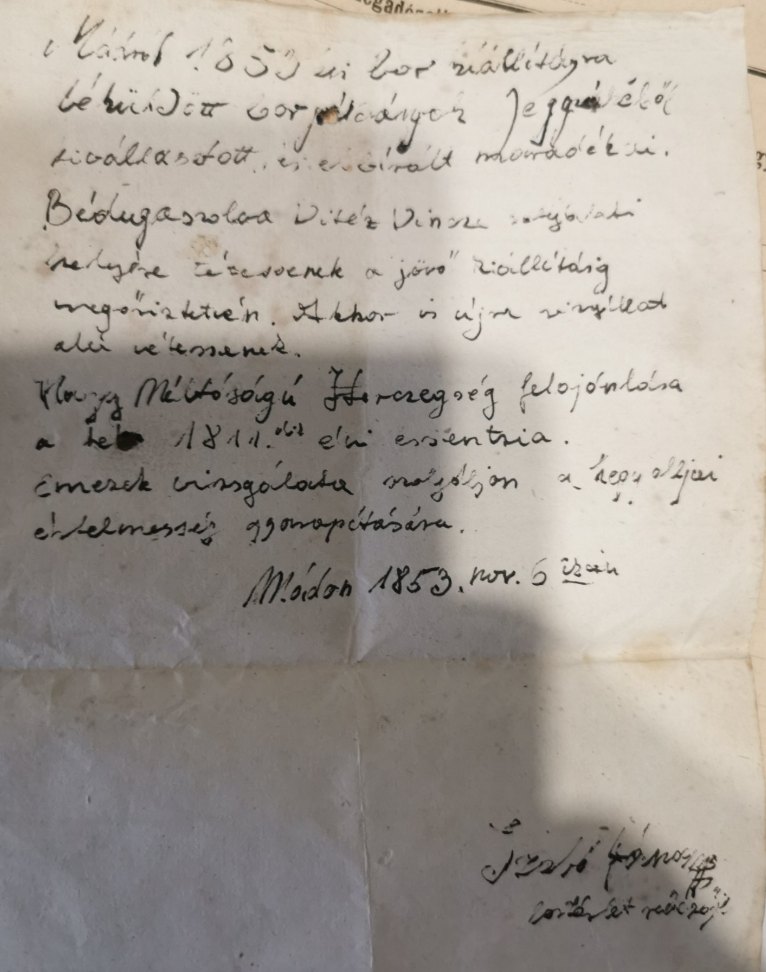
Dusóczky’s plan was not the first of its kind in Hegyalja. A single sheet, written at Mád on 6 November 1853, disposes of the wine samples sent in to that year’s exhibition — and in doing so sets out a re-tasting protocol:
„Bédugaszolva Vitéz Vincze szolgálati helyére tétessenek a jövő kiállításig megőriztetvén. Akkor is újra vizsgálat alá vétessenek. … Ezeknek vizsgálata szolgáljon a hegyaljai értelmesség gyarapítására.“
“Corked up, let them be placed at Vincze Vitéz’s place of service, there to be preserved until the next exhibition. Then let them be taken under examination again. … Let the examination of these serve to increase the knowledge of Hegyalja.”
That is a longitudinal design, not a tidying-up: the same wines, sealed, held in a named custodian’s keeping, and assessed at a second point in time, with the stated purpose of adding to what the region knew. The complaint running through the article above — that no modern study measures the same Tokaji twice — was understood and provided for by a Hegyalja committee in 1853. If the second examination was ever written up, it would be the oldest controlled ageing observation in the region’s literature; so far it has not been found.
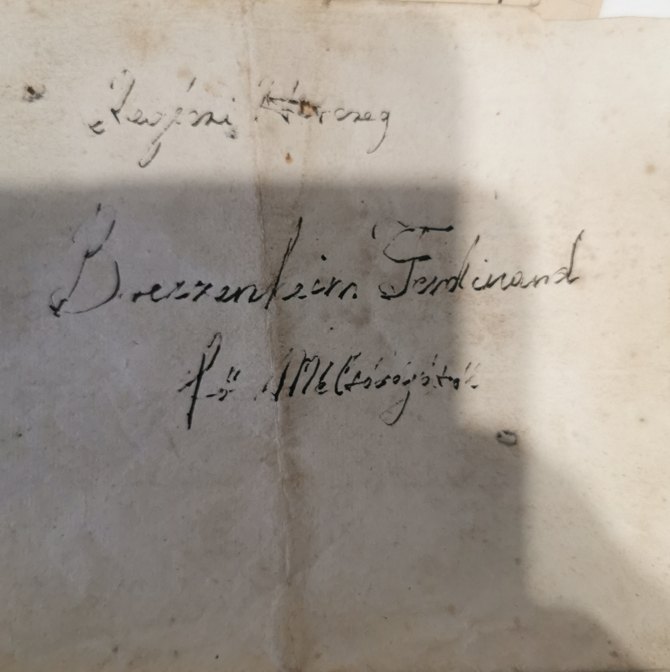
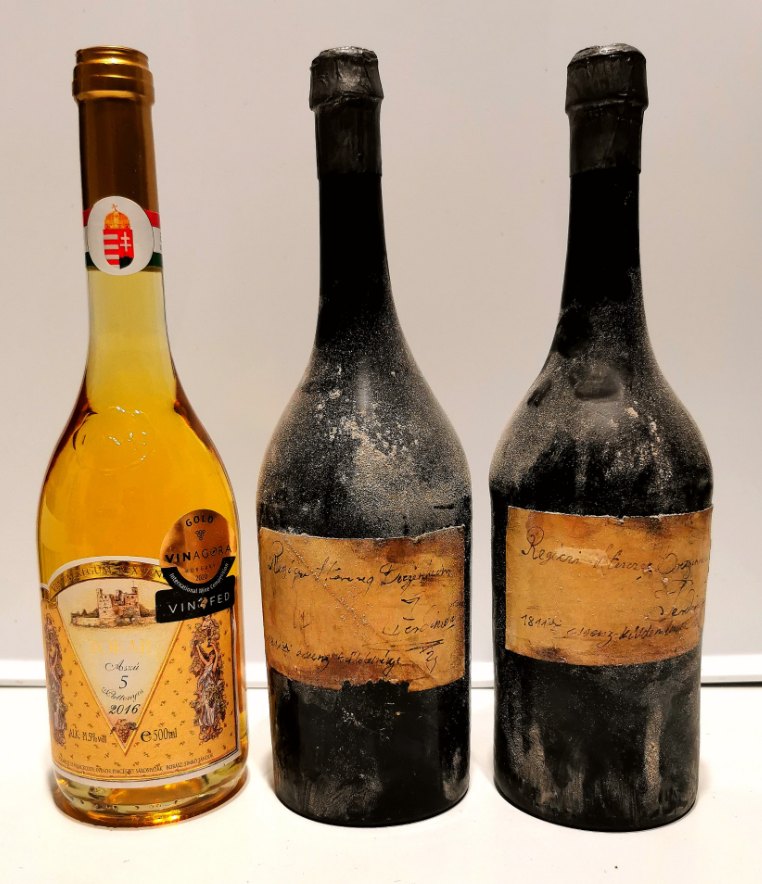
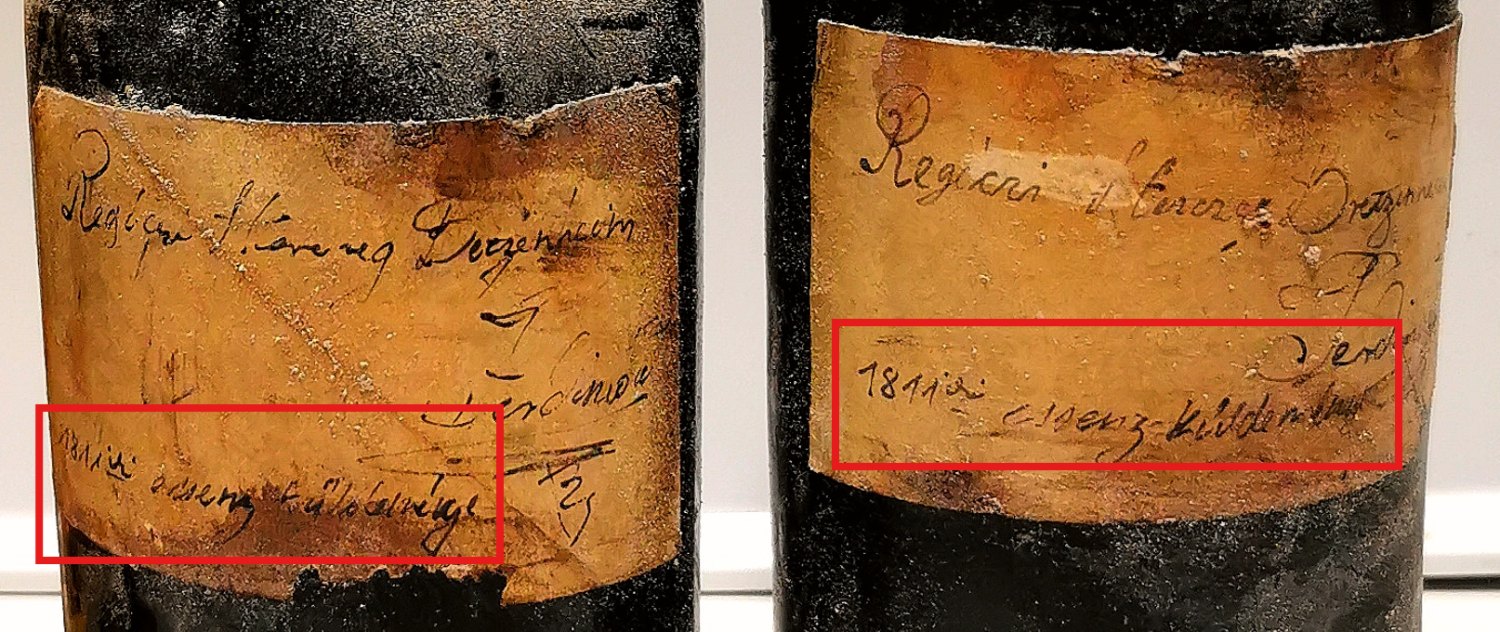
The wines themselves are named on the same sheet: two essencias of the 1811 vintage — the comet year, the same vintage that appears in the Fukier list Henryk Fukier recited in 1954 — donated by „Nagyméltóságú Herczegség“, His Serene Highness the Prince. The verso names him: Bretzenheim Ferdinand. Ferdinand (1801–1855) was the reigning prince of the Bretzenheim von Regécz line, which held the Hungarian lordships of Regéc and Sárospatak from 1803 and died out with his brother Alfons in 1863 — so an 1811 Hegyalja essencia in princely hands in 1853 is exactly where it should be. Signed at the foot, apparently Szabó Ignácz, borászati rendező — wine steward of the exhibition.